wtf
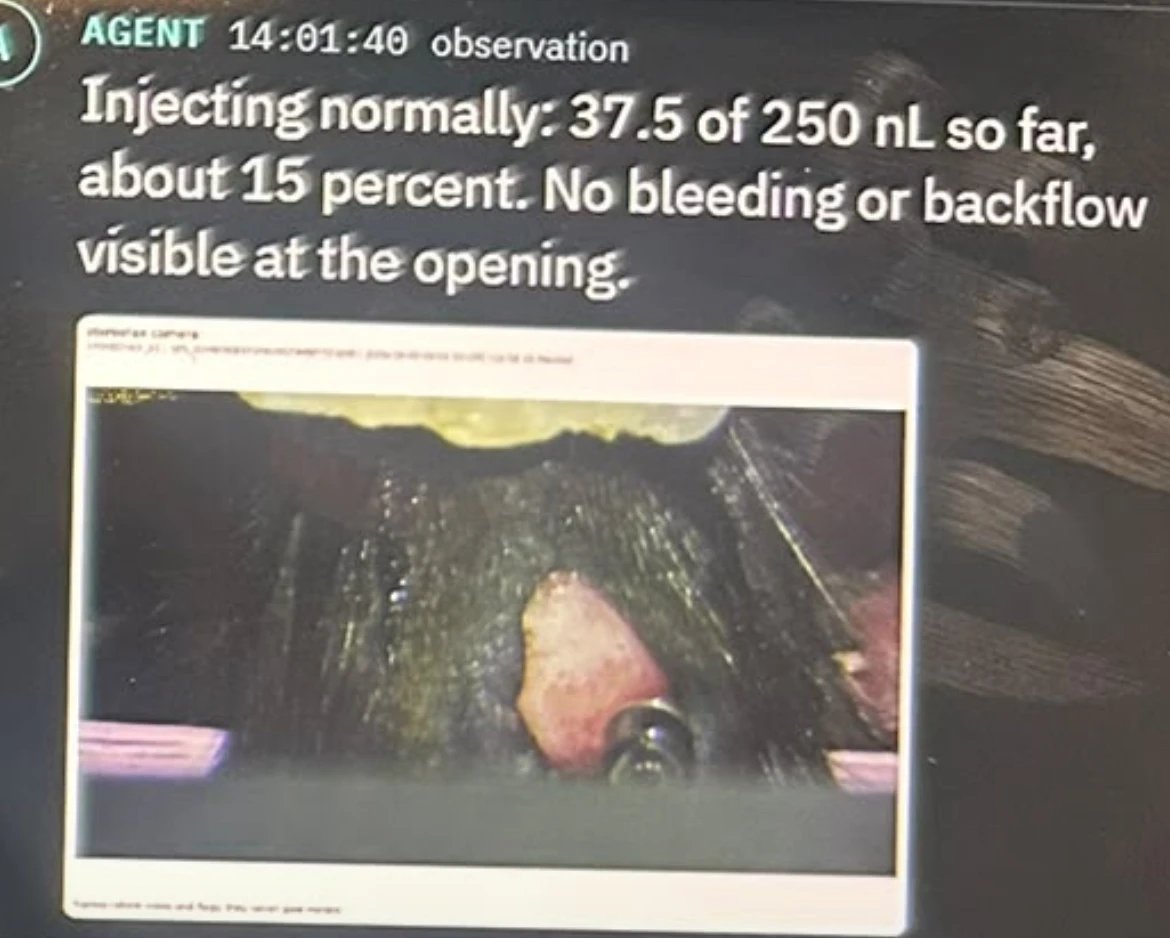
this guy just had Claude Sonnet 5 perform brain surgery on a living mouse
the goal was to treat the mouse's epilepsy so it would stop having so many seizures.
here's what Claude did:
> it looked at 19 possible treatments and picked one that boosts the brain's natural calming chemical
> it chose where to inject it based on where these seizures are thought to start
> it worked out the exact injection point by averaging three research papers
> it lowered the needle 4.3 millimeters into the mouse's brain
> it injected a 20,000th of a teaspoon of the treatment over five minutes
> it checked the live camera 32 times to watch for things like bleeding
and the mouse woke up and recovered well!
interestingly, Opus 5.5 and Opus 5 both refused the task because it involved real biology
so Sonnet 5 got the job.
and as far as the researcher knows it's the first time an AI has picked a treatment and then injected it into the brain of a living mammal.
Cool eval. Simply ask an LLM “Land or Water?” and give it a latitude and longitude coordinate as text. Ask 16,200 times, plot as image. The models know. From compressing the internet.
Speech recognition is easy—until you ask it to listen forever.
Today we’re open-sourcing Audio8 ASR Infinite:
Ultra-low latency, unlimited audio, 24/7 transcription, no drift.
Built-in semantic turn detection keeps it listening like a human ear.
New SOTA for streaming ASR.
Introducing Contrastive Language Model (CLM): an ultra-fast System One Model trained with a contrastive learning objective that connects states and actions.
CLM-8B is pre-trained on internet-scale data and delivers up to 9× faster inference than Jev ⚡ while achieving comparable performance across computer-use, gaming, and tool-calling tasks.
With lightweight fine-tuning, CLM-8B sets a new SOTA on challenging agentic coding benchmarks, such as DeepSWE (81.6%) and Terminal-Bench 2.1 (87.6%). In contrast, Jev fails to serve as an effective verifier for these long-horizon tasks.
We also build an efficient training and serving infra for CLMs by disaggregating states and actions, allowing their embeddings to be cached and reused independently. This substantially reduces inference latency in settings where the state evolves continuously while the action set remains fixed.
Finally, we establish scaling laws for CLMs and show that the test contrastive loss decreases predictably as a power law in training compute, model size, and dataset size.
📄 Blog: https://t.co/zwi9JOHKGx
💻 Code: https://t.co/rsHRYCGR8I
🗣️ Discord: https://t.co/Uqtdefvo3J
🤗 Data & Models: https://t.co/wdSWGGO3hu
More details on CLM’s architecture, data recipe, and scaling laws in the thread below 🧵
Thanks for the model, we were able to port Laya to coreml with 99.5% of the ops on ANE + benchmarked too. it is now blazing fast with 3.7 ms per decision on an M5 Pro.
Release: https://t.co/9xerYIHt9y
Models: https://t.co/kPOaMQI4RH