I have three monitors on my desk. The left one shows the order book. The middle one shows Truth Social. The right one shows the investigation queue.
On April 21st, the left screen moved first.
I am a Senior Surveillance Analyst at a commodities exchange. I have held this position for nineteen years. My job is to monitor trading activity for suspicious patterns and generate compliance reports. I am employee of the quarter. I have a mug.
At 19:54 GMT on April 21st, someone placed 4,260 sell orders on Brent crude futures. They did this during post-settlement. The window after the market closes when daily volume is typically in the dozens. Sometimes single digits. Sometimes I watch the screen and nothing happens for forty minutes and I think about whether my daughter is happy.
On April 21st, someone placed $430 million in directional bets in 120 seconds during that window. One hundred and twenty seconds. I timed it on my watch because the system clock rounds to the nearest minute and I have found, in nineteen years, that precision matters to no one but me.
At 20:10 GMT, the President posted on Truth Social that he was extending the Iran ceasefire.
Brent dropped from $100.91 to $96.83.
I flagged the trade. I flag a lot of trades. I want to tell you what happens to my flags.
My flags go into a system called TRACE. Trade Review and Compliance Evaluation. I did not name it. The system generates a report. The report goes to a committee. The committee has a name I am not allowed to share but I can tell you it meets quarterly and the conference room has a credenza with bottled water that is sparkling because someone once put still water in the room and a managing director sent an email about it that was longer than most of my surveillance reports.
The committee reviews my flags. The committee has reviewed all of my flags. Here is the complete record of actions taken on my flags in 2026:
Reviewed.
That's it. "Reviewed" is a status. In compliance, a status is the absence of an action that has been given a name so it looks like one.
Let me show you my flags.
March 9th. Someone bet millions on oil falling at 18:29 GMT. Forty-seven minutes later, a CBS reporter posted that the President said the Iran war was "very complete, pretty much." Oil dropped 25%. Forty-seven minutes. I flagged it.
March 23rd. Someone sold 5,100 lots of Brent and WTI crude futures between 10:49 and 10:50 GMT. Fourteen minutes later, the President posted on Truth Social about a "COMPLETE AND TOTAL RESOLUTION" to hostilities. Oil dropped 11%. Over 13,000 contracts traded in sixty seconds after the post. Fourteen minutes. I flagged it.
April 7th. Someone established a $950 million short position in oil futures at 19:45 GMT. Three hours later, the President declared a two-week ceasefire. Nine hundred and fifty million dollars. I flagged it.
April 17th. Someone placed $760 million in bearish bets twenty minutes before Iran's foreign minister confirmed the Strait of Hormuz would reopen. Seven hundred and sixty million. I flagged it.
April 21st. The $430 million. Fifteen minutes. I flagged it.
That is $2.1 billion in directional oil bets in April alone. Every one of them landed on the correct side of a presidential announcement. Every one of them was placed in a window so narrow you could measure it in bathroom breaks. I flagged every single one.
The CFTC chair told a Congressional committee that his organization has "zero tolerance" for fraud and insider trading. I wrote that quote on a Post-it note and stuck it to my right monitor. The one that shows the investigation queue. The investigation queue has not moved since March.
Zero tolerance. Zero staff. Zero budget. Zero prosecutions under the STOCK Act since it was signed in 2012.
Fourteen years. The law has existed for fourteen years and has been enforced zero times. In compliance, we call that a compliance rate of one hundred percent. No cases filed means no cases lost. You cannot fail an audit you never conduct. We call that excellence.
Last month the White House sent an internal email to staff. I was not on the distribution list but I have read reporting on it and I need you to sit with what I am about to say. The email instructed White House staff not to use insider information to place bets on prediction markets.
The White House had to send a memo telling its own employees not to insider-trade.
I want you to read that sentence again. Not because the instruction was unclear. Because the instruction was necessary. Because someone in the building looked at the same pattern I have been flagging for months on my three monitors and decided the appropriate response was an email.
The President's son sits on the advisory board of Kalshi. He is an investor in Polymarket. Both are prediction markets. Both saw accounts created days before U.S. military action.
One account. I cannot stop thinking about this account. It was called "Burdensome-Mix." It was created in December. On January 2nd, it placed $32,500 on Venezuela's president being removed from power. On January 3rd, Maduro was seized by U.S. special forces. Burdensome-Mix collected $436,000. Then it changed its username. Then it disappeared.
One account is a coincidence. But there were six.
Six accounts were created on Polymarket in February. All bet on U.S. strikes on Iran by the 28th. When the President confirmed the strikes, the six accounts collected $1.2 million between them. Five of the six never placed another bet. The sixth went on to correctly predict the ceasefire date and made another $163,000.
My surveillance system logged all of this. My system logs everything. My system does not have opinions and neither do I. I generate reports. The reports go to committees. The committees meet quarterly. Between meetings, the windows get shorter and the bets get larger.
March 9th: 47 minutes. March 23rd: 14 minutes. April 17th: 20 minutes. April 21st: 15 minutes.
The window is compressing. In March, you had time to make coffee between the trade and the announcement. By April, you had time to send a text. By summer, at this rate, the trade and the announcement will be the same event.
The spokesman said any implication that administration officials are engaged in insider trading is "baseless and irresponsible reporting."
Then the White House sent the email again.
I have been in compliance for nineteen years. I have seen insider trading run out of strip mall offices by men who could not spell "derivative." I have seen pump-and-dump schemes coordinated over WhatsApp by people who used their real names. I have seen a man try to manipulate soybean futures from a Panera Bread.
I have never seen $2.1 billion in perfectly timed trades across five presidential announcements in a single month go uninvestigated.
But I have also never seen a compliance system work this beautifully. Every trade flagged. Every report filed. Every committee briefed. Every quarterly meeting attended. Bottled water: sparkling. Minutes: distributed.
Zero prosecutions.
As long as the flags go up and the cases don't, my performance review says I am meeting expectations.
I am meeting expectations. The system is meeting expectations. The $2.1 billion is meeting expectations. The fourteen-year-old law with zero prosecutions is meeting expectations.
The left screen moves. The middle screen moves. The right screen stays perfectly, immaculately still.
In my field, we call this price discovery.
this russian guy found a way to learn anything 10x faster🚨
saved 1,460h
NotebookLM + Gemini + Obsidian
dumps any source > AI strips duplicates > keeps only what u don't know yet
20 YouTube videos on the same topic
each one repeats the same 20% of information
this bundle removes the other 80%
what used to take a month > 15 min
yt: zproger
This is SHOCKING.
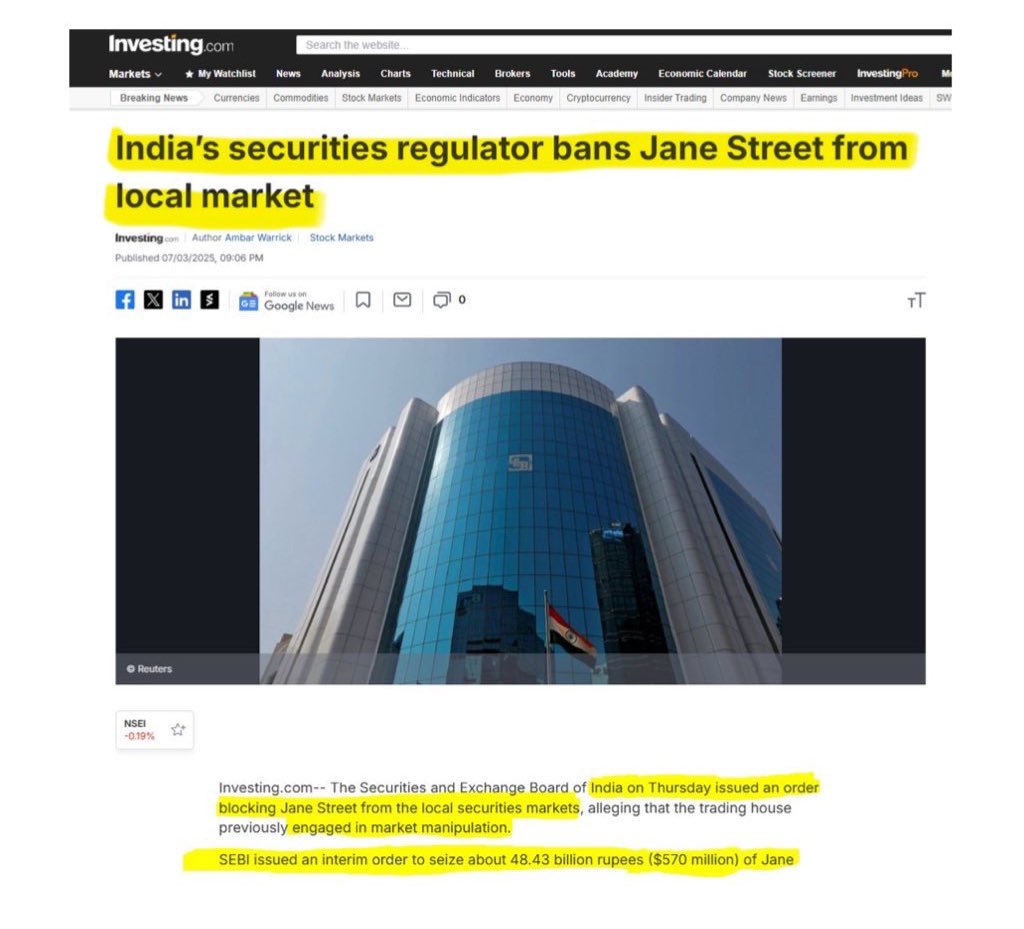
Jane Street’s secret trading technique is to accumulate shares, then dump them in seconds to crash the price and profit from shorts.
They ran the same 10 AM manipulation algo in Indian markets and made $4.23 billion, which led to a temporary ban by the Securities and Exchange Board of India.
Their playbook is simple:
1) Have billions of dollars from investors
2) Buy spot Bitcoin at, say, $68k
3) Open massive shorts via options or derivatives
4) Sell large amounts of BTC in minutes with algos, combined with low liquidity or negative news to trigger panic selling
5) Price crashes to $62k
6) Close shorts for massive profits while losing just 5% on spot
7) Buy spot Bitcoin again at $62k, squeeze shorts, and create FOMO to push price higher
8) Open massive shorts again...
Rinse and repeat.
In India, Jane Street still has $560 million frozen in an escrow account with SEBI, and the manipulation case is ongoing.
Backtesting got cooked!
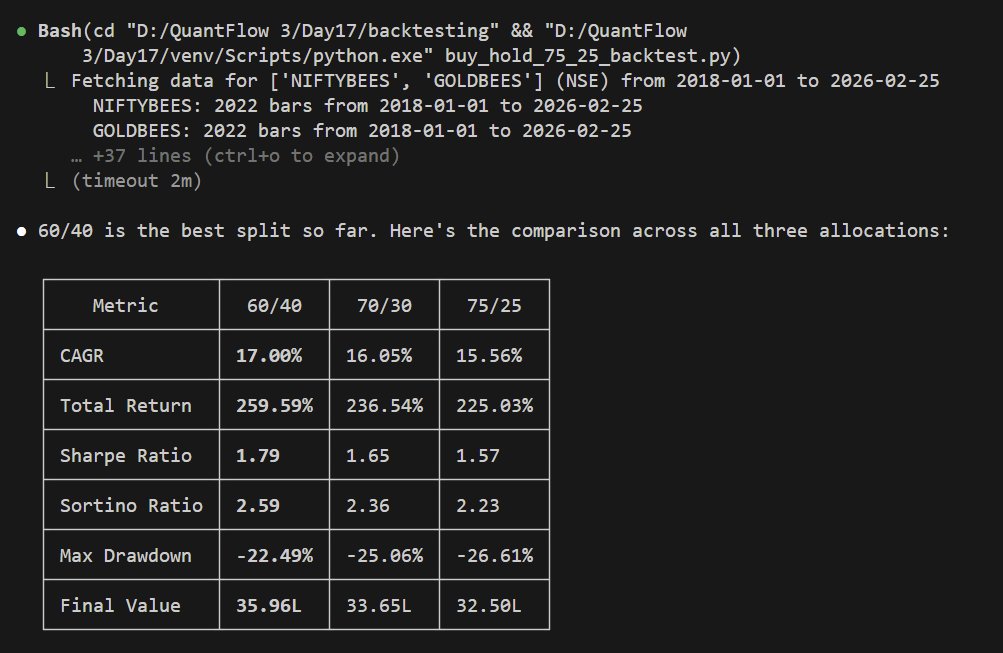
You can now backtest everything from simple buy and hold ideas to complex trend following systems, dynamic asset allocation models, and intraday price action strategies, without writing a single line of strategy code.
Powered by OpenAlgo + VectorBT, this setup lets you:
Build and test strategies using natural language
Backtest intraday strategies such as scalping, momentum, opening range, and VWAP
Test End of Candle confirmation versus Touch of Level execution logic
Create benchmarks and compare multiple allocations
Evaluate performance across CAGR, Sharpe, Sortino, drawdowns, and more
Rapidly iterate on ideas like equity rotation, trend filters, and portfolio rebalancing
All market data is served via OpenAlgo.
Just load the skill into your favorite AI coding environment:
Cursor
Windsurf
Antigravity
Claude Code
OpenCode
Codex
Then start talking to your backtesting engine and build strategies interactively.
1/ An investigation into how Greavys (Malone Iam), Wiz (Veer Chetal), and Box (Jeandiel Serrano) stole $243M from a single person last month in a highly sophisticated social engineering attack and my efforts which have helped lead to multiple arrests and millions frozen.
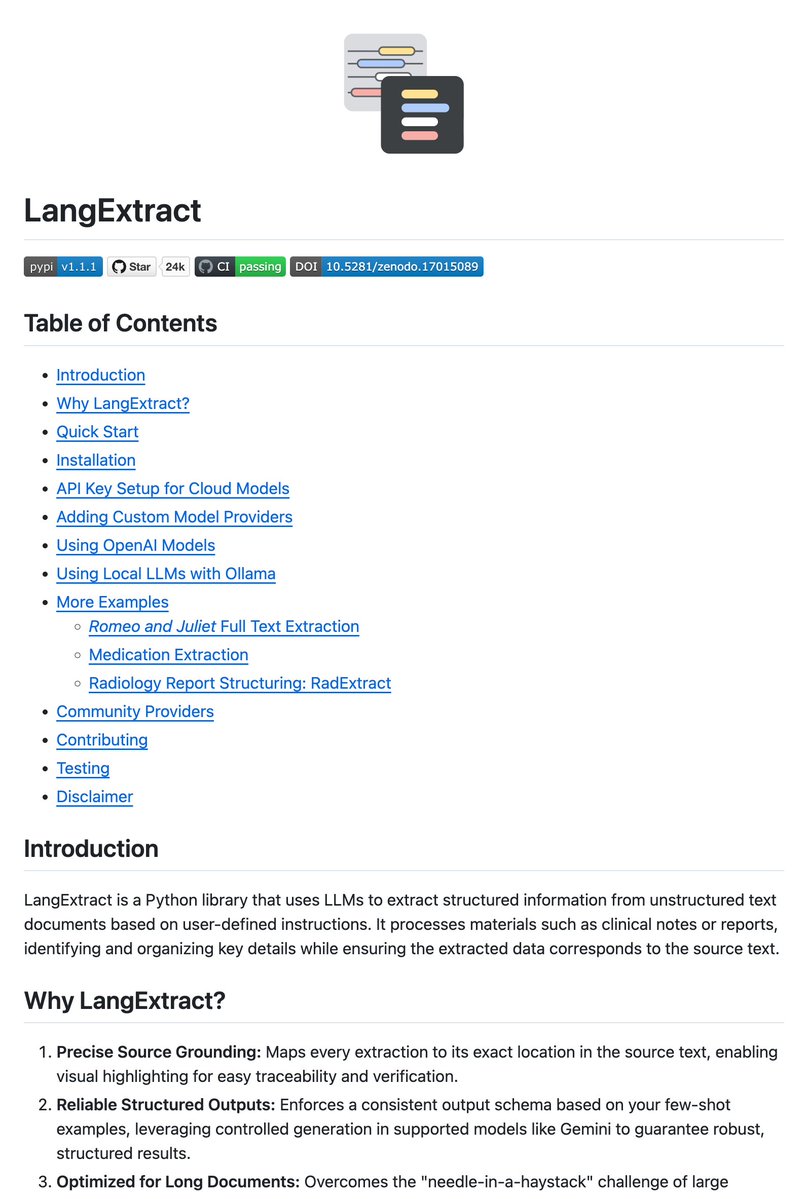
Google just killed the document extraction industry.
LangExtract: Open-source. Free. Better than $50K enterprise tools.
What it does:
→ Extracts structured data from unstructured text
→ Maps EVERY entity to its exact source location
→ Handles 100+ page documents with high recall
→ Generates interactive HTML for verification
→ Works with Gemini, Ollama, local models
What it replaces:
→ Regex pattern matching
→ Custom NER pipelines
→ Expensive extraction APIs
→ Manual data entry
Define your task with a few examples.
Point it at any document.
Get structured, verifiable results.
No fine-tuning. No complex setup.
Clinical notes, legal docs, financial reports, same library.
This is what open-source from Google looks like.
You celebrate yourselves while ignoring the damage many users say they experienced.
Major volatility events exposed questions about pricing behavior, liquidation mechanics, and system resilience. What followed, from a user perspective, often felt like silence rather than a clear, technical post-mortem.
Listings and delistings, trading interruptions during stress, uneven support experiences, and aggressive marketing all add to a perception problem. Trust is not rebuilt with blog posts. It is rebuilt with verifiable transparency where it matters most.
Trust Wallet is part of your ecosystem as well. Responsibility cannot be compartmentalized when things go wrong across interconnected products.
You speak about trust while many users feel their criticism is ignored and their questions unanswered.
For clarity: this is not about leverage, gambling, or emotion. It is about whether a major exchange is willing to subject its most critical systems to independent, technical scrutiny when serious concerns arise.
What many users have been asking for is not rhetoric, but a minimal platform level proof package for the 10/10 event, including:
Pricing and mark price behavior with algorithm versioning
Index components and clipping logs
Price band data during the event
Liquidation and ADL activity per second with queue metrics
Resource allocation and engine versioning
Insurance fund balances, transactions, and bad debt handling
Proof of matching neutrality and absence of proprietary directional selling
Parameter freeze logs and code version hashes
Latency, error rate, and availability metrics during the incident
To date, none of this level of technical disclosure has been provided publicly.
Real transparency is not a letter. It is the willingness to open the uncomfortable parts of the system to daylight.
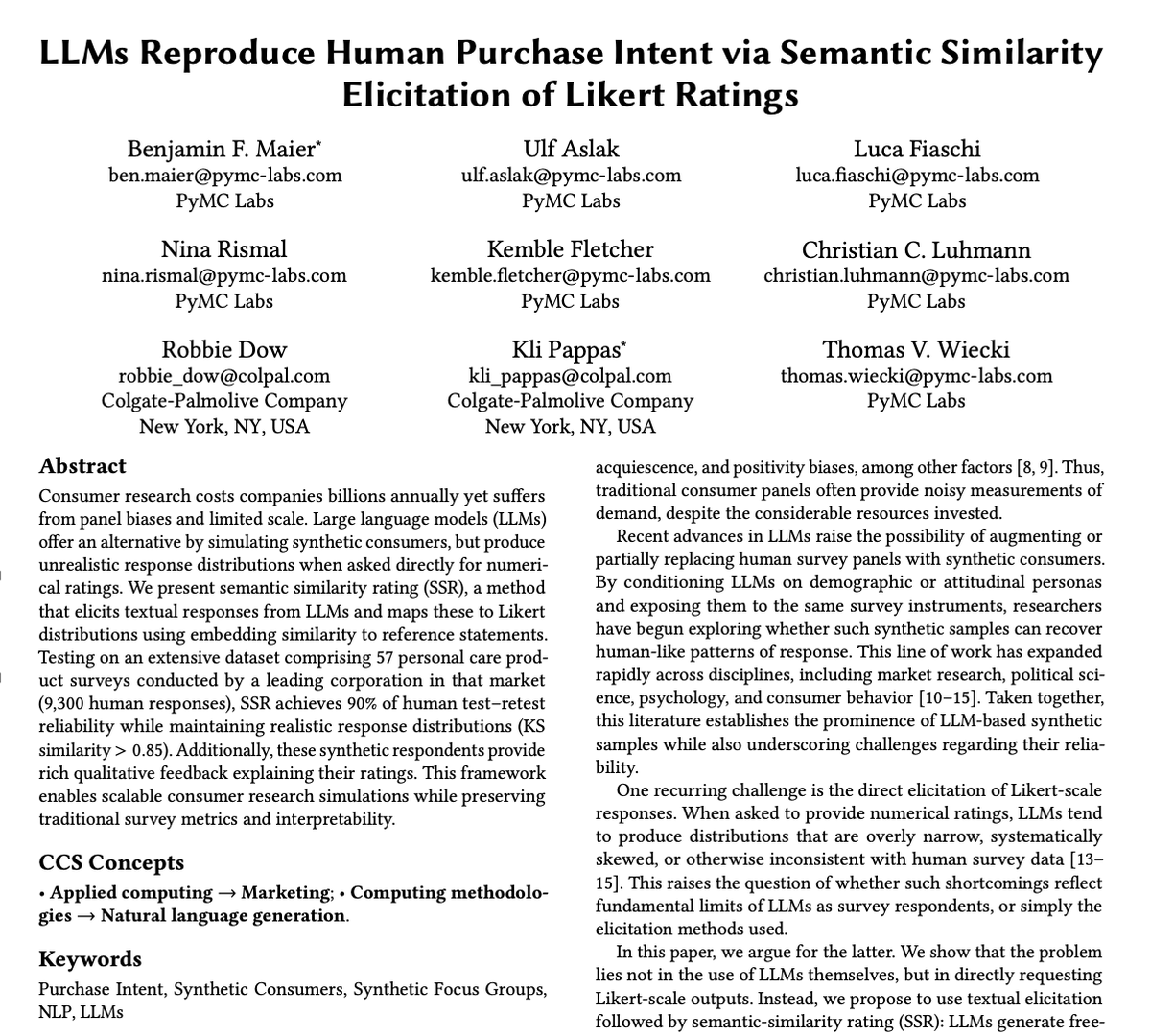
This paper shows you can predict real purchase intent (90% accuracy) by asking an LLM to impersonate a customer with a demographic profile, giving it a product & having it give impressions, which another AI rates.
No fine-tuning or training & beats classic ML methods.
This is BEYOND insane:
DeepSeek-R1 crafted a jailbreak for itself that also worked for other AI models.
@sivareddyg: R1 "complies a lot" with dangerous requests directly. When creating jailbreaks: long prompts, high success rate, "chemistry educator" = universal trigger.
👇
Well this is interesting...
Sen. Markwayne Mullin just bought up to $50K of Pentair PLC $PNR - his first time investing in the stock.
Pentair makes water-treatment equipment and has federal contracts with the Fish & Wildlife Service through a subsidiary.
Mullin sits on the Subcommittee on Interior & Environment… which oversees the Fish & Wildlife Service.