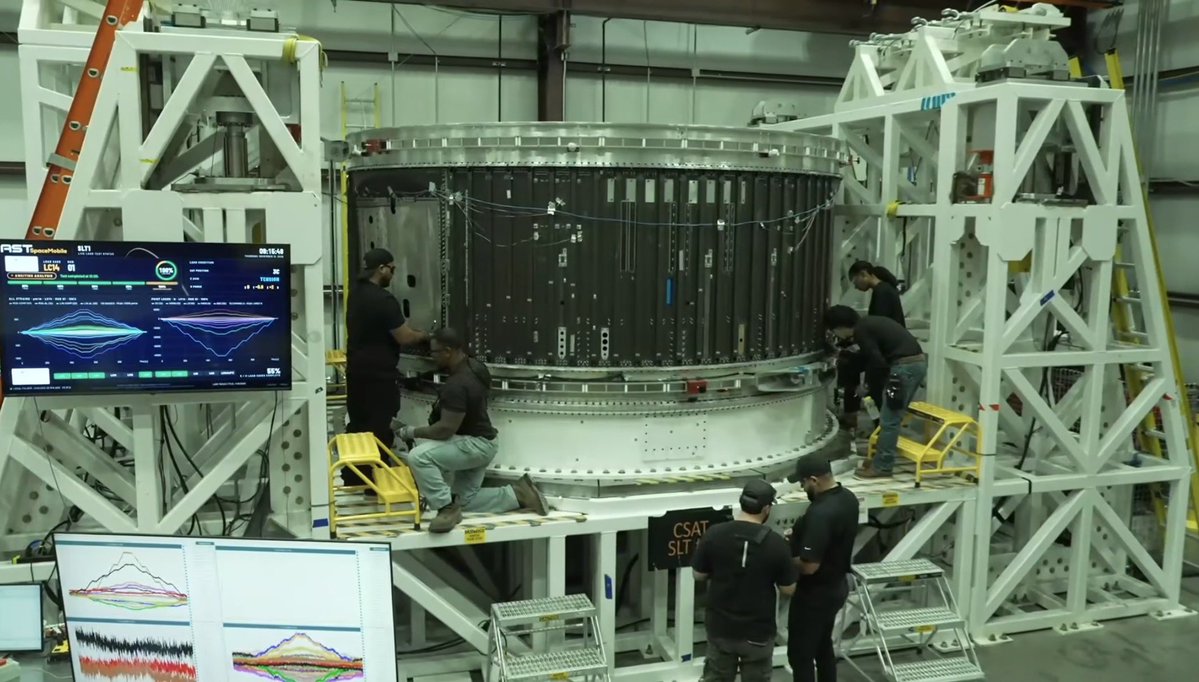
Watching the @AST_SpaceMobile Blacklift unveiling video this morning and something that sticks out to me is just how similar their satellite structures are to rocket body structures.
Not entirely the same obviously but close enough that the pivot into developing and building a vehicle structure doesn’t seem like too much of a leap for them.
$ASTS: Fantastic Blacklift Unveiling Event! Thank you @AbelAvellan and @scottwisniews.
Some quick highlights:
+ A model of Block 2 was present during the presentation. @CatSE___ApeX___ nailed it perfectly!
+ Started with a Jensen Huang joke “Im wearing a leather jacket. Im not resigning today”
+ AST will connect to "AT&T, Verizon, to a new one hopefully coming very soon" (TMOBILE), "to all the operators in Europe with a new one also that I think you are going to like." (DEUTSCHE TELEKOM).
+ Said US government wants their own satellites
+ Reiterates they have up to BB28 in final stages
+ Showed a LIVE TOUR of the manufacturing facility including showing up to BB28.
+ BB29 to BB51 are running through SLT tests (static load test). They have 2 SLT facilities.
+ 95% vertically integrated on satellites and 95% vertically integrated on rockets, and will have their first set of composite rocket tanks ready for testing in January. Same carbon composites they use on BlueBirds.
+ Slipped up calling Blacklift "Blackbird"!
+ AST has "SpaceX launches with help from the DoD"
+ “This is a multi trillion dollar opportunity” -Abel
+ Launching with Blacklift will be ~75% cheaper than using external launchers
+ Building BlueBirds on the ground costs ~20M per week
+ When asked about Starlink concerns in Ukraine and the threat of Starlink turning off your connectivity, etc., Abel said "First of all, I’m not Musk. And I don’t want to be!” and "We don't insult them. We partner with them. That's a fundamental difference."
+ "The US government does not want to see one company controlling everything. As a country we do not want to be dependent on a single entity to dominate and control space." -Abel
+ "Japan is the formula that will be replicated many many times over where we partner with the government, in this case with our long term partner Rakuten to basically secure on a vision of a sovereign system built and powered by AST." -Abel
+ "The opportunity is many many times bigger than what we initially set out to do" -Abel
Full video: https://t.co/E7U3ArNuNi
SMH Daily-Best markets in my experience have semis leading QQQ and QQQ leading SPY. SMH into strong resistance here to at 200SMA, 20EMA, AVWAP. Don't see much reason to be interested in market below it.
Not all Follow Through Days=FTD are equally actionable. FTDs must be graded on the action in and quantity of new leaders. I would grade todays likely FTD a C. If, if, if more quality new True Market Leaders erupt higher, I will upgrade my rating but for now today looks mostly like a short covering rally vs the start of something big. Dozens of todays big % movers like SNDK remain -40% to -65% off highs and even after todays large % gains remain below their 200DSMA. Hopefully in the next few days market health will improve. https://t.co/UkFoeQBtoY for all my best ideas.
#StockMarket #CANSLIM #BTC #Finance
https://t.co/UkFoeQBtoY If you haven't read the recent report, you're missing out.
#IBDPartner @marketsurge
https://t.co/ttEaIPvTCt
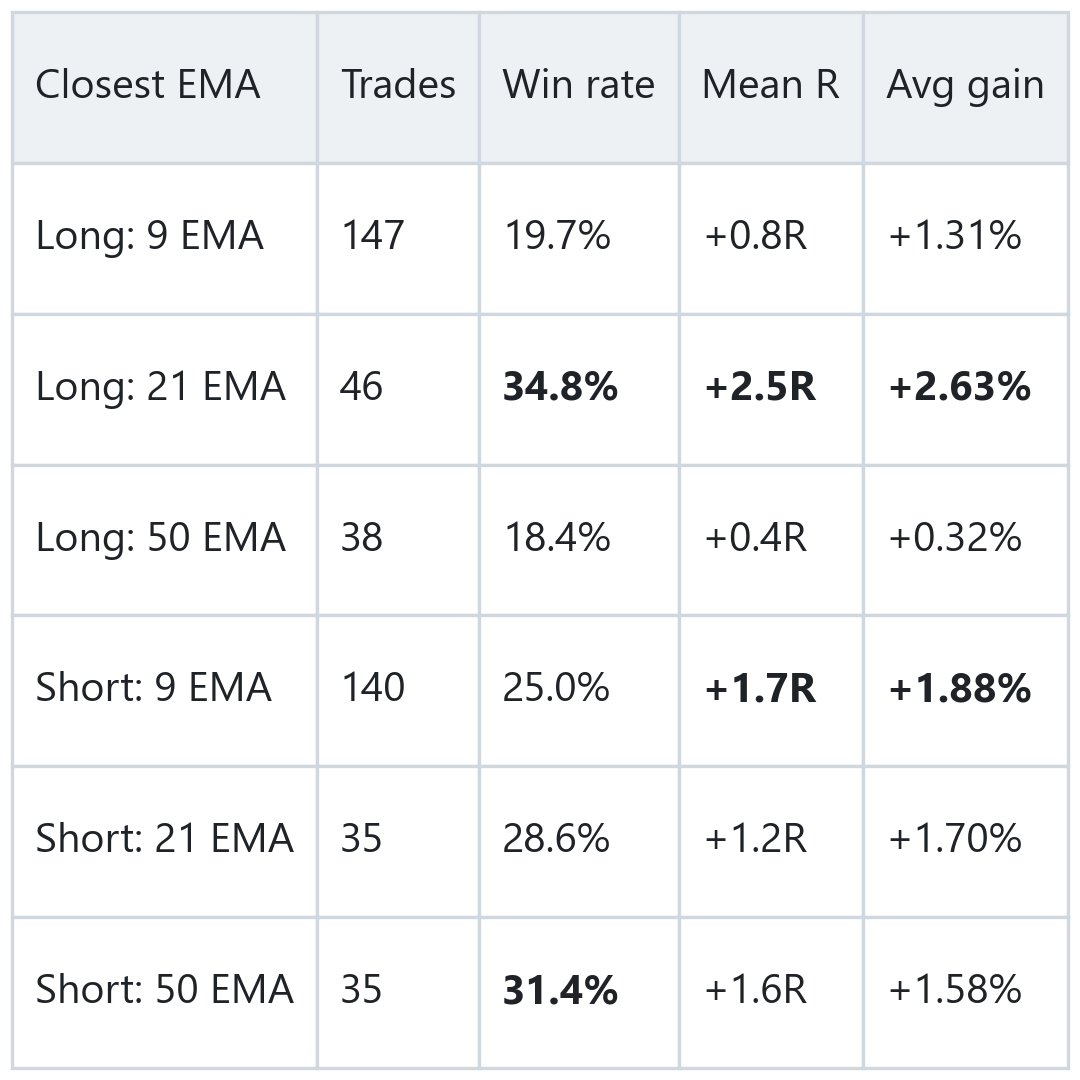
This table should probably be it's own 3 hours masterclass video, but sharing it first here..
For anyone studying Martin's pullback strategy key question is "What moving averages shall we use"?
This table answers that.
And it shows what to expect of each.
For longs, 21 EMA is the clear sweet spot. 50 EMA is borderline no-go (but small sample)
For shorts, win-rate improves steadily as EMA increases, but 9 EMA still produces the highest mean R and avg gain
Here's some additional valueable key insights:
Martin's pullback setup was first developed for the short side
MARTIN LUK: Actually I learned the pullbacks mostly from the short side first... For shorts, the best risk-reward play should be shorting at the resistance, right at the bounce or the pullback into the declining EMAs or into the resistance levels. So this is how I really dig deep in the pullback side, and also I just flip the short side around and then it will be the long side, and they are really similar.
Why does he take 2/3 of his pullback longs at the 9 EMA when 80% fail, whereas 21 EMA longs has almost double win-rate and triple expectancy?
MARTIN LUK: Then I bought it at the pullback on the daily 9 EMA... I think this one would be a fair entry. Definitely not the best one because it's like a slight pullback, and generally a pullback to the daily 9 has the lowest win rate amongst—or like a slower EMA will have the highest win rate—from my study. But sometimes stocks, you have to take risk. Sometimes if the stock pulls back to the 21, then you have a better entry, more high-win-rate entry, you have more conviction, or the risk-reward will be much better. But sometimes the stock, if it's strong like Tesla here, it doesn't pull back to the 21. So this time I'm just trying to take a risk and trying to test whether it works or not
If we go back and look at the uptrend, especially a strong uptrend that the semi sector has made or the Qs has made: a lot of the times we get an uptrend, then we pull back into the 21 EMA and re-bounce at the 21, and then we start another uptrend—we start another leg up.
WHY NOT JUST SKIP 9 THE 9 EMA FOR LONGS?
Runaway Stage 2 leaders (MRVL, AAOI, NBIS, etc)
surf the 9 EMA without touching the 21 EMA for weeks. To not miss the strongest momentum stocks in the market, Martin probes the 9 EMA aggressively with ultra-tight ~1.2%–1.5% stops
WHY DOES 50 EMA LONGS FAIL, BUT 50 EMA SHORTS WIN?
Don't have a good answer for that, yet.
MARTIN LUK: I don't have a really good statistic on that, but... I tried this recently with the cybersecurity longs like NET. Before them, I think I rarely tried this type of pullback buys just purely off the 50 EMA. To me, it's a little bit more difficult and I'm still not good at doing that. I would prefer a pullback buy into the EMA convergence—when the EMAs are converging really close to each other—instead of purely buying the pullback into the 50 EMA.
Compare that to how he describes his bread-and-butter 50 EMA Short:
MARTIN LUK: Stocks tend to decline immediately, without further basing, right after being rejected at the declining moving averages, particularly the 21 and 50 EMAs. The tighter the EMAs, the higher the rejection rate.
I think the ideal picture-perfect [short] would be the first breakdown of the 50 EMA and then the first pullback into the 50 EMA—and generally when [you get] the first breakdown and then a pullback into the 50 EMA, the 21 or the 9 would also be really near the 50 EMA too, and they start curling back and crossing down the 50 EMA
---
A ton of other insights related to this particular chart.
$ASTS: @AST_SpaceMobile discloses role in Space Force airborne-tracking program
Direct-to-device satellite company expects $100 million from subcontract to STR for technologies for tracking airborne targets from orbit
WASHINGTON — AST SpaceMobile, best known for building giant satellites designed to connect directly with ordinary smartphones, expects to generate about $100 million in revenue from a U.S. Space Force program aimed at tracking aircraft and other airborne threats from orbit.
The Texas-based company is supporting defense technology firm Systems & Technology Research, or STR, which is the prime contractor on the effort. AST first disclosed the relationship on Nov. 5, saying it would provide commercially developed space technology for an additional phase of a Space Force sensing program.
AST on Nov. 9 identified the work as Space-Based Airborne Moving Target Indicator, or SB-AMTI, and said it represented approximately $100 million in expected revenue. The amount is significant for a company that reported total third-quarter revenue of $42.3 million, although AST has not said over what period the government revenue will be recognized.
President Scott Wisniewski described the contract during AST’s latest earnings call as “a small step towards a much larger program of record for AMTI.”
The Space Force has not disclosed what STR and AST will deliver, how many spacecraft are involved or when their technology will be demonstrated. Public contracting records list STR’s SB-AMTI Other Transaction Agreement, awarded in March, with a ceiling of about $146.4 million and $43.5 million obligated to date.
The award gives AST a foothold in one of the Space Force’s largest new sensing initiatives as the Pentagon looks to shift some surveillance missions traditionally performed by aircraft into space.
SB-AMTI is intended to provide persistent tracking of airborne targets, including aircraft and cruise missiles, particularly in areas where large surveillance planes could be vulnerable to advanced air defenses. The Space Force in May awarded SpaceX a $4.16 billion agreement to establish the initial constellation.
Space Force officials said the service does not want to rely on a single company or sensing approach.
In August, Space Systems Command announced three initial agreements totaling $615 million with Rocket Lab, STR and an unidentified contractor under a second SB-AMTI task order designed to mature alternative technologies and broaden the supplier base. Brig. Gen. Ryan Frazier, the Space Force portfolio acquisition executive overseeing the program, subsequently identified Lockheed Martin as a fourth contractor.
Frazier has described the broader AMTI architecture as a system of systems rather than a single constellation. The Space Force plans to combine multiple sensor types and vendors, including active and passive sensing technologies, and fuse their data on the ground.
AST’s core business is a planned low-Earth-orbit broadband constellation whose BlueBird satellites use unusually large electronically steered phased-array antennas to communicate directly with standard mobile phones. The company says those same large apertures, combined with a multi-frequency architecture and onboard processing, can be used for missions beyond communications. Its Nov. 5 announcement highlighted the BlueBird platform’s phased array, multiple frequency bands and processing capabilities in describing the technology being brought to the STR project.
Military applications for radar
During the Nov. 9 earnings call, AST’s chief executive Abel Avellan said the company intends its satellites to support multiple missions rather than build separate production lines for commercial and government spacecraft. He said AST’s large phased arrays could support direct-to-device communications, sensing, radar and artificial intelligence applications.
The company has not provided details on whether STR is adapting AST’s large BlueBird phased array itself for moving-target radar, or using the spacecraft as a platform for a separate sensing payload. Either approach could give the Space Force another technical option alongside the initial SpaceX architecture.
The Pentagon’s push to field space-based airborne tracking has taken on additional urgency in the wake of the war with Iran, which exposed vulnerabilities in both fixed ground sensors and airborne surveillance assets.
An Associated Press analysis published in October found that Iranian and Iran-backed missile and drone attacks damaged or destroyed structures at 26 U.S. military bases and other sites, with early-warning radars among the first systems targeted. An Air Force E-3 Sentry, one of the aircraft traditionally used to provide airborne warning and battle-management coverage, was also severely damaged in a March Iranian attack on Prince Sultan Air Base in Saudi Arabia.
These events have reinforced the Pentagon’s interest in spreading sensing capabilities across larger numbers of satellites that are harder to attack and can maintain coverage without putting aircraft and crews close to hostile airspace.
In June, the White House included $4 billion for airborne moving target indication and the Space Data Network Backbone in a defense supplemental funding request tied to the Iran war. That came on top of roughly $7.1 billion sought for SB-AMTI procurement in the Space Force’s fiscal 2027 budget plan.
$ASTS: Does anyone know why the Japanese government did not go with Starlink - which already has an active D2D service with Docomo and is planning to launch V2 soon - and instead went with AST which only has a measly 13 satellites and is probably going bankrupt soon?
We shareholders of $SPCX demand answers now! @elonmusk
Rakuten and AST SpaceMobile are launching Rakuten AST, a joint venture to build a D2D satellite network in Japan🚀
With $1B in support from Japan’s MIC, Rakuten AST will build disaster-resilient, uninterrupted communications infrastructure for Japan.
https://t.co/qvvmzdFyG3
This is getting absolutely ridiculous now. 💀
2026 has given us:
- Maduro getting captured and flown to America.
- A US–Iran war that refuses to end.
- Oil prices going absolutely nuts.
- Leopold's Situational Awareness hedge fund getting margin called 3 times and wiped out.
- KOSPI getting smoked, 5% crash every other day
- Thousands of US stocks sitting deep in bear-market territory.
- AI stocks getting absolutely destroyed over spending and valuation fears.
- One of the biggest crypto hacks in history hitting Binance.
- A Nasdaq selloff that wiped out trillions in market value.
Trump losing control is all in the midterms.
And NOW we're talking about Jensen Huang's infidelity and an investigation into a possible foreign intelligence operation.
THE MAN RUNS NVIDIA.
One of the most valuable companies on the planet.
At this point I don't even know what headline I'm supposed to be worried about anymore.
Let us have one normal fucking week
Some have criticized $ASTS for 1st building the sats then planning a rocket
But guess who said this is ideal? Yes, Sir Peter Beck of Rocket Lab $RKLB when 1st introducing Neutron
“So where do you start designing a new rocket? Well ironically you don’t start at the rocket, but at the satellite and all the spacecraft that you need to launch. Then you start the design process around that.”
48sec in
https://t.co/OpvC3XbhMO
I'm am sure most $ASTS shareholders are unaware that the engines they just bought from Firefly Aerospace $FLY will also be used on Northrop Grumman $NOC (PRIME Defense contractor) Antares 330 rockets at Wallops. https://t.co/OZKUOheWVv
This is the @FireflySpace MIRANDA engine spitting fire.
It will power the BlackLift rocket, launching up to 5 BlueBird or BlackBird satellites at a time for @AST_SpaceMobile.
$ASTS $FLY
$FLY 🤝 $ASTS
Two bold Texas companies, Firefly and @AST_SpaceMobile, signed a deal valued at more than $1.3 billion.
Firefly will deliver 36 rocket engines, offer engineering support, and provide a license to manufacture our Miranda and Vira engines for AST SpaceMobile's new heavy-lift rocket.
This is a tremendous win-win for both companies: AST SpaceMobile will be able to launch their own satellites, while Firefly will rapidly scale testing and production of our existing launch vehicle lineup.
https://t.co/T58GhYroF5
You're Not Behind In Life Because of Today's Market - You're Just Competing With Yourself.
If you're trying to transition into trading from a demanding career, here is a hard truth: you are going to feel behind in life, especially in this market situation. You look at friends and family on normal, predictable paths compounding steady promotions, titles, and linear progress, while you sit in front of screens fighting your own psychology and enduring drawdowns. Naturally, it feels like they are sprinting while you're stuck.
That comparison, however, is a complete trap. You aren't competing with them, and you never were; trading isn't a race against your peers. Behind the charts, numbers, and technical frameworks lies a deeply personal psychological trial where your real job isn't predicting candles — it's aligning your mindset, emotional triggers, and thought processes with the market's inherent nature of absolute uncertainty. When you constantly look sideways at what everyone else is doing, you get out of your own lane, start chasing setups that aren't yours, force trades, and ultimately lose touch with your process.
Breaking this loop requires intentional redirection. You must slow down and ground yourself in your own execution, knowing that when you stop rushing to keep up, your mental clutter clears and actual chart opportunities become visible. Release the pressure to explain your timeline or seek external validation from family or strangers, because true proficiency in markets takes the time it takes.
Finally, don't suffer in isolation; find a community or mentors who understand the raw realities of the craft makes all the difference on a journey that is undeniably difficult, but doesn't have to be lonely.
Trust your own timing.