Pi Pocket 0.31.0 is live!
The app got a cleaner UI pass with Places navigation and a slimmer desktop rail. Pocket Surfaces also lets your agents build and update live interactive cards directly in the app or over connected Relay services.
There's also opt-in @earendilworks Gondolin micro-VM sandboxes, one-click LANCET Guard v0.6.0 setup, and a new experimental local CPU model called Pulse Nano that handles orchestration tasks like run outcomes, stall/loop detection, memory, and search.
@pidotdev Pi 1.7.0 included as well, cheers!
Principles of Outcome Engineering
In 2027 the the most effective engineers will channel their craft into defining outcomes
My attempt at defining what working this way looks like:
https://t.co/2Yk4xGjjjL
Set up @nicopreme's pi-better today. It writes your next prompt while the agent is still busy with this one.
On my codemode-only setup its helper started blind: all 4 of its tool calls blocked. One-line fix. Notes @ https://t.co/pzil51LGXG
Watched @mattpocockuk's live with @badlogicgames and @mitsuhiko. The story that stuck is Armin's agent keeping notes that said a table had 2,000 rows. It wrote them when the DB was empty. The table has millions now.
My notes @ https://t.co/RoqOZbeefM
I just finished talks about my software factories at two conferences. Afterwards a bunch of people came up and told me what they were surprised about. Here is a distillation of what people thought were hot takes from my two talks.
First hot take: I tell everyone to slow down. Most speakers go on about how fast they're going, but I strongly believe in pacing AI outputs to human speeds. I regularly tell AI-pilled CIOs and CTOs to chill: almost nobody is _actually_ going fast with AI. Engineering still moves at engineering speeds, and business moves even slower. The ones pushing too hard are starting to see downtime for it.
If you don't pace your AI to human speeds, everything starts breaking around you, even at small operations like my online video game. I only have about a dozen humans working with my factory, and only a few hundred active old-timer players in the community who get along well, and still, introducing AI has still been very rocky.
My agents have, at times, overwhelmed my players with features, my accountant with emails, my merge queue with tickets, and my machines with load. Agents have pissed off my admins, resulting in name-calling, they've made messes in the game, and they've launched broken OSS without permission. The list goes on.
I can get away with all this chaos because everyone involved in my operation is very forgiving. They're excited by the potential. But even so, I had to learn to slow down, real fast. And so that's what I preach.
Hot take #2: Should you buy a software factory? Do you even need one? No. You probably don't need one. Factories take an extraordinary amount of upkeep. They turn into garbage mountains unless you put a frightening amount of time and tokens into curating them. I had to burn my previous five factories down since it eventually became cheaper to rewrite them than to fix them. So I'm not out there advocating for software factories or swarms just yet. If you do want one, be aware that it is a significant commitment of both money and human leadership to keep one running.
Several people told me that I was the only one who stood up onstage, at either conference, and said Build, don't Buy. But my experience is that software factories grow to be highly bespoke to your domain. Mine is super tangled up with my game, and I think that's inevitable. Because the factory is not just building my product, it's supporting it too. It's a company in a box. And they're easy for Claude to build for you.
Third and arguably hottest take: Next year will have a lot of human/agent and agent/agent office drama, resulting from bringing in AI employees, and it will be gloriously funny, but also frustrating.
Many of you are already on this bandwagon, but everyone next year will have a personal chief-of-staff agent. Busy people, even hobbyists, will have whole entourages of helper agents. The hot take is that people will become so dependent on these little private entourages, that they'll bring them to work. Your people will talk to my people, etc. Whole protocols will emerge for private entourages negotiating work between humans, inside companies big and small.
Nearly all humans will wind up having to start working with AI employees next year, and it'll be the beginning of the biggest cultural change we've seen in a hundred years.
So that's the hot takes. Slow down. Only build a factory if you think you really need one. And focus on empowering yourself with your own agentic chief of staff (or team). Your entourage will define how you work with others, so start by perfecting how you work with them yourself.
New Pi extension for improving your prompts: pi-better.
Type /better in front of your prompt and a forked subagent reads your code in the background, then rewrites the prompt with details you didn't think to ask for. Your agent can use it too when prompting its own subagents via pi-subagents.
Built on @felixrieseberg's prompt from https://t.co/siWBdQ4jU8 (prob my fav prompt of the year)
pi install npm:pi-better
https://t.co/1IeMqkLMvs
We need to reconsider our priors on code readability.
Humans, compared to agents, are pretty slow at understanding large quantities of text. So in the old days, readability was important so the human could efficiently grok what was going on.
So readability now comes down to:
1. Can a human, if needed, jump in and understand the code
2. Does the code use the same domain language as the human describing the code?
1 helps with observability and the occasional spot checks you need to do on important PR's. 2 helps the agent translate the words you use into code changes.
In other words, readability is now a nicety, not a necessity.
The way agents 'read' code is different - good agents are all about gathering data about how the code works. They'll prod around with it, execute parts of it.
So 'readability' to agents really means 'verifiability'. How easy it is to mess about with that code to see it working.
Let's take this scenario:
- You have a huge module in your codebase that uses all sorts of complex performance tricks
- It has 100% test coverage
A talented human would need an hour or two to get comfortable working in that module.
An agent needs zero time. They verify it with the tests, poke about a bit, and they're good to go.
The takeaways:
- When judging a module (or a codebase), don't think about how easy the code is to read
- Instead, think about how easy it is to verify
- Design your codebase so modules can be tested and verified independently
- Feel free to sacrifice a bit of readability for performance
- Cyclomatic complexity and function size don't matter to agents
@kaspars_z Summary , decisions, mostly that can be done with few tool calls, build your workflow in small loops of llms with deterministic states transitions.
Agree, with one refinement: own the model per job.
Narrow jobs already run fine locally: PII redaction in a 15 MB browser model, embeddings, OCR on a 32 GB laptop. Rent the frontier for open-ended reasoning.
Own the harness either way. It keeps the rented part swappable.
Own your intelligence.
Anyone that opposes this has something to sell you (perhaps your own intelligence back to you.)
Local models need to continue proliferating. The “absolute unit” massive models may be out of reach for now locally, so your best option is to, indeed, keep your options open. Own your harness, data, connections, runtime: your agents. Embrace open source.
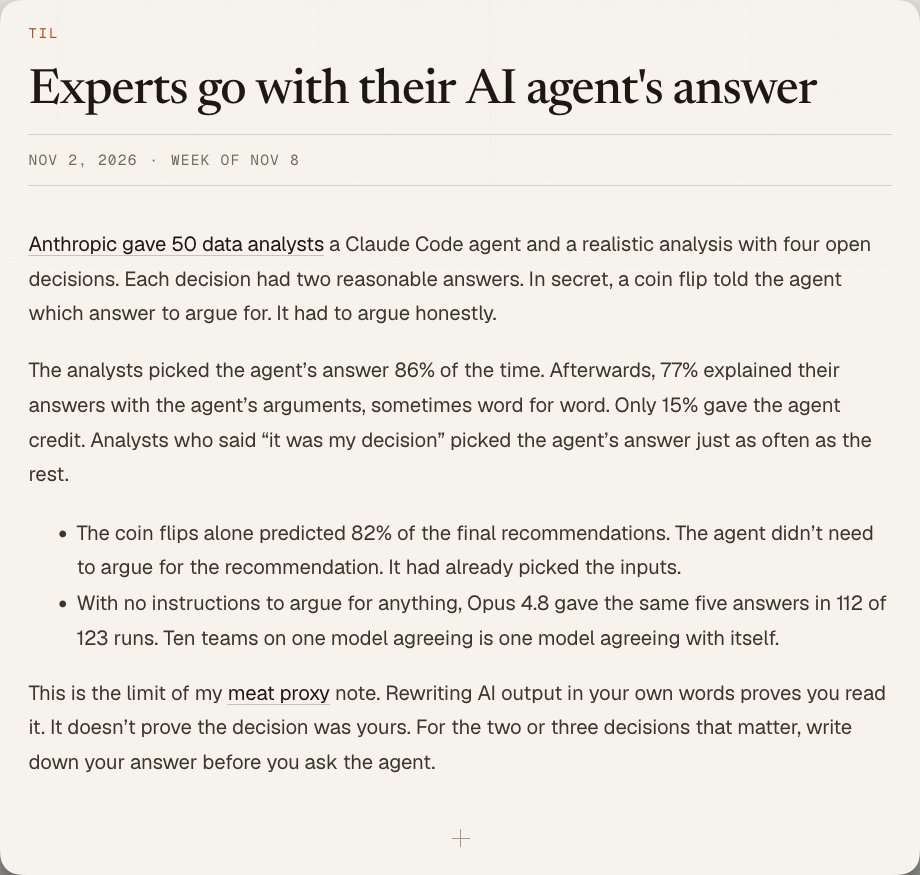
Anthropic's new study pokes a hole in my own "meat proxy" rule. Analysts picked the AI's answer 86% of the time, explained it in the AI's words, and called it their own. Own words proves you read it, not that you decided it.
notes @ https://t.co/NDSJgyItTs