@Robert_E_Kelly As insane is this is, I think one could make a strong argument that Trump has been trying to collapse the Canadian economy for rebuffing his "you will be our 51st state" talk.
@conor64 I think your three recommendations here would all be steps in the right direction. But IMO a more impactful reform would be to change the 1967 federal law requiring single-member House districts, which could pave the way for multi-party representation.
https://t.co/3uHY0TuHxB
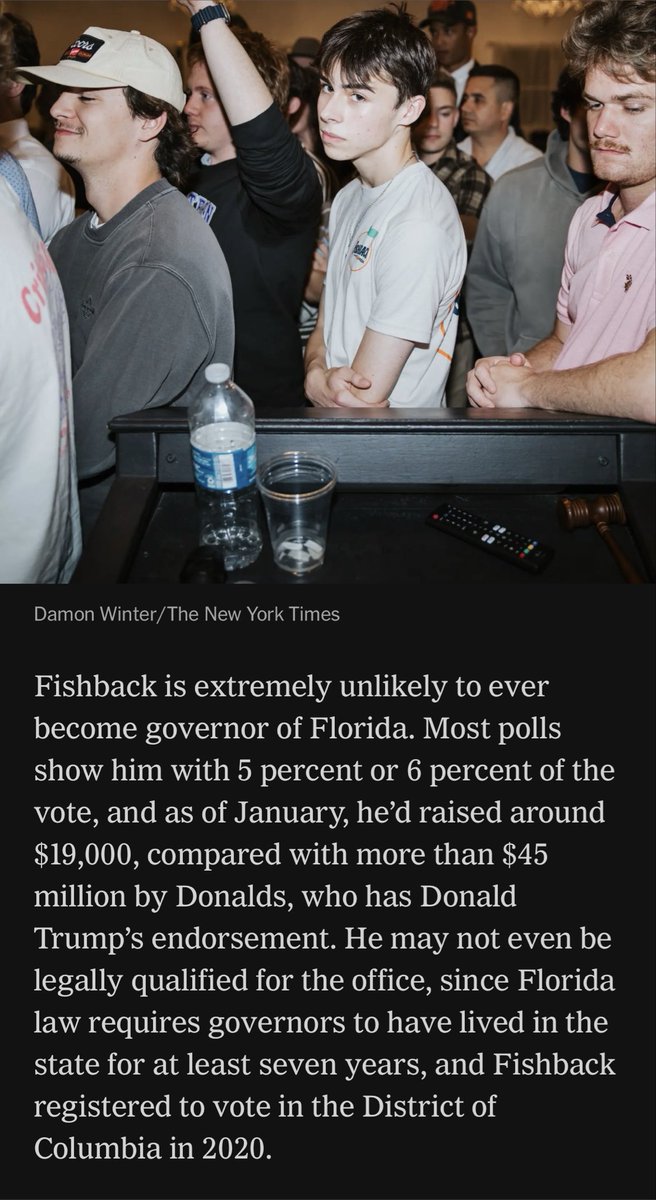
@CharlesFLehman@EWErickson Direct quote from the piece that seems kinda relevant here:
“Fishback is extremely unlikely to ever become governor of Florida. Most polls show him with 5 percent or 6 percent of the vote…”
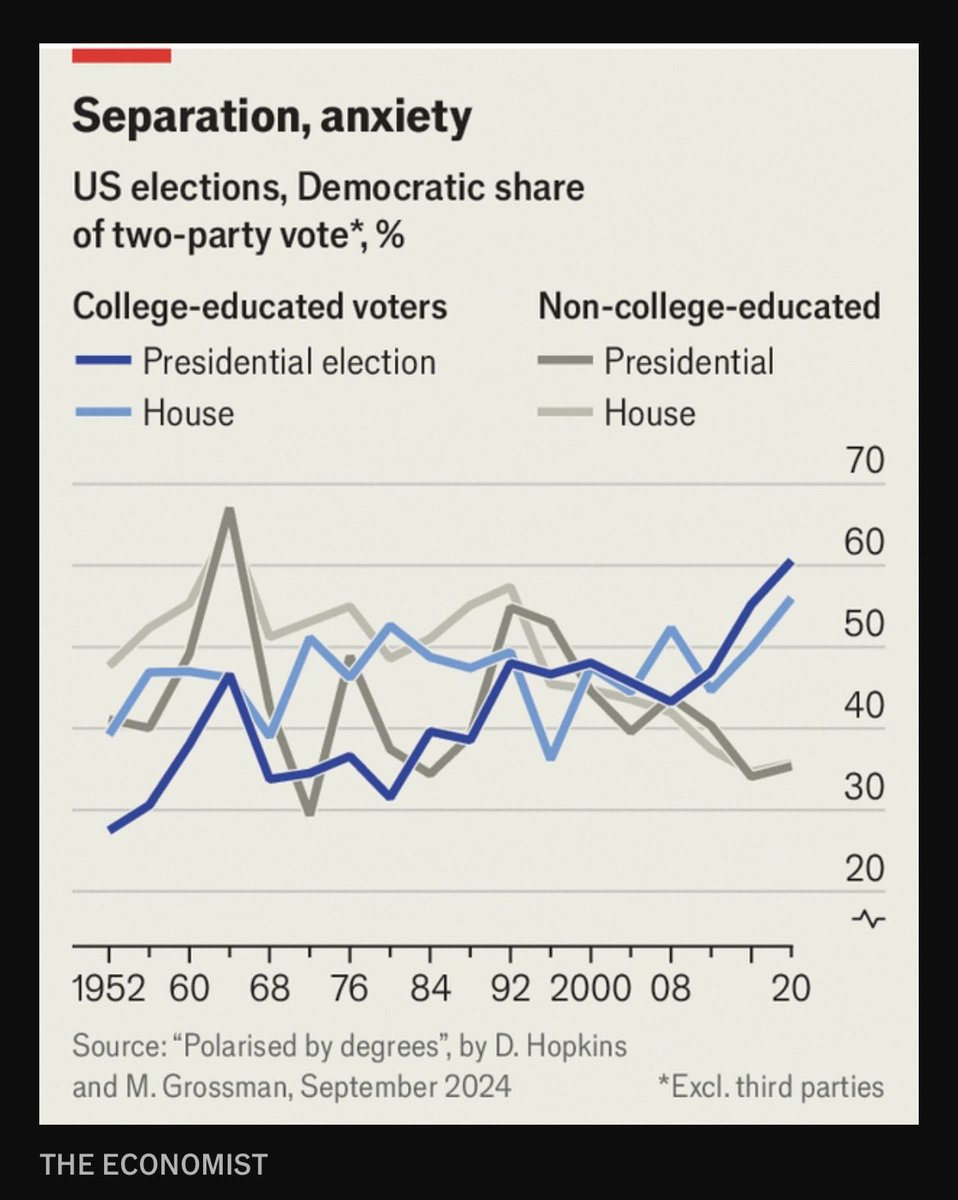
@alphakenmoore@kevinnbass Educational polarization: voters with more formal education moving left; voters with less formal education moving right.
A fairly obvious result of the GOP shifting to a much more aggressively anti-intellectual posture under Trump.
@christopherrufo That was not the design of the Fairness Doctrine, which in any case was repealed *in 1987*.
Can you cite examples of previous FCC chairs making direct threats to media organizations over a comedian’s speech (“we can do this the hard way or the easy way”), or anything similar?
@robertgraham@Kasparov63 Don’t mean to distract from the main point here (and I’m glad FIRE is defending free speech), but what are some examples of “Biden’s attempts to squash” free speech on college campuses?
My essay on how the decline of deep reading is (arguably) reshaping our consciousness, culture, and politics is out from behind the paywall
https://t.co/BuLF8zmyqc
@EricLevitz Mannn, great piece! I wasn’t familiar with Ong’s work in this field (I’m a little embarrassed to say), but there are lots of parallels to Neil Postman’s “Amusing Ourselves to Death”, which was also written in the 1980’s and has recently been cited to support similar arguments.
@HistoryBoomer@DouthatNYT@_alice_evans Very similar to the central idea in David Foster Wallace’s seminal novel from almost 30 years ago, Infinite Jest, and his general concern with increasingly seductive tech.
https://t.co/TW7X2krGwJ
@VickieforNYC@guypbenson Republicans are a little more likely to date someone with different political views, but the difference isn’t huge (6-8%). IMO you only hear of progressives doing this kind of thing because algorithms push content that reinforce existing views.
https://t.co/HzeFsmNfUF
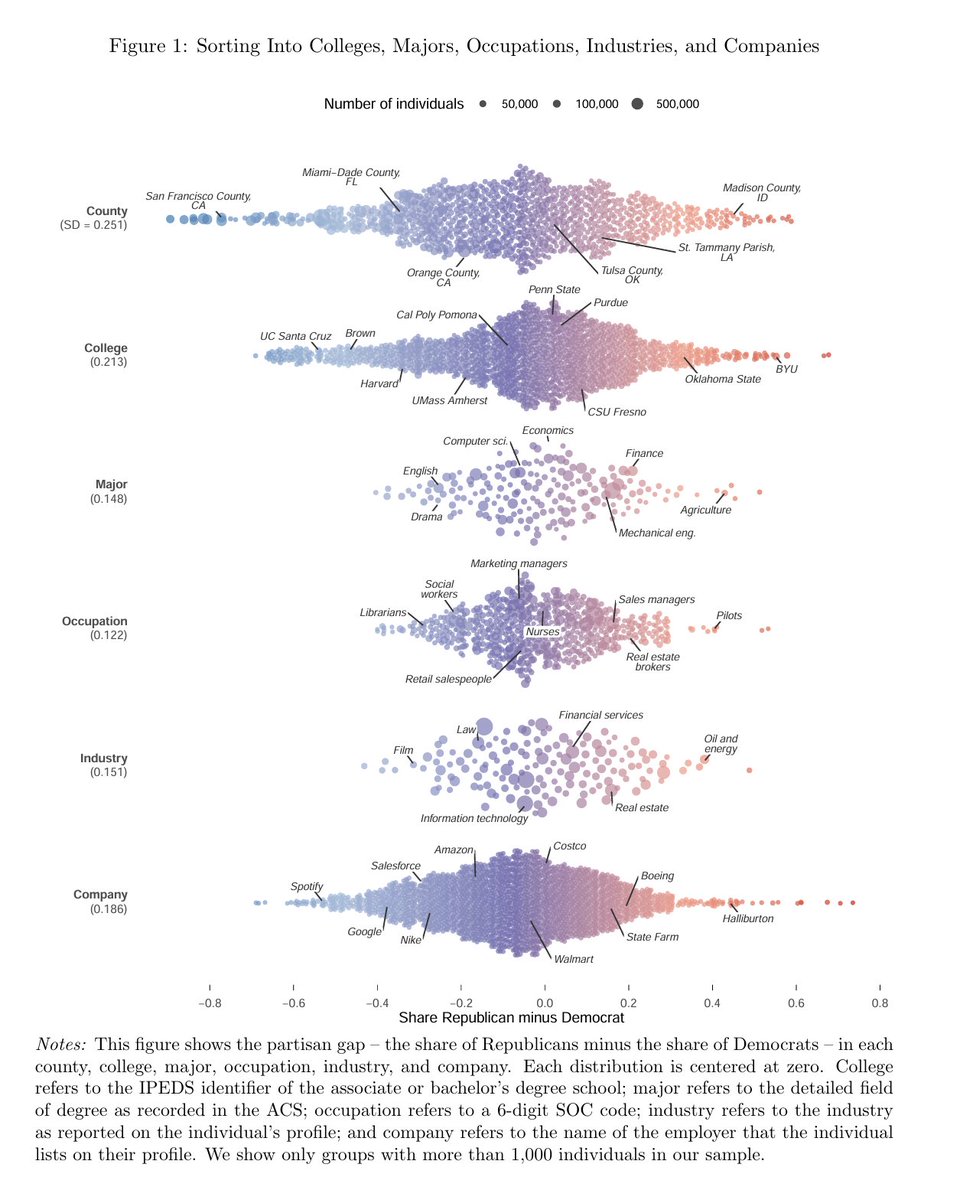
Like the paper below? Here's another that will be right up your alley.
In this paper, the authors merge voter file data and online resumes to create a panel of 34.5 (!) million people.
They show that Democrats and Republicans choose distinctive career paths and employers. This leads to a lot of partisan segregation at the workplace.
They then explore whether...
1.) partisan segregation arises because jobs shape workers’ politics OR
2.) partisan segregation arises because workers’ politics shape their job choices.
To examine the first possibility, they use a quasi-experimental design leveraging the timing of job transitions.
They find that uncommitted workers adopt the politics of their workplace, but not workers who were already registered Democrats or Republicans. The average effects are too small to generate the segregation they document.
To study the second possibility, they measure the intensity of workers’ preferences for politically compatible jobs using two survey experiments motivated by the observational data.
Here, they find that the median Democrat or Republican would trade off 3% in annual wages for an ideologically congruent version of a similar job. Wow!
These preferences are strong enough to generate segregation similar to the observed levels.
So, there you have it. Partisan segregation in the work force is...
1.) large
2.) probably driven by selection into jobs that people agree with.
ht @UptonOrwell
Partisans often seem unwavering in their support for a politician/policy, even when faced with opposing evidence. But recent studies show that partisans can be persuaded. So how can both be true? My new @BJPolS paper explores this Q: https://t.co/2IWU2Si8EQ