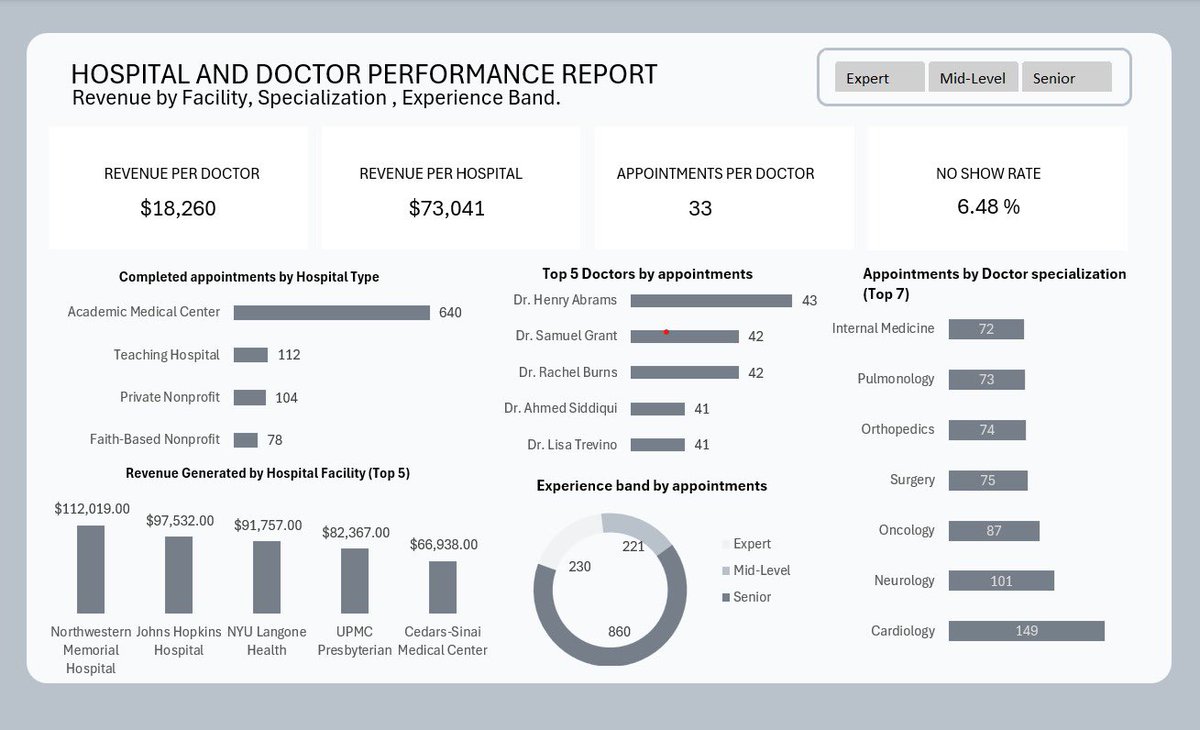
This report analyses 1,600 appointment records across ten major US hospitals including Mayo Clinic, Johns Hopkins and Northwestern Memorial. Raw data was cleaned in Power Query, modelled into a star schema in Power Pivot and analysed in Pivot table.
Page 1 - Executive Summary
The network collected $730,405 against $1,090,887 scheduled leaving $358,441 in unrecovered revenue. Despite appointments growing 5.49% and patients growing 1.44% year over year revenue declined 6.67%, more patients came but generated less money. Only 58.56% of appointments completed. The remaining 41.44% split across no shows, cancellations and rescheduled appointments representing 661 missed care opportunities and the primary driver of revenue leakage.
Page 2 - Patient and Clinical Analysis
The 65+ age group leads appointment volume with 388 visits. Medicare and Medicaid together account for nearly 25% of all appointments contributing to the average scheduled fee declining 11.44%. ST elevation myocardial infarction ranks as the second most common diagnosis reflecting the national cardiovascular burden. New patient registrations peaked at 207 in 2023 signalling strong future demand but revenue per patient fell 8.42% year over year meaning volume growth is not yet translating into financial recovery.
Page 3 - Hospital and Doctor Performance
Northwestern Memorial leads revenue at $112,019 ahead of Johns Hopkins at $97,532 proving revenue follows procedure mix not reputation. Cardiology dominates with 149 appointments above Neurology. Top 5 physicians carry 24-30% above the network average of 33 appointments creating burnout risk. Academic Medical Centers account for 68% of all completed appointments across the network.
Recommendations
1. Deploy reminder systems; Automated SMS reminders could reduce no-shows by 25-30% recovering an estimated $42,000–$58,000 annually.
2. Introduce no-show policy; Graduated accountability measures convert repeat offenders without alienating genuine emergencies.
3. Review fee structure; Average fee declined 11.44%. A pricing audit aligned to market rates could recover significant revenue without increasing volume.
4. Rebalance workloads; Redistributing appointments across all 40 physicians reduces burnout risk and protects care quality.
5. Geriatric care strategy; Coordinated multi-specialization visits and Medicare Advantage partnerships improve both outcomes and reimbursement rates.
6. Strengthen cardiovascular capacity; Preventive cardiology investment reduces emergency presentations the most expensive appointment type in the network.
#healthcareanalysis #Excel @msexcel@omoalhajaabiola@iam_daniiell
127.0.0.1 is the IP address known as localhost. It always points back to your own machine. No matter where you are in the world or what network you’re on, 127.0.0.1 means “this computer, right here.”
When developers test websites, APIs, or servers, they usually run them on 127.0.0.1 first. It’s a safe, isolated environment where nothing is exposed to the internet and nothing external can interfere. If it works on localhost, then you can think about letting others see it.
So the phrase “There is no place like 127.0.0.1” is a nerdy spin on “There’s no place like home.” For developers and engineers, localhost is home. It’s where things are predictable, controlled, and forgiving. You can break things, restart them, and try again without consequences.