As a lifelong gamer, I spend a lot of time thinking about how to push gaming experiences forward across CPUs, GPUs, software, and games.
My team and I have been working hard to evolve @AMD FSR 4 and bring it to more cards.
We power over 1 billion gaming devices worldwide. It’s a responsibility we care deeply about.
🎮 This July, RDNA 3 players will experience FSR Upscaling 4.1, delivering sharper visuals and smoother gameplay than ever before.
I’m grateful to our fans. Your enthusiasm and ideas inspire us to keep pushing gaming forward.
FSR Upscaling 4.1 on RDNA 3 will be ready out of the box for Radeon 7000 Series players in over 300 supported games at launch.
And for our RDNA 2 players, we have something exciting coming in early 2027. FSR Upscaling 4.1 will be coming to your cards as well, bringing sharper visuals and smoother gameplay to even more gamers.
We cannot wait to show you what is next. Stay tuned 🚀
This is an email I sent earlier today to all employees at Coinbase:
Team,
Today I’ve made the difficult decision to reduce the size of Coinbase by ~14%. I want to walk you through why we're doing this now, what it means for those affected, and how this positions us for the future.
Why now
Two forces are converging at the same time. We need to be front footed to respond to both.
First, the market. Coinbase is well-capitalized, has diversified revenue streams, and is well-positioned to weather any storm. Crypto is also on the verge of the next wave of adoption, with stablecoins, prediction markets, tokenization, and more taking off. However, our business is still volatile from quarter to quarter. While we've managed through that cyclicality many times before and come out stronger on the other side, we’re currently in a down market and need to adjust our cost structure now so that we emerge from this period leaner, faster, and more efficient for our next phase of growth.
Second, AI is changing how we work. Over the past year, I’ve watched engineers use AI to ship in days what used to take a team weeks. Non-technical teams are now shipping production code and many of our workflows are being automated. The pace of what's possible with a small, focused team has changed dramatically, and it's accelerating every day.
All of this has led us to an inflection point, not just for Coinbase, but for every company. The biggest risk now is not taking action. We are adjusting early and deliberately to rebuild Coinbase to be lean, fast, and AI-native. We need to return to the speed and focus of our startup founding, with AI at our core.
What this means
To get there, we are not just reducing headcount and cutting costs, we’re fundamentally changing how we operate: rebuilding Coinbase as an intelligence, with humans around the edge aligning it. What does this mean in practice?
- Fewer layers, faster decisions: We are flattening our org structure to 5 layers max below CEO/COO. Layers slow things down and create coordination tax. The future is small, high context teams that can move quickly. Leaders will own much more, with as many as 15+ direct reports. Fewer layers also means a leaner cost structure that is built to perform through all market cycles.
- No pure managers: Every leader at Coinbase must also be a strong and active individual contributor. Managers should be like player-coaches, getting their hands dirty alongside their teams.
- AI-native pods: We’ll be concentrating around AI-native talent who can manage fleets of agents to drive outsized impact. We’ll also be experimenting with reduced pod sizes, including “one person teams” with engineers, designers, and product managers all in one role.
In short: AI is bringing a profound shift in how companies operate, and we’re reshaping Coinbase to lead in this new era. This is a new way of working, and we need to leverage AI across every facet of our jobs.
To those who are affected
I know there are real people behind these decisions — talented colleagues who have poured themselves into this company and our mission. To those of you who will be leaving: thank you. You’ve helped build Coinbase into what it is today, and I am sincerely grateful for everything you've done.
All impacted team members will receive an email to their personal account in the next hour with more information, and an invitation to meet with an HRBP and a senior leader in your organization. Coinbase system access has been removed today. I know this feels sudden and harsh, but it is the only responsible choice given our duty to protect customer information.
To those affected, we will be providing a comprehensive package to support you through this transition. US employees will receive a minimum of 16 weeks base pay (plus 2 weeks per year worked), their next equity vest, and 6 months of COBRA. Employees on a work visa will get extra transition support. Those outside of the US will receive similar support, based on local factors and subject to any consultation requirements.
Coinbase prides itself on talent density. Our employees are among the most talented people in the world, and I have no doubt that your skills and experience will be highly sought after as you pursue your next chapters.
How we move forward
To the team that is staying, I know this is a difficult day. We’re saying goodbye to colleagues and friends you've been in the trenches with. But here’s what I want you to know as we move forward together:
Over the past 13 years, we have weathered four crypto winters, gone public, and built the most trusted platform in our industry. We’ve made it this far by making hard decisions and by always staying focused on our mission. This time will be no different – nothing has changed about the long term outlook of our company or industry. And most importantly, our mission has never been more important for the world. Increasing economic freedom requires a new financial system, and we’re building it.
The Coinbase that emerges from this will be more capable than ever to achieve our mission.
Brian
If you're a caveperson like me who sometimes uses web chat interface of different LLMs and likes markdown export then you might find it useful: bookmarklets!
* repository: https://t.co/aoJOILV5dP
* page: https://t.co/9NceGTrc1h
"GitHub's scale is unprecedented." No, it really isn't.
GitHub: 150M total users.
Office 365: 345M total users.
Xbox: 500M monthly active users.
Bing: 100M+ daily active users.
The company that runs Office, Xbox and Bing can run GitHub.
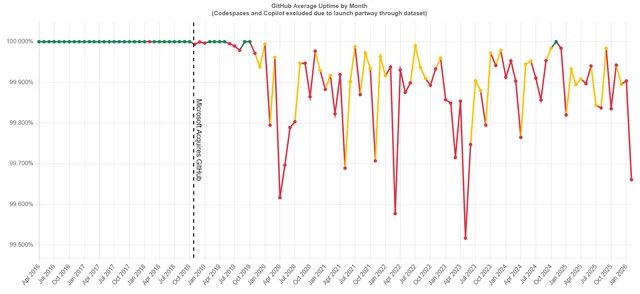
If reliability is slipping, that's a priorities problem, not a scale problem.
The only people who believe any of this are non-coders.
I tried to build a game (an area I’m an n00b in.) The results are amusingly disastrous - I never before coded a decent game.
But I’ll crack out backend services w AI rapidly - because I coded dozens of them before…
Adobe tried to buy Figma for $20 billion in 2022.
The deal collapsed. So Figma went public on the NYSE in July 2025 instead. Ticker FIG. Public company. Quarterly earnings. Wall Street pressure.
You know what happens to design tools after they IPO.
In March 2025, Figma raised the Professional Full seat 33%. From $15 to $20 a month. Organization seats jumped to $55. Enterprise to $90.
Then they took Dev Mode, which was free during beta, and locked it behind a paid seat. Your developers now pay extra to inspect the designs your designers already paid to create.
In March 2026, Figma started charging for AI credits on top.
If Figma raises prices again, you pay.
If Figma gets acquired, you pray.
If Figma shuts down, your files die with it.
Your design system. On their servers. In a proprietary format only their app can read. To draw rectangles on a screen.
There is an open source design platform that runs on your hardware. Stores your files in plain SVG. Costs $0 forever for unlimited users.
It is called Penpot. 45,700+ stars on GitHub.
A full Figma-grade design platform built on open web standards. Vector editing. Components. Design tokens to W3C spec. Flex and Grid layouts. Real-time multiplayer. Interactive prototyping.
Here's what it does:
→ Real-time collaboration. Live cursors. Comments in line.
→ Components, variants, shared libraries.
→ Auto layout, Flex, CSS Grid. The tool outputs production CSS, not lookalike CSS.
→ Interactive prototypes with overlays, animations, and flows.
→ Inspect tab. Free. Built in. Every developer grabs production CSS, SVG, HTML without a separate seat.
→ Plugin ecosystem. Figma import to migrate your files.
→ Self-host on Docker in one command. Your designs never leave your network.
Here's the wildest part:
Figma stores your designs in a proprietary format only Figma can read.
Penpot files are SVG. The same format your browser has rendered for 25 years. Open them in any editor. Open them in 20 years. Nobody can lock you out.
The feature Figma charges your developers extra for, Penpot gives away. Without asking permission.
Figma Professional: $20/month per seat. A 10-person team: $2,400/year.
Figma Organization: $55/month per Full seat. A 50-person org: $33,000/year.
Penpot: $0. Unlimited users. Unlimited files. Unlimited teams. Self-hosted. Free forever.
45,700+ stars. 2,700+ forks. 250+ contributors. MPL-2.0 license. Backed by a community that believes design tools should be free.
Your designs. Your files. Your standards.
100% Open Source.
(Link in the comments)
Massive L from GitHub
One of the most embarrassing outage that can happen (a data integrity issue), and the response is "well, actually, it's only 0.07% of customers...")
Customers whose workflow is messed up badly are fuming reading this. No respect for the customer...
A terrible incident coming from an infra provider. This is not an outage resulting in downtime, or data lost on the cloud (that is trivial to restore from local git.)
It’s a data integrity issue, which sounds hard and difficult to untangle by anyone hit by it.
A real WTH moment
i know what i'll be playing with over the weekend!
also, light up a candle for crystal because they will be competing for same target audience:
https://t.co/cO4NAgjass
@johncrickett That is a valid point, but LLM context windows grow as we speak, and current 1M tokens (Sonnet, Opus, Gemini) can fit a lot. Small and well defined (boundaries!) modules are superior because they're easier to reason about, test, verify and replace - and it's the same for humans.