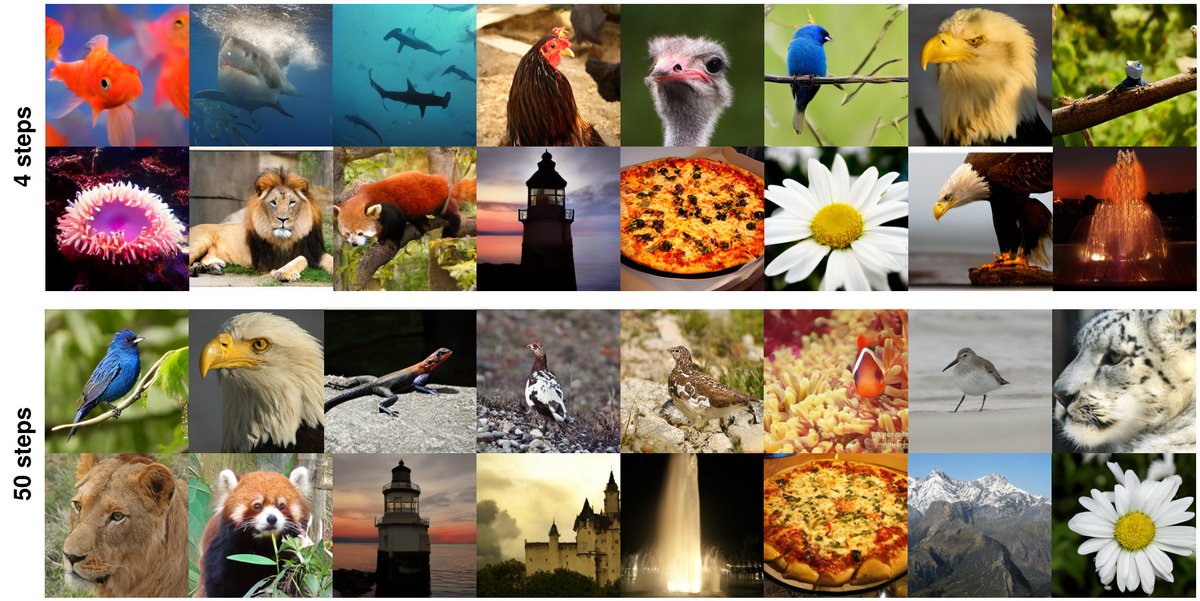
⚡️Few-step diffusion without a teacher, self-distillation or JVPs.
iDDM: a single model trained from scratch in one stage. ImageNet-256: 4.48 FID at 4 steps and 2.38 at 50, from the same checkpoint
🧵 (1/6)
Directly predict the distribution over possible futures in one forward pass.
To find out how, come by our poster at #ECCV in #Malmö today.
Poster session 3 - Poster 101. See you at 10:30 am!
People often think of prediction as choosing a likely outcome. But that’s not how the world works!
Given partial information, the future is a distribution of possibilities. And more knowledge collapses the distribution.
We built a representation that models exactly that 🧵
Most representation learning methods produce generic embeddings that try to preserve everything in an image.
We introduce VICIS: a way to use example sets to define a tailored embedding space for what matters.
This is useful whenever the desired visual signal is easier to show than to describe.
Code & weights available now 🧵👇
⚠️ Standard first stages are not sufficient for safety-critical applications!
The most extreme weather events are often the hardest to decode.
One latent → many plausible reconstructions
Deterministic decoders hide that uncertainty.
Meet FREUD 🧵👇
The internet is full of video. So why can't novel view synthesis just scale on it?
Real-world video is simultaneously unposed, messy, and dynamic, breaking self-supervised NVS.
We fixed that. RayDer learns static-scene NVS from dynamic internet video, scaling like an LLM. A🧵
My first blog post in over a year is a deep dive on flow maps🗺️, or how to learn the integral of a diffusion model to enable faster sampling and several other cool tricks.
It's the longest one yet👀 Let me know what you think!
https://t.co/O8bBGZ9qjC
Diffusion models treat every part of an image equally.
→ Same number of steps. Same compute.
But images aren’t uniform. 🤔
Some regions are easy, others are hard.
So why force the model to treat them the same? 🧵
Excited to finally share Myriad. It was fun working with @StefanABaumann, @Ragor_, Mahdi M. Kalayeh, and Björn Ommer on sparse and efficient motion prediction!
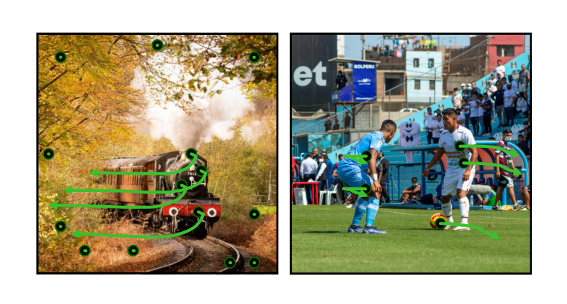
You don't imagine the future by mentally rendering a movie. You trace how things move -- abstractly, sparsely, step by step.
We built a model that does exactly this. It predicts motion, not pixels -- and it's 3,000× faster than video world models.
Myriad, accepted at @CVPR 2026
Video diffusion models learn motion indirectly through pixels.
But motion itself is much lower-dimensional.
We introduce 64× temporally compressed motion embeddings that directly capture scene dynamics.
This enables efficient planning -> 10,000× faster than video models.
🧵👇
Great to see corroborating evidence to our https://t.co/RNBHfAJIGs work from other groups!
Check out this concurrent great work from @StefanABaumann,
@Ragor_, @_tommymarto_ , Mahdi M. Kalayeh, and Björn Ommer!
Thanks for the shoutout! Great to see others sharing a similar conviction around modeling the world through point tracks over pixels. The analysis of efficiency gains from sparse tracks vs pixel-based representations which incur the “visual tax” is especially impressive and insightful. Excited to see this direction gaining momentum!
You don't imagine the future by mentally rendering a movie. You trace how things move -- abstractly, sparsely, step by step.
We built a model that does exactly this. It predicts motion, not pixels -- and it's 3,000× faster than video world models.
Myriad, accepted at @CVPR 2026