Sakana AI just dropped something massive.
They launched Fugu a single API that gives you full multi-agent orchestration power.
One model. One endpoint. Multiple expert agents working behind the scenes.
Post 1/3
Since June 12, we’ve been working closely with the US government to restore access to Claude Mythos 5 and Fable 5. Today, the government notified us that Mythos 5, our strongest cybersecurity model, can be redeployed to a set of US organizations that operate and defend critical infrastructure.
We’re restoring access for these organizations quickly, and we’re continuing to work with the government to expand access to Mythos 5 and make Fable 5 available for general use again.
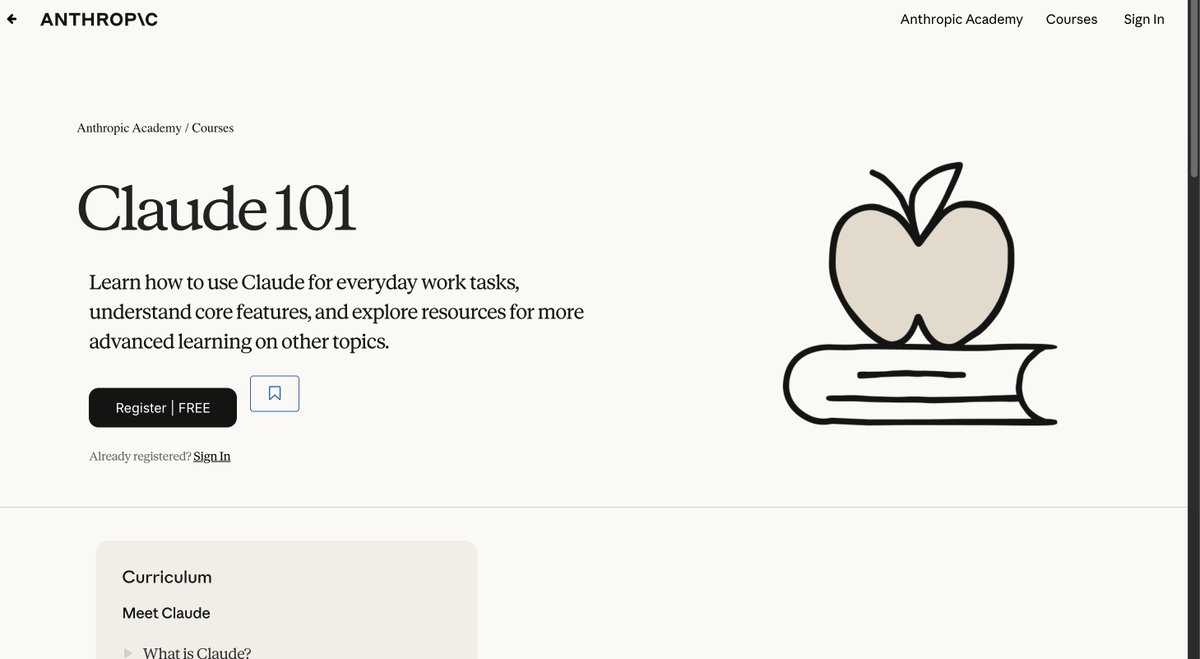
🚨 ANTHROPIC JUST MADE THOUSANDS OF DOLLARS WORTH OF AI COURSES COMPLETELY FREE.
From zero to production-ready AI agents. No subscription. No catch.
Here's everything inside the new Anthropic Academy course matrix.
The lineup spans developers, educators, students, and nonprofits, and it covers the full path from "what is Claude" to deploying agents in production.
1 -Start here if you are new: Claude 101 walks through everyday use, core features like Chat, Cowork, Code, Projects, Artifacts, Skills, and research mode.
https://t.co/yDrCD0CIoM
2 -Then there is AI Fluency: Framework and Foundations, co-designed with Professor Joseph Feller from University College Cork and Professor Rick Dakan from Ringling College. This one is not about prompt tricks. It teaches the 4D Framework: Delegation, Description, Discernment, and Diligence, the actual thinking behind working with AI well.
https://t.co/axtArYUCZ0
For builders, the technical track is deep:
3 -Introduction to Agent Skills teaches you to build and share reusable Markdown instructions that Claude applies automatically to the right tasks.
https://t.co/43tCrCgth2
4 -Building with the Claude API is over 8 hours of content covering function calling, tool use, streaming, RAG systems, MCP server development, and full agent architecture patterns.
https://t.co/Pa33ZqrCoD
5 -Claude Code in Action goes into the architecture behind AI coding assistants, context management, and extending functionality through MCP and GitHub.
https://t.co/4oslusm45c
6 -Then two dedicated MCP courses. Intro to Model Context Protocol has you building MCP servers and clients from scratch in Python:
https://t.co/MLKV9nPHMG
7 -MCP Advanced Topics covers sampling, notifications, file system access, and production deployment:
https://t.co/NRw8JUepfU
For education, there are four separate tracks:
8 -AI Fluency for Students https://t.co/3oO96rf4Xn
9 -AI Fluency for Educators https://t.co/CoXC5xzOP0
10 -Teaching AI Fluency, for instructors who need to assess it https://t.co/n1JhErNxkV
11 -AI Fluency for Nonprofits, built with GivingTuesday for fundraising and program teams https://t.co/mZakJw13Ar
And for enterprise deployment, two full accreditation courses:
12 -Claude with Amazon Bedrock 85 lectures, 8 hours, 10 quizzes
https://t.co/zJcEcqo6QY
13 -Claude with Google Cloud's Vertex AI covering tool use, RAG, MCP, and computer use at production scale
https://t.co/0jYPJLx1lr
That is 13 courses, real documentation, and real code, with zero barriers to entry.
When one of the leading AI companies puts out a curriculum like this for free, the question becomes simple: what are the people still charging for this actually selling?
Anthropic already answered it. The only thing left is whether you start.
Introducing a limited preview of GPT-5.6 Sol, our next generation frontier model, as well as GPT-5.6 Terra, a balanced model for efficient, everyday work, and GPT-5.6 Luna, a fast and affordable model for high-volume work.
https://t.co/OoM83SyISN
Work at OpenAI is being transformed by agents, in every department.
Across our entire company, people are using Codex to do work that is more complex, longer-running, and increasingly cross-functional.
Our internal usage offers an early look at how agentic tools may reshape work as they become more capable and broadly available.
OpenAI is leaning toward holding off its IPO until next year, people involved in the company’s deliberations said, a delay that highlights the unclear paths of A.I. titans. https://t.co/T5REJ7PL54
Science is entering a new era - one where AI agents can do scientific work.
🧬 Today NVIDIA is launching the BioNeMo Agent Toolkit - an open, agent-ready toolkit that gives any AI agent callable tools for protein structure prediction, molecular docking, generative chemistry, genomic analysis, and more.
(1/2)
You can now pay for things in Africa directly from your AI agent.
Today we’re introducing Paystack Index, the easiest way to check out with Paystack merchants through Claude, ChatGPT, OpenClaw, and any AI agent.
At launch, you can:
→ Buy airtime: “Buy ₦500 MTN airtime for 080…”
→ Send money with @zapbypaystack: “Send ₦25k to…”
→ Buy food with @ChowdeckHQ: “Order jollof under ₦3k near me”
As more merchants join the Index, you’ll be able to do more, from booking rides and ordering groceries to paying utility bills, quickly and securely.
Paystack Index is now available in Nigeria, with more African markets coming soon.
An experimental product from Paystack and TSG Labs.
Today, we’re announcing Runlayer has raised $30M from Felicis and Khosla Ventures to help companies go all in on AI.
Runlayer is the golden path for AI: enablement, security, and control in one platform.
So, how does it give your team the right tools for AI? 🧵
Qualcomm and Meta are teaming up on data center CPUs to challenge the status quo.
Qualcomm unveiled its Dragonfly C1000 processor with over 250 Orion cores running above 5GHz, massive I/O bandwidth (PCIe 7.0, CXL, >2TB/s), and strong power efficiency.
Meta plans to deploy it in its next-generation servers, with collaboration spanning multiple future generations.
This expands their long mobile partnership into AI infrastructure.
Qualcomm is bundling the CPU with AI accelerators and open software. Meta gains early influence on next-gen architectures for its massive data centers and "personal superintelligence" push.
Mass production starts in the second half of 2028.
Diversification away from traditional x86 dominance is accelerating as hyperscalers optimize for AI workloads.
How many more big tech players will bet on custom or alternative CPUs in the coming years?
$QCOM $META