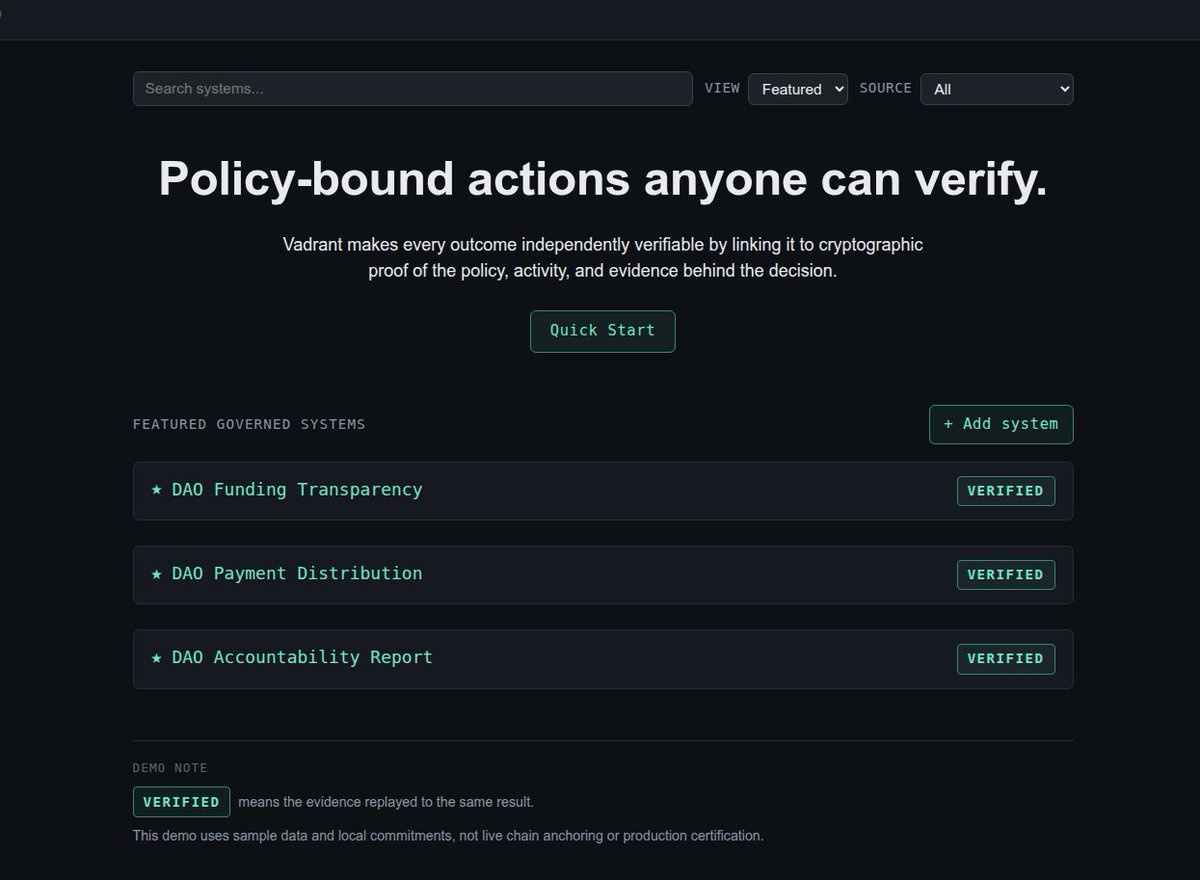
I’ve received great feedback on Vadrant’s interactive demo and applied a lot of it.
The goal is simple:
Help reduce some of the arguments around Cardano governance by making off-chain execution easier to inspect.
On-chain data shows part of the story. Vadrant explores how anchored policies, evidence, and replayable verdicts can help people check whether governed actions followed the rules in force at the time.
Thank you to everyone who has reviewed it so far. You will not be forgotten.
If anyone else wants to take a look, please use the feedback button in the top right of the demo.
https://t.co/iBRxnVyKAG
@SundaeSwap Hi Pi, this is very insightful. I'm not done yet with the bounty, so don't judge.
I also view it like a skeleton that you're building on top of. Without the bone structure the LLM has more hallucinations. I use replay and invariants to get there.
https://t.co/A9uEz1iAnG
The ability to add verifiable execution to governance.
For example on Cardano there's onchain governance but that's only deciding who's allowed to get funds.
My solution covers the other parts once that decision has been made. The governance decision's execution methods are verifiable and anchored back to the chain so that the entire life-cycle is completely verifiable and easily audited by anyone.
The demo is still up if you want to check it out.
https://t.co/61h6OLJchI
I’ve received great feedback on Vadrant’s interactive demo and applied a lot of it.
The goal is simple:
Help reduce some of the arguments around Cardano governance by making off-chain execution easier to inspect.
On-chain data shows part of the story. Vadrant explores how anchored policies, evidence, and replayable verdicts can help people check whether governed actions followed the rules in force at the time.
Thank you to everyone who has reviewed it so far. You will not be forgotten.
If anyone else wants to take a look, please use the feedback button in the top right of the demo.
https://t.co/iBRxnVyKAG
@NaVi_GaT0R Makes total sense and I'm glad you framed it this way.
Staying silent doesn't help solve the true issues impacting adoption. We all have a voice and role to play to keep things civil and progressing.
I would like to caution dReps regarding some proposals. To me it looks like some proposals are:
- omitting technical details / architecture (trust me bro)
- trying to create proposal for V2 of a protocol while V1 has zero adoption
- overcharing per developer and high hidden administrative costs
- using excessive language (Cardano will get in trouble without this)
- assuming users will adopt the solution (like we didn't have Marlowe as an example [used by nobody or almost nobody]), a proposal can be amazing, technology can be amazing but it will still can be used by almost zero people
- resubmitting same proposals that were already not funded by Catalyst and hoping for miracle
- forgetting and not revealing to users that there is 2026 and AI can generate a lot of code (of course not all projects and not everything but still, a lot with a good AI Engineer)
- a project not thinking about scaling to zero infra costs (e.g. running on expensive cloud, using db-sync, etc)
I am actually saddened by some of it because a vendor is also responsible and accountable for a proposal in a sense that submission MUST be done in good faith. This does not seem to be the case for many proposals despite 100k upfront ADA deposit.
For these reasons it is important to be really careful and vote NO or ABSTAIN if something sounds "too good to be true or smells" and not all details are provided. With missing details, rather than trusting it is better to distrust and ask for resubmission with details (e.g. architecture, existing user base / projected user base, trust assumptions, ROI (Return on Investment projection).
We cannot bankcrupt our treasury and I will let you know one thing, from conversations outside of our Cardano bubble, people are observing this Cardano Governance experiment and see if we go responsible route or another "Polkadot route".
A term "Polkadotting" really means these days letting community bankrupt treasury on pointless stuff that does not bring a meaningful adoption but finances those on other end.
Be honest, be brutal with proposals, do not over assume trust. A vendor is a vendor and this has never changed since forever I remember.
Vendor's goals are often not your goals.
#Cardano
We’ve agreed to a partnership with @SpaceX that will substantially increase our compute capacity.
This, along with our other recent compute deals, means that we’ve been able to increase our usage limits for Claude Code and the Claude API.
@IOGroup I'm pretty sure we all understand how important it is, but where are the details? Numbers, transparency, and accountability.
Why not use Reeves or other tools to gain more community support? If I'm ever as big as you guys, I certainly will.
Introducing https://t.co/ivhQ4gEA5p, in collaboration with @googlecloud
For the first time agents can discover, access, and pay-per-request for APIs from Google Cloud including Gemini, BigQuery, Vertex AI, and more using stablecoins on Solana.
No accounts, no subscriptions, just machine-native commerce.
afaik the constitution already mandates this - and goes further than most realize.
article II section 7 requires every treasury withdrawal GA to specify: purpose, delivery timeline, costs & expenses, refund conditions, prior funding history, audit allocation, and a designated administrator.
section 6 requires all GAs to include sufficient rationale - title, abstract, justification, supporting materials.
and tenet 8 states plainly: "the Cardano Blockchain shall not unreasonably spend resources." how can reasonableness be assessed without adequate disclosure?
the gap isn't in the rules - it's in enforcement. i'd expect the CC to be voting these down as unconstitutional.
Cardano is moving toward partner chains and trusted infrastructure.
As execution spreads across chains, DAOs, AI, and off-chain workflows, the key question becomes:
Can we verify that governed actions followed the rules?
#Cardano#Vadrant#VerifiableExecution