GameStop is about to post a near-record profit. Almost none of it came from selling video games.
The company guided to $290 to $310 million in net income last quarter, up from $169 million a year ago. Roughly $238 million of that is a paper gain on its eBay stake, not its stores. Actual sales fell to about $790 million from $972 million, down 19%.
A video-game retailer now earns more from a stock bet than from its business. Ryan Cohen even made a $56 billion run at buying eBay outright, and eBay called it neither credible nor attractive. The register is shrinking while the balance sheet plays hedge fund.
The stock tells the real story. Shares slid from $22 to $18 over the past 3 months, and a near-record profit has not stopped the bleed. A trading gain does not repeat on a schedule. The store decline does. $GME
Hedge funds are rapidly dumping chip stocks:
Semiconductor and semiconductor equipment stocks now account for ~16% of total global hedge fund market exposure, near their lowest in 6 months.
This percentage has declined -8 points since its June peak.
However, exposure still remains double the levels seen in November 2025.
To put this into perspective, semiconductor stocks accounted for ~6% of global hedge fund exposure on average in 2024 and 2025.
Meanwhile, software and services stocks now account for just ~2% of hedge funds' portfolios, near the lowest level on record.
Hedge funds are locking-in massive profits in chip stocks.
🤯THIS IS ABSOLUTELY MIND-BLOWING:
US debt is growing nearly TWICE as fast as the economy meant to service it:
Since 2006, US public debt has surged by +$31.9 trillion, while nominal GDP has grown by just +$19.2 trillion over the same period.
Debt has grown nearly fivefold over this stretch, while the economy has grown less than 2.5x, meaning debt has grown roughly TWICE as fast as GDP.
This has pushed federal debt held by the public from below 40% of GDP in 2006 to roughly 100% today, with the CBO projecting it could climb toward 175% of GDP under current policy.
Meanwhile, US gross federal debt, including intragovernmental holdings, has now reached a record ~$40 trillion, or ~123% of US GDP, highlighting how quickly the government's total debt burden has expanded.
OMB forecasts annual budget deficits near 5% of GDP in the coming years, on top of a current run rate closer to 6%, levels typically seen only during recessions, not periods of full employment.
Bond investors may be the only force left capable of forcing Washington to rein in spending by demanding higher yields to finance its growing debt.
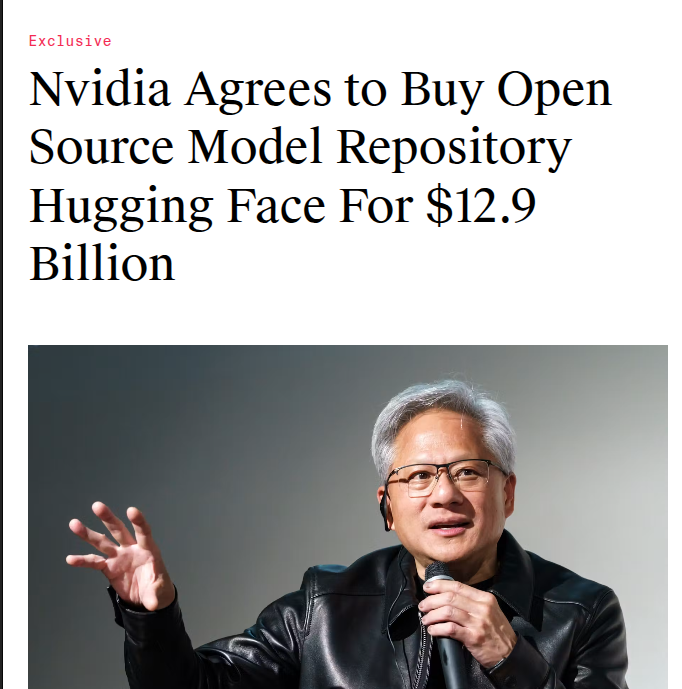
JUST IN: Nvidia agreed to buy Hugging Face for $12.9B.
At roughly $150M in reported annualized revenue of HuggingFace, thats 86X that run rate.
- The Information.