Paper: https://t.co/stNhhlUEnl
Site: https://t.co/78jlQ70Lsq
Built on DeformX (IROS '26 Oral): https://t.co/vlpJSuOvEP
With @ShawnFei331, @LehongW, @ZilinDai, Ruogu Li, Jiting Cai, Liyao Chang, Xinyi Yang, Henry Kou, Ruijie Fu, Lu Li & @howiechoset@cmubiorobotics@CMU_Robotics
A robot whips a rope to knock an apple off someone's head, using a policy trained only in simulation.
Introducing DeformX (Oral @ IROS 2026): Cosserat rod physics co-simulated with NVIDIA Isaac Sim, so cables bend, twist and collide like the real thing.
https://t.co/i4IvYcCPvR
A robot swings a rope and hits a falling balloon mid-air. Motion capture predicts where it will be; the policy strikes there.
Point It, Strike It: send a rope tip to any 3D point from a chosen direction. Across 25 targets on three real ropes, 87% of strikes land within 5 cm.
Step 3, a new rope. RECAP fits 11 rope and rig parameters from 8 calibration swings, so the simulator matches the real rope.
For each new goal, a correction policy trained in sim proposes candidates, the fitted sim picks the best, and the robot strikes once, open-loop.
@ErenChenAI Thanks for the shoutout! 😄 This demo is from our upcoming DeformX 2.0 work — more coming soon!
Here is the project website with interactive demo: https://t.co/NicS9V4Qke
@kdpisda Great question! Our follow-up work actually addresses this. For a new rope, the robot first performs a few fixed swings once to automatically calibrate before deployment. We’ll be releasing this soon!
A robot whips a rope to knock an apple off someone's head, using a policy trained only in simulation.
Introducing DeformX (Oral @ IROS 2026): Cosserat rod physics co-simulated with NVIDIA Isaac Sim, so cables bend, twist and collide like the real thing.
https://t.co/i4IvYcCPvR
Application 2: dynamic rope swinging, where small modeling errors blow up at the tip.
For a fair test, we first calibrate DeformX and Isaac Sim's linked-capsule rope on the same real rope, driven by a UR5e and tracked with mocap. Both end up with small, comparable errors.
Left: our policy's swing in DeformX. Right: the same motion replayed open-loop on a real UR5e. The real rope follows almost the same path to the goal (★).
Real-robot min tip-to-goal distance (3 goals × 10 runs):
DeformX: 6.6 / 7.3 / 5.8 cm
Capsule baseline: 15.1 / 25.9 / 30.4 cm
Application 1: training data.
WireSeg-36k: 36,000 images from 720 sim runs, with per-wire instance masks and depth. Fine-tuned SAM3: +10.2% relative mAP@75 on real photos.
3,100+ @huggingface downloads in 3 months. Best Short Paper Award (Runner-up) at SynData4CV @ CVPR 2026.
Does it match reality? A trefoil knot under continuous twist goes through the same buckling and shape transitions in sim and on the bench.
The material parameters come from factory specs. No hand-tuning.
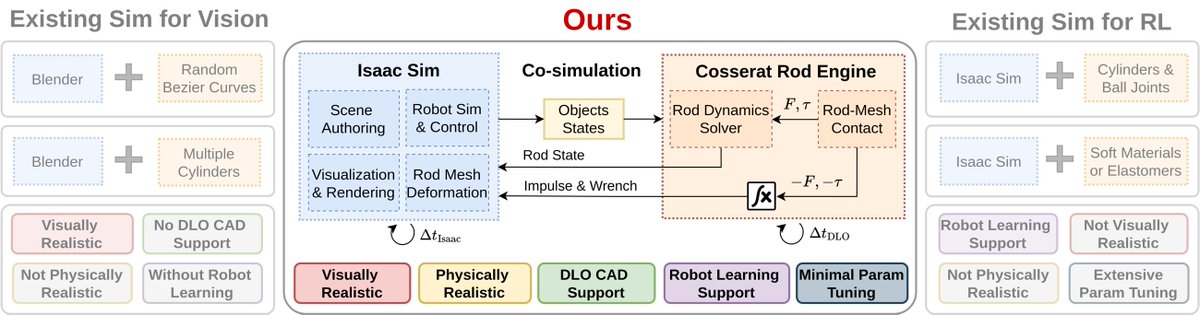
How it works: a dedicated Cosserat rod engine handles stretch, shear, bending, twist, self-collision and contact with arbitrary meshes.
It substeps at ~10⁻⁵ s inside each ~10⁻² s Isaac Sim step and hands back impulses and wrenches, so the coupling stays stable both ways.
Simulating cables usually means picking a side. Visual tools deform procedural shapes with no real physics. Physics sims treat cables as rigid-link chains or generic soft bodies.
DeformX does both: real rod mechanics, rendered on the actual CAD model of the cable.