Reference motions are often used as trajectories to track or teachers to distill. We explore a different way of learning from them.
I am excited to share our work, Generalizing from References (GfR), to appear at RSS 2026, as a follow-up to our previous HIL work.
Using a unified multi-task RL framework, we jointly train reference-guided imitation and goal-driven RL within a single end-to-end policy.
No distillation.
No RL fine-tuning.
Just one policy, trained end-to-end, that learns from references and generalizes beyond them.
Rather than treating reference motions as trajectories to track, distill, or follow, we use them to shape behavior while allowing RL to explore and adapt beyond the references.
In the following example, without human joystick control, the robot can autonomously compose learned skills using only task goals.
🌐 https://t.co/pdMWBWgtCY
🤖 Things beyond locomotion coming soon.
Over the past few years, motion tracking has largely taken over humanoid whole-body control. Most motion tracking methods rely on explicit phase variables or future target poses to track reference motions.
But, do we actually need them?
We find that task conditions and scene observations alone can already provide enough structure for reference motion tracking. Building on this observation, we introduce HIL: Hybrid Imitation Learning.
Using a unified goal-conditioned observation space, we formulate motion tracking and adversarial imitation learning as a single end-to-end multi-task learning problem.
This allows a single policy to simultaneously:
• track reference motions with high fidelity
• compose and adapt skills through adversarial imitation learning
By sharing the same observation representation across both tasks, behaviors learned from motion tracking naturally transfer to more general goal-conditioned control.
📄 To appear in ACM Transactions on Graphics (TOG 2026) & SIGGRAPH 2027
🌐 https://t.co/MBb9j1U6Sk
🤖 A real-world humanoid follow-up is coming soon
We release Wuji MJLab, an open-source MuJoCo environment for dexterous hand manipulation.
It includes a cube reorientation task, a sim2real pipeline, and the setup needed to reproduce the system.
We will be at ICRA booth 121 with a live demo and welcome discussions on dexterous manipulation.
Code: https://t.co/EpJMcozjnV
Contributors: Jielin Wu, @yaoshzh, @BergerHunger, Li Chengmeng.
This project is based on @kevin_zakka’s mjlab project.
❗️Flat-terrain tracking is solved. Rough terrain breaks everything, because the reference itself has to change. So we built a system that generates references as it goes.
🦿Parkour over boxes, hurdles, stairs - all onboard.
🔗 https://t.co/ZmgNu1e72h
📄 https://t.co/sdksBQfDa6
How do you teach a humanoid to assist another person in close-contact? 🤖
The hard part: the two bodies are physically coupled — helper & helped continuously shape each other's motion.
Neither can be solved alone.
Meet AssistMimic, our multi-agent RL framework👇🧵 #CVPR2026
We are back again :) After three weeks of quiet building.
Introducing Genesis World 1.0, our latest simulation platform, the second release in our full-stack suite. Open-sourced.
Robotics is still bottlenecked by the 1× speed of the physical world. Every model, checkpoint, and data recipe eventually needs to be tested on physical hardware, slowly, expensively, and with limited coverage.
One hour in reality can become 100 days in simulation. That is how robotics model iteration moves from a wall-clock bottleneck to a compute problem.
To make this work, simulation has to be both fast and trustworthy.
Over the past year, we rebuilt the entire stack: a GPU-accelerated cross-platform compiler, penetration-free multi-physics contact solvers, unified rigid and deformable physics, and a photo-realistic renderer purpose-built for physical AI applications.
We built Nyx, a high-performance path-traced rendering engine for robotics application.
Genesis World 1.0 achieves near realtime performance with our latest development for penetration-free IPC solver, supporting various types of deformables beyond rigid bodies. It supports contact-rich, dexterous manipulation simulation across different embodiments: unitree, sharpa, wuji, genesis hand and various types of grippers.
Under the hood is Quadrants, our effort in pushing forward cross-platform GPU-accelerated computation. Quadrants started as a fork of Taichi, and we rebuilt most of the critical parts for optimizing simulation workloads, giving 10x faster launch time and up to 4.6x runtime performance compared to the initial Genesis release.
Together, they bring us to an unprecedentedly low sim-to-real gap, enabling zero-shot real-to-sim model evaluation and much faster iteration of GENE.
All available today.
Genesis World 1.0: https://t.co/aknCM3eqws
Quadrants: https://t.co/uXqPNI4cb6
Nyx: https://t.co/R8j0djqGnV
Side quest release: mujoco-torch -- a full PyTorch port of MuJoCo MJX with torch.compile and torch.vmap support. Now on PyPI.
`pip install mujoco-torch`
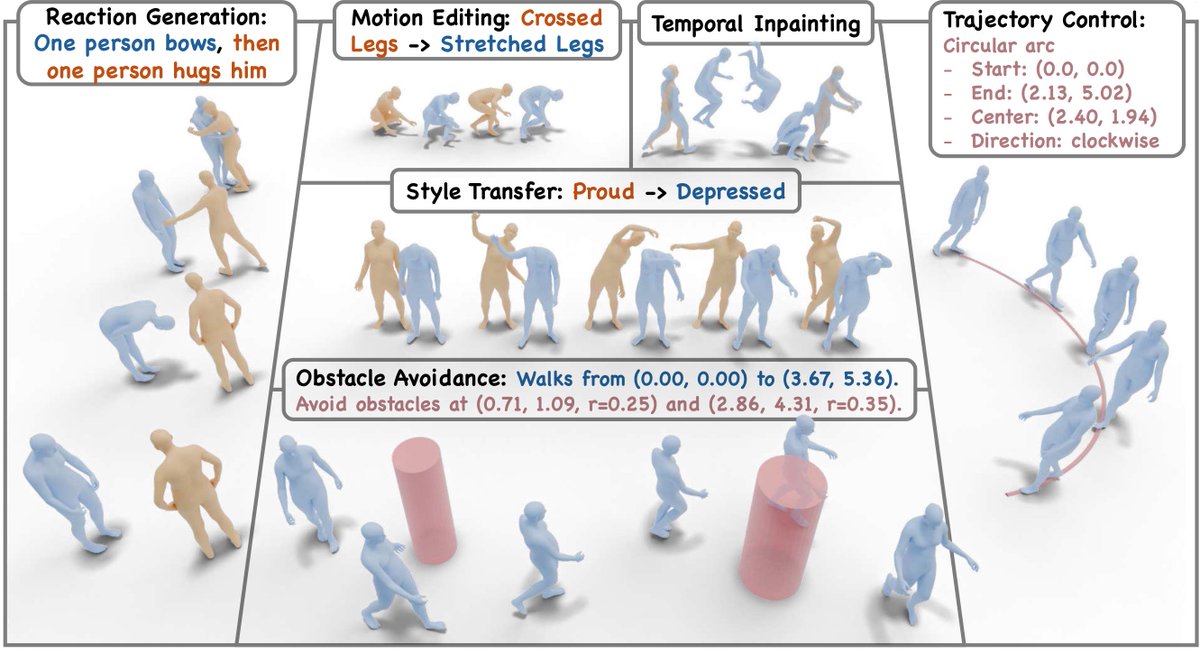
We just released 𝗞𝗶𝗺𝗼𝗱𝗼 — our new diffusion model for generating high-quality motion for humanoids and digital humans 🏃🤖
Check out the project page for more details!👇
https://t.co/QITKwmLQf8
Training humanoid robots?
You need motion data. Real, high-fidelity, human motion data. And until now - there was no open dataset purpose-built for humanoid robotics.
For 5 years, we've been building the largest enterprise-grade human motion and behavior datasets for embodied AI. Our data powered breakthrough SONIC research.
Today, at GTC, with @NVIDIARobotics, we're opening a piece of it to the world.
BONES-SEED:
→ 142,200 motion capture animations
→ Up to 6 natural language descriptions per motion
→ Temporal segmentation of every action
→ Curated for humanoid robotics
→ In NVIDIA SOMA and Unitree G1 (MuJoCo) formats
From text to action. Now yours.
Go build → https://t.co/00PzoIBMWe
#NVIDIAGTC
288 hours of high-quality, text-annotated human motion data are now available! 140k motion sequences!
Do you know that a large part of SONIC's training data is now open-sourced?
Check out the dataset here 👇🏻 from our friends at Bones Studio!
Full human + G1 retargeted motion!
Stie🌐:https://t.co/ui84wZXUxC
Data💿:https://t.co/Kevt6PxQ25
SONIC training code coming VERY VERY soon!
Can humanoids perform agile, autonomous, long-horizon parkour—based on what they see in the world?
We present 𝗣𝗲𝗿𝗰𝗲𝗽𝘁𝗶𝘃𝗲 𝗛𝘂𝗺𝗮𝗻𝗼𝗶𝗱 𝗣𝗮𝗿𝗸𝗼𝘂𝗿 (𝗣𝗛𝗣): a framework that chains dynamic human skills using onboard depth perception for long-horizon traversal.
1/6
We trained a foundation model on 18 million heart ultrasound videos to predict structure instead of pixels.
Introducing EchoJEPA, the first foundation-scale JEPA for medical video.
Paper: https://t.co/iN7MBfSBFW
Code: https://t.co/n4svDzRM7Q
🧵 1/n
We're thrilled to share ProtoMotions v3.1!
With a fully modular architecture and robust domain randomization, we’re taking a massive step toward bridging the gap between animation and real-world robotics deployment.
Git: https://t.co/K7icUfh5eO
🧵 👇
Tired of waiting hours for humanoids to learn to walk?
Our new technical report shows how to train sim-to-real humanoid locomotion in 15 minutes with FastSAC and FastTD3! The full pipeline is open-source in the newly released Holosoma codebase.
Thread 🧵
Sim-to-real learning for humanoid robots is a full-stack problem. Today, Amazon FAR is releasing a full-stack solution: Holosoma.
To accelerate research, we are open-sourcing a complete codebase covering multiple simulation backends, training, retargeting, and real-world inference.
How do we make dexterous hands handle both power and precision tasks with ease? 🫳👌🫰
We introduce Power to Precision (💪➡️🎯), our new paper that optimizes both control and fingertip geometry to unlock robust manipulation from power grasp to fine-grained manipulations.
With simplified finger motions and augmented fingertips, the hand can perform diverse motions from pinching a nut🔩 to handling a pan🍳. Check the demos below🎥.
How do you give a humanoid the general motion capability? Not just single motions, but all motion?
Introducing SONIC, our new work on supersizing motion tracking for natural humanoid control.
We argue that motion tracking is the scalable foundation task for humanoids. So we "supersized" it: 9k+ GPU hours and 100M+ motion frames.
But tracking alone is not enough; we show how to make a useful control system out of it:
- Universal Kinematic Planner: Enables game-like gamepad control and high-level teleoperation, just like controlling a character in a game.
- VR Full-Body Teleop: Direct, real-time whole-body control by a human wearing a VR headset.
- VR Keypoint Teleop: Control the upper body (hands/head) while our planner handles robust locomotion automatically.
- VLA Integration: We connect this motion tracker to autonomous Visual-Language-Action (VLA) models for autonomous task execution!
We use a Universal Token Space to UNIFY this command space, turning our robust tracker into a general-purpose, programmable humanoid brain.
This is the generalist "System 1" for humanoids. 🚀
Project: https://t.co/X5xl7daKAS
#Humanoids #Robotics #AI #FoundationModels #NVIDIAResearch 🧠🔥
Meet BFM-Zero: A Promptable Humanoid Behavioral Foundation Model w/ Unsupervised RL👉 https://t.co/3VdyRWgOqb
🧩ONE latent space for ALL tasks
⚡Zero-shot goal reaching, tracking, and reward optimization (any reward at test time), from ONE policy
🤖Natural recovery & transition