I decided to review and explicitly post about the limitations of all my previous papers because I believe this is the fundamental driving force behind research, especially in this era of PRs and bubbles.
It’s great to see growing interest in MBRL. Last year in RWM, we demonstrated that policies trained entirely in world-model imagination transfer zero-shot to the real world.
Sometimes, ideas are ahead of their time. Glad to see this direction getting the recognition it deserves.
🧠Model-Based RL shows promises but has seen limited success in real-world robotics.
🌎Introducing Robotic World Model, a black-box end-to-end neural dynamics model that bridges this gap, where policies are trained purely in imagination.
@NeurIPSConf
🎯https://t.co/6YYsiVWZic
📢 New paper out!
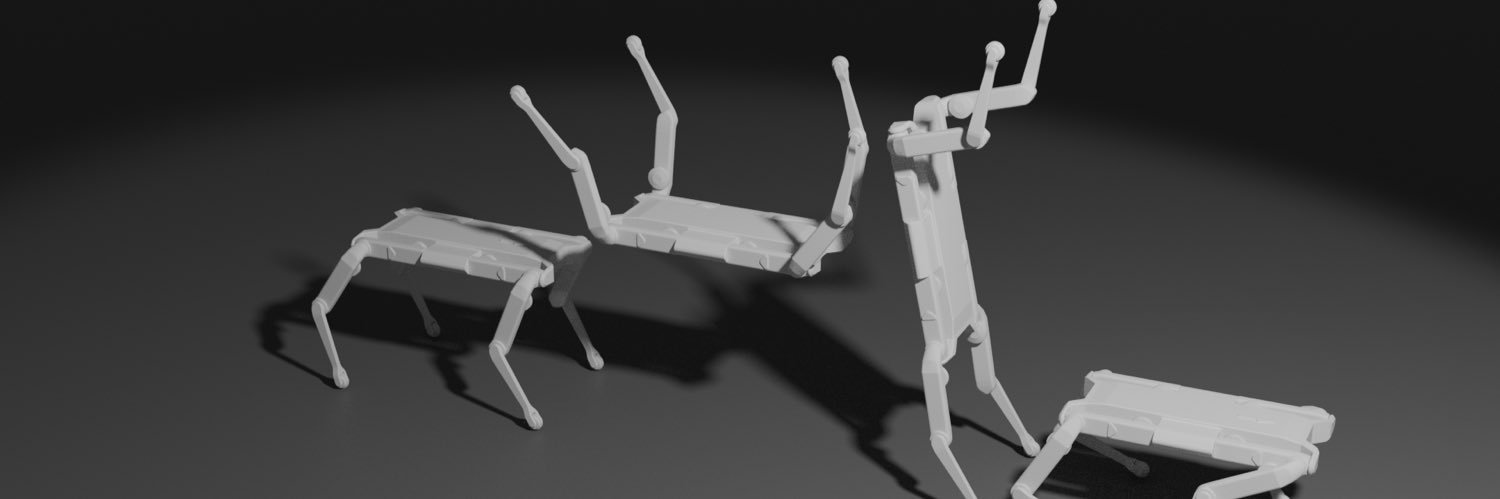
We introduce QWM: a single locomotion world model trained across 8 quadrupeds and deployed zero-shot on robots it had never seen by conditioning on their morphology specs: ANYmal-D and Unitree Go1 🦾
No fine-tuning, no warm-up, no retraining from scratch.
The key insight: robot morphology isn't a latent variable to infer from motion history, it's a known engineering spec sitting in the USD (or URDF) file. So we just use it directly.
@x_h_ucb@etaoxing@qiayuanliao A velocity tracking reward is a dense reward giving signals at every step. Can think of it as mimic reward with constant reference velocity.
The discontinuity lies in the dynamics is independent from the reward design as mentioned by @siddancha.
It’s surprising the world model gradient could actually be useful in training policies in imagination, which is opposite to the conclusion drawn from RWM, where such gradients are “sharp” when contact changes. Any insights @qiayuanliao?
And great work as always! Congrats!
We found a way to scale humanoid control that reduces GPU-hours by more than 1000×.
Across 129,514 motions, SuperMimic surpasses the state of the art (128 GPUs, 7 days) with 1 GPU in 3 hours.
Project: https://t.co/6gc9WKm9qY
Demo: https://t.co/OHRvx5ogQY
@MarcJSchmidt@qiayuanliao We are comparing this with zero-order policy optimization which also introduces noise during Monte-Carlo rollout (as in RWM).
What lacks a good intuition is
1. if first-order gradient is accurate
2. if yes, why BPTT doesn't break
3. if not, how can it lead to good policy update
@animesh_garg@qiayuanliao Pretrain or not seems a design choice to me, rather than a methodological necessacity -- one should always pretrain when they can.
Using DiffSim/WM gradient in policy optimization also sounds like a choice. One can if it works well enough (whose update leads to good policy).
🧠Model-Based RL shows promises but has seen limited success in real-world robotics.
🌎Introducing Robotic World Model, a black-box end-to-end neural dynamics model that bridges this gap, where policies are trained purely in imagination.
@NeurIPSConf
🎯https://t.co/6YYsiVWZic
Excited to share that our paper «Tactile Curiosity Drives Robot Interaction» has been accepted to #Corl2026!
We study how tactile feedback can help robots explore more efficiently. Great collaboration between @CSatETH@berkeley_ai@ETH_AI_Center
Website: https://t.co/y0Mu9MCeQQ
15 Robotics Research Voices on X
@chris_j_paxton
= Honest takes on every humanoid demo, from AI at Agility.
@KarlPertsch
= Robot datasets and open VLAs, from DROID to OpenVLA.
@kevin_zakka
= The sim tooling behind MuJoCo Menagerie and mjlab.
@chichengcc
= Diffusion Policy and UMI, from the person who built them.
@hausman_k
= Robot foundation models, from RT-2 to Physical Intelligence.
@ankurhandos
= Dexterous robot hands, straight from NVIDIA research.
@du_yilun
= Video generation models used as robot planners.
@AjayMandlekar
= A few human demos turned into thousands in simulation.
@0x_meden
= Robotics jobs, free courses and open-source robots, broken down.
@xuxin_cheng
= Humanoid teleoperation, from the creator of OpenTeleVision.
@peteflorence
= Scaling robot foundation models at Generalist.
@breadli428
= How legged robots and humanoids learn to move.
@ericjang11
= Long essays on where robot learning is heading.
@IlirAliu_
= The robotics industry for founders, investors and operators.
@TheHumanoidHub
= Every humanoid launch, demo and funding round in one feed.
@Jensen_Yuan numbers are actually much better now, but agree that RL on world models is super interesting! @breadli428 and all have awesome work on this!
https://t.co/MkSPYHIyLh
Gemini 4 Argon taught a robot to play cornhole just by watching a video.
It mapped the physics, coded its own simulation, and taught @Apptronik's Apollo humanoid to sink 7 throws in a row.
In our latest work at @corl_conf, we introduce Quadrupedal World Model: a single morphology-conditioned dynamics model, where policies are trained entirely in imagination.
We found generalization emerges by conditioning the dynamics, not the policy.
🔗https://t.co/6Ptc7z7LQP