The Robotic Systems Lab designs machines, creates actuation principles, and builds up control technologies for autonomous operation in challenging environments.
Our new work WayTrace: an off-the-shelf VLM, an onboard trace model, and an RL policy take a robot from web-map directions to 2.35 km of real-world missions in Zurich.
Details in the thread 👇
We gave a robot the walking directions you'd get from a web map.
Then we let it find its own way through Zurich: crosswalks, stairs, crowded streets, construction sites, 2.35 km in total.
Introducing WayTrace 🧵👇
This work is led by Yan Wu @Yan_Wu_7 and Chenhao Li @breadli428, with the team Kaifeng Zhao, Gen Li, Marco Hutter @leggedrobotics and Siyu Tang @SiyuTang3.
📄 Paper: https://t.co/TKb65ujdrk
🌐 Project page: https://t.co/5lJdGnaIN3
📍#CoRL2026 Session 3, Poster #174!
In our latest work @corl_conf, we present ADAPT: an end-to-end framework for interactive, text-conditioned humanoid control, in contrast to dominant pipelines that generate kinematic motions for a separate RL tracker. 🤖
🌐 https://t.co/5lJdGnaIN3
Full video in🧵
Dominant text-to-motion pipelines generate kinematic motions for a separate tracker.
Instead, in our @corl_conf work ADAPT, we solve humanoid language control end-to-end closed-loop, where the robot must continuously respond to changing commands.
🌐Page: https://t.co/87y3FVjT4H
We hope to change ideas on how perception should integrated in rough terrain locomotion with our latest work
Watch Your Step: Anticipated Perception for Humanoid Locomotion
We predict and perceive only where it matters.
🌐 https://t.co/lgDDkoJ3BR
📷 https://t.co/qYZ8QZKFN0
We only care about where our feet are about to land when we walk. Why shouldn’t humanoids?
Introducing Anticipated Perception for Humanoid Locomotion, anticipating upcoming footholds and perceiving only the terrain patches that matter for next step.👣
🌐 https://t.co/hDXr3GUlol
We walk without worrying about what’s behind us. Why should humanoids?
We introduce Anticipated Perception for Humanoid Locomotion: a new approach that focuses terrain perception on where the feet are about to land. 👣
🌐 https://t.co/lgDDkoJBrp 📷 https://t.co/qYZ8QZLdCy
Vision foundation models like DINO and SigLip now power much of robot learning.
But they are built for RGB. What about depth?
Introducing DeFM: a foundation model for depth images, built for robotics.
🌐 https://t.co/KzloKyRZyF
Weights, code, and demo are out today 🧵
Can a humanoid learn faster and better by seeing less?
We train a small model to predict the policy's next steps, and show the policy only the terrain there. Together, they learn to cross gaps, stairs, drops and boxes.
🌐 https://t.co/lgDDkoJBrp
📄 https://t.co/qYZ8QZLdCy
What does a humanoid need to look at to cross challenging terrain?
People only look around their next few planned steps. So we showed a humanoid only that.
Watch Your Step: Anticipated Perception for Humanoid Locomotion
🌐 https://t.co/W4NNjxI0tX
📄 https://t.co/wDOEsxkYdj
In our latest work at @corl_conf, we introduce Quadrupedal World Model: a single morphology-conditioned dynamics model, where policies are trained entirely in imagination.
We found generalization emerges by conditioning the dynamics, not the policy.
🔗https://t.co/6Ptc7z7LQP
What if one world model could control many different robots? 🤖🌍
That's QWM.
In this 2 minutes video we show keypoints about QWM: learning across heterogeneous quadrupeds, and transferring zero-shot to unseen morphologies.
No fine-tuning. No warm-up. No retraining.
Let's talk it further at CoRL 🥳
Scaling Rough Terrain Locomotion With Automatic Curriculum Reinforcement Learning
Authors: Ziming Li @ZimingLi97, Chenhao Li @breadli428, Marco Hutter
Published in: IEEE Robotics and Automation Letters ( Volume: 11, Issue: 8, August 2026)
https://t.co/RF93oRGsrd
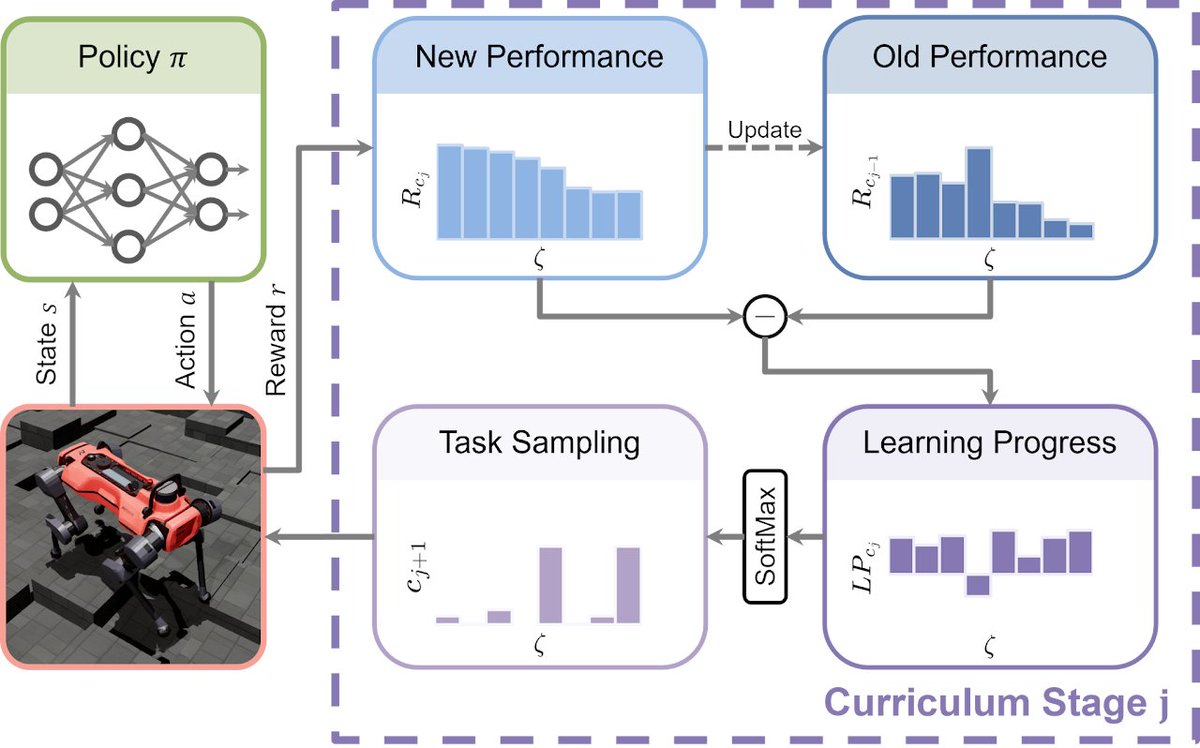
LP-ACRL removes the need to predefine task difficulty. It measures task-wise learning progress from episodic-reward changes, then uses a softmax to shift sampling toward the current learning frontier, where tasks show stronger positive competence gains at that stage.
After teacher–student distillation, a single policy transfers to ANYmal D and achieves:
• 3.0 m/s on flat terrain
• 2.5 m/s on challenging terrain
• Up to 3.0 rad/s angular velocity across all tested terrains
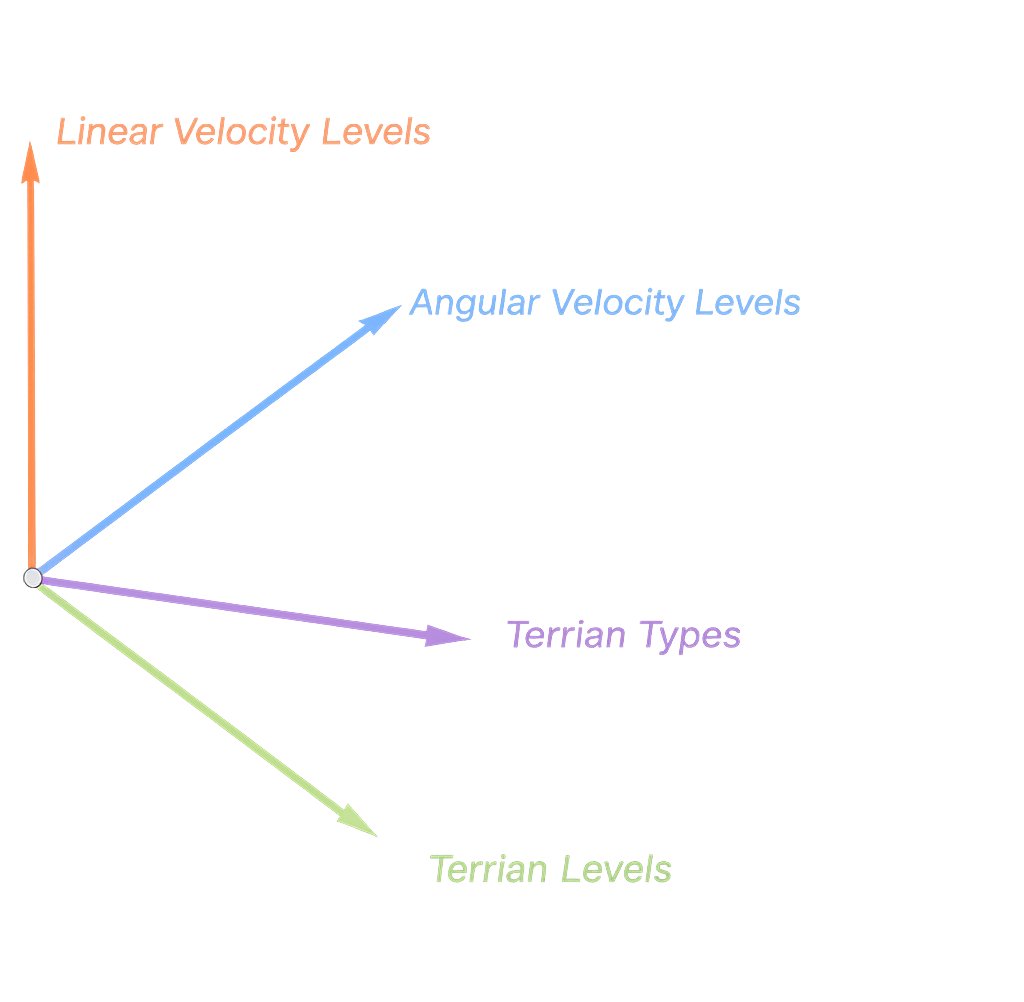
Real-world locomotion does not follow a single easy-to-hard axis. Terrain type and geometry compound with linear and angular velocity specifications.
In our scaled setup, their Cartesian product forms 600 tasks, making a manually ordered curriculum impossible.
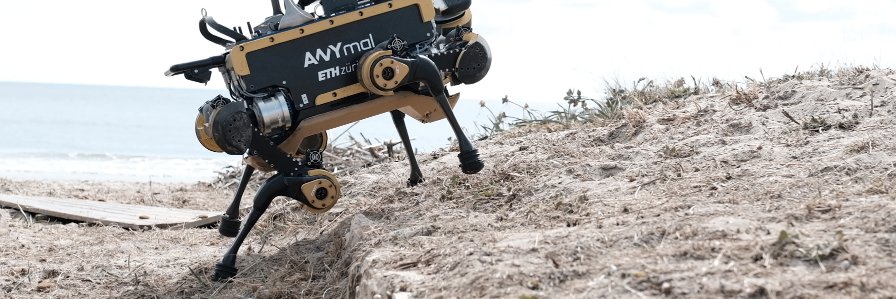
We achieved high-speed rough-terrain locomotion on ANYmal with an automatic curriculum.
LP-ACRL automatically samples terrain types, levels, and velocity commands at the correct time based on policy performance, without predefining an order.
🔗https://t.co/ip3pQ0z2qF
🧵RAL 2026
Congrats to Kaixian Qu, Guowei Lan, René Zurbrügg, Changan Chen, Christopher Mower, Haitham Bou-Ammar & Marco Hutter. Say hi at IROS 2026!
https://t.co/4APFhtIG6t
https://t.co/1tuEgO0cXH
https://t.co/UKPpXcG8i0
https://t.co/byNWeCEce1
VLMs don't understand a robot's body. How can a robot learn from its failures without retraining?
PragmaBot: online in-context learning from real-world experience. The robot reflects on failures, stores lessons in memory, and retrieves them for new tasks.
RA-L · #IROS2026
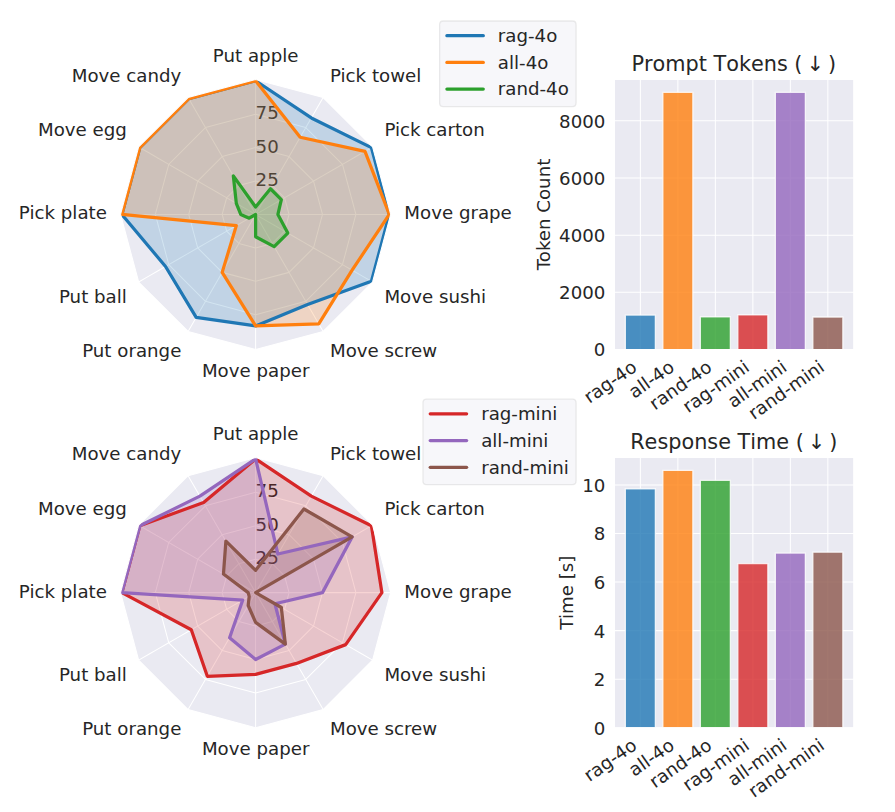
How much memory belongs in the context? 5 random memories: 17% first-action accuracy on unseen tasks. Entire memory in the prompt: 74%, at 7.5x the tokens. Top-k relevant via RAG: 89%. Relevant context beats more context. As memory grows, what should a robot forget?