FED MEETING MINUTES (11/18/26):
1. Almost all Fed officials saw “further action” appropriate
2. A couple Fed officials believe a hike of more than 25 basis points may be warranted in December
3. Some officials favored a 25 basis point rate hike in October
4. Returning inflation to 2% in a “timely manner” remains top priority
5. A few officials who supported no change in rates indicated the decision was a “close call”
6. A few officials believe inflation could prove more persistent than expected
The path is set for a December rate hike.
JUST IN: Nvidia ($NVDA) interim CEO Colette Kress promises company-wide pay raises and additional equity grants months ahead of schedule as the chipmaker scrambles to retain employees following Jensen Huang’s departure, according to WIRED.
Dario Amodei on open source models:
“If the path continues, I think we could get to a very dangerous place.”
“When you control a model and you're deploying it, you have the ability to monitor its usage.”
“You can revoke a user's access. You can change what the model is willing to do.”
“When a model is released in an uncontrolled manner, there's no ability to do that. It's entirely out of your hands.”
“We should confront the advocates of this with that problem and challenge them to solve it.”
He clearly doesn't believe Intelligence should be in the hand of the masses and Sam Altman also saying "RAM" shouldn't be accessible to everyone indefinitely agreed with him.
Over the past week, I’ve been overwhelmed by the love and support of friends, industry colleagues, and people I've never met. Thank you to everyone who has shown kindness to my family and me. It means the world to me.
I came to the United States 53 years ago, and becoming an American citizen is one of the greatest gifts and proudest moments of my life. NVIDIA has been my life’s work. Building it into the company it is today alongside my colleagues has been a privilege and an honor. Nowhere but in America could a company like NVIDIA be possible. I love our country, and I love NVIDIA.
I did not live up to the standards expected of everyone at NVIDIA, and I have made serious mistakes in my personal life. I created problems for the Board that I deeply regret. I own my mistakes completely, and I am committed to cooperating with the Board’s independent investigation.
Since my departure, I’ve seen an outpouring of calls from NVIDIA’s employees, investors, business partners, and customers for me to return as CEO. Many continue to reach out to me directly as the company navigates complex technology, market, competitive, and geopolitical dynamics. NVIDIA is a once-in-a-generation company. If the Board of Directors decides that my return is in the best interest of our shareholders, our employees, the company, and America, I would be honored to answer these calls and return as CEO.
Thank you again to everyone who has shared their good wishes. I am profoundly humbled by your support. To my family: I love you, and I will spend the rest of my life being worthy of yours.
Jensen
FWIW - the pie that is the global consumer is shrinking from here on out...decelerating growth of poor consumers, outright declining 10's of millions of consumers of means every year. Companies now fight for what's left, the era of growth is over.
microsoft 365 & google workspace have maybe 4-5 years of relevance left simply cuz the document/spreadsheet paradigm itself will become mostly irrelevant.
i.e. it already makes zero sense to draft, review, or analyze anything without a native ai environment around it. that gap only widens over time. & most communication incl. email, chat, status updates is heading toward agent mediated flows where humans set intent & ai handles execution.
this leaves the incumbents stranded with human first tools in an ai first world, retrofitting copilots onto artifacts nobody should be producing manually in the first place. they become the system of record, but no longer the system of creation.
& that’s a very dangerous place to be.
We’ve trained Claude to flag potential misuse in conversations, a technique we call self-assessment. Right after it responds, Claude gives a preliminary safety assessment of the conversation.
Since we began using self-assessment in June, it has surfaced misuse that our other safeguards weren’t designed to catch.
Because Claude has already read the conversation, self-assessment is very efficient. And unlike classifiers, which target a discrete set of harms, it draws on Claude’s own judgment, so it gets more accurate as our models improve.
Read more on our new Safeguards blog:
https://t.co/18j6zdHub4
Text messages with a machine, in and of themselves, are not criminal, immoral, or dangerous, for there is no victim, whatever the content. It is the very same thing as with thoughts—regardless of the content, no thought can be said to create a victim.
• If someone steals info and feeds it into an LLM, it was the theft itself which created the victim, not the subsequent text message.
• If someone uses the output of an LLM to hack a system, it is that subsequent hack which creates the victim, not the text message preceding it.
• If someone threatens harm to themselves or others through messages into a machine, here still the messages themselves cannot be said to have created any victim.
Imagining otherwise inappropriately reorients blame from its rightful place: the action of harm actually done by a perpetrator. Thinking harm =/= harm.
As humans integrate AI as an extension of their mind, policing at the message layer means to increasingly police thought itself.
Which company, which committee, do you trust to police your thoughts? Or do you simply want the thoughts of others policed, and not your own?
This is solved with larger context windows though right? The stickiness is once users move their entire lives into the application it knows them incredibly well. Its not like Meta hasn't already done this with their social platforms. In fact they could leverage that data.
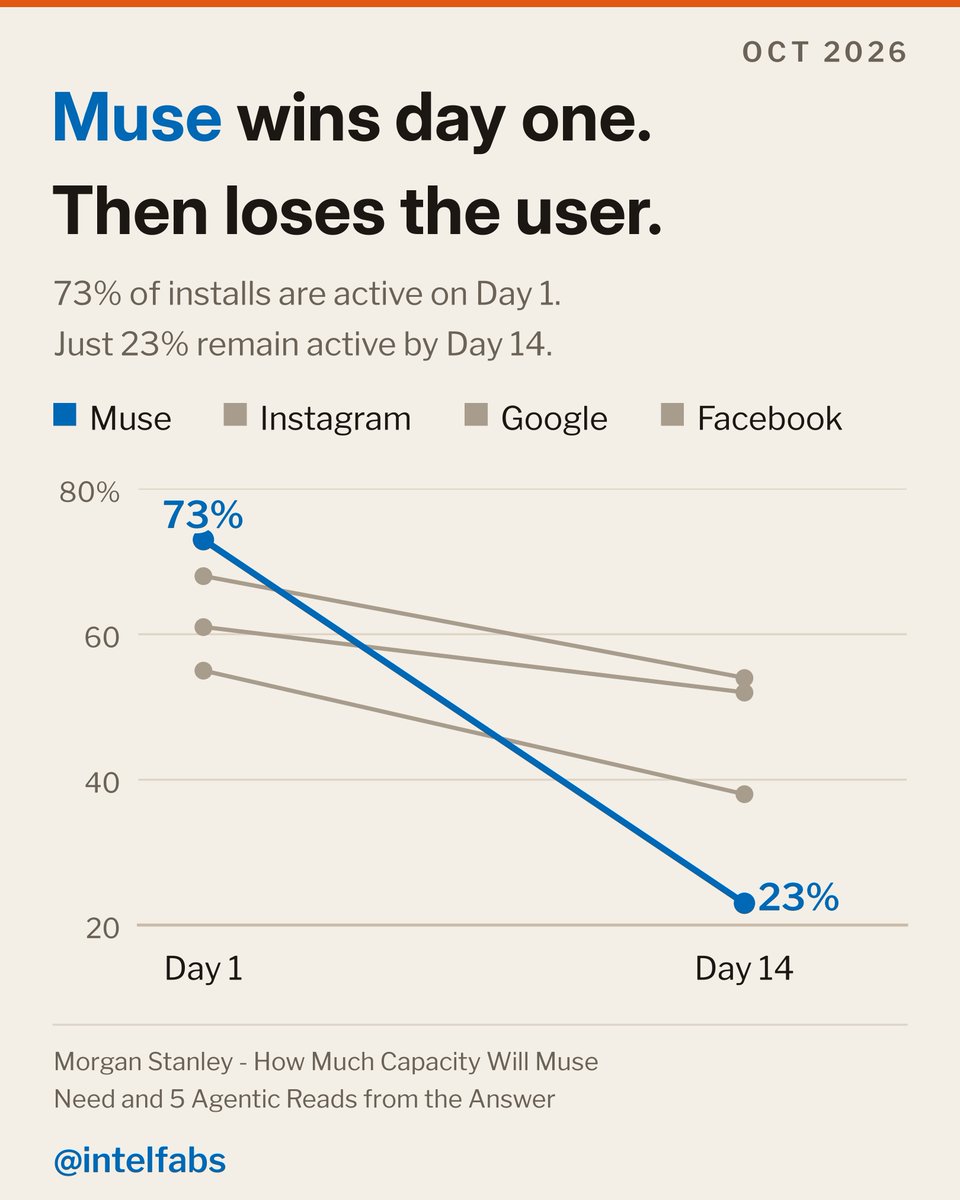
One of the big issues with Muse? Retention.
The bearish side of these agents is that consumers don't have much incentive to stick to them. What is the switching cost? None.
I believe Muse will do great, but a major work in progress still. Retention matters.
$META
One of the big issues with Muse? Retention.
The bearish side of these agents is that consumers don't have much incentive to stick to them. What is the switching cost? None.
I believe Muse will do great, but a major work in progress still. Retention matters.
$META
Burry sees the AI boom as a dot-com-style bubble. He argues OpenAI and Anthropic valuations near or over $1T rest on unprofitable LLMs that are not AGI, face commoditization of compute, and show weak long-term ROIC. Massive IPOs would lock in the mania and misallocate capital at historic scale. A hard market drop blocking them now could avert a larger later crash and greater economic harm.
@MBTA Im going to yell at every single T driver, every single time they fail to open the middle car doors on trolley (above ground) stops. What was the point of using tax dollars to install tap to pay if you are going to force everyone through the front doors? Inefficient, waste
Random thought. It was luck that the companies best suited to building out AI happened to be immensely profitable quasimonopolists. They could finance the first leg of the buildout internally without having to meet external ROIC tests. Though they are now issuing debt, that debt is backed by the hyperscalers' non-AI cash flows, not the AI itself. In other words, the AI capex boom has been possible because the technology has never had to prove its profitability. That wasn't the case with the TMT or other prior booms, which went bust when the capex ran too far ahead of the prospective profits.