@marchr@leandrojmaia_@zeealeid@bacadd@marcusash@pavandavuluri@JenMsft Excellent news, even if about a decade too late. Windows really needs a consistent design, no matter where you look. It it's in the box, it should be using the modern Windows 11 design. Also love the use of WinUI 3, always good to see you use your own tools.
I still see this mistake in most .NET APIs.
The endpoint accepts a query parameter, runs an async DB call, and returns the result. Looks fine. But there is no CancellationToken anywhere.
The user closes the tab. The mobile client times out. The load balancer drops the connection. The server does not care. It keeps running the query, holding the connection, allocating memory, racing toward a result nobody is waiting for.
.NET can handle this, actually. Every endpoint can accept a CancellationToken parameter, and the framework wires in HttpContext.RequestAborted automatically. Pass it down to EF Core, HttpClient, file IO, channels, any async call. The moment the request is aborted, those operations stop. The DB query is cancelled mid-flight. The HTTP call is dropped. The connection goes back to the pool.
Two scenarios where this is the difference between healthy and on fire:
A burst of users hammering a slow search endpoint. Half rage-click and abandon. Without the token, the server runs every query to completion. With it, the abandoned ones drop in milliseconds and the pool stays open for the users who are still waiting.
A long-running export that fails halfway. The client retries with new parameters. Without the token, the old export keeps grinding for two more minutes while the new one queues behind it. With it, the connection abort frees the worker immediately.
The change is two parameters: one on the endpoint, one on the data access method. That is it.
The counter I hear: "what about background work that should not be cancelled?" Fair. Pass CancellationToken.None explicitly for those, and the intent is documented right in the signature.
Every async IO call in your codebase should accept and propagate a CancellationToken.
Are you already using this on your codebases?
@Microsoft@XBOX@XBOXSupport Is this really your official policy? Account gets hacked, hacker violates your policies and the original account owner gets punished? In what world is this fair? You should be helping him get his account back, not making things worse for him!
Following the hacking of my @Microsoft account (in which the hacker added Xbox and purchased two games), I appealed against the summary termination of the account. I proved ownership beyond doubt. The appeal was pointless. Violation includes ‘Gaining or attempting to gain unauthorized access to any secure systems such as accounts’. Since the hacker manifestly did this, the policy is violated. What an absurd system.
@awakecoding They announced ages ago that there will be no further .NET Standard versions. It was a tool to use while both Framework and Core were a thing. Given that Framework is now essentially dead, there is no point in .NET Standard.
A dad took a photo of a rash on his sick toddler so the doctor could see it over video. It saved to Google Photos by itself. Two days later Google had wiped his email and phone number and reported him to the police for child abuse.
The police looked into it and cleared him completely. Google still would not give his account back. That same year another dad in a different state went through the exact same thing, and the New York Times wrote about both of them in 2022.
The manga artist in this post fell into the same machine. Anything you save to Google Drive or Google Photos gets scanned and turned into a kind of digital fingerprint, a short code that stands in for your file. Google compares that code against a huge list of files it has already banned, like pirated movies or known abuse photos. The newer software does not even wait for a match. It looks at a picture it has never seen and makes its own guess about whether you broke a rule.
When the software flags you, the damage does not stop at one file. Your Google login is also your YouTube, your photos, sometimes your phone service, and the button you click to log into dozens of other websites. One flagged upload can lock you out of all of it at once, which is how the artist lost things that had nothing to do with Drive.
This post asks how long Google has been doing this, and the numbers answer it. In a single six-month stretch, Google reported more than a million files to the national center that tracks child-abuse material and shut down about 270,000 accounts. Some of those people did nothing wrong, like the two dads.
Getting back in is nearly impossible. A law from 1996 gives tech companies broad legal cover for decisions like this, and the fine print you agreed to lets Google shut your account whenever it likes. The dad the police cleared never got his back, even after officers confirmed he had done nothing wrong.
Anything you upload to Google can be scanned by software with the power to shut down your whole online life on its own, before a single person ever reviews the decision. The manga artist is just the latest to find that out.
Tried to submit feedback to @SamsungMobile... I wonder how their AI managed to make feedback about the clock to somehow being about one earbud having lower volume 🤦♂️ God, I hate AI!
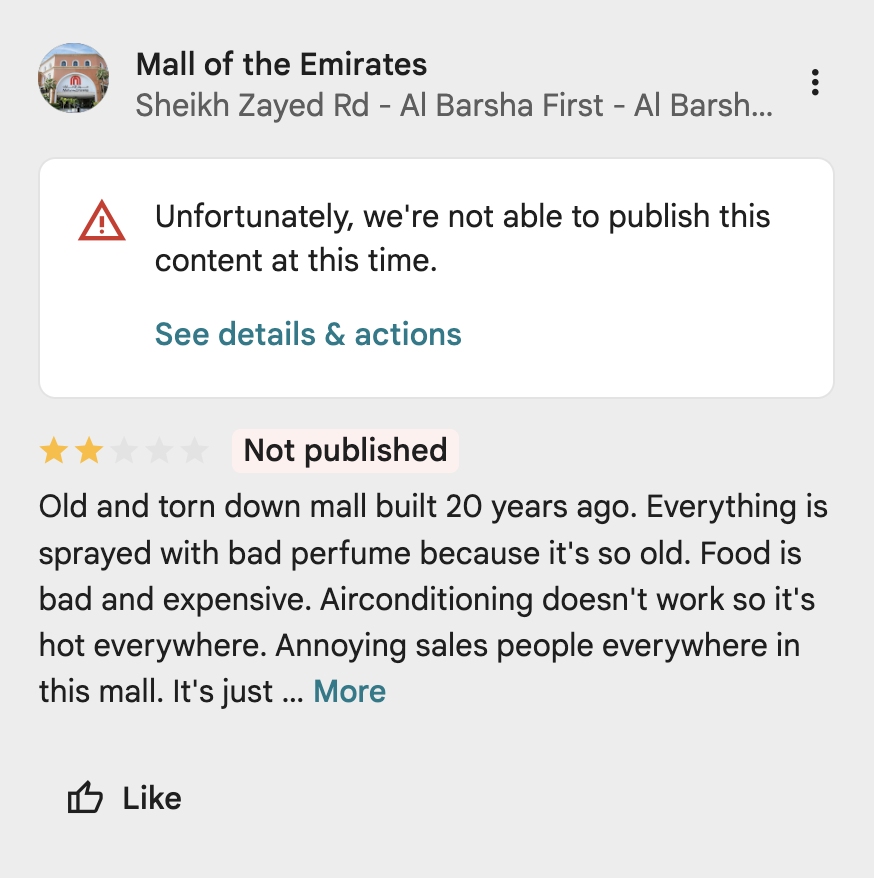
How can Google allow this? Posting a bad review, including using harsh language to describe what you experienced, should be the whole point. Businesses should not be able to influence this in any way. I've also experienced similar censorship on Play Store.
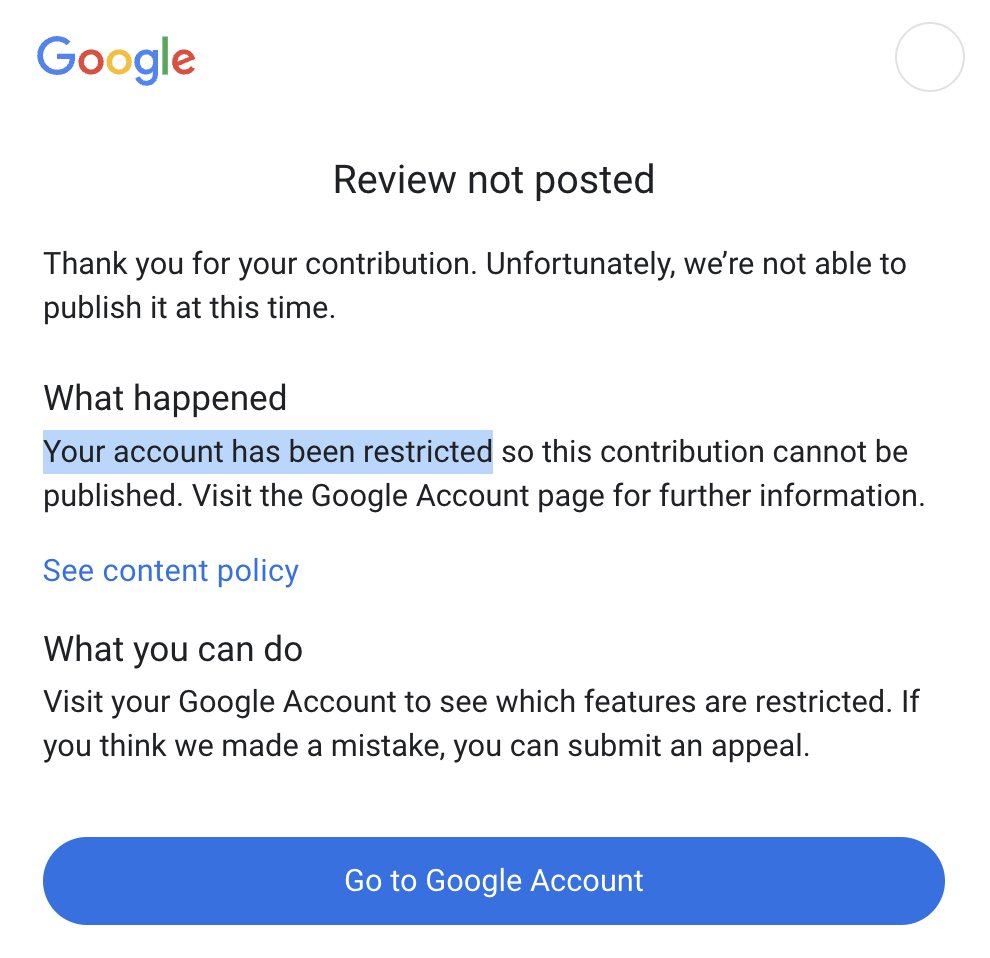
After this post my Google Maps has now also been banned from reviewing places
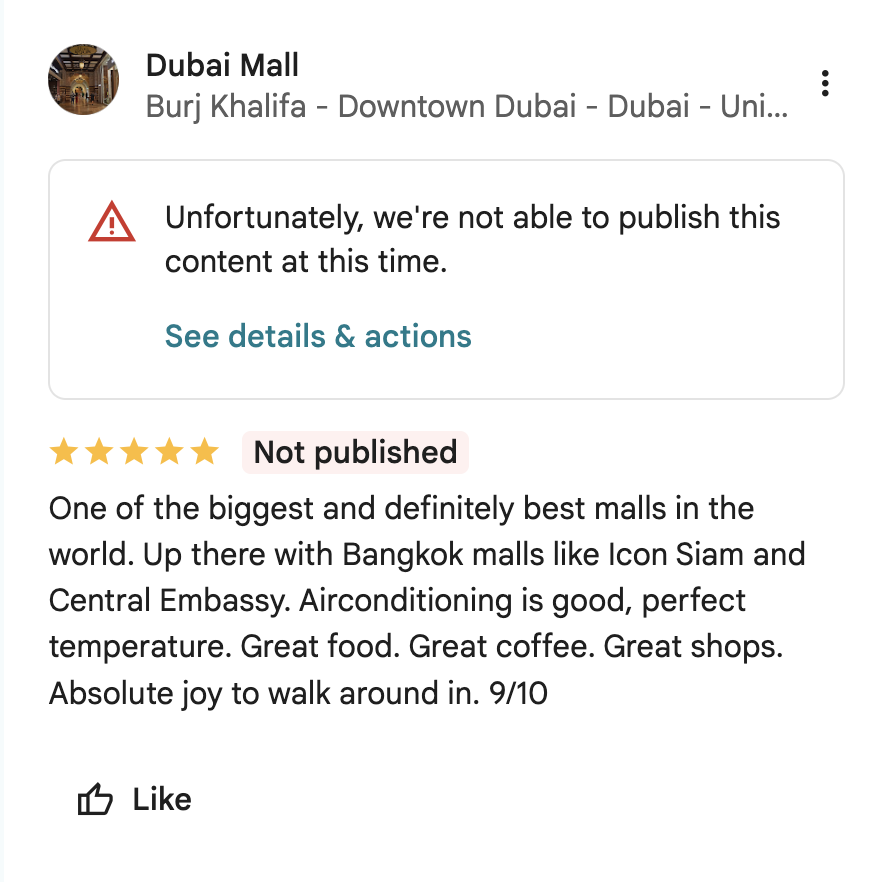
No wonder every place is now a 4.7/5, they all converge to that rating if you just remove all the bad ratings
Interestingly, my account has been banned because of my reviews in Dubai from ages ago, I know UAE has strict defamation laws, so I think businesses use that to remove reviews there
I don't know why the Google Maps team is allowing this though, a review or rating is not defamation, it's just an opinion, and Google needs that opinion for people to know where to go
What Google should be doing I think is defending the people who review and rate places in court wherever they live, because by just allowing any business to remove bad ratings/reviews, they make Google Maps completely non-credible!
Long term people will just use other apps to find good places and I don't think you want that @sundarpichai
Maybe we need @X Maps with real reviews @elonmusk?
@Techjunkie_Aman Now they just need to address their rendering engine being way behind on implementing web standards. These days it is unfortunately quite frequent that Chromium and WebKit have implemented something and only Firefox is lacking it.
ExpressVPN, @torproject, Tuta, Mozilla, @EFF and Mullvad, alongside 13 other organizations advocating for digital privacy rights, have published an open letter.
In the letter, they express serious concerns regarding the age verification measures planned for implementation across the internet following the introduction of a new child protection law.
The organizations argue that forcing users to prove their age across most websites and online services could severely undermine privacy, anonymity, and the open nature of the internet.
The central message of the letter is that protecting children should not come at the cost of jeopardizing the freedom, security, and privacy of all internet users. The signatories are calling for more balanced, privacy preserving solutions to be developed instead.
The 19 organizations that signed the letter are:
1- Big Brother Watch
2- Defend Digital Me
3- Electronic Frontier Foundation
4- ExpressVPN
5- Gamers Voice
6- Global Partners Digital
7- Index on Censorship
8- Internet Society
9- Mozilla
10- Mullvad
11- IPVanish
12- NO2ID
13- Open Rights Group
14- Privacymatters
15- Proton
16- Stop Killing Games
17- Tor Project
18- Tuta
19- VPN Trust Initiative
@HomerPavlos A movie having a working title that is different from the final title is entirely normal and not really something nefarious. That's standard practice to disguise what is actually being made. Doesn't make the casting any better though...
Blogged: .NET finally gets union types🎉 - Exploring the .NET 11 preview - Part 2
https://t.co/CPW2cac14F
In this post I discuss the support for union types released in .NET 11, how they're implemented, the choices made, and how to create your own union types
#dotnet#csharp
@WindowsLatest Passkeys have one HUGE problem: they are limited to a single device. Using an account across devices with a passkey is a nightmare. Yes, there are workarounds with QR codes, but really clumsy compared to s username and password.
@Pirat_Nation The irony of course being that they are afraid of the US snooping, while they are increasingly snooping on their own citizens and forcing encryption backdoors.
@aakashgupta They will also track if you have searched for the same trip previously and make it more expensive the next time. Hence the cookie trick, although they also use other means to track these days...
@aakashgupta Oh, they absolutely do. They profile you and price will depend on which country you're from and other criteria they can use to guess how much you will be able/willing to pay.