Michael Martin Murphy’s “Wildfire” is the best song about a young girl who dies in a blizzard while looking for her pony. In over 50 years since its release no one has written a better dead girl-pony-blizzard song.
America turns 250 today.
Let me read back the resume.
We started by telling a king to pound sand, in writing.
By 1803 we bought half a continent from France for about four cents an acre.
We fought a war with ourselves and somehow stayed one country.
We strung a railroad across the entire thing.
We handed the world the lightbulb, the telephone, and the airplane in about thirty years flat.
Then a man named Willis Carrier invented air conditioning and made half the planet actually livable.
You are welcome, Texas. You are welcome, Dubai.
Twice the whole world caught fire, and twice we showed up and helped put it out.
We split the atom.
We put men on the moon in 1969.
Then we went back and hit golf balls up there, because why not.
We invented jazz, blues, rock and roll, and hip-hop, and the whole planet is still dancing to it.
We put a burger and fries on every corner of the earth.
We built rockets that fly themselves home and land standing straight up.
We flew a helicopter on Mars.
We launched a car into actual space and it is still out there cruising.
We also invented ranch dressing and somehow talked the entire world into putting it on pizza.
Priorities.
We even invented three of our own sports so we could win them.
Baseball, basketball, and football.
Real football, the kind with hands, because we named it and we are not taking corrections.
The rest of the planet can keep soccer, which is fine, we are hosting it in our backyard this summer anyway.
And yes, Canadian football exists, wider field, extra man, one fewer down, and we try very hard not to think about it.
Frankly it was generous of us to invent our own games.
If we put all that energy into soccer, nobody else would ever lift that trophy again.
We would win it so often they would just rename it the America’s Cup and hand us the keys.
You are welcome for the suspense.
And in 2026 we threw a birthday so big a German tourist live-tweeted our gas stations to 750,000 people.
Not every chapter was clean.
We argued, we stumbled, we fixed what we broke, and we kept building.
That is the whole trick.
Two hundred and fifty years in, and we are still the loudest, brightest, most improbable experiment on the map.
Not bad for a country that started as a strongly worded letter to a king.
Happy birthday, America.
🦋
Wherever you are on this Independence Day, take a moment and watch the entire song (not just 8-10 seconds, as it's the average attention span of X videos) and appreciate the words and feeling you hopefully get when you listen to Ray Charles
.
In September of 1814, America was once again in trouble.
The young republic was only thirty-eight years old. The War of 1812 had gone badly. British troops had marched into Washington, burned the Capitol, set the White House ablaze, and now turned their sights toward Baltimore. If Fort McHenry fell, the harbor would be open, the city would likely follow, and another devastating blow would be dealt to the fragile nation.
Amid this uncertainty, a young American lawyer named Francis Scott Key sailed under a flag of truce to the British fleet. He had come to negotiate the release of a friend, a physician the British had captured.
He succeeded.
The British agreed to free the doctor.
But there was a catch.
Because Key and his companions had seen too much of the British fleet and learned too much about its plans, they were not allowed to return to shore. Instead, they were detained aboard a ship in the harbor and forced to watch the coming battle from behind enemy lines.
On the morning of September 13, the bombardment began.
For the next twenty-five hours, British warships unleashed somewhere between 1,500 and 1,800 bombs and rockets upon Fort McHenry. These were the “bombs bursting in air” and the “rockets’ red glare” of the song—not poetic embellishments, but terrible realities.
Key stood on the deck through the endless day and the long, terrifying night. Every explosion lit the darkness for a fleeting instant before the smoke swallowed everything again. Somewhere beyond that wall of fire stood the fort. Somewhere beyond it flew an American flag if it still flew at all.
He could not see.
He could only listen.
As long as the guns continued firing, there was reason to hope. The British would not waste ammunition on a fort that had already surrendered.
Then, just before dawn…
The guns fell silent.
For the first time all night, there was only stillness.
It was the most frightening sound of all.
Had the fort finally fallen? Had the defenders surrendered? Had the flag been torn down in the darkness while no one could see?
There was nothing to do but wait.
As the first light of September 14 slowly pushed back the smoke, Francis Scott Key strained his eyes toward the distant fort.
Then he saw it. Not a British flag.
The American flag. Still there. Still flying.
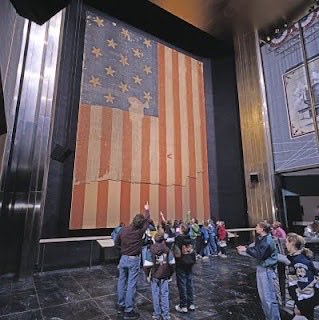
That flag was no ordinary banner. Months earlier, the fort’s commander had commissioned a Baltimore flagmaker, Mary Pickersgill, to sew a flag so enormous “that the British would have no difficulty seeing it from a distance.” It measured roughly thirty by forty-two feet, carried fifteen stars and fifteen stripes, and was so large it had to be assembled on the floor of a brewery because no ordinary room could contain it.
That was the Star-Spangled Banner.
The very flag Key saw through the morning mist.
The very flag that still survives today in the Smithsonian.
Overcome by what he had witnessed, Key reached into his pocket, pulled out an envelope, and began writing. The words came from a heart that had spent an entire night fearing his country might disappear with the dawn.
He first titled the poem Defence of Fort M’Henry.
Within days it was printed and circulating throughout the country. Before long, people began singing it to a melody they already knew—an old British tune called “To Anacreon in Heaven,” originally written for a London social club. There is something beautifully ironic in that: America’s most beloved patriotic song borrowed the melody of the very nation it had just survived. It also explains why the anthem is so notoriously difficult to sing. It was never written for ordinary voices gathered in stadiums or school assemblies.
The song spread quickly and became one of America’s favorite patriotic hymns, but it would wait more than a century before receiving official recognition. Not until 1931 did Congress declare “The Star-Spangled Banner” the national anthem of the United States.
@FromTeachrsDesk Absolutely not. Early in my career, teachers past a given point no longer had to be evaluated. I saw way too many 59 year old teachers putting their feet on their desks and screaming at kids all day. It definitely happened.