New preprint from the Agrawal lab! Structures of the human mitochondrial ribosome recycling complexes reveal distinct mechanisms of recycling and antibiotic resistance. #CryoEM
https://t.co/eVa48MZsEy
New preprint! Do all kinase domains have similar activation mechanisms?
We steer AlphaFold2 using "transfer seeding" of known kinases to sample 8.3 ms of MD simulations via Folding@home. We find that the pathways are different and kinase-specific!
Link: https://t.co/8RZqE8JTjU
A history of viral encephalitis is one of the strongest risk factors for developing dementia. With @JacobJacobog02, Yifan Chen, @RNA_Life, and @RyanDhindsa, we refine this link by describing a neuronal cell type that can reactivate HSV-1 in humans 1/n
https://t.co/y8D2orzUur
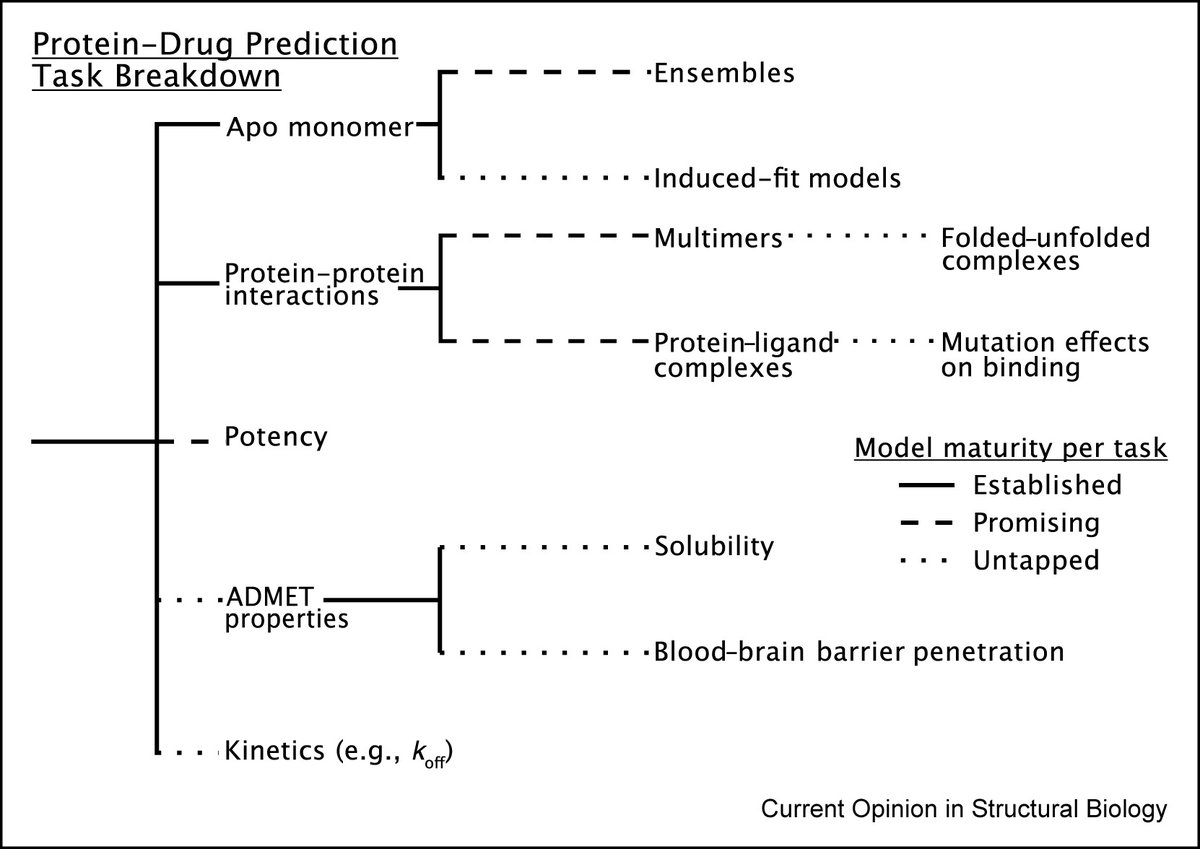
More protein-ligand data are needed for AlphaFold-like models (& AI/ML) to enable prospective design!
Read our piece in "Current Opinion in Structural Biology" – Equal parts a thank-you-letter to the PDB & a summary of the need for task-specific models!
https://t.co/eDrj3TvBeb
Next Tues (2/24) at 4PM ET, @arthurwchow and @hoyin_chu will present "Sequence and structural determinants of efficacious de novo chimeric antigen receptors"
Paper: https://t.co/Cb3ehjdCn9
Sign up on our website for zoom links!
⚠️ If you’re reading this, you’ve been infected* ⚠️
*~95% the human population has been infected by the Epstein-Barr Virus (EBV).
Today in @Nature with @nyeo_sherry, @EMC22381830, @RyanDhindsa@SlavePetrovski, we shed some light on what happens next.
https://t.co/Db1j4aHeFO
Excited to share the first preprint of a new direction for our group. Led by the fearless duo of @arthurwchow and @hoyin_chu, our foray into computational protein design— 1/n
https://t.co/o5kDJ5TiWr
Sequence and Structural Determinants of Efficacious De Novo Chimeric Antigen Receptors
1. A new study explores the development of de novo protein binders for chimeric antigen receptors (CARs) using artificial intelligence, identifying key challenges and solutions for improving CAR T cell therapies. AI-driven design enables rapid creation of binders against tumor-associated antigens like BCMA, CD19, and CD22.
2. Researchers synthesized protein design workflows to screen 1,589 novel binders, identifying three main challenges: tonic signaling, occluded epitope engagement, and off-target activity. They developed computational and experimental heuristics to overcome these limitations, restoring on-target CAR activation.
3. The study highlights the potential of BindCraft and RFdiffusion pipelines for generating high-affinity binders. BindCraft showed higher success rates in binder design, likely due to more stringent filtering criteria. The team also developed a CAR-PNN framework to diversify and optimize binder sequences.
4. In CAR T cell assays, several de novo binders demonstrated strong antigen-dependent activation and effector functions comparable to clinical scFvs. Notably, sequence variation was found to influence tonic signaling, with net charge emerging as a key determinant.
5. The work underscores the importance of considering native protein complexes when designing binders, as epitopes occluded by natural binding partners can hinder CAR function. Off-target activity was mitigated through sequence diversification, highlighting the need for comprehensive screening.
6. Retrospective analysis revealed that the ipSAE metric could serve as an effective filter for binder identification across different antigens. The study also suggests that moderate affinity binders may enhance CAR efficacy, supporting the need for affinity optimization.
7. This research provides a roadmap for accelerating the development of AI-designed proteins for future preclinical therapeutic screening, potentially enabling a new generation of CAR T cell therapies with enhanced efficacy and reduced liabilities.
📜Paper: https://t.co/6Qt5nvb0It
#CAR_TCell #AIDrivenDesign #ProteinBinders #ChimericAntigenReceptors #CancerTherapy #Bioengineering
AlphaFold3 for Structure-guided Ligand Discovery
1. A new study evaluates AlphaFold3 (AF3) for ligand discovery, comparing it to traditional docking methods. AF3 shows promise but also limitations, particularly in generalizability and computational efficiency.
2. Researchers benchmarked AF3 across various tasks, including retrospective enrichment, pose reproduction, and prospective screening. AF3 outperformed DOCK3 in some areas but struggled with novel targets.
3. A key finding is that AF3's performance is heavily dependent on training-set similarity, indicating it memorizes rather than learns general principles of molecular recognition.
4. In a head-to-head prospective screen against the sigma-2 receptor, AF3 achieved a 13% hit rate, identifying a 13nM binder. However, it was less efficient than DOCK3.
5. The study suggests AF3 is best used as a complementary tool to traditional docking, offering early enrichment and improved hit rates when combined with physics-based methods.
6. Future work should focus on expanding the diversity of training data and integrating AF3 with docking for more efficient and effective ligand discovery campaigns.
📜Paper: https://t.co/L9nYwl17Ga
#AlphaFold3 #LigandDiscovery #MolecularDocking #ComputationalBiology
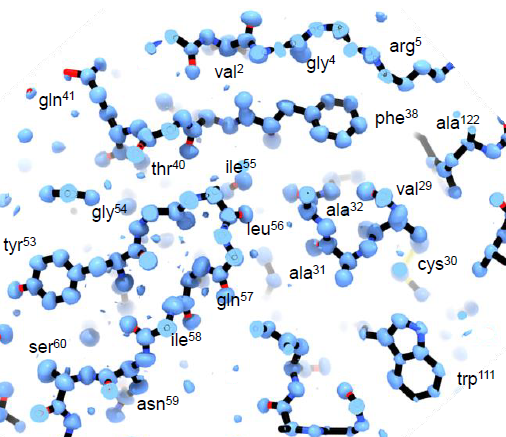
#cryoEM#MicroED with electron counting. Protein structure at 0.8A resolution. Ab initio phasing for two proteins facilitated by electron counting on a falcon 4 direct electron detector. A section of the map is shown below
https://t.co/ODsZ0Z1yF5
For those who have missed the news
We proudly present a #Review from Eva Kummer and Nenad Ban: Mechanisms and regulation of mitochondrial protein synthesis
@eva_kummer@The_Ban_Lab#mitoribosome#translation
https://t.co/ZP24z8A8MG
FREE #sharedit pdf https://t.co/d4Wt8MrKN5
Structures of the human mitochondrial ribosome recycling complexes reveal distinct mechanisms of recycling and antibiotic resistance https://t.co/oikVW7dTCa
1) SARS-CoV-2 Vaccines - I promised a Tweetorial and here we go. This is going to be long and nerdy. But I'll make sure it is easy to understand. If you want more details, please just read this: https://t.co/XBnamI2pKk
In a Review in Nature, @florian_krammer reviews the status of COVID-19 vaccine development, concluding that effective and safe vaccines might become available within months rather than years. https://t.co/s0mpTppiZr
Pubmed: Structures of the human mitochondrial ribosome bound to EF-G1 reveal distinct features of mitochondrial translation elongation. https://t.co/6BQFaJTbTp
Researchers have captured the first-ever images of antibodies, purified from the blood plasma of people who have recovered from COVID-19, latching onto a key protein on the SARS-CoV-2 virus.
https://t.co/Mne00L4waN