Social media is fascinating.
The loudest people commenting on Mythos have never actually worked in VR.
The loudest people commenting on the new electric Ferrari can’t afford one.
After uncovering memory bugs in @NASA's CFITSIO, we looked at turning its documented features into attack primitives.
Check out the blog post for details & a newly released Docker playground to reproduce the demos locally.
#AppSec#doyensec#security
https://t.co/9x9Flkqk6r
Big slay! maitai (@MaitaiThe) of Doyensec was able to exploit OpenAI Codex! If confirmed, they win $40,000 and 4 Master of Pwn points. They're off to the disclosure room for the deep dive. #Pwn2Own#P2OBerlin
In our @a_denkiewicz's latest post, see how combining AFL++ with GPT-5 Codex sped up triaging the results from fuzzing NASA’s CFITSIO library and uncovered numerous vulnerabilities.
https://t.co/oXnzPaPnr2
#doyensec#appsec#security#fuzzing
We see our home planet as a whole, lit up in spectacular blues and browns. A green aurora even lights up the atmosphere. That's us, together, watching as our astronauts make their journey to the Moon.
I have kids. I work in AI every day. And honestly? I have no idea what their careers will look like in 15 years. But I know what will carry them through.
First, and this might sound unromantic: make money and save it for them. We can debate educational philosophy all day, but the world is changing so fast that financial security might be the most practical gift we can give. Buy some gold bars. Seriously.
Second, nurture their imagination. AI rewards people with initiative and wild ideas. The kid who daydreams, who asks weird questions, who wants to try ten things at once? That kid will thrive. AI can execute. AI can be disciplined. What AI can't do is dream up something nobody's thought of before.
Third, build resilience. There are no more iron rice bowls (guaranteed lifetime jobs). Any stable, predictable job is exactly the kind of job AI will learn to replace. Our kids will likely switch directions many times in their lives. Learn something new, get replaced, pivot, repeat. It's more like being a hunter than a farmer. Schools don't teach this. Schools teach you to follow a linear path: high school, college, grad school, stable job. That linear path is becoming the most dangerous one.
Last, invest in their ability to connect with other humans. Not networking. Not schmoozing. Real emotional connection. Building trust, offering support, making people feel seen. As AI handles more of the rational, analytical work, the human ability to genuinely relate to other humans becomes more rare and more valuable.
I don't have all the answers. But I know that imagination, resilience, and genuine human warmth aren't going out of style anytime soon.
#AI #Parenting #Education #FutureOfWork
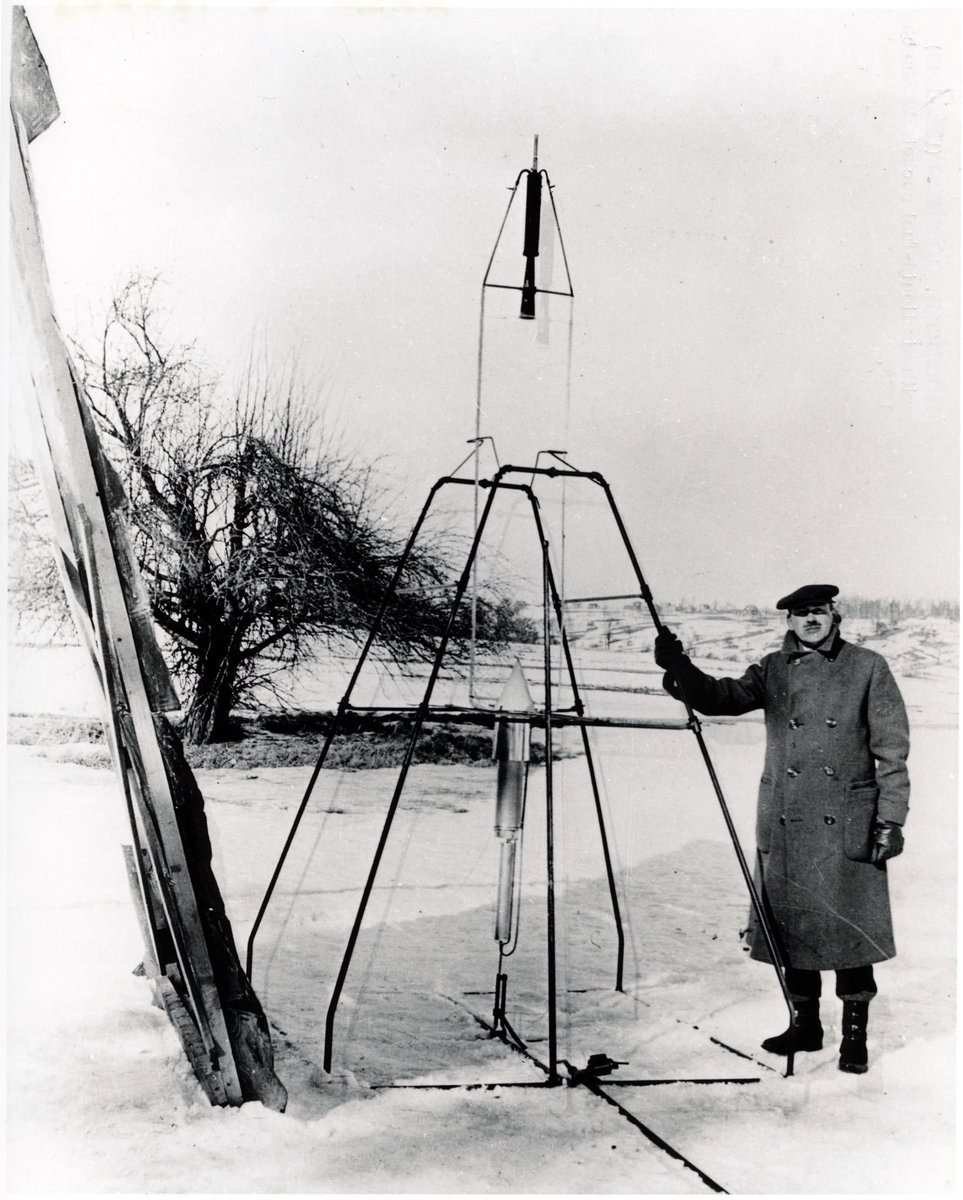
100 years ago today, Robert Goddard launched the first liquid fueled rocket engine! It only went 12.5m (41 feet), but it was where it all began. My favorite thing is the engine on top with the tanks below. This was the pendulum fallacy, and it in fact, is not more stable.
I want to share a quick thought for people in cyber security. This will be my longest tweet ever.
I’ve spoken to many lately who are having an existential crisis from the constant posts about “the end of cybersecurity jobs.”
Yes, things are changing quickly. This is a significant moment for the tech industry. Change can be uncomfortable. But we’ve seen cycles like this before.
• When GitHub and open source took off, people said software engineers would disappear because code was free.
• When AWS and cloud computing emerged, people said infrastructure jobs would vanish.
• When fuzzing and SAST tools improved, people said vulnerability research would disappear.
• Virtualization would eliminate infrastructure jobs.
• Mobile computing was going to end desktop dev.
• Exploit mitigations would end exploitability. It didn't.
Each time automation improved, the amount of software grew faster than the automation. It does feel "different" this time as it's explosive.
Some roles will shrink:
• repetitive pentesting
• basic vulnerability scanning
• tier-1 SOC monitoring
But other areas are expanding rapidly:
• AI system security
• supply chain security
• identity architecture
• autonomous agent security
• critical infrastructure protection
Historically, every time we eliminate one class of bugs, new classes emerge. Right now people are vibe-coding entire systems, giving AI access to their machines, crossing trust boundaries, and deploying autonomous agents with excessive permissions. The legal and regulatory world is nowhere close to ready.
There will absolutely be new failure modes. Humans are amazing and always adapt, finding new ways to do things.
The worst thing you can do right now is fall into a doom loop.
...and I’ll be honest, I too have felt the "psychological paralysis" a few times thinking, “Is this time different?” It's especially impactful when it comes from someone I respect in the community. There are certainly unknowns, in an industry where we've become accustomed to predictability.
But... the majority of those reactions are usually driven by social media, not reality. Platforms like X reward engagement, and sensational doom posts spread faster than measured thinking.
If you see something like:
“Holy #$%^! Opus 66.6 just found every bug in Chrome and replaced 50 startups!”
…mute it and move on.
Instead:
Stay curious.
Learn the new technology.
Adapt your skillsets.
Build things.
We’ll get through this transition the same way we always have. If I'm wrong then Sam Altman better be right about UBI! :) I'm sure that if this tweet gets any engagement that I'll get some heat for it, but a good friend of mine reminds me often to focus on what you have control over. I'll revisit this tweet at DEF CON 40!
📢 Our latest blog post shows why VBScript’s Randomize + Rnd are terrible for cryptographic token generation. See how attackers can easily recover seeds and secrets.
🔗 https://t.co/YzWkvuudGN
#doyensec#appsec#security#crypto
@Cmdr_Hadfield Do you think the first real attempts at settling the Moon or Mars could lead to significant conflicts back on Earth? How important do you think it is to enforce strict resource conservation - especially when it comes to essentials like water - among the first settlers?
Here's our new blog on hiding your implant in VTL1, where even an EDR's kernel sensor can't see it.🧑🦯
Post includes full operational details. Plus our OST offering has been updated with a Cobalt Strike sleep mask exploiting secure enclaves.
Full read ➡️ https://t.co/oe9A6RowDV
While learning astrophotography, I ran some light fuzzing on CFITSIO, the most complete FITS implementation out there. It’s used by a variety of stacking and FITS-processing tools, such as those behind the most iconic Hubble and JWST images.
🚀We have just released a new Security Advisory for @NASA's CFITSIO library 🛰️. Click the link for details on the Heap Overflow, Type Confusion, Out-of-Bound Writes and other vulnerabilities discovered by our @a_denkiewicz !
https://t.co/7X6YVBzhdo
#doyensec#appsec#security