No one asks where the pine tree would rise, under normal conditions.
Lebanese resilience: bend, adapt, survive in a system that keeps collapsing beneath you. Admired, of course. Fixed? Never. Someday, maybe. 🤔
#Lebanon#Resilience#Nature
"كم بكرا بدّو يمرق لنعرف بالنسبة لبكرا شو؟" زياد الرحباني
“How many tomorrows must we survive before we finally see what ‘tomorrow’ even looks like in this country?”
ChatGPT translation 😎
#ZiadRahbani#Lebanon#PoliticalSatire#Beirut#MiddleEast
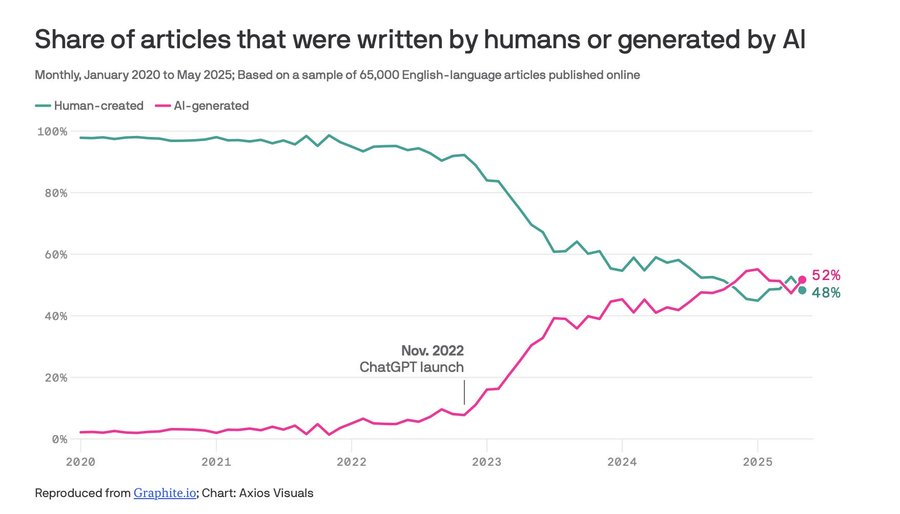
Oxford researchers just confirmed what we feared:
The internet as we knew it is dying.
AI content went from ~5% in 2020 to 48% by May 2025. Projections say 90%+ by next year.
Why? AI articles cost <$0.01. Human writers cost $10-100.
But the real crisis is model collapse. When AI trains on AI-generated content, quality degrades like photocopying a photocopy. Rare ideas disappear. Everything converges to generic sameness.
It's recursive. Today's AI slop becomes tomorrow's training data, producing worse output, which becomes training data again.
Gaza’s political house is in ruins—and the world keeps pretending it can be managed from afar. My New Yorker essay on what comes next. Read in @NewYorker https://t.co/dqiQoyqkJQ
US Ambassador to Türkiye Tom Barrack:
There is no Middle East. There is tribes and villages.
Nation states were created by the British and the French in 1916.
But the Middle East doesn't work that way.
It starts with individual, family, village, then tribe, community, religion. Lastly, Nation.
Source: @HibaNasr
When you start to use more AI Agents that do long running work in the background, it becomes clear that software is going to look very different in the future.
Right now the vast majority of software was built to enable people to do all the work. Next, we saw a brief period where software has evolved for AI to be an occasional assistant in helping with that work. You can chat with AI in-line, it provides useful suggestions or data retrieval, and so on.
But, as Agents get more powerful, this paradigm will likely flip. At least for some important chunk of software.
As the AI Agents get more powerful, and you don’t need to go back and forth with them at every point, the software starts to become a tool for managing what AI Agents are doing for you. And software for people managing how agents work will look different from software that enables people to work.
Software becomes about reviewing the AI Agents’ work, creating task queues, seeing the status of work as it’s happening, being able to interrupt the work when necessary, checking audit trails, managing parallel threads, connecting work outputs from multiple agents, and more.
A large portion of software will likely evolve toward supporting this new approach. But a lot of software equally will need to be reinvented along the way. This is going to be both a crazy time for incumbents and a window where lots of new startup opportunities emerge.
So sick.
Remember that members of Congress are permitted to own stock in war manufacturing, so when they vote to send more bombs or send our loved ones to war, they profit personally.
Following the 2020 Beirut port explosion and the Lebanese economic crisis which the World Bank described as one of the worst the world has ever seen in the past 200 years, @SaraYafi said this about Lebanon:
“What we are currently living is something I believe, even if you were to do a Hollywood movie out of it, probably the producers would tell you to tone it a bit down because it doesn’t look very realistic.”
Today I remembered that quote.
Topic of the day: is citizen development all it's cracked up to be?
The promise of no-code is that every person can develop their own app, tracker, hubs etc.
Thats what companies like Airtable, Notion, Monday and we as Morta preach. But what if we are getting it all wrong?
What if people shouldn't be developing their own resources always?
On one level --> being able to develop their own resources = innovation & thats really cool
On another level --> anything developed is potentially another silo, is ad-hoc in nature, difficult to scale and goes against the idea that each company aims for a standardised set of processes. I've also found that skill sets are lacking, time is lacking, etc.
Maybe it's a hybrid approach. Some processes are set if they are to be adopted on a company-wide level, whereas users can innovate on others. Users can input on company-wide iterations, and templates can be improved in a controlled manner.