😁😄😄So funny.........
but on a serious note......your foreword adds immense value and I am very glad its there 🌷🌼🌸🪷🍗
Thank you for making the time @fleroy1974
#QuoteoftheWeek: Mawlana Hazar Imam discussed the legacy for the Aga Khan University's academic facilities and future hospital in Kampala, Uganda on 11 September 2025.
#TheIsmaili#AgaKhan
Customer: "My granddaughter says I want to be cutting down on red meat."
Butcher: "How old's your granddaughter?"
Customer: "Twenty-six."
Butcher: "And how old are you?"
Customer: "Seventy-one."
Butcher: "What have you eaten on a Sunday since 1962?"
Customer: "Beef, mostly."
Butcher: "And how are you?"
Customer: "Fine. Bit of a knee."
Butcher: "Then the experiment's been running sixty-odd years, the results are in, and a twenty-six-year-old has read something else."
Customer: "She means well."
Butcher: "They all mean well. That's how the whole thing works."
Customer: "She sent me an article about it."
Butcher: "They always send an article."
Customer: "So what do I tell her?"
Butcher: "Tell her you'll take it under advisement. And have the topside."
Butcher: "Anything else, love?"
Customer: "The fat you've just cut off. Can I have that as well?"
[He stops with the knife halfway down.]
Butcher: "The trimmings."
Customer: "The trimmings."
Butcher: "That goes in the bin at four."
Customer: "Then this is the easiest sale you'll make today."
Butcher: "I can't sell you the bin. I'll give you the bin."
[The man behind her, waiting on four chicken breasts, has turned round.]
Second customer: "Sorry. You're taking the fat home."
Customer: "I'm rendering it."
Second customer: "Into what."
Customer: "Dripping. That's a fortnight of roast potatoes."
Butcher: "She's had the kidney fat off me twice this month. Suet. Best of the lot."
Second customer: "What do you do with the rest of it."
Butcher: "It goes for rendering, or it goes in the waste. Depends on the week."
Second customer: "And you just hand it over."
Butcher: "Nobody's asked me for it since about 1985. I'd started thinking of it as rubbish."
Second customer: "Is it not rubbish?"
Butcher: "My grandad sold it by the pound and kept the shop open on it."
Butcher: "It's the same animal as what you're queuing for. Just the part that tastes of something."
[She left with a bag that cost nothing and weighed more than her steak.]
Every living thing on this planet organises its day around getting into the sun. One species has been sold a cream to keep it out.
The sunflower tracks it all day and parks facing east overnight, because a head that warms first gets several times the visitors a cold one does.
The lizard is out on the rock by eight, because every enzyme it owns runs at the wrong speed until the stone has warmed it through.
The butterfly will not fly until it has opened its wings and held them open. Cold muscle makes no power, so the wings become a panel and the insect sits there charging.
A single cyanobacterium works as a lens. Light goes through the cell, focuses on the far wall, and it crawls towards the bright spot. One cell, no eyes, no brain, and it has worked out where the sun is.
The coral farms algae inside its own body and grows outwards to hold them in the light. Take the light away and it turns white and starves with its mouth full.
Not one of them has a policy on it. Not one of them owns a hat.
You were built the same way. Cholesterol sitting in your skin one photon from becoming vitamin D. A store of nitrite in the top layers one photon from releasing the gas that opens your arteries. Receptors in your eye with nothing to do with sight, whose entire job is telling your body what hour it is.
Then the fat changed. Your cell membranes are built out of whatever went in the shopping basket, and after 1975 that meant a fat carrying two double bonds in every molecule. A double bond is where oxidation starts. Skin that used to brown began to burn.
Melanoma has more than tripled since 1975. Every generation before that one had the same sun and did not get it.
And it climbs hardest in people who work indoors. Outdoor workers take three to ten times the annual dose of ultraviolet and get the same rate or less, which is a fact the entire campaign has been built directly on top of without ever once looking down.
So we blamed the fireball that has been up there for four and a half billion years.
Then we bought a cream to block it, and the wavelength it blocks hardest is the one your skin makes vitamin D with.
Then, when everybody came up short of vitamin D, we sold them a capsule of it.
Three products in a row to fix a problem that arrived in a bottle of sunflower oil.
Bin the seed oils. Cook in butter, tallow and dripping, and give your skin two years to rebuild itself out of something that does not catch light.
Then go outside like every other living thing on earth, and stop apologising to the sun for a crime committed by a frying pan.
Beef math.
Buying direct from a rancher is not cheaper than Walmart; there is absolutely no way to compete with their economy of scale/feedlot models and raise the animals right. It is, however, much higher quality than Walmart (single animal, no commingled trim from who knows how many cattle or countries) and cheaper than buying from a quality butcher with still higher quality overall.
If you buy the equivalent of a whole beef from Walmart, it will cost roughly $4800.00.
If you buy a finished whole beef from a rancher including processing, it will cost roughly $5200.00.
If you buy the equivalent of a whole beef from a quality local butcher, it will cost roughly $6000.00.
If a family of four buys a whole beef:
The beef will supply 50% of their annual protein needs for an entire year if they eat beef five days a week (one beef centric meal a day).
The family will avoid the growth hormone implants and routine antibiotics used in feedlot production, and the commodity mixing that blends trim from hundreds of animals, often from multiple countries, into a single package. That commingling is also why one problem animal can trigger a recall covering tons of ground beef. Finally, if the animal is raised the way we raise ours, it is active, healthy, and calm its entire existence which creates better, more nutritous beef overall that was treated humanely and respectfully its entire existence.
Costs:
We price roughly in the middle of the antibiotic free, hormone free, no feedlot, raised-on-pasture-their-entire-life market at $5.95 a lb. hanging weight. Processing (billed by the processor) costs $1.00 a lb.
At those prices you're paying $6.95 a lb. hanging weight or between $11-$12 a pound take home weight across the board for all steaks, roasts, hamburger etc. If you figure equivalent steak, roast, and hamburger percentages that works out to $6.50 a lb. for hamburger, $22.50 a lb. for steak, and $9.00 a lb. for roasts.
Butter did not live in the fridge in this country until the mid eighties.
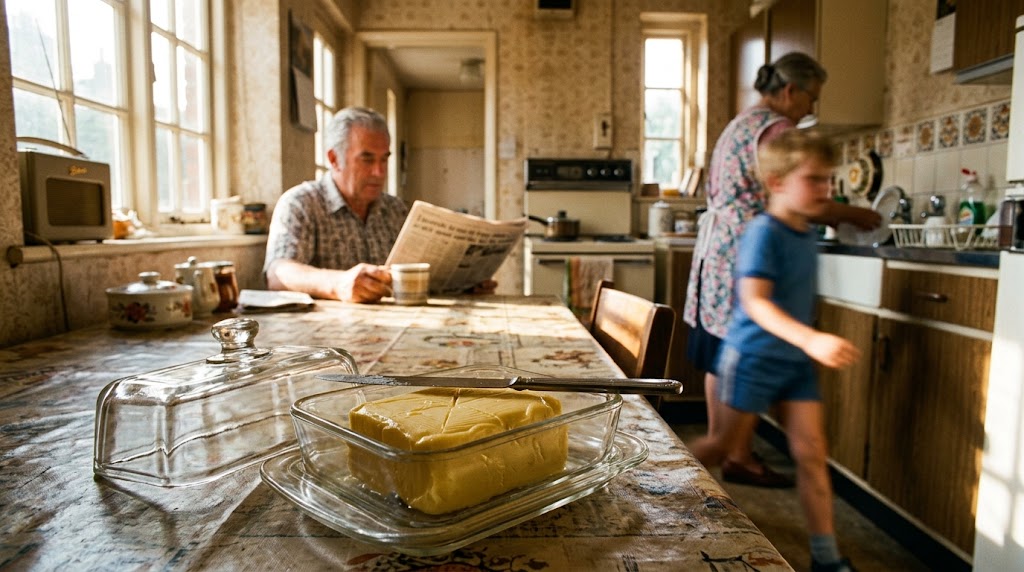
It lived on the table. Under a little lid, or a bell of frosted glass, and it stayed put from breakfast to supper. It got a top-up, never a wash and a fresh pack. When it ran low, more went in. It was there the way the salt was there and the teapot was there, and nobody in that house gave it a second thought.
And it was soft. You pulled it straight across warm toast without tearing a hole in the middle, without the wait, without the cold shrapnel that comes off a fridge-hard block.
It sat out through a July afternoon and nothing happened. It sat out through Christmas week beside the cake and nothing happened. Your grandmother kept butter on the side for fifty years and buried nobody.
Butter is around eighty per cent fat, and the water in it is locked in droplets inside that fat with the salt dissolved in them. Bacteria need free water and there is almost none to be had. The fat is the thing keeping it safe.
The fat. The exact property they spent forty years telling your mother would kill her is the property that lets butter sit on a table all summer and behave itself.
She knew none of that and she was right anyway.
Then the government's committee on nutrition reported in 1984, the country was told to cut the fat out, and inside about three years the dish was in a cupboard and there was a tub in the fridge door with a sunflower on the lid.
Butter out of a fridge cannot be spread. It tears the bread and sits on the knife in a lump. The tub beat butter on exactly one thing, which was that it came out already soft, and it only had that advantage because the competition had just been sent somewhere cold on doctor's orders.
Clover launched in September 1983, made by Dairy Crest, which was the processing arm of the Milk Marketing Board. The dairy industry's own company sold Britain the tub.
Then it sold the fix. Spreadable butter is butter with rapeseed oil blended through it so it comes out of the fridge soft, and the market leader runs at sixty four per cent butter to twenty three per cent oil. It costs more than the block it is diluting.
There is a generation now that flinches at a fat left out at room temperature, and the same people will eat mayonnaise out of a jar that has been sat on a warehouse shelf since March.
Leave a dish of it out tomorrow. Watch it sit there all day doing absolutely nothing, then spread it without a fight.
Your fridge is full of things that would have you on the floor by Thursday. The butter was never one of them.
Go to any railway station.
You'll see poor elderly men and women lying on the floor, their bags beside them.
Many of them are travelling to Delhi AIIMS or other major cities just to get proper medical treatment.
Why can't we have at least one AIIMS-level hospital in every district?
Isn't that a better use of public money?
I talk a LOT about beef.
But some days I’d rather just sit on a good horse and watch the sun go down. 😂
Ranching has a funny way of being your job, your hobby, your headache AND your favorite place to be.
Wouldn’t trade it.
Happy Sunday.
While they’re flooding the market with cheap foreign beef and pushing lab-grown and processed garbage, real American ranchers are still raising clean, grass-fed cattle the right way.
Support your local ranchers this weekend. Buy direct. Know your farmer. Feed your family real food.
That’s how we win.
At 25 I trained so women would look at me.
At 32 I train because it is the only hour of the day I am not thinking about rising ground beef prices.
The results have never been better.
Want to stop worrying about beef prices?
Fill your freezer.
Buy direct from a rancher.
You know what you paid.
You know where your beef came from.
And the next headline doesn’t change what’s for supper.
A full freezer is food security.
Know your rancher. Know your food.