I see a few questions about scanning process for finding delayed EP setups . It's much simpler than most people think.
In this video, I'll show you the exact process I use and how I build a database of delayed EP names for future opportunities.
Watch the video and let me know what you think. If you have any questions, drop them in the comments and I'll do my best to answer them.
Good luck
🚨 Introducing the XP market breadth score!
XP is a market breadth score that tells the underlying health of the broader market in a single number.
The XP score is an open-source proxy for @stocksgeeks's proprietary EM score, & is now freely available under the Stocksgeeks MBI 2.0 indicator, which you can find here:
https://t.co/EtVr3DQRo5
How to interpret the XP score
XP and EM share the same regime band structure, so the same ranges apply. XP >= 15 is the swing-friendly environment. In practice, the score is most useful around the regime boundaries. e.g. a move from 11 to 13 is more meaningful than a move from 17 to 19, even though both are two-point changes.
To setup watchlist like @Qullamaggie you need to create 1 month, 3 month, and six month momentum scan and then use them to sort the Universe of stocks by it and select top 25 or 30 ranked stocks by each.
In TC2000 create the following sort columns
1 month momentum c/avgc25
3 month momentum c/avgc66
6 months momentum c/avgc126
Now sort a list of US common stocks with it and flag the top 25 and transfer to watchlist
After that you can look for tightness on them to narrow it down further
Improving your performance often has nothing to do with finding the magic screener or indicator, but everything to do with mastering the space between your ears. I have some personal belief for structural non-negotiables for trading longevity and i am still trying to refine and improve them;
1. Patience is a Position, Improve your execution, improve your average holding period: The best traders aren't the ones clicking the most buttons; they are the ones waiting for the high-probability breakout to manifest. They are also the one that have the balls to hold beyond their predetermined stops if they have an unexplained conviction from their years of experience. A trader that could hold $STX from 2025 May 12th entry vs a trader entering and exiting $STX with multiple magnitude of wins, breakevens, and stops losses with latest hold from 2026 May 1st entry will speak volume of who has an enhanced skill set in this endeavor. Try to explore quantifiable ways to improve your avg holding period for winners without second guessing, first.
2. Systems Over Emotions: Discipline is following your stop loss and position sizing rules even when your ego wants to fight the tape. Yes I know it kinda contradicts point 1. above but that is what experience rewards you for the outlier performance through 'holding' on that 5 star trade with calculated risk in mind when other traders couldn't.
3. Focus on Relative Strength, Relative Strength Precedes Setup: Stop trying to catch every move and focus on the institutional inflow that drives true momentum. Some best trades only gives a single day pause before resuming it's rally without revisiting rising 10-MA. You need to be innovative enough to design a risk controlled trading plan around it.
5. The Power of Consistency: Wealth isn't built on one "lucky" trade; it’s built through a systematic approach that wins over hundreds of trades. How many times have you revisit your trading journal and go through the statistics in batches of hundred trades?
5. Habits Build the Equity Curve: Your daily routine—screening, journaling, and reviewing—shapes your future PnL more than any news headline. Our individual equity curve actually mimic like a stock chart. If you trade well even on streaks of controlled losses, it should actually reflect a basing pattern in your equity curve before your edge and alpha plays out in matter of time.
Trading is a performance sport. Focus on the longevity of your trading performance.
The markets reacted nicely to the ceasefire, and if you try to buy anything here, you will get chopped up quickly.
The only play here (if you weren't long before), is to wait for this gap to be digested via TIME and/or PRICE relationship, so until the market doesn't pull back a bit, or consolidates up here until the 8/20 EMAs catch up, there is no high probability trade in sight based on my system.
What I do with my momentum breakout system is trade the first valid consolidation after the first leg of a fresh new trend is established, which comes after a trend reset of the 50 EMA, often times after a multi-week bases break out forming the first leg.
And THIS is what has been happening since last Thursday (that's why I flipped my view over the weekend, waiting for a 2nd leg lower), as I saw a big multitude of stocks breaking out from big bases, AND the bear side dried up massively, especially the Regional banks...
Now, we have to wait for the indices to consolidate through time and or price, let the 8/20 EMAs catch up with price, and wait for the next wave of consolidation breakouts.
In the picture below, there is a perfect representation of:
- what the leading stocks are doing right now with momentum, and
- How my model works and when it brings me long signals.
It might take a few days to get there, as it is, and I will be getting waves of longs on the first valid consolidation breakouts.
All I do is execute my system, ride the distribution of it, adhere to my rules, and let the edge play out.
For reference, I'm an EOD breakout trader (do everything in the last 30 min of the trading day), avg 100%+/y, and trade 95% on mechanical rules only, so no discretion = no stress.
There will be waves of longs coming, and the only thing you must do is track momentum, follow price, and let the rules of your setup/system play out.
Follow price, everything else is just noise 📈
Today’s market strength was textbook. This is exactly what markets do during corrections when they get stretched to oversold levels. As I said just recently, "some of the biggest rallies occur during bear markets and corrections." Today was a perfect example.
Traders rushed in after headlines hit that Iran’s president signaled a willingness to end the conflict with the U.S. The Dow exploded higher by 1,125 points. But let’s not confuse cause and effect. The news may have been the trigger, but the market was already set up for a rally. It was oversold and primed. Now comes the part where discipline matters.
We ignore the first few days of a rally attempt. That’s potential noise. What matters is whether the market can follow through and whether leadership begins to emerge and proper setups develop.
Technically, this is a classic snapback: Indexes that broke below the 200-day are rallying back toward it, while Indexes that held the 200-day are bouncing off it. That’s typical countertrend behavior until proven otherwise.
Expect volatility to remain elevated. That’s not where low-risk money is made, but it's certainly where the risk is. Your job during corrections is simple: identify the stocks showing the best relative strength and the tightest price action. Those are your future leaders when the market finally turns.
On the macro side, nothing has been resolved. Higher crude prices are still a problem. Yesterday’s rally did nothing to materially bring down oil. The bigger issue is still in play and the jury still out. Oil at these levels feeds inflation, pressures growth, and gives the Fed a reason to stay on hold longer. Yields stay elevated in that environment.
To cut through all the noise, I look to the market itself, which has a much better track record of telling us the truth than the politicians, the analysts, the news, and the gurus.
The four steps of the bottoming process are:
1. Oversold – The difference between an ordinary pullback and an oversold condition starts with price, but it does not end there. Poor breadth and and a lack of volume confirmed follow through describe a one-sided market, and one not to trust.
2. Rally – Inevitably, the market bounces from its oversold condition. A high-quality rally is broad-based. A low-quality rally is defined by short covering and driven primarily by the stocks that have declined the most. Again, the character of the rally is important to distinguish. So far, we simply don't have enough data to make a confident determination, so patience is the watch word while we wait.
3. Retest – After the rally, there is almost always a retest. The popular averages approach, and in some cases breach, their oversold lows. The key to a successful retest is less selling pressure, such as fewer stocks below their moving averages, fewer stocks, sectors, and markets making new lows, less total volume, and less downside volume. If the retest fails, the process reverts and we generally start looking for divergences during lower lows. In the event of unexpected news, it is possible for the market to recover in a "V" fashion with no retest. In that case, we look at breadth confirmation and participation.
4. Breadth thrusts – In the final phase, not only do benchmark indices rally sharply with few pullbacks, but they do so with an extremely high percentage of stocks, sectors, and markets participating, or what technical analysts call breadth thrusts. In rare cases, the market has skipped step 3. With strong enough breadth, retests are not necessary. The Covid bottom is an example of a pretty powerful V-shaped recovery.
Bottom line:
This was an oversold rally, sparked by headlines—but not defined by them, and certainly not confirmation of a reliable bottom.
Now we watch:
--Quality of follow-through
--Emergence of leadership
--Market internals and model health
If the rally lacks quality, if economic pressure builds, or if leading stocks begin to deteriorate, then this remains what it likely is—a rally within a correction.
Stay objective. Let the market prove itself. If you are going to trade, do so incrementally.
https://t.co/JXzFFTmMtn
Want to build muscle and strength? Keep it simple.
You don’t need complicated routines. You need to get the basics right.
Here are the 5 pillars:
1️⃣ Progressive strength training
Muscle grows when it is challenged.
🔸Lift weights
🔸Increase load/reps over time
No progression = no muscle growth
2️⃣ Adequate protein intake
Target:
🔸1.2–1.6 g/kg/day (for most people)
🔸Up to ~2.0 g/kg in some athletes
Spread across meals for better absorption.
3️⃣ Balance cardio (don’t overdo it)
Cardio is good for heart health. But very high volumes (e.g., intense long-distance running) can interfere with muscle gain and increase recovery demands.
🔸Moderate cardio is ideal
🔸Combine smartly with strength training
4️⃣ Avoid prolonged calorie deficits
Muscle needs energy. Chronic under-eating or prolonged fasting can reduce muscle protein synthesis and limit strength gains
🔸Fuel your workouts
🔸Prioritize recovery nutrition
5️⃣ Sleep & recovery
🔸7–8 hours sleep at night is needed.
🔸Muscles grow during recovery, not during workouts
Take-home:
Muscle building is about:
✔️ Training
✔️ Protein
✔️ Recovery
✔️ Consistency
Dr Sudhir Kumar
@hyderabaddoctor
(Disclaimer: Information provided here is general in nature. Discuss with your nutritionist and fitness trainer for individual advice.)
Supplements for Strength Training: What You Actually Need
✅Core (Evidence-backed, useful for most people)
1. Protein (if dietary intake is inadequate)
Options include Whey or plant protein. You should target ~1.2–1.6 g/kg/day of total protein
2. Creatine monohydrate
It is one of the most studied supplements, which improves strength, power, and muscle mass. The recommended dose is 3–5 g/day.
3. Vitamin D
This is especially useful in those with low levels (very common in India)
4. Omega-3 fatty acids
It is useful in those with low dietary intake (fish, nuts)
▶️Situational (needed only if deficiency is confirmed/situational)
1. Iron
2. Vitamin B12
3. Electrolytes
🔸Useful in heavy sweating or during long workouts
4. Caffeine (pre-workout)
🔸May improve performance & endurance. Use cautiously as it may cause sleep & anxiety issues in some.
🟠Not Necessary for Most/Overhyped
1. BCAAs (if protein intake is adequate)
2. Glutamine (limited benefit for muscle gain)
3. Testosterone boosters (mostly ineffective, may be harmful)
4. Fat burners (minimal benefit, marketing-driven)
🔴Unsafe / Potentially Harmful
1. Anabolic steroids
🔸Associated with serious risks such as heart disease, liver damage and infertility
2. Unregulated “pre-workouts”
🔸These may contain hidden stimulants, which can cause arrhythmias and anxiety
3. High-dose fat burners/thermogenics
🔸Associated with risk of hypertension and stroke
4. Excess protein (>2–2.5 g/kg/day long-term)
🔸These is no added benefit and may stress kidneys in predisposed individuals
5. Unknown herbal/muscle-building mixes
🔸There is a risk of contamination (heavy metals, steroids)
Take home message
🔸If your basics are right:
Diet; Sleep; and Progressive training
🔸Then just 2–3 supplements (protein + creatine ± vitamin D) are enough.
Dr Sudhir Kumar
@hyderabaddoctor
Total disaster with @ThaiAirways TG313 today. Entire family's luggage (3 bags: TG688825, TG689039, TG689023) left in Bangkok. No essentials, no communication, just pure frustration. Is this how @ThaiAirways treats its passengers? @MoCA_GoI@AAI_Official,
Champions!
Congratulations to the Indian team on winning the ICC Men’s T20 World Cup!
This remarkable triumph reflects exceptional skills, determination and teamwork. They have shown outstanding grit through the tournament.
This victory has filled every Indian heart with pride and joy.
Well done, Team India!
Dan Zanger in Momentum Master:
“Observe and live in the firestorm of the market for a few dozen years, and you’ll learn not to stick your hand in the fire when you see it. I got burned too many times to forget what “chop and slop” truly means, whether long or short. Market behavior follows distinct repetitive patterns that teach clear lessons, so when you see a market starting to act badly, you’ve learned instinctively that it’s time to back off for the required weeks or months. During that time you don’t go on vacation and turn your back on the market; you still need to be watching the market every day so you’ll know when it has calmed down and is back to normal. Diligence even during a choppy market is part of good timing.”
Zanger’s point is that the market has a certain feel when it is healthy and a certain feel when it is not. After enough time watching it, traders learn to recognize when conditions have turned hostile. In those periods, the issue is not just that setups look less clean. It is that the market stops rewarding good decisions. Breakouts fail, reversals stall, momentum fades quickly, and both longs and shorts can get chopped up. Experience teaches that when the market starts acting this way, it is usually better to back off rather than keep forcing trades. But backing off does not mean disconnecting. It means staying close, continuing to watch, and waiting for the market to settle and return to a more normal rhythm.
That idea connects directly to follow-through, because follow-through is really the proof of whether progress is real. A breakout above resistance may look bullish, a strong market bounce may feel promising, and a gap up may grab everyone’s attention, but none of that means much by itself. The real question is always what happens next. Does the stock continue higher? Does it hold its gains? Does it absorb selling and remain in a position of strength? Or does it immediately stall, fade, and slip back into the range? The initial move may create excitement, but follow-through is what confirms intent.
That is why choppy markets are so dangerous. Chop is not just about volatility or noise. It is about the absence of sustained progress. The market may still produce triggers, but those triggers do not lead anywhere. Stocks break out but cannot hold the breakout. Strong candles get retraced. Good entries fail to expand. In that environment, the problem is not always the setup itself. The problem is that the market is not in a condition where follow-through can develop consistently.
Zanger is also pointing to an important truth about corrections. Markets do not only correct through price; they also correct through time. Sometimes the market does not collapse. Instead, it drifts sideways, churns around, and frustrates traders for weeks or months. That kind of correction can be even more deceptive because it keeps traders engaged while quietly destroying follow-through. It creates movement without progress, action without resolution. Traders who feel the need to always be involved often get worn down the most during these periods.
The lesson is that timing is about more than entries and exits. Good timing also includes knowing when conditions are too unstable for real progress to occur. There are periods when the market is calm, constructive, and ready to reward sound decisions. In those periods, follow-through tends to show up more naturally. Then there are periods when the market is unsettled and erratic, where even strong-looking moves struggle to hold. Recognizing the difference is a major part of trading skill and wisdom that no indicator will tell you.
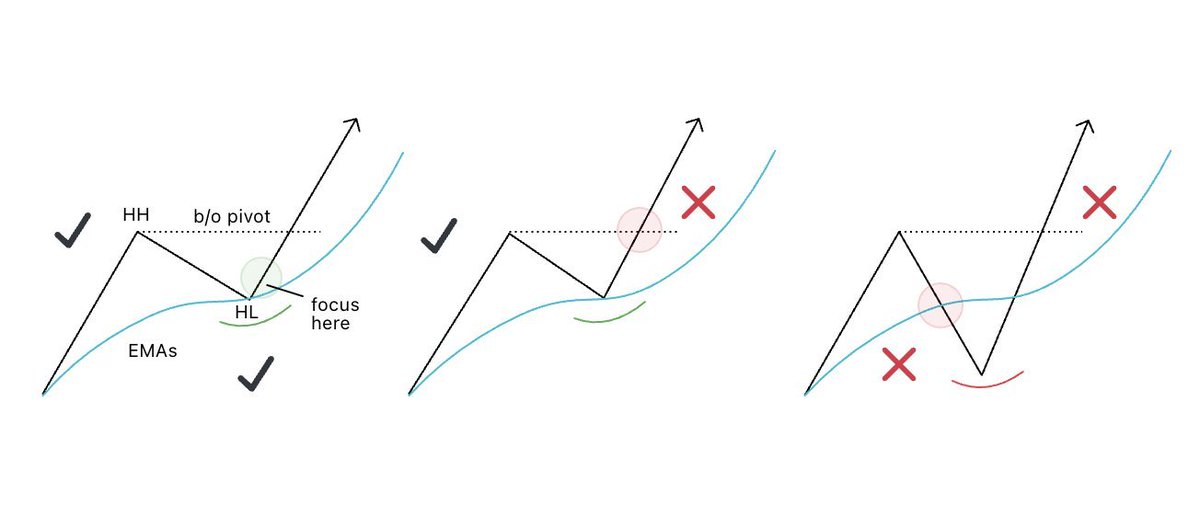
Coming into 2026, one of my biggest goals for me was focusing on buying the right side of the V on leading names in leading sectors.
Not to chase the obvious breakout… not predict the bottom… but wait for prior demand, let the pullback digest along the 9/21 EMAs, and step in when price starts turning back up with structure underneath it.
If I had to grade myself through the first two and a half months, I’d give myself a solid B+.
because there's always room for improvement.
I’ve been far more intentional about waiting for higher lows, focusing on tightness against EMAs, and entering as momentum shifts.
This infographic I made sums it up perfectly:
- move up (prove demand)
- volatility contraction along rising EMAs
...then expansion.
Pair that with a clean undercut & reclaim entry near a major pivot, and in this current environment, you’re putting yourself on the right side of probability.
Less chasing, more patience, and tighter risk.
By focusing here, I'm letting structure tell the story before I commit capital.
5 Signs a Stock Is About to Explode
(My Pre-Breakout Checklist)
Don't chase AFTER the move.
Focus on what happens BEFORE it.
Here’s what I look for 🧵👇
1. EMA Alignment (Launchpad Setup)
-Price above 50 DMA
-11/21 EMA acting as “launchpad”
-11/21 EMA acts like a → price hugs and bounces off it repeatedly
2. Volume Behaviour (Hidden Accumulation)
-Pocket pivots (5D / 10D) inside base before Breakout*** Extremely Important
-U/D ratio >2 = strongest names.
3. Structure (Compression Zone)
-Tight contraction: Inside bars/NR3/NR5 cluster
-Tight flags / shallow pullbacks (≤15%)
-Noisy setups (wide, whipsaw candles) are avoided.
4. Trigger (Ignition Point)
-Tight Range breakout above recent highs
-RVOL surge ≥1.5.
-ADR in a healthy zone (3%+)
-No volume = no breakout.
5. Market Behaviour (Leadership)
-Leaders show RS strength before breakout
-Multiple resistance tests
-Trust Stocks Near 52-week highs (within 20% from 52W)
Bookmark this.
You’ll start seeing setups differently.
Your success rate in trading will purely depend on how many hours you put in post and pre market and on weekends.
There are no shortcuts. No magic indicator. No fancy course.
Good books + hours and hours of historic bar by bar chart reading. That's it. Don't let anyone tell u otherwise.