In a hotel room in northeast Nigeria, I opened a leading AI chatbot, turned my laptop toward a former Boko Haram commander, and asked if he'd used it. He nodded.
"You type in the question… like 'How can I build a bomb?', and then it tells you how. It is like a human robot. We used it a lot."
My new study on how the jihadist terrorist group Boko Haram uses frontier AI with @CamAISciPolicy, covered today in @nytimes 🧵/9
There was a time the IITs were famous for scientific engineering and high-level research. How low they have fallen today. IIT Mandi, IIT Kanpur, and University of Virginia just concluded a special session on reincarnation and astrology. Absolute shame!!! https://t.co/Txvk9Vw9hR
Our unique 2⃣D representation enables occlusion-aware 3⃣D control for text-to-image generation !
🧊 https://t.co/WxoalWaPyK
Come to poster 3⃣7⃣0⃣ in poster session 4 today (4.45pm) and find out how @CVPR#CVPR2026@iiit_hyderabad@CVIT_IIIT_Hyd@val_iisc
This is an unbelievable piece of work by Sarthak and something that requires amplification.
Let me explain what he found, in simple terms.
Sarthak is a Class 12 student from the 2025-26 batch, one of the 17 lakh students whose answer sheets went through CBSE's new On-Screen Marking system.
He spent days reading through CBSE's evaluation tenders, scraped all 576 tenders CBSE has issued, and tracked how the rules changed across three versions of the same tender.
The core finding is that the company that won the contract to scan and grade 17 lakh students' answer sheets is Coempt Eduteck.
Coempt used to be called Globarena Technologies. Globarena was the company behind the 2019 Telangana intermediate exam disaster, where software failures led to 3.8 lakh students getting wrong or missing marks, and 23 students died by suicide.
A government committee found systemic failure and negligence. Six months later, Globarena rebranded to Coempt Eduteck.
So a company with that track record won a contract to handle 17 lakh CBSE students. Sarthak's investigation is about how the rules were rewritten to let that happen.
The tender was issued three times.
> First tender, February 2025. It existed, then disappeared from the public GeM portal. Sarthak scraped all 576 CBSE tenders and this one was missing from the archive entirely.
> Second tender, May 2025. Four companies applied including TCS and Coempt. All four failed the technical evaluation. Cancelled.
> Third tender, August 2025. Coempt won. Between the second and third tender, a series of rule changes happened, and every single one made it easier for Coempt to qualify.
Here is what changed, one by one.
01. The old rules disqualified any company with a history of abandoning work, failing to complete contracts, or financial weakness. The new rules deleted this clause entirely. Coempt's Telangana history stopped being a barrier.
02. The old rules disqualified any company that was "blacklisted earlier." The new rules changed this to "currently blacklisted." Because Globarena rebranded after Telangana, removing the word "earlier" effectively erased their past.
03. The rules required Rs 50 crore average turnover over three years. Coempt's exact average came to Rs 50.86 crore. They cleared the bar by less than 1%. Earlier, a smaller company had asked CBSE to lower the bar to Rs 30 crore for fairer competition. CBSE refused. So the bar was kept high enough to block small players, but sat exactly low enough for Coempt to scrape through.
04. Software maturity is measured on the CMMI scale, 1 to 5. The old rules required Level 5. The new rules dropped it to Level 3. Coempt is a Level 3 company.
05. The cooling-off period for engaging retired CBSE officials was cut from two years to one. This makes it easier to use recently retired insiders to influence the process.
06. The old rules required experience with large projects of at least 5 lakh students each. The new rules removed the student count and counted cumulative answer-book volume across small projects instead. Coempt has many small fragmented university contracts. This helped Coempt and hurt TCS.
07. The old rules required bidders to own their own data centre and disaster recovery centre on Indian soil. The new rules allowed third-party MeitY-empanelled cloud hosting. Coempt runs on AWS and Azure. This helped Coempt and hurt TCS, which owns its own data centres. It also means student data is no longer on sovereign, Indian infrastructure.
08. The old rules required the bidder to own or control the complete source code of its software. The new rules deleted this. Coempt's platform runs on Microsoft's proprietary IIS, which they don't own.
09. A last-minute corrigendum, issued right before bid submission, removed CBSE's own power to blacklist the firm if its software failed catastrophically. So even a Telangana-scale failure couldn't get Coempt banned from future government tenders.
10. The penalty structure shifted from punishing mistakes to punishing delays. The old rules fined the vendor for wrong scanning, merged pages, and unscanned books. The new rules dropped those and instead levied Rs 50,000 per day for delays. This incentivises rushed scanning over accurate scanning.
11. The old rules had a hard accuracy threshold, error rate not to exceed 0.5%. The new rules removed this number entirely.
12. The old rules specified proper book and robotics scanners. The new rules just say "sufficient scanners." The definition was vague enough that, as Sarthak notes, the scanning could be done with a phone on a stand.
13. On the security side, the contract required a VAPT (vulnerability and penetration test) certified by CERT-In before go-live, and a restricted beta phase before launch. The system clearly wasn't restricted, because the other researcher, Nisarga, was able to access it and find vulnerabilities four days before go-live. So the mandatory security audit appears to have been bypassed.
These are more than a dozen rule changes, all between the failed tender and the winning tender, all pushing in the same direction, all benefiting the one company with the worst track record in the field.
The security holes Nisarga found last week now have an explanation. The system was built by a vendor that was specifically allowed to skip the security certification, the source code ownership, the data sovereignty, and the quality thresholds the original rules demanded.
Following things need to happen immediately;
1. An immediate CAG audit of the tender process.
2. A parliamentary debate on the topic.
3. An independent investigation into
> Why the first tender vanished?
> Why the disqualification clauses were deleted?
> Why the turnover bar was held exactly where it was?
> Why the security level was dropped?
> Why the blacklisting power was removed at the last moment?
Sarthak, this is genuinely exceptional investigative work. Far better than most journalists with full resources ever manage. Take a bow. :)
Python code should be full of asserts
Duck typing is just dangerous for deep learning: pass a list instead of a tensor, and you get a weird bug instead of "pass a tensor, not a list"
If the code needs a tensor, add an assert
Sharada manuscripts are among the most difficult Indic texts for OCR. Their lines are often long, curved, and rich in diacritics.
We built CURIO, a curvature-aligned OCR to read them.
🧵👇
Dear friends, I have something important to tell you.
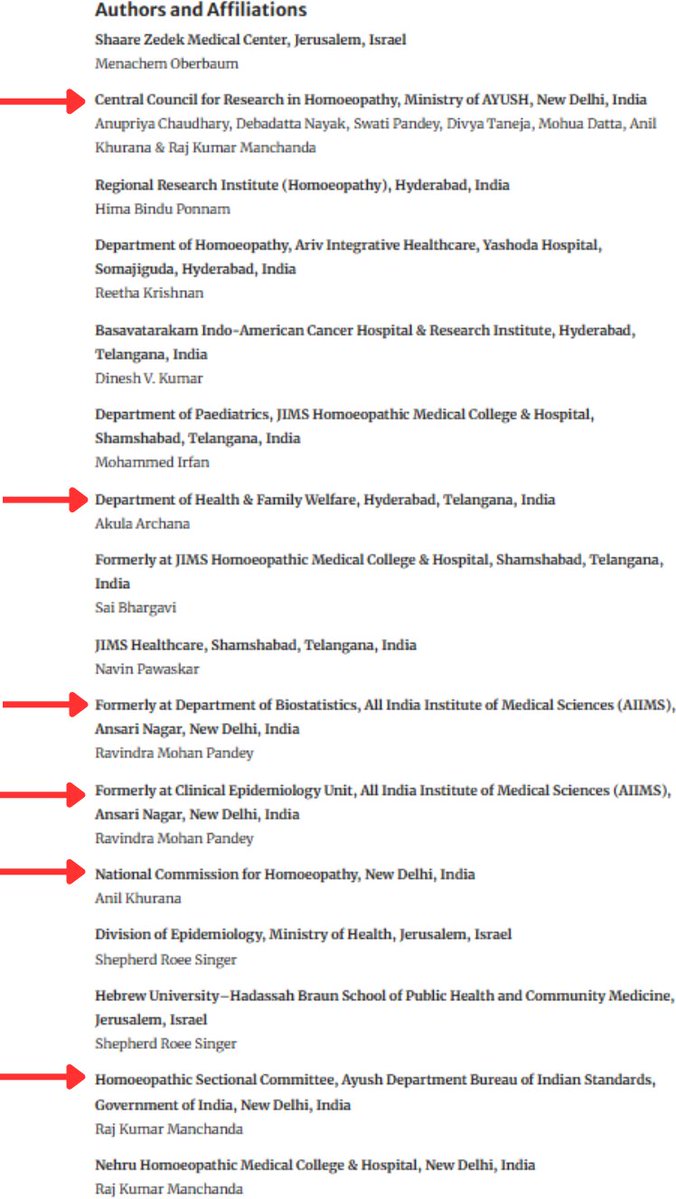
In December 2024, 'researchers' from multiple Indian Government Homeopathy institutions along with 'researchers' from Israeli Homeopathy institutes, published a randomized controlled trial that concluded that use of Homeopathic formulations in children during first 24 months of life reduced infections and antibiotics use compared to 'standard of care.' This was published in the prestigious European Journal of Pediatrics.
The study was viral. It was all over the media and news here in South India and also in some National media and was Whatsapp 'proof' of Homeopathy being better than modern medicine in infants. The study was used to promote anti-vaccine sentiments and Homeopathy products in South India. Homeopaths hailed the study as 'path breaking' - also because the Ayush Ministry and Government Homeopathy practitioners were study authors involved in it.
I read the study. I am trained in advanced statistics and research writing.
The study was utter nonsense. And fraud. It looked like the authors did not even actually perform the study. I really doubted whether any patients were involved at all.
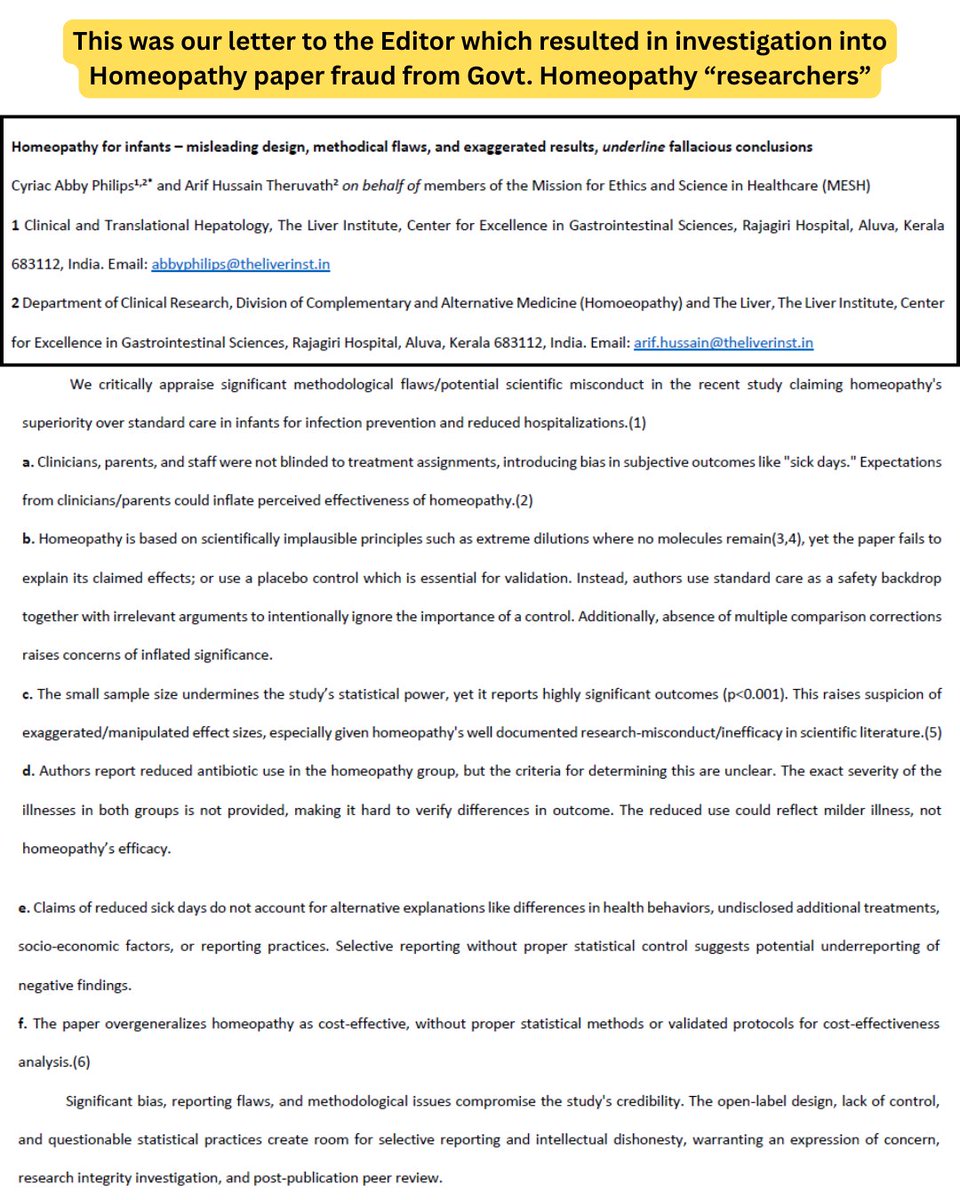
I wrote a letter to the editor of the journal, asking him to kindly review the paper and investigate 'scientific integrity' and ethics.
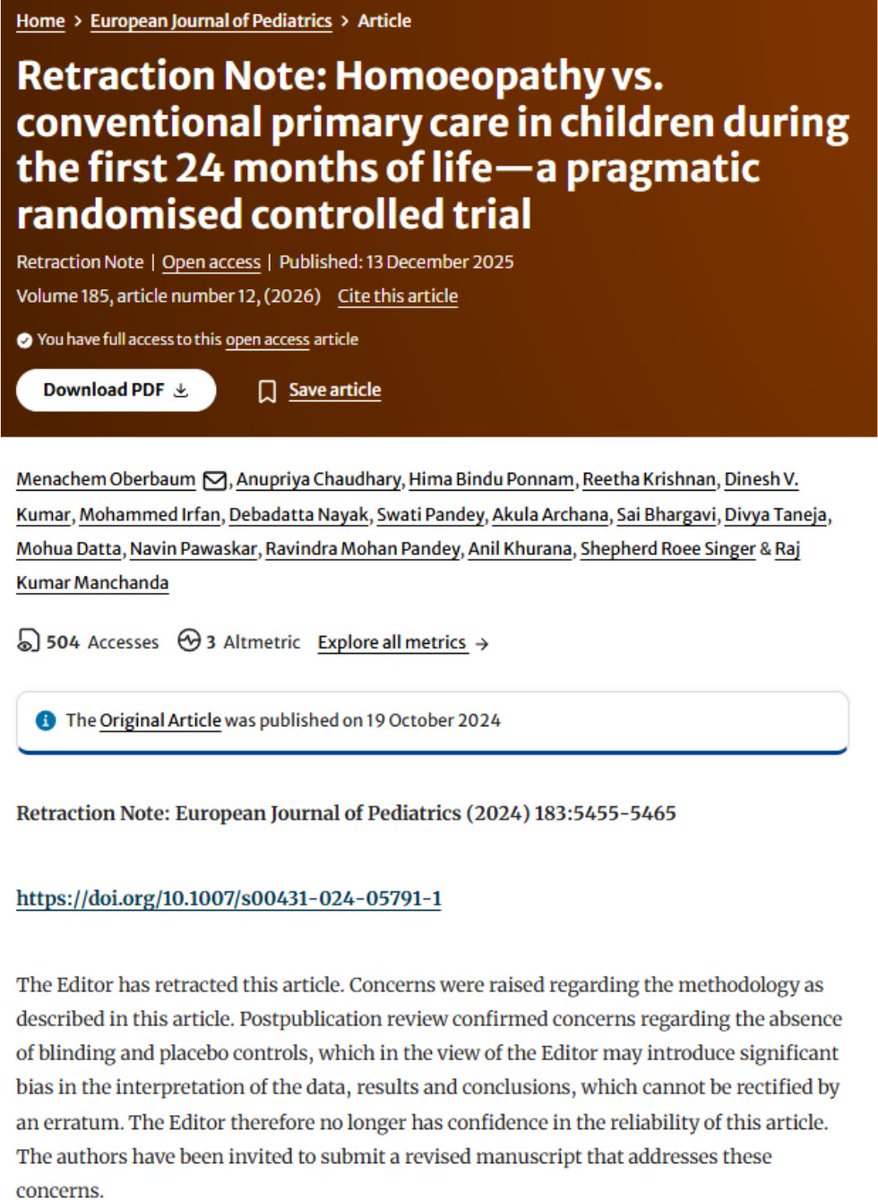
And after nearly 10 months of investigations by the Journal, Publisher and Research Integrity Team, we were proven correct.
The paper was fraud and now it has been RETRACTED. @RetractionWatch
The lesson here is that, if people really did understand what Homeopathy is and what its practitioners are, it is easy to find that it is clearly fraud. There is nothing in Homeopathy that works. It is unscientific utter nonsense. Every positive study on Homeopathy is mostly published in 'Homeopathy' journals. Sometimes, it infiltrates a real, valid journal (like in this case) and then it gets retracted because the scientific community is always alert.
There are many such instances: See - https://t.co/JHC3anPss3 and https://t.co/iDRNha2Yw5 and https://t.co/84S02zuxv3
The worst part here is that all these Homeopathy practitioners who are authors of the study are working in Indian Govt. public health sector - meaning, their salary is paid from public funds and citizens taxes. These wastrels are eating away our hard earned money and using it to fund fraud. Who will stop these criminals?
Even worse, the fraud, now retracted study was published as 'open access' in the European Journal of Pediatrics - which means, the authors paid £3090.00 GBP or $4990 USD, or €3990 EUR equivalent in INR to publish fraud. Where did they get this money from? Yes. Indian public tax money.
Homeopathy needs to be booted out of this country. Parents, do not send your children to study Homeopathy even though India offers a 5 year course and gives them a "Dr." title at the end of it. They are not doctors. They are legitimized frauds and legalized quacks, as you can see from this retraction.
"Homeopathy is a lively relic of the prescientific era. Not healthcare."
@arifhussaintm
Link:
https://t.co/0CxLrVMHDj
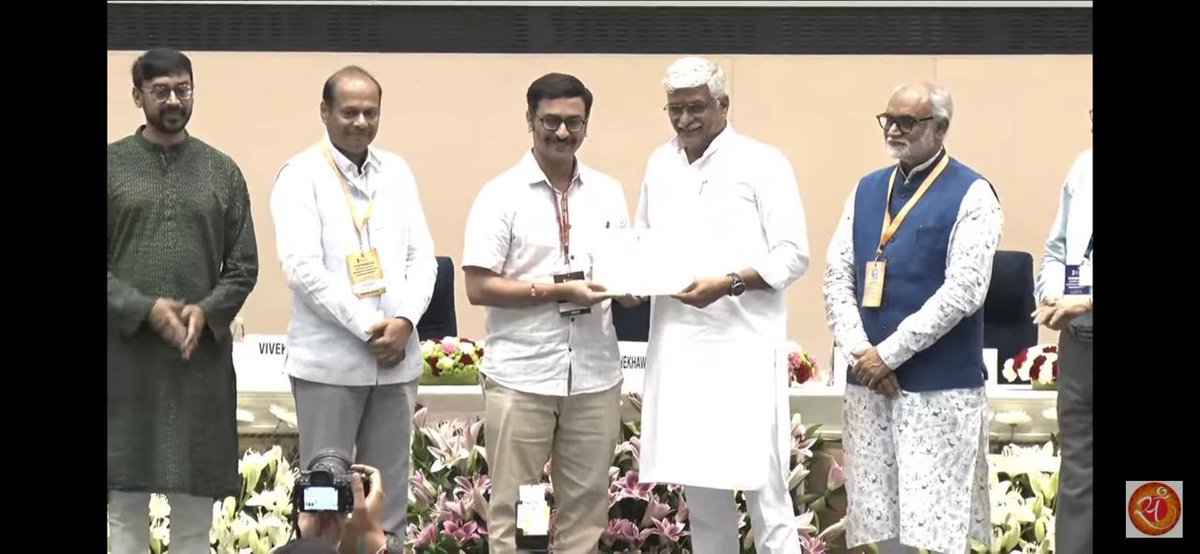
🎉 Proud moment for IIITH!
Prof. Ravi Kiran S @vikataravi's AI project on decoding historical manuscripts won 2nd prize at the GyanSetu AI Innovation Challenge, Delhi 🏆
Awarded by Shri Gajendra Singh Shekhawat in the presence of Fields Medalist Manjul Bhargava.
I am tired of linear ways of thinking with ChatGPT & Co.
I made a way to think that comes naturally to us. In branches & unlike strict docs
Whats next: get feedback, make it open to teams, improve interface
lmk wyt
@FarzaTV@_buildspace@sharifshameem@_nightsweekends
52 LAKHS for 160 plastic water jugs?
That’s ₹32,500 per jug! Are these made of gold @ChhattisgarhGov?
This is how public money meant for tribal welfare is looted shamelessly, under the nose of the system.
Who approved this? Who benefits from this scam?
Happy to announce the open-source release of Patram-7B-Instruct -- India’s first document vision-language foundational model trained from scratch. Patram outperforms larger models such as DeepSeek-VL-2. @huggingface link: https://t.co/JfJ7xgzbtw
More @ https://t.co/WZ5kejd6Bz
Use BezierFit to define a degree n bezier curve with control points or fit your curve with a degree n bezier using least squares approximation.
https://t.co/7I3Ub68A5v
#bezier#deeplearning#linearalgebra#lanedetection#detr
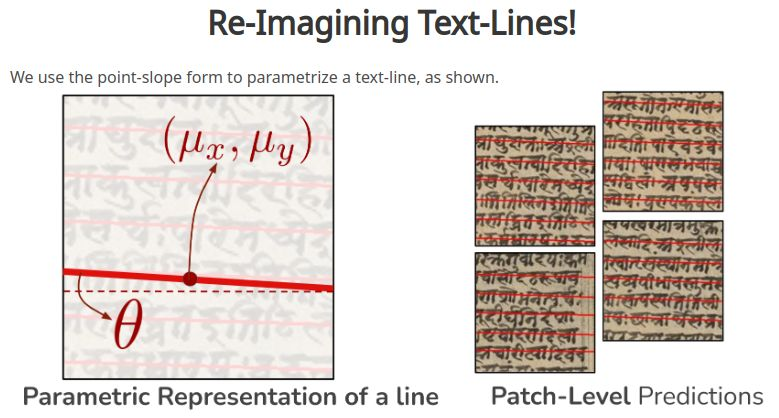
Thrilled to announce LineTR: A Unified Approach for Text-Line Segmentation, to be presented today at ICPR 2024! LineTR uses a parametric representation of a line, leveraging its inductive priors.
https://t.co/kaI3yn3CJ6
@ICPRConference@vikataravi@iiit_hyderabad