@TatTvamAsi33 Why and How MS got to recite subrabhataam and Vishnu sahasranamam is another wonderful tale of serendipity. In the end it is maybe nimitta...the great MS, the chosen one
@RahulGandhi Needed 4 days to post a speech delivered on 8th? Hanky Panky lag raha Hai! Didn't notice even one leader from dotted alliance talk abt this speech on 8th. Looks like studio recording after the meeting!
@ajitanjum Cong was never democratic pre or post -independence. Every dissent led to breakaway factions. Jan Sangh came coz of its undemocratic nature. So also TMC, NCP. Today's INC is also a faction masquerading as original. If one truly believes in democracy Cong must go into oblivion
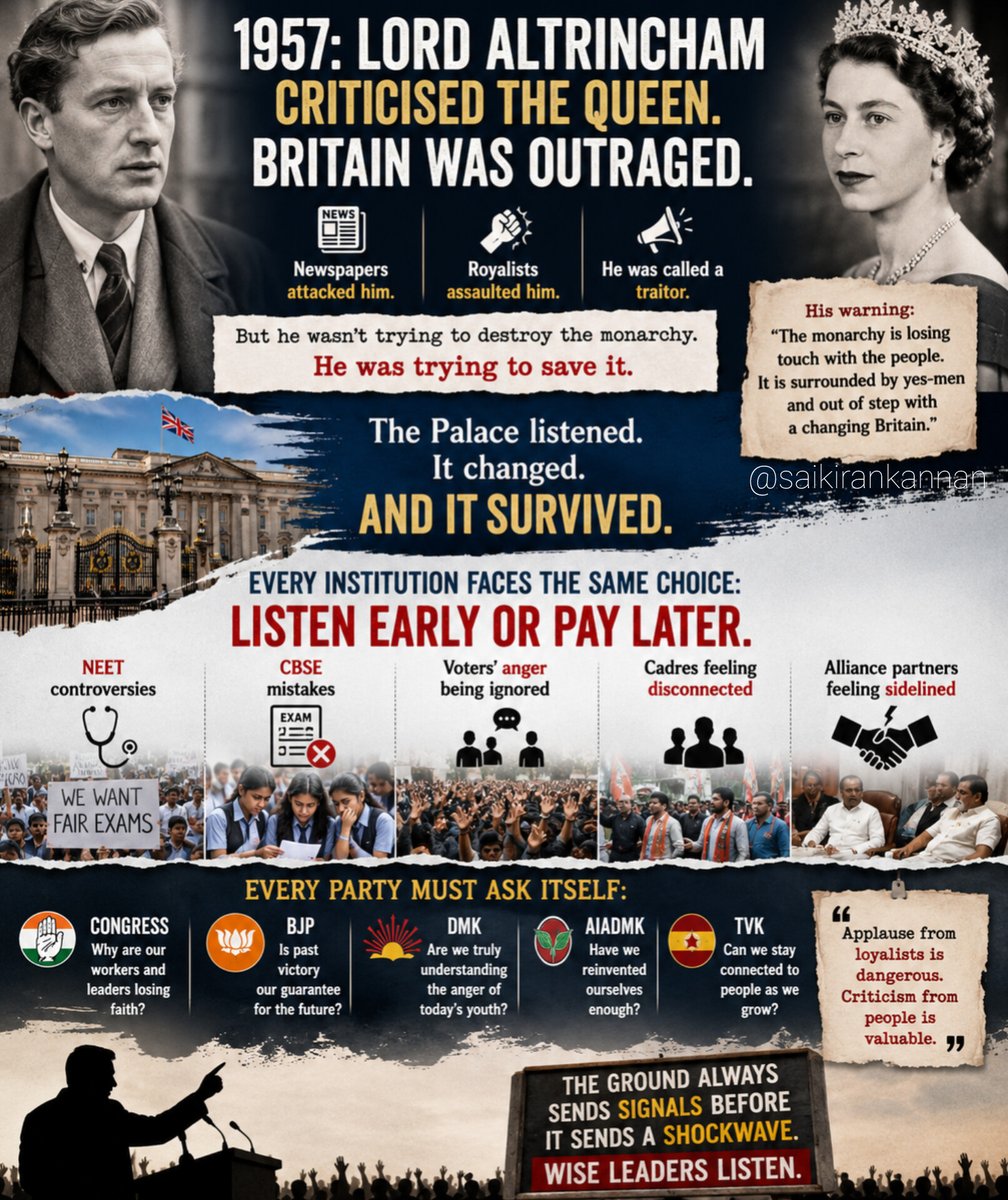
💡In 1957, a British aristocrat named Lord Altrincham did something almost unthinkable. He publicly criticised Queen Elizabeth II and Buckingham Palace.
The establishment, naturally, was furious. Then...the media attacked him. Royalists branded him a traitor.
One extremist politician even physically assaulted him. (Lord Altrincham was slapped if I'm not wrong!)
👉But history remembers him differently.
Lord Altrincham... wasn't trying to destroy the monarchy. He was trying to save it. He was a Lord after all.
His argument was simple:
~The monarchy had become surrounded by people who only told it what it wanted to hear.
~The Palace had become insulated from ordinary citizens.
~It was slowly losing touch with the mood of the country.
👉The uncomfortable truth is that every institution eventually faces this danger. Not just monarchies.
Governments. Political parties. Bureaucracies. Corporations.
Even media organisations.
And when institutions stop listening to criticism, decline begins.
Looking at India of today, this lesson feels more relevant than ever.
🔺When students and parents raise concerns about NEET, the answer cannot simply be "everything is fine." There has to be an acknowledgement of grievous mistakes made. Accountability...
When CBSE makes mistakes that affect lakhs of students, the response cannot be defensiveness.
When farmers, youth, middle-class taxpayers, small businesses or unemployed graduates express frustration, dismissing them as politically motivated is not leadership.
The same lesson applies to political parties.
>>The Congress leadership must ask why so many grassroots workers and regional leaders feel disconnected from decision-making.
>>The BJP must ask whether electoral success in the past automatically guarantees success in the future.
>>The DMK must ask whether the anger visible among sections of young voters, GenZ and urban middle classes is being understood early enough.
>>The AIADMK must ask whether it has genuinely reinvented itself after Jayalalithaa.
>>TVK, despite its current momentum, must ask whether it can avoid creating the same echo chambers that damaged older parties. I've mentioned about the "Power Centres" before...
Because political history is ruthless.
👉Parties rarely fall because their opponents become stronger. They fall because they stop listening.
The Congress once seemed unbeatable. The Left once dominated entire states. The AIADMK and DMK have both experienced periods when they believed victory was inevitable and even felt invincible! Today, BJP is in a similar position.
Every political giant eventually learns the same lesson.
Voters change. Society changes. Aspirations change. And if leaders fail to change with them, voters move on.
The greatest danger to any leader is not criticism from opponents. It is applause from loyalists.
Because loyalists often tell leaders what they want to hear. We've seen how MK Stalin was surrounded by such loyalists which became an echo chamber of sorts.
But...critics tell leaders what they need to hear.
Lord Altrincham understood something that many politicians across the world still struggle to understand:
~Criticism is not always a threat.
~Sometimes criticism is an early warning system.
~The institutions that survive are not the ones that silence criticism.
~They are the ones mature enough to learn from it.
~The ground always sends signals before it sends a shockwave.
~The wise listen to the signals.
👉The foolish wait for the election result.
"India against Corruption was always about Arvind Kejriwal. Anna was just a pawn.Arvind played him the same way Nehru played Gandhi. Anna became an innocent face for Arvind's nefarious politics and he succeeded."
- Raju Parulekar.
CJP will be the same
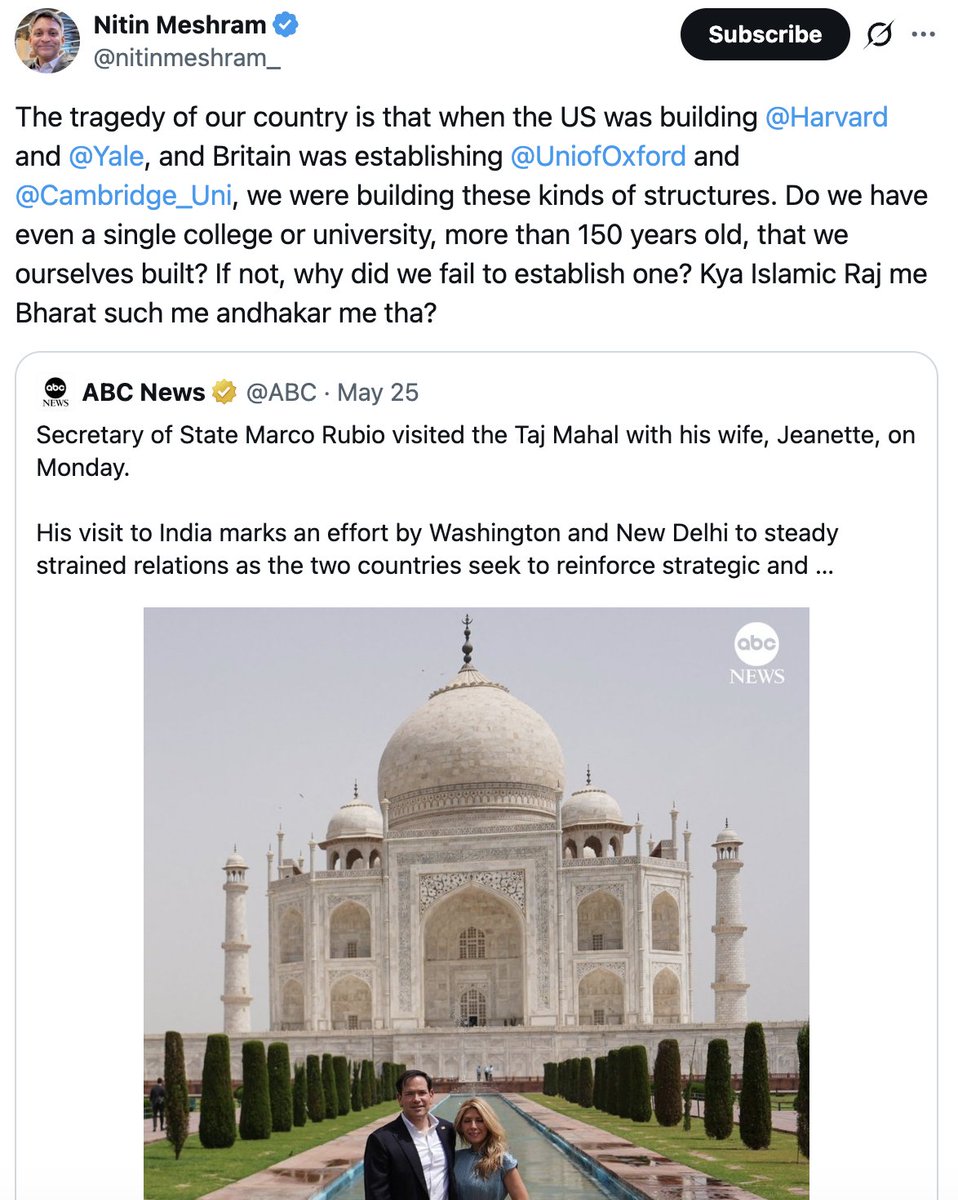
In the early 1700s, a tiny, cash-strapped theological school called the Collegiate School of Connecticut was on the verge of financial collapse. It desperately needed money to construct its very 1st permanent building in New Haven.
The school's trustees reached out to a wealthy London merchant named Elihu Yale. Yale had spent nearly 30 yrs working for the East India Company at Fort St. George in Madras (now Chennai) looting India & eventually rising to become the Governor-President of the settlement.
While in India, Elihu Yale amassed an immense personal fortune through private trading: specifically in Golconda diamonds, high-grade textiles & spices & by participating in the Indian Ocean slave trade. He was eventually ousted from his post by the East India Company for rampant illegal profiteering & corruption.
In 1718, responding to the school's plea for help, Elihu Yale sent a massive cargo shipment from London to Boston. The shipment did not contain cash. It contained:
- 9 large bundles of exotic Indian textiles (including fine muslins, calicos & silks from Madras).
- 417 books.
- A portrait of King George I.
The school sold the Indian textiles & goods in Boston for the staggering sum of £800, which at the time, was enough money to completely fund the construction of their brand-new wooden college building. In pure gratitude for this South Asian windfall, the trustees officially renamed the entire institution Yale College.
Yale University would literally not exist w/o India. Its very name, its 1st major building & its foundational survival were directly paid for by wealth extracted from India.
@kamleshksingh Aww..so rightly written..as someone said, all revolutions leave behind is just a new slime of bureaucracy! IMO one thing GenZ revile is cockroach and it is amusing that manipulators have coined CJP to attract GenZ. How in the world they will call themselves cockroaches?
The generation before ours first laughed at us, and then crushed our revolutionary ideas. We were confounded. And pissed. They forced us back onto what they considered the path. I cannot thank them enough.
We believed we were speaking truth to power, holding them accountable, demanding what was rightfully ours. The government was apathetic and used force when we went a bit off the rails. It was a beautiful time. Barely out of our teens, we had a purpose, a small following (there was no social media), and, God knows, the feeling that apun ich bhagwan hai.
What we thought were ideas were a product of age. Cultivated by manipulative agents provocateur, books we half-understood, and editorials we consumed (there were no reels).
The feeling went away. The curated anger was devoured by the desire to beat hunger and the hunger to succeed in a brutally competitive world, and the general hostility. What good of it remains is a heightened sense of empathy. That, and the pain in the shin that returns with the easterlies.
Change is constant and, constantly, a slow grind. The cockroaches, however cocky, are roaches. The ultimate survivors who can escape a nuclear event. May they not receive the blessing of a CRPF baton. Because that shit returns every time the easterlies blow.
@surjitbhalla Contradictory at many places without explaining reasons for macro economic paradox- he himself points out - finally boils down to one suggestion which is basically batting for FIIs. Looks like sensational HL n intentional initial misgivings to draw attention to only that matter!
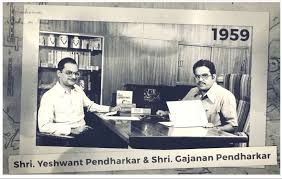
The name sounds British, but it is actually a purely Indian acronym. In 1952, a 55 yr old grocery store owner from Nagpur named Keshav Vishnu Pendharkar decided to shut down his shop, pack up his family of 10 children, & move to Bombay. He wanted to create a chemical-free, swadeshi alternative to the foreign cosmetic brands that were ruling post-independence India.
He started his business in a tiny, cramped godown in Parel, Bombay. He named his company after his father: Vishnu Industrial Chemical Company. V-I-C-C-O. There was no British Lord or foreign laboratory. It was just a middle-aged Marathi man & his sons working out of a shed with a dream to revive ancient texts.
Keshav Pendharkar’s brother-in-law held a basic degree in Ayurveda. Together, they huddled over ancient scripts & formulated a tooth-cleaning powder made from 20 rare herbs & barks (including Babool, Bakul, & Neem).They called it Vajradanti.
In the 1950s, urban Indians were rapidly switching to chemical, white, sweet-tasting toothpastes imported by MNCs like Colgate. When the Pendharkers tried to sell a brown, astringent Ayurvedic powder, shopkeepers laughed them out of their stores. Keshav & his sons refused to surrender. They literally walked the streets of Bombay, going door to door to hand out samples, educating people on how chemical foam was destroying their gums, & manually building their empire 1 household at a time.
In 1971, Keshav passed away, & his son, Gajanan Pendharkar, took over. Gajanan looked at the skincare market & saw it was utterly dominated by colonial-legacy snow creams like Afghan Snow, Pond's, & Nivea. All of them were stark white. Gajanan decided to launch a face cream containing Turmeric (Haldi) & Sandalwood oil. When the product launched, shopkeepers panicked. They screamed, "Baap re! If women put this on their faces, it will turn them yellow!" Nobody wanted to buy a yellow cream because the world had been conditioned to believe that beauty products had to be white.
The Pendharkars weaponized the traditional Indian wedding ritual of Haldi-Chandan. They sent salesmen into the markets armed with handheld mirrors. The salesmen would manually apply the cream onto the shopkeepers' faces right then & there to prove it absorbed completely into a vanishing base, leaving a glow w/o any yellow stains. If you remember the iconic jingle: "Vicco Turmeric, Nahi Cosmetic, Vicco Turmeric Ayurvedic Cream"... you should know that those words were not just a clever marketing tagline. They were a battle cry born from a massive legal warfare.
In 1975, the Central Excise Department of India dropped a bombshell on Vicco. They insisted on classifying Vicco Turmeric & Vajradanti as "Cosmetics." If classified as cosmetics, the govt could levy a crippling 105% luxury tax on the products, which would have priced Vicco completely out of the market & forced them into bankruptcy. The Pendharkars refused to pay. They argued that their products were manufactured under a formal Drug License & were Ayurvedic Medicines (Drugs), which attracted significantly lower taxes.
This was not a minor dispute; it turned into a historic, grueling 25 yr legal battle. The case climbed all the way up to the Supreme Court of India. While battling global giants in the market, the family spent their resources fighting their own govt in courtrooms for ~3 decades. Finally, in the 2000s, the Supreme Court ruled in favor of Vicco, legally decreeing that their products were indeed medicinal, cementing the truth of their tagline forever.
How did a homegrown brand from a Parel godown become globally famous? Through sheer marketing brilliance before the internet existed. In the 1980s, South Asian immigrants abroad were obsessed with watching Bollywood movies on rented VHS video cassettes. Gajanan Pendharkar realized this & started buying ad space directly inside the video cassettes distributed globally.
Long before foreign networks recognized Indian brands, families in the US, UK, & Middle East were singing along to the Vajradanti jingle before their favorite movie started.
Despite controlling a multi-million dollar empire, the house had only 1 giant mega-kitchen. Every single meal was cooked in massive industrial-sized pots, & the entire family sat on the floor together to eat. Gajanan believed that if the family broke bread separately, the business would fracture into pieces.
In the early decades, the sons & grandsons who worked for Vicco did not get individual corporate salaries/luxury allowances. The company took care of all household expenses centrally. If a family member needed a car/a dress/a medical trip, it was cleared by the family elders, ensuring that personal greed could never overtake the company's mission.
Vicco did not survive because it was backed by British capital/Western tech. It survived because an Indian family was willing to go door to door with brown tooth powder, rub yellow cream onto skeptical faces, & spend 25 yrs in court defending the scientific validity of Ayurveda. The name might sound like a colonial legacy, but the blood inside the tube is Sampoorna Swadeshi.
It's a pity that today in TN there are leaders who even question the link of Vande Mataram with our land and culture. In 1907, Bharathiyar translated Bankim Chandra's Vande Mataram, with a notable revised stanza published in his pamphlet Swadesa Gitankal. As a journalist and editor of journals like India and Vijaya, he promoted Vande Mataram. Bharatiyar's song "Vande Mataram enbom" became a an anthem in Tamil Nadu, often used in protests. Here is a small glimpse of his Vande Mataram sung by @ranjanigayatri
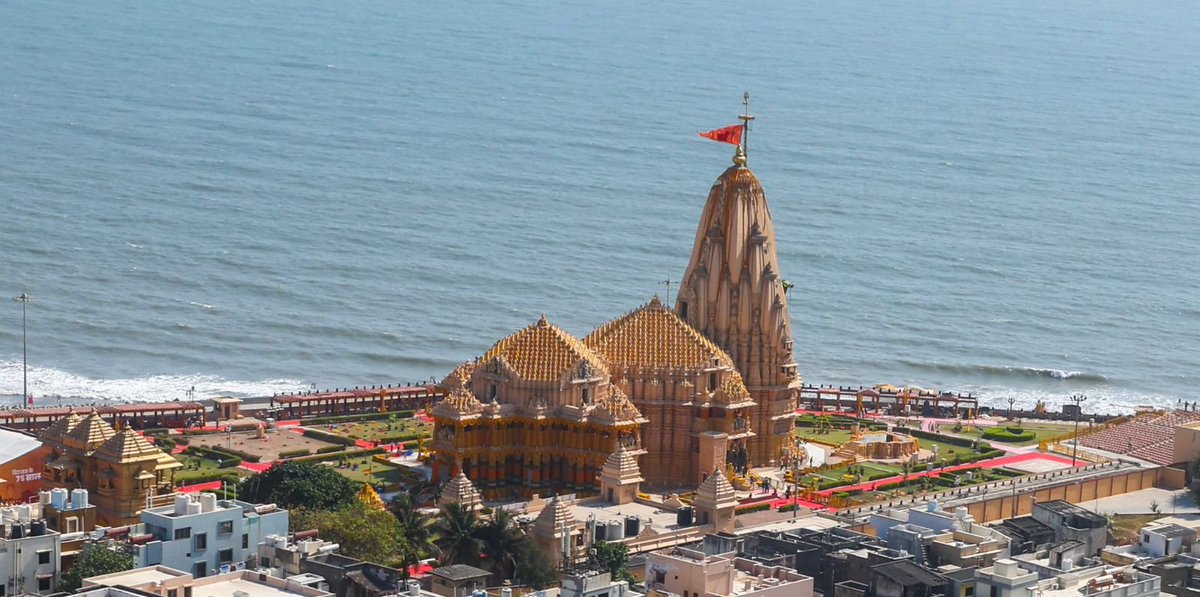
Took this photo while on the way from Somnath to Vadodara…
On the shores of Prabhas Patan, the Somnath Temple stands tall as a radiant symbol of devotion, history and civilisational spirit. It has outlasted barbaric attacks, invasions and the passage of centuries. It is eternal. Somnath gives every Indian strength, courage and hope.
Har Har Mahadev!
It is so appropriate that India's national anthem invokes Lord Krishna as the eternal charioteer of her destiny
The national song “Vande Mataram” personifies India as Divine Goddess Mother:
Vande Mataram
Sujalaam suphalaam
Malayaja sheetalaam
Shasya-shyaamalaam Mataram
@RapperPandit Exactly, will congress, left, all seculars etc boycott National anthem too?!..well, i also didn't know the entire version.. but had deep resentment coz song written for a King was turned into national anthem.
Haha! The irony is almost poetic.
You invoke “Cyrus the Great”; yet the only people who truly preserved his civilizational flame are the Parsis, those very Zoroastrians who fled Persia when the Islamic wave crushed their world and found refuge in Bharat. You follow the faith that uprooted them; they carried the legacy you now claim.
Let’s talk some facts @IraninSA .
Out of 167 fire temples recorded globally (as of 2021), around 150 stand in India; 45 in Mumbai alone; while barely a handful survive in Iran. Of the nine highest-grade Atash Behrams, eight are in India and just one in Iran. The rest; Agiaries are smaller shrines, quietly sustained by a displaced community.
That is the record of preservation which we can narrate through the geography of memory.
And yet, you speak of “Cyrus” as if you are his civilizational heir.
Strip away pre-Islamic Persia, and what remains of that continuity? The invocation of Cyrus today is just appropriation by a poor civilization. A symbolic borrowing to manufacture a lineage that history itself interrupted.
You mention the Cyrus Cylinder. Have you actually read it?
It speaks of:
A) Restoration; not erasure (that you do).
B) Returning displaced peoples;not subjugating them.
C) Multiple gods; not enforced singularity.
Cyrus freed the Jews from Babylon. Your ideological descendants call for their annihilation.
Cyrus restored temples. Your system erased them.
Cyrus respected plurality. Your framework struggles to accommodate it.
And yet, you say “we”; as though you stand in seamless continuity with those Zoroastrians whose very existence was made untenable under the order you now defend.
That “we” is a false projection.
The Cylinder itself is clear: Cyrus returned gods to their sanctuaries and allowed exiled communities to reclaim their homelands. It aligns with the Biblical account of Jews returning from Babylon to rebuild Jerusalem. It is a document that stands as antithesis of your view.
Your regime, in contrast, stands as its inversion.
You persecute dissenters, enforce conformity, and punish those who refuse to bend to imposed codes. And yet you invoke Cyrus; the very ruler who rose against such oppression.
In fact, the parallel is uncomfortable. Cyrus defeated Nabonidus to end tyranny. Today, the ideological posture you defend resembles far more the ruler Cyrus replaced than Cyrus himself.
And then comes the grand claim; “first charter of human rights” which was propaganda of even last Shah whom you despise. Interestingly you both are on the same page for this propaganda.
It was amplified under the last Shah during the 2,500-year celebration of Persian monarchy; ironically by a regime hardly synonymous with human rights (I agree that— even that regime was not so great). You have just elevated tyranny to next level.
The British Museum itself has clarified that such declarations were common across Mesopotamian kings long before Cyrus. The Cylinder is part of a broader Near Eastern tradition;not an isolated Iranian invention.
To elevate it as a uniquely “Iranian human rights manifesto” is a non-scholarly stand.
The truth is stranger; as well as harsher.
A civilization that once shaped empires now seeks validation through fragments of a past it no longer embodies. The sermons of the 7th century severed Persia from its own civilizational continuity.
And what remains today is this contradiction:
“Invoking Cyrus; while standing against everything he represented.”
Written in lighter vein maybe?
But still if it's true then reverse must also hold good...do the white/light skinned non-brahmins/dalits feel l 'privileged' like brahmins due to their skin colour? Unlikely!
The paradox of being a dark-skinned Brahmin
The dark-skinned brahmins pass through Indian privilege inside a skin that Indians associated with another people*
People of the same race and caste in India come in different colours. So there is a cruelty of perception but without the fellowship and solidarity of the dark-skinned*
An unsung fact of Indian mediocrity… is that it is populated with very ‘presentable’ people.
*
My column in the Mint
https://t.co/J6y9wUcJjW