Our 57th annual conference at @LancasterUni on 9-11 September 2026 was a great success. In this final, summary post on it, we thank once again the keynote speakers, @PierpaBenigno , Eric Swanson, Ester Faia & Lucio Sarno (a photo of each below), the chairs and presenters
1/3
Pablo Hernández de Cos speaks about “Artificial intelligence, growth and financial stability: challenges for central banks” at the Global Fintech Fest @GffFintechfest@RBI#GFF2026#AI https://t.co/cvrg5oioPc
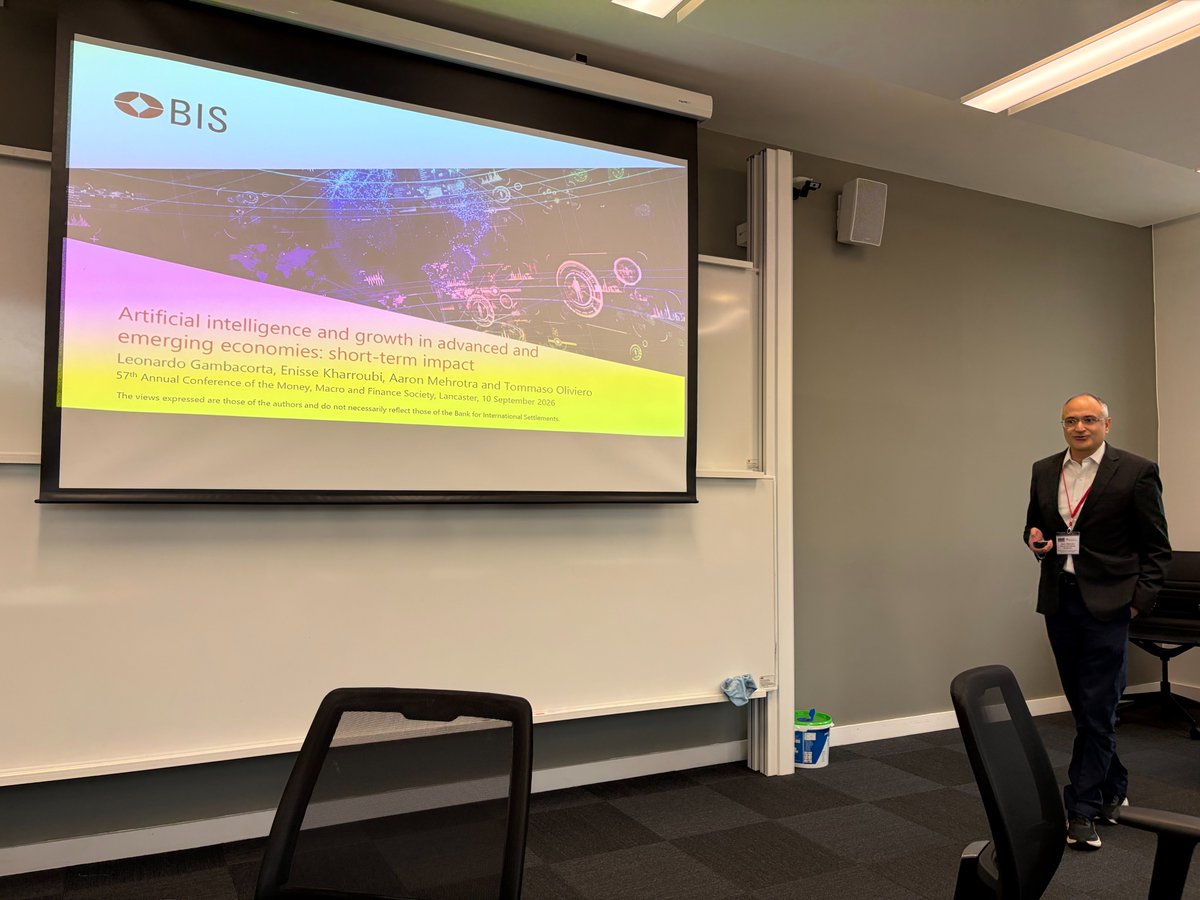
The 2nd day of the MMF annual conference at @LancasterUni is now featuring another topical special session, by the @BIS_org, on AI, the Macroeconomy and Monetary Policy. We list the presentations below and add a photo for each speaker:
1/3
Cross-border bank credit expanded by $1.7 trillion in Q1 2026 and by 11% year-on-year, driven by double-digit growth rates in credit to banks and non-banks
Read more: https://t.co/ZZmugJ32XW
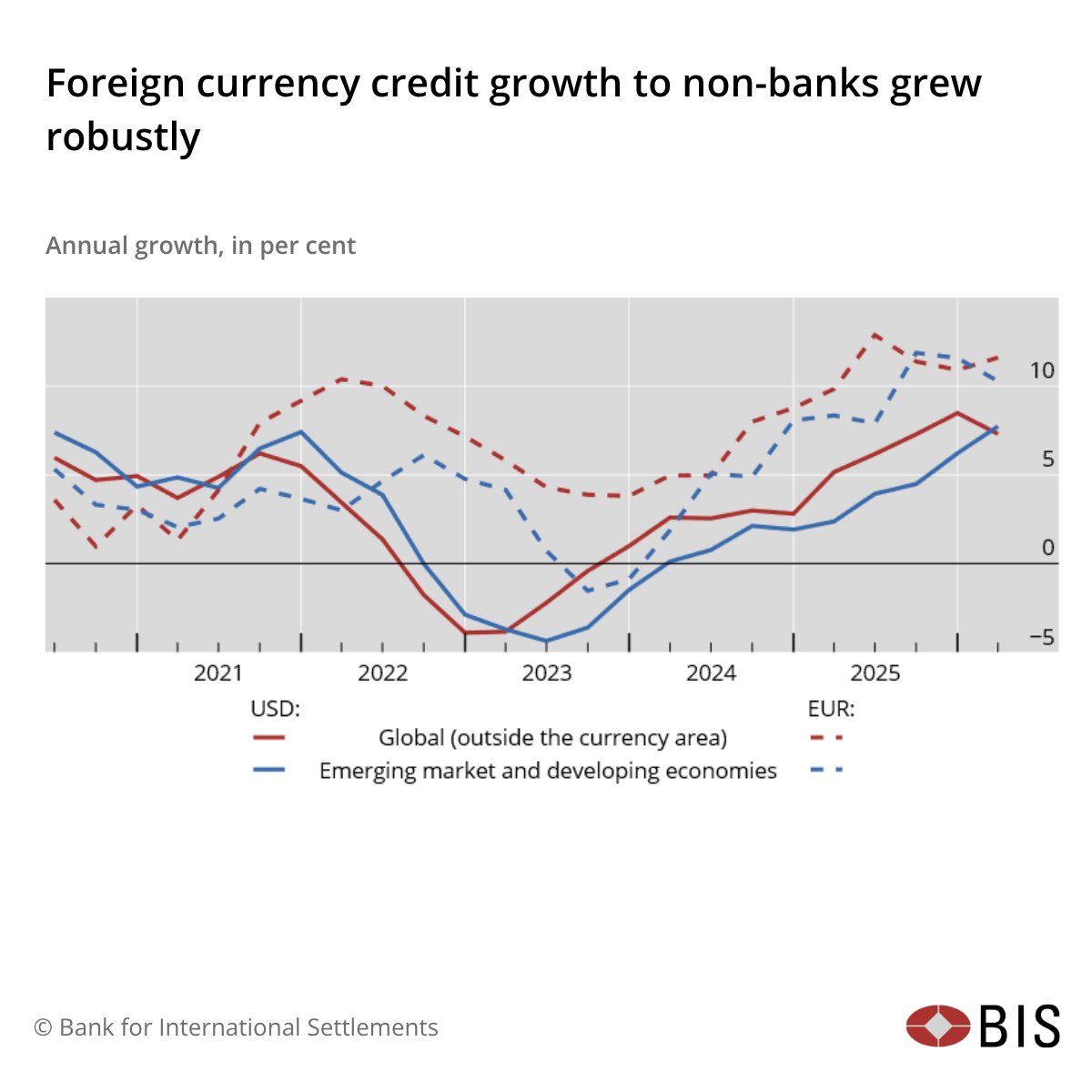
The BIS global liquidity indicators show that foreign currency credit denominated in US dollars and euros continued to grow robustly, with the latter expanding at a relatively faster pace.
Read more: https://t.co/F9Xo9r1PDa
Super interesting!
"What drives exchange rate pass-throughs? Evidence from a non-parametric method" by Emanuel Kohlscheen and Aaron Mehrotra.
"We provide new evidence on the drivers of the pass-through of exchange rate movements into consumer prices across four decades and close to a hundred countries, combining econometrics and random forests. Random forests are particularly useful for modelling highly non-linear relationships, as well as for identifying the relative importance of the different theoretical factors that can affect the degree of pass-through. We find that the size of the economy, which tends to be related to the extent of pricing-to-market, and the level of inflation emerge as the factors most strongly associated with exchange rate pass-through, followed by product homogeneity and the volatility of the exchange rate. As we show, several of these covariates display a non-linear relation with exchange rate pass-throughs. We also document important implications of macroeconomic policy regimes and outcomes, including those related to fiscal policy, for exchange rate pass-through."
https://t.co/acwVjjpNKX
What drives the strength of exchange rate pass-through into consumer prices and what’s the relative importance of the different factors? See the new BIS Working Paper https://t.co/e0Ahllasab
Super interesting!
"Dollarisation and monetary control: what lessons for the rise of stablecoins?" by Boris Hofmann, Aaron Mehrotra, and Jan Paulick.
"The emergence of stablecoins has created a new channel to access US dollar liquidity in emerging market and developing economies (EMDEs), similar to the historical role of foreign currency deposits, or "deposit dollarisation". This has raised concerns about the possible implications for monetary control in EMDEs. Drawing on data on foreign currency deposits and dollar-pegged stablecoin inflows for more than 130 economies, we compare the dynamics and drivers of "stablecoin dollarisation" with those of conventional deposit dollarisation. We document that historical deposit dollarisation and recent stablecoin flows are both associated with similar macro-financial drivers, including the strength of exchange rate pass-through and sovereign or banking crises. We further document significant persistence in both deposit and stablecoin dollarisation, suggesting that dollarisation is hard to reverse once established. Unlike deposit dollarisation, stablecoin flows seem to be largely unaffected by either broad or specific capital flow restrictions. This likely occurs because stablecoins are partly circulating outside the regulatory perimeter. The historical record also suggests that moderate deposit dollarisation has been associated with somewhat higher inflation risks, although there is little evidence of significant impacts on monetary policy transmission."
https://t.co/GZkO9pNbmh
Highly relevant!
"Public debt and monetary policy transmission: evidence from advanced and emerging Europe" by Christopher Johns, Aaron Mehrotra, and Fabrizio Zampolli.
"Using high-frequency euro area monetary policy shocks and panel local projections for the period 2001-2020, this paper examines how macroeconomic variables respond based on the level and the maturity structure of public debt. The results show that public debt plays a significant role in influencing monetary policy transmission. Higher public debt is associated with a weaker response of prices and inflation expectations to tighter monetary policy, while output declines at least as much as in low-debt economies. The maturity structure of debt also matters in a non-linear way: debt at intermediate maturities is associated with weaker effects, whereas debt at very short and long maturities is associated with stronger effects. Fiscal responses indicate a lack of contemporaneous fiscal backing, as primary balances tend to deteriorate following monetary tightening. Finally, for non-euro area European economies, the paper introduces a novel dataset on public debt maturity profiles and shows that spillovers from euro area monetary policy depend on the maturity structure in the receiving economy."
https://t.co/NJUvU4KDOt
ICYMI -🎙General Manager Pablo Hernández de Cos on the Annual Economic Report: AI's risks, leveraged hedge funds in sovereigns, the fiscal-financial stability nexus and policy priorities. Watch the full video: https://t.co/N4Iork4fXg
#BISAnnualEconReport
Does public debt alter monetary policy transmission? Yes, and both the size and the maturity of debt matter. Our new BIS Working Paper https://t.co/xqMKatxaHR provides new evidence for Europe. #MonetaryPolicy#PublicDebt#FiscalPolicy#BIS
New BISness #podcast episode: Gaston Gelos and Frank Smets on stablecoins, tokenisation and safeguarding trust in money in the future monetary system 🎙 https://t.co/jR2gqCcsg3
#BISAnnualEconReport
🎙General Manager Pablo Hernández de Cos on the Annual Economic Report: AI’s risks, leveraged hedge funds in sovereigns, the fiscal-financial stability nexus and policy priorities. Listen to the full podcast: #BISAnnualEconReport https://t.co/IQ14BwFrHN
BIS Annual Economic Report: the fiscal-financial stability nexus – high debt plus a growing role for non banks in sovereign debt markets – may amplify stress and create challenges for central banks. Read more at https://t.co/hRAOTmAJk9 #BISAnnualEconReport
Resilience in 2025 driven by progress in AI, but heightened risks of rising inflation, uncertainty over the sustainability of the AI investment boom, financial fragilities, near record-high public debt, plus the Strait of Hormuz shock call for policy discipline.
This year’s #BISAnnualEconReport sets out how policy can safeguard stability amid inflation pressures, #AI investment risks, financial fragilities, high public debt and a new fiscal-financial stability nexus. https://t.co/YV2mFvVnXi
📅 Coming soon: The BIS Annual Economic Report 2026, released this Sunday, 28 June, will cover a new fiscal–financial stability nexus, inflation risks, AI boom risks, financial fragilities and high public debt, and look into policy priorities. #BISAnnualEconReport
How should policy shape the future monetary system? Gaston Gelos answers this question from the #BISAnnualEconReport Chapter III. Read the full chapter: https://t.co/IQKPwEXGwl