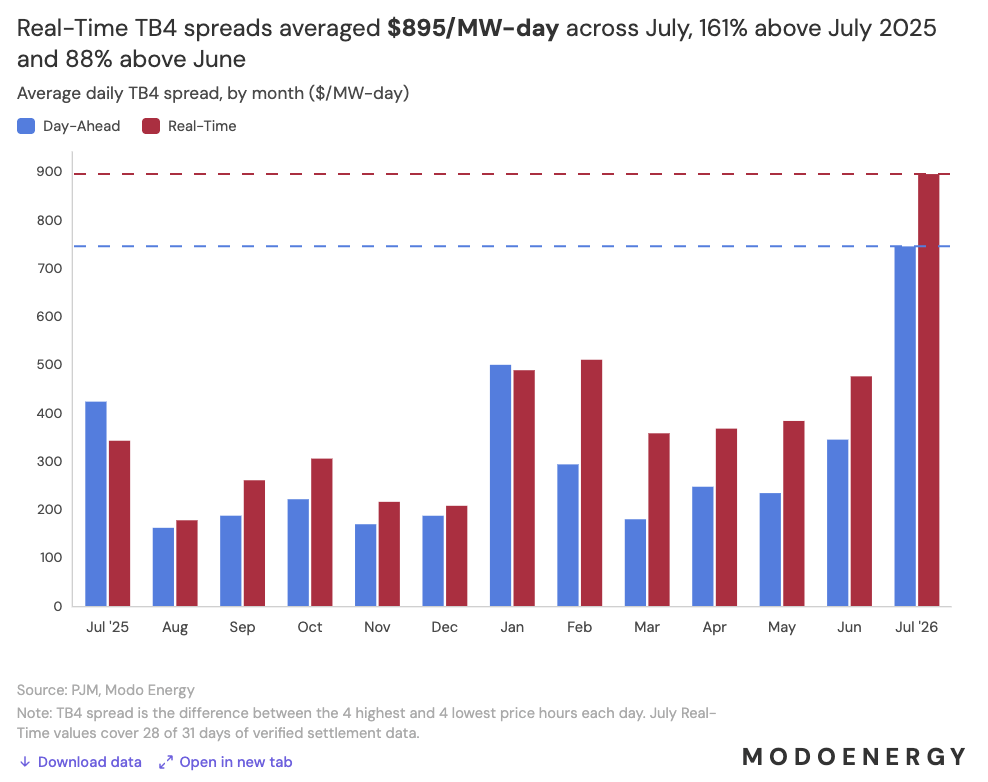
Record heat in PJM sent July's TB4 spreads soaring. Real-Time spreads averaged $895/MW-day, up 161% on last year and 88% above June.
Almost all of it came from three days. An extreme heat wave over July 1 to 3 carried 56% of the month's entire spread.
July 2 broke records across the board: an all-time PJM peak load, and the hottest average temperature the grid has ever recorded at 97°F. Washington DC hit 102°F, breaking a mark that had stood since 1872. That single day carried a quarter of the month's spread, worth 14 ordinary trading days.
Full breakdown on the Modo terminal, link in the comments below.
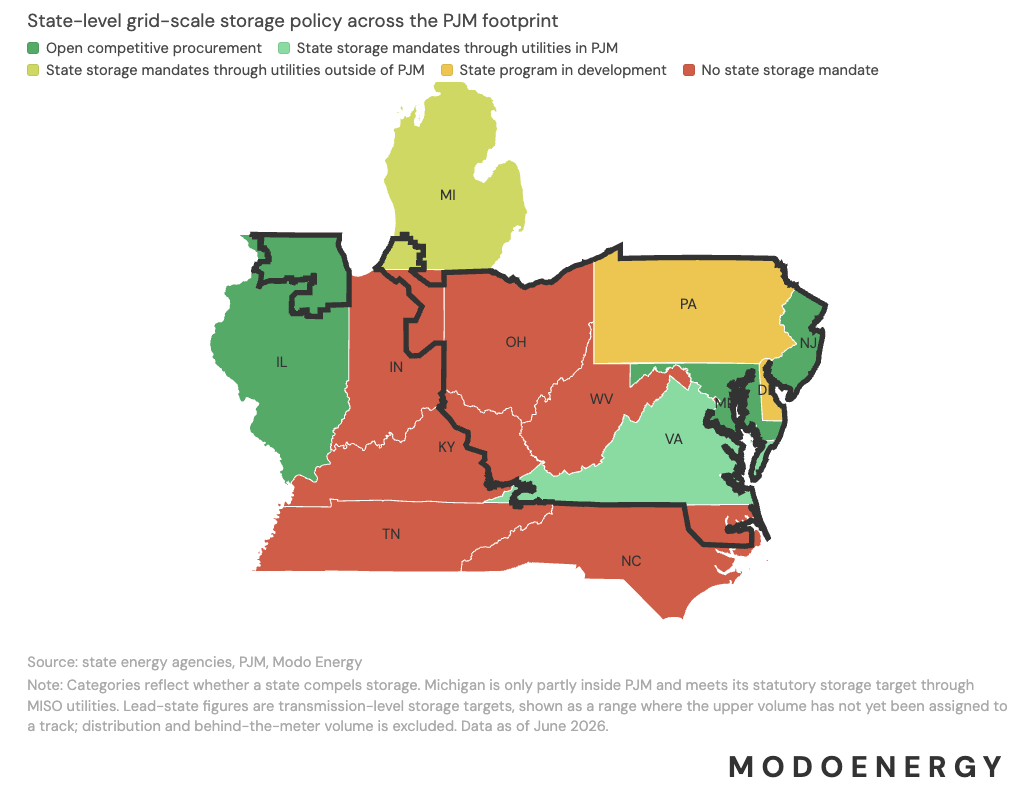
Four states are driving PJM's storage buildout, each use a different model:
NJ: fixed incentive, developers keep market upside
MD: hedges capacity revenue
IL: hedges the entire revenue stack
VA: utility mandate, mostly Dominion
Full breakdown: https://t.co/IteNTNIlZT
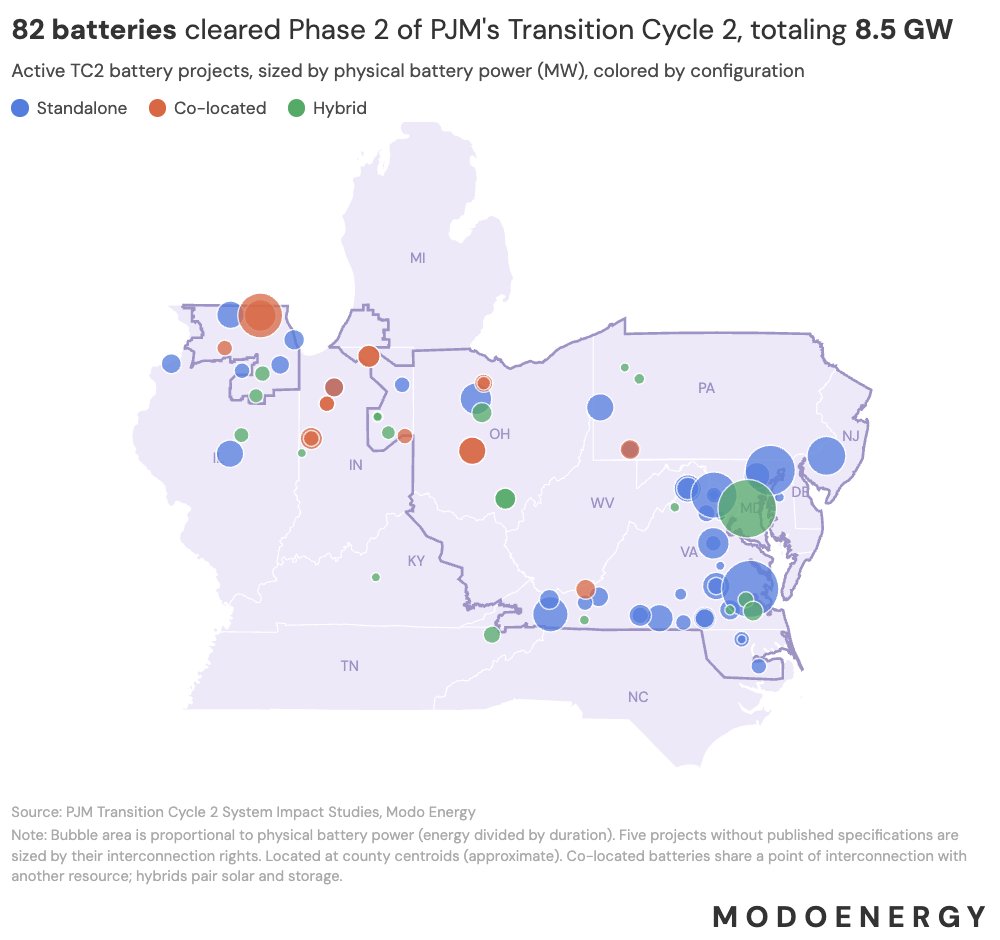
82 batteries cleared Phase 2 of PJM's Transition Cycle 2, totaling 8.5 GW of interconnection rights.
That's 28% of the active queue. Storage is now a meaningful share of what's moving through PJM's pipeline.
A few takeaways from this checkpoint in the cluster study:
1. Virginia leads by a wide margin. 33 of the 82 batteries are sited there, at 3.2 GW. Illinois is next at 1.5 GW, then Maryland at 1.3 GW.
2. Long duration is starting to show up. Nine ten-hour projects cleared, mostly solar-paired systems in the Midwest.
3. PJM's two new fast-track policies did little for storage. Transferable capacity rights went mostly to solar (14 of 18 projects), and the Reliability Resource Initiative went almost entirely to gas. Just 3 of its 41 active projects are batteries. Both were meant to speed capacity into a tight market, and both mostly favored other technologies.
4. Interconnection costs vary widely, and not with project size. They run from about $3,000/MW to $1.9M/MW, with a median near $151,000/MW. These costs will likely decide which projects drop out of the queue next.
To see the full analysis, check out the full article on the Modo Energy terminal. Link in the comments.
PJM storage policy: New Jersey, Maryland, and Illinois run competitive procurements. Virginia mandates utility storage. Michigan mandates utilities only outside PJM's footprint. Pennsylvania and Delaware are forming programs. Remaining states have no policies.
PJM's capacity auction cleared at the cap again for DY 2028/29. But the uncapped numbers are even crazier: without the cap, the RTO-wide price would have cleared at $555/MW-day, with ComEd reaching $777/MW-day. There's clearly still a lot of work to do to address reliability needs in the coming years.
Full analysis: https://t.co/AlMkrKlB3x
PJM's capacity market is in a "credibility trap." Prices high enough to spur new builds trigger interventions that cap them. The ISO's white paper offers three paths out of this trap. Which path forward do you think we'll see in the coming years?
Source: https://t.co/14ozKPojPs
also at grid scale, and in particular PJM, projected large load growth is almost entirely data centers. i'm just not sure why we're pretending otherwise. weird disconnect, as PJM is quite open about this being the major driver requiring a fundamental overhaul
@fancy_1982@edcporter Good question. The historical EQR numbers here are energy and ancillaries only, no capacity showing up for the PJM battery fleet. The $72/kW-month modeled stack does include capacity though, $5/kW-month assuming full BRA participation.
@shiyam_kashfiq@edcporter Cycle 1 timing is mostly PJM's call, prices don't really speed up the study process. What teams can adapt is portfolio prioritization (which projects to keep pushing vs withdraw) and how they underwrite reg revenue given the Phase 2 timeline.
@pskpspspss@edcporter That's exciting! BGE is the place to be for arbitrage, hard to imagine that system tightness easing any time soon. Regulation prices will probably settle by the time your batteries clear the queue though, especially once Phase 2 splits RegUp/RegDown this October.
PJM battery revenues averaged $62/kW-month in Q1 2026, triple the pre-redesign rate. The October 2025 regulation market overhaul unified Reg A and Reg D into a single ancillary service. Regulation now accounts for $56/kW-month of the revenue stack.
I moderated a roundtable earlier this week at a storage conference on energy storage + load growth in PJM.
The main Q: CAISO & ERCOT have ~10,000 MW+ of storage each. PJM has <500 MW. Wtf??!!
Several developers & investors raised great points worth sharing.
1- Renewables penetration
- This is an obvious one, wind + solar is not huge in PJM unlike ERCOT or CAISO creating less volatility. PJM States import a lot of RECs from MISO
- But hey, SPP has HUGE amounts of wind, LOT of negative pricing, and less batteries than PJM!! Clearly RE penetration is not the only reason and anyway this will change with lot of solar coming online
2- ELCC risk
- With not much energy arbitrage, capacity market is important for revenues. But storage accreditation is variable and projections are heading down. For 4-hr, from ~60% ELCC today to just 25%(!!) in 2032. Investors are obviously wary
- One solution: allow storage & large loads to contract resource adequacy risk bilaterally, or BIGPAL. Load flexes if storage runs out. No impact on the rest of the market, maximum contractual flexibility & innovation
- Another one that came up A LOT: LDES. Short duration ELCC risk is driving lot of interest in long duration storage (12hr+) that would get ~100% ELCC. I was surprised to see so many developers mention LDES. Keep an eye on this one, particularly with LDES mandates also under discussion in several PJM States.
3- Storage bidding in the energy market
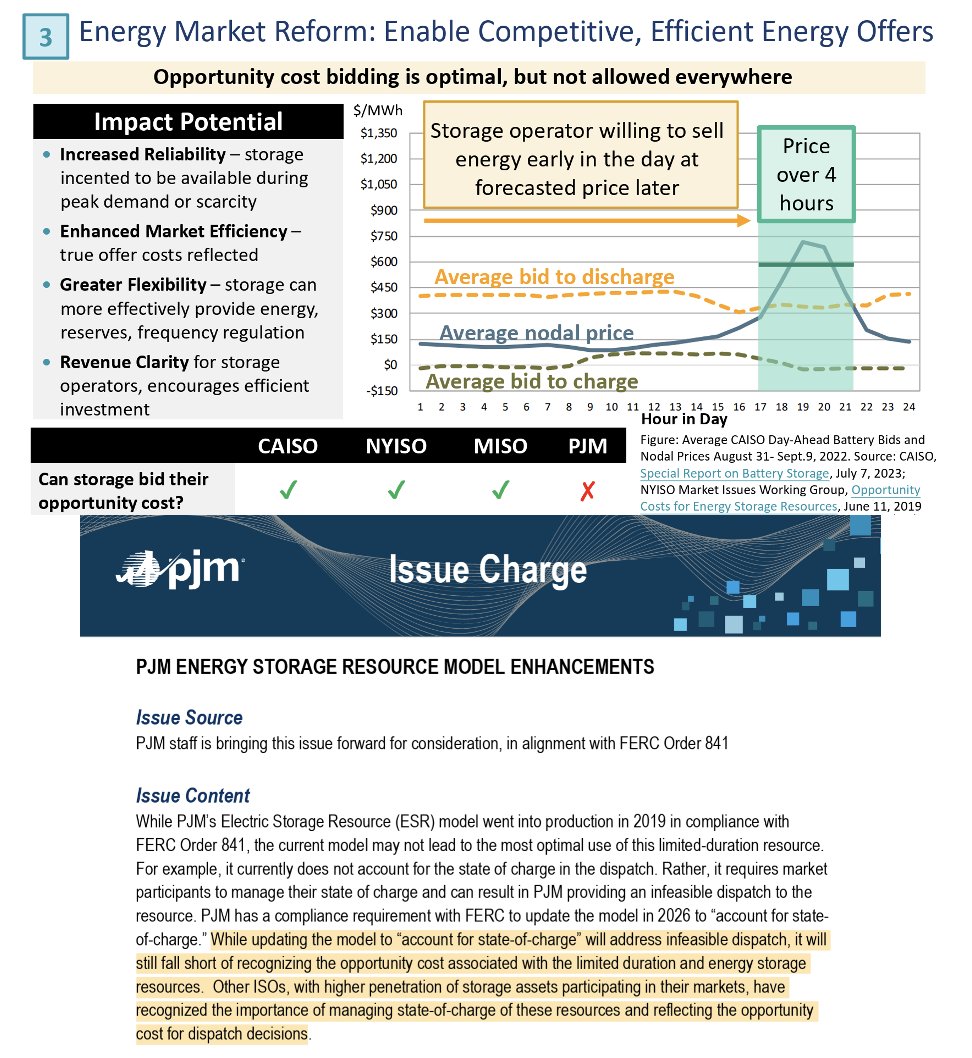
- B/c of the market monitor’s focus on market power mitigation, batteries cannot bid their opportunity cost in PJM. They can only bid their charging cost. This is crazy and needs to change
- Thankfully, PJM has recognized this and is undertaking a stakeholder process to allow short duration resources to bid their opportunity cost. Freedom & markets! 🇺🇸
4- Surplus IX Service
- Can wind/solar developers use their surplus IX capacity to add batteries? A developer pointed out this is completely unusable for wind. Because the capacity injection rights are SO LOW compared to wind ELCC, adding storage has no RA value.
- It’s the opposite for solar though, expect to see more movement there
5- Future outlook: A LOT of storage is coming on
- 2,300 MW was approved in the RRI expedited queue
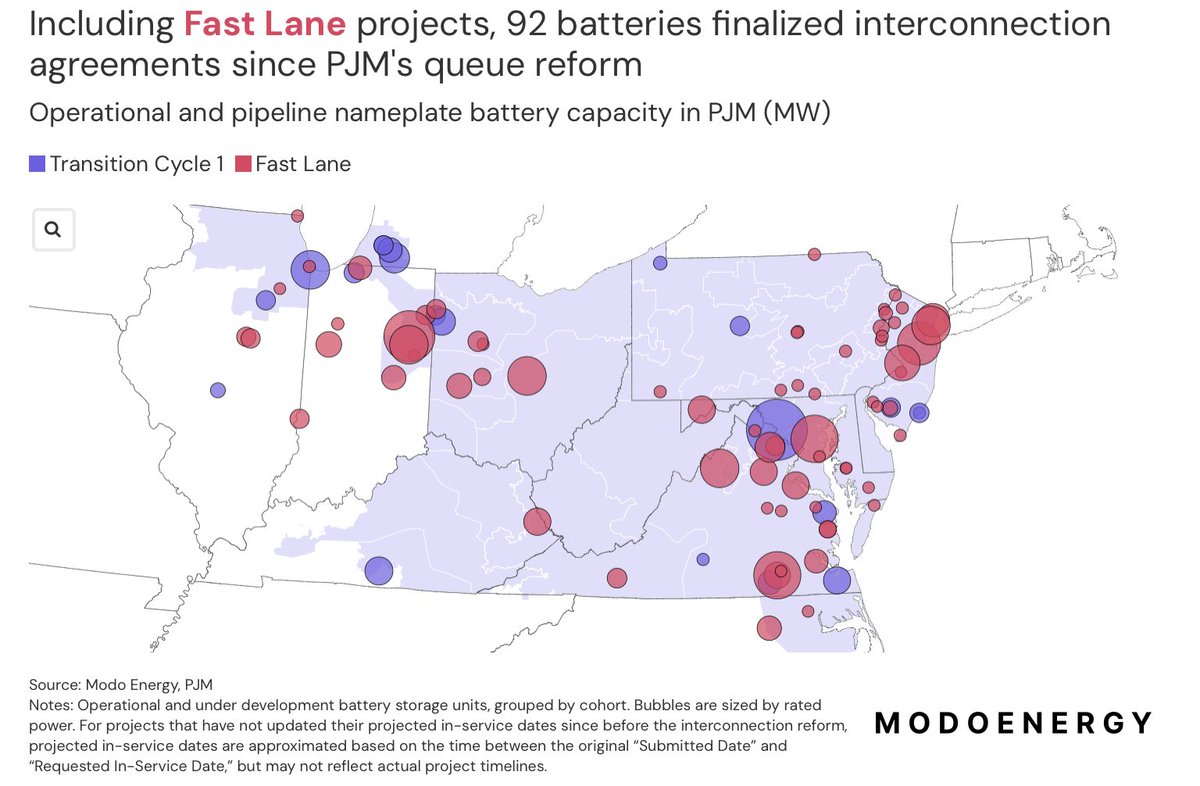
- 6,400 MW already has an IX agreement across Fast Lane + TC1 queue as per great data from Modo Energy
- Load growth, IX queue reforms, as well as mandates from MD, NJ, VA are going to keep pushing this
- Co-location docket will also create opportunities for storage to directly site with large loads, if PJM can expand some of the configuration options
NY's demand growth components tell a clear story: a fundamentally transformed grid is coming. Steeper ramps, longer overnight stress, and winter overtaking summer as peak season by 2039.
Source: https://t.co/FB45dtlO7M
PJM's latest capacity auction hit the $333/MW-day price cap and cleared 6.6 GW short of its reliability target. 8 proposals are now on the table to close the gap for future auctions. Excited to see how results shift in June 2026...
Source: https://t.co/MfC2SFhpTU