Germany pays roughly €4bn a year for congestion management. That’s the cost of a grid that can’t always move power from A to B.
Batteries can bring that number down. But integrated poorly, very large ones could push it up.
Wilhelm Kiewitt, Head of Energy Economics at @50Hertzcom, makes two points worth sitting with:
TSOs are still learning how batteries work commercially. Operators, investors, developers, tolling. Understanding that structure matters for how batteries are integrated.
Bringing congestion costs down means not adding uncertainty. That’s why the four German TSOs published joint battery requirements in May, aiming for a sweet spot between operational freedom and predictability.
Full conversation below
#BESS #EnergyStorage #Germany #Energiewende #GridCongestion
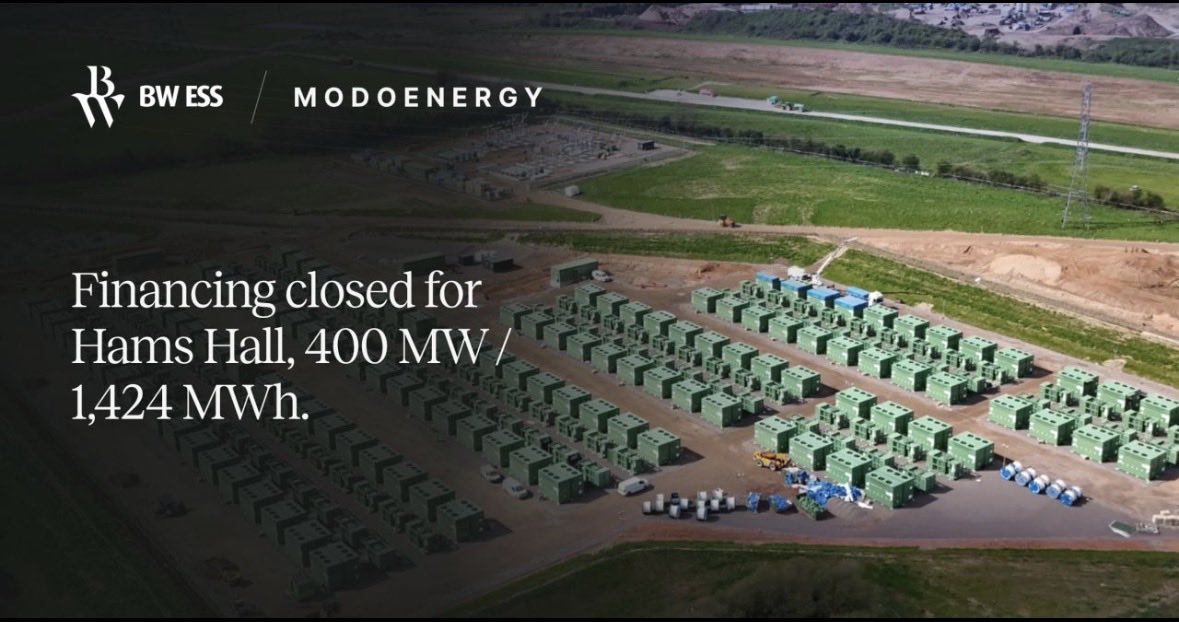
Congratulations to the BW ESS team on closing financing for Hams Hall, and to all their project partners.
It's really cool to see projects of this size come through, and I'm excited to see the scale of what's coming down the pipeline.
At a time when our power markets are increasingly stressed and we need flexibility, this is the news we need to see.
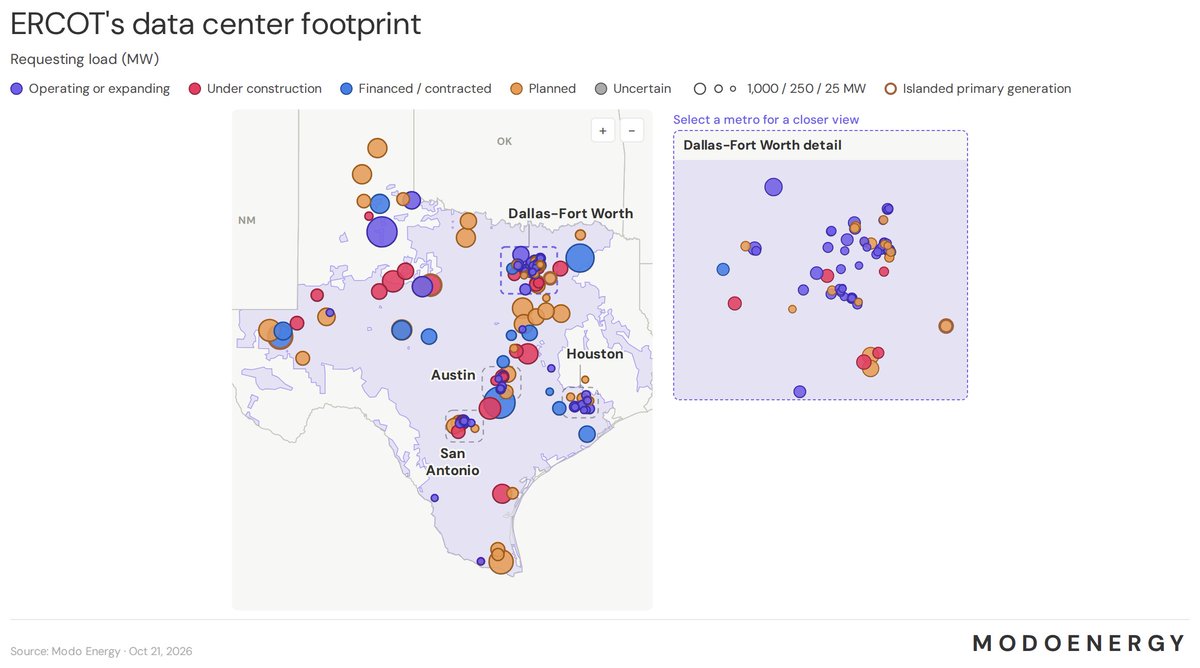
ERCOT: Modo tracks 92 GW of data center load in advanced planning as of October 21, spanning Dallas-Fort Worth into West Texas and the I-35 corridor. But these projects are heavily phased, so the timing and volume hitting the grid depends on how customer ramps actually land.
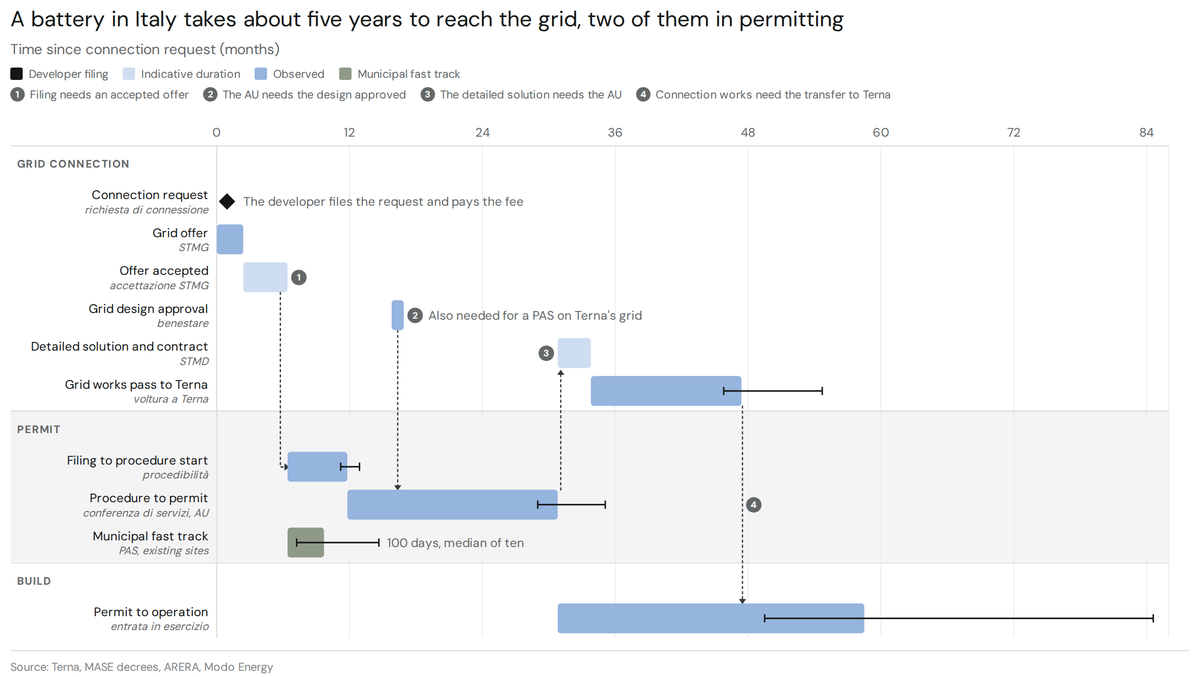
Italy: a standalone battery takes about five years from first grid request to operation. The bottleneck is permitting at MASE, where median review time rose from 12 months in 2024 to 19 months in 2026 as requests piled up. Terna issues its grid offer in about two.
Renewable curtailment has two main causes: insufficient demand and transmission congestion.
Low demand is seasonal. In California, most solar curtailment happens in spring. Daylight hours are getting longer, but mild temperatures keep air conditioning load low, so solar output exceeds what consumers need.
Congestion is geographic. The strongest wind and solar resources, in far West Texas and the California desert, are far from the cities and data centers that drive demand. When transmission capacity between them runs out, generation gets curtailed at the source.
Explore curtailment across US markets with Ko, your AI energy analyst, on the Modo Energy terminal.
#Curtailment #ERCOT #CAISO #Transmission
Around 13.5 GW of data center campus capacity is connected or seeking connection to SPP. Google, IREN, Beale, STACK, Core Scientific and Nebius account for about two-thirds of it.
Further growth depends on customers paying for connections and new supply.
NESO's Ten Year Outlook 2026 has 13 GW less wind in 2030 than last year's outlook, with offshore down from 40.8 to 33.6 GW. From 2030 it adds 4 to 6 GW of offshore a year, against 1.3 GW connected in 2025. Modo Energy forecasts 3.2 GW a year from 2030, reaching 48 GW by 2036.
🎧 Transmission: Germany: 50Hertz saw around 180 battery connection requests this year, more than 80 GW, roughly the country's entire peak demand.
https://t.co/KQMVCUByPs
Until recently, Germany’s transmission grid got a handful of connection requests a year. But big power stations are slow to build. Batteries aren’t.
Over the last two years, 50Hertz alone has seen 100+ applicants, most of them batteries.
→ 30+ GW of new connection capacity offered
→ 14 GW of batteries with grid reservations, projects starting 2029 or earlier
→ A starting point of less than 1 GW
On top of that, 50Hertz received around 180 more battery applications this year, totalling 80+ GW. Germany’s peak demand is about 80 GW.
How much of it will actually get built? Wilhelm says it’s the question that keeps 50Hertz awake at night.
Wilhelm Kiewitt, Head of Energy Economics at @50Hertzcom, on Transmission with @Edcporter.
#BESS #EnergyStorage #Germany #Energiewende #GridConnection
Curtailment is when a solar or wind farm that could be generating is instructed to reduce output or switch off.
It usually comes from one of two constraints. There may be more supply than the grid can absorb in that area, or there may not be enough transmission capacity to move the power to where demand is. In both cases the resource is available, but the system can’t use it.
That lost output costs asset owners directly. Most renewable PPAs only pay for energy delivered, so curtailed generation usually earns nothing.
Ask Ko, your AI energy analyst, about curtailment across US markets on the Modo Energy terminal.
#Curtailment #Renewables #EnergyMarkets #PowerGrid
The optimiser is one of the most underpriced risks in battery storage.
For any BESS with merchant exposure, revenue depends on who is dispatching the asset. Grace Kankindi, Deputy Head of Investment at Aquila Clean Energy, says investors need to get two things right:
Aligned incentives. An optimiser chasing short-term revenue can degrade the battery aggressively, at the expense of its long-term health and value.
Market understanding. In Germany, dynamic grid fees could soon vary by location and change every 15 minutes. Optimisers will need to read local grid signals as well as wholesale prices.
Also, don’t just pick the lowest profit share in a tender. 3% of a weaker number can leave you worse off than 5% of a stronger one.
Full episode of Transmission below.
#BESS #EnergyStorage #BatteryStorage #Germany
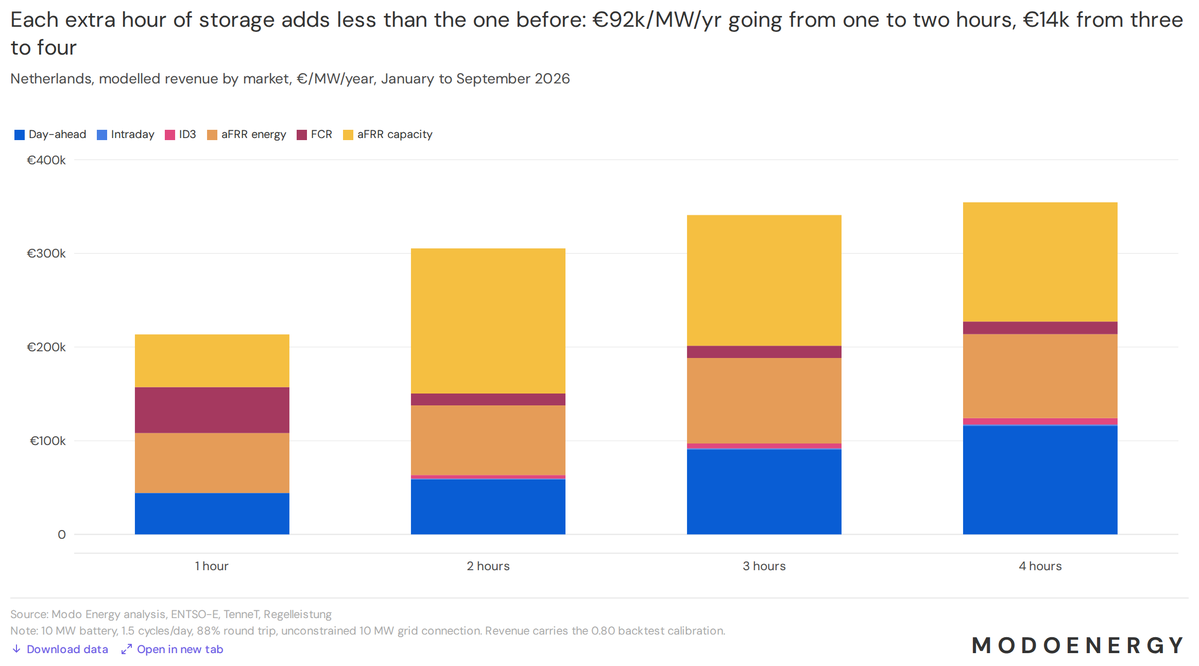
Netherlands: a 2-hour BESS with full grid connection earned €305k/MW/yr over the first nine months of 2026. The jump from 1 to 2 hours adds the most, €92k/MW/yr, because it unlocks upward aFRR capacity. A 1-hour battery can't guarantee its aFRR obligation.
Google had contracted 1 GW of demand-response capacity with US utilities by March 2026. How reliably can data centers deliver those reductions while keeping customers online?
- 3 grid events in 2024 saw Google reduce machine-learning electricity demand with Omaha Public Power District.
- 6 MW of Digital Realty’s uninterruptible power supply capacity joined Ireland’s frequency-balancing program.
- 99.99% service availability allows about 53 minutes of downtime a year.
Batteries and generators can keep servers powered while grid imports fall. Moving or delaying computing depends on spare capacity and customer deadlines.
The 1 GW measures contracted capacity. Repeated delivery across commercial AI campuses still needs more evidence, and brief battery responses do not demonstrate coverage through prolonged shortages.
Link below for the full article.
One of the best short documentaries I've seen explaining why the energy transition is no longer just about generation, it's about the grid and, increasingly, storage. #SWB#Bettrification#EnergyTransition
Key takeaways:
• Britain doesn't have a wind problem, it has a transmission problem. Scotland produces more wind power than the grid can carry south.
• Consumers pay twice: wind farms are paid to switch off while gas plants are paid to switch on elsewhere.
• Batteries are scaling rapidly but there still isn't enough storage to absorb surplus renewable energy during major grid constraints.
• The solution is clear: more transmission, more batteries, more flexible demand like EV charging and AI data centres, and smarter market design.
The lesson extends far beyond Britain. Curtailment isn't a failure of renewables, it's evidence they're growing faster than the rest of the system. The answer isn't less wind and solar, it's accelerating the infrastructure around them.
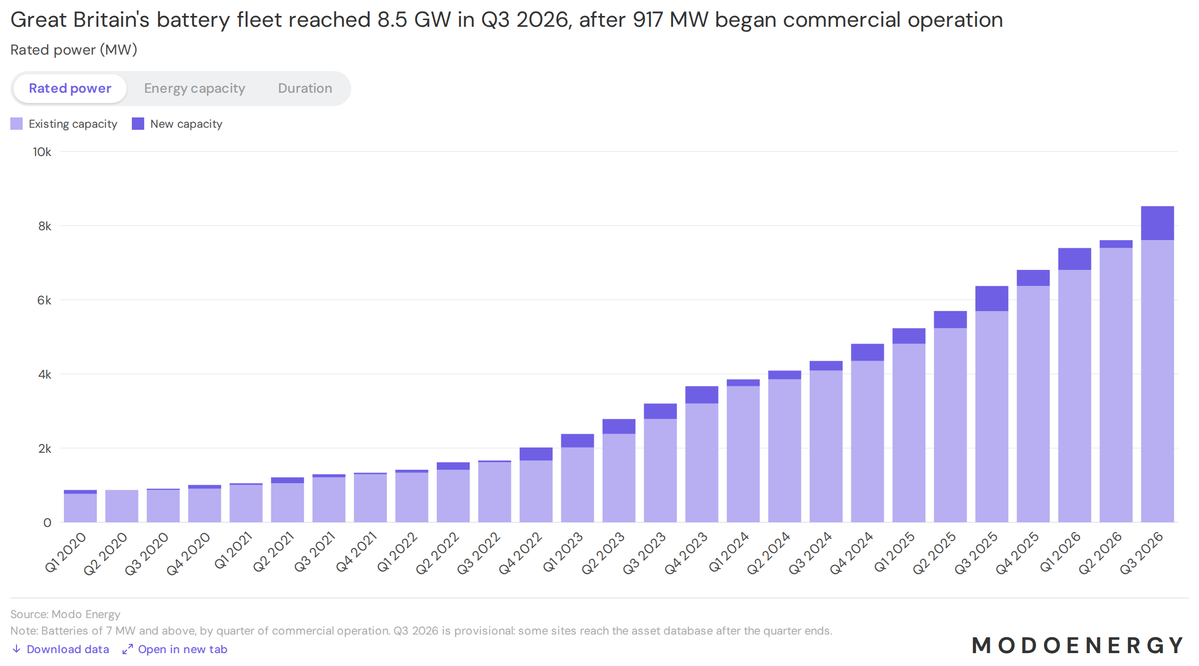
Great Britain: Q3 2026 added 917 MW / 1,844 MWh of batteries, a record quarter that took the fleet to 8.5 GW / 14.4 GWh. Coalburn 1 came online at 500 MW, now the largest site in GB. Revenues held up too, with the ME BESS GB index up 23% as capacity grew 12%.