🎧 Transmission: Germany: curative dispatch, using batteries to manage constraints rather than build around them, could free up 30-40% more grid capacity without new lines.
https://t.co/Ilo6sa8ZWg
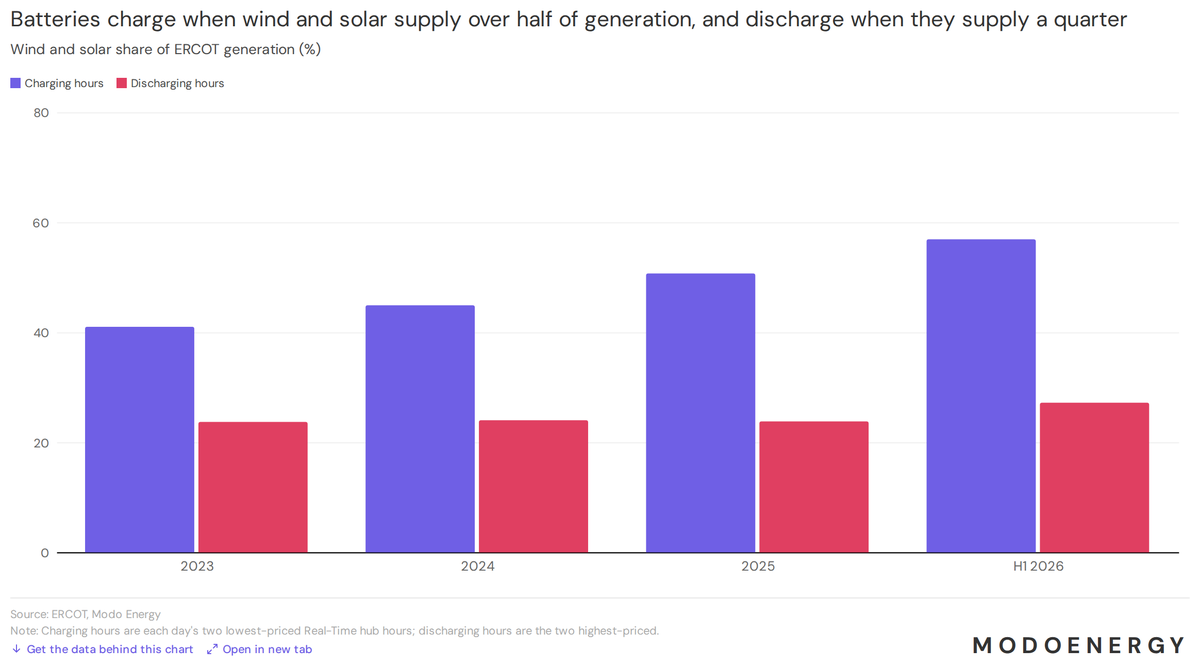
ERCOT: Texas approved hourly energy certificates, which stamp every MWh with the hour it was produced. Batteries can't generate clean power, but they can shift it to evening when it's scarcest. If that spread runs $10 to $20/MWh, a 2-hour battery earns $6 to $13/kW-yr.
CAISO: a 4-hour battery commissioned today needs $12.6/kW-month for a 10% IRR. Merchant revenues are on track to end 2026 just shy of $2.5/kW-month. Even as they recover from today's lows, that still leaves them below half of what a project needs. No offtake, no bankability.
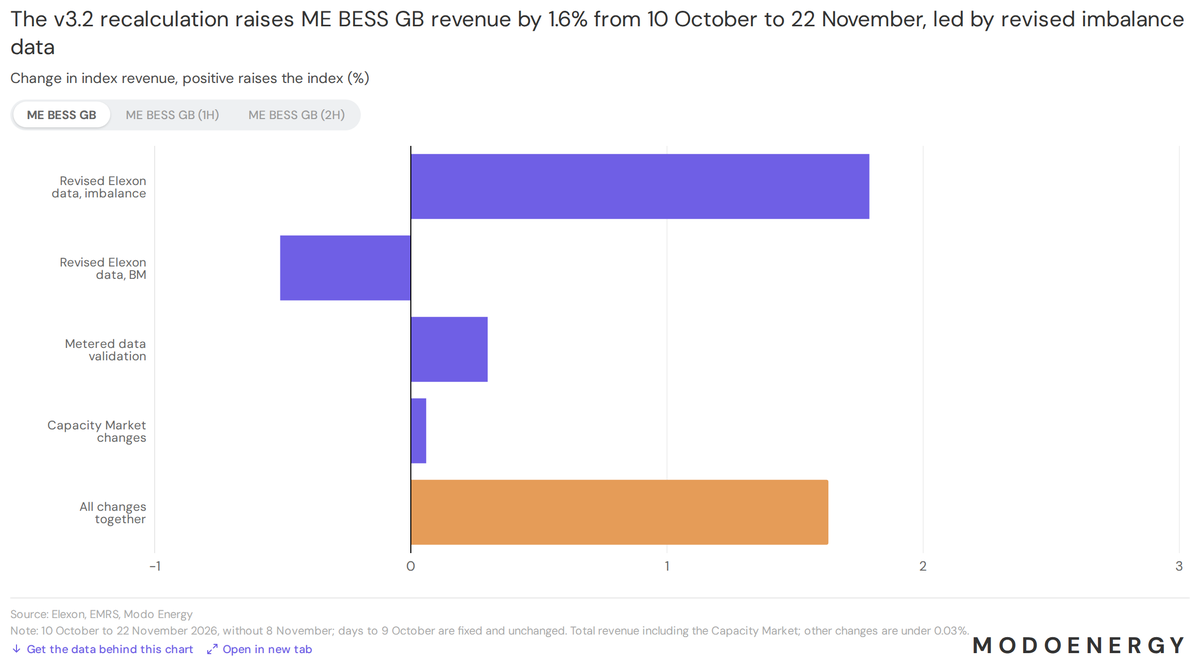
Great Britain: the ME BESS GB index now fixes each value on a known date, 45 days after it occurs. The 23 November recalc raises revenue 1.6% over the unfixed period, mostly from revised Elexon imbalance data. Values up to 9 October stay final as they stand.
ERCOT: Texas approved hourly energy certificates, which stamp every MWh with the hour it was produced. Batteries can't generate clean power, but they can shift it to evening when it's scarcest. If that spread runs $10 to $20/MWh, a 2-hour battery earns $6 to $13/kW-yr.
Good questions. Base case is a 4h battery (0.25 kW/kWh), $1,230/kW capex from our US capex survey, 30% ITC, ~$44/kW-yr fixed O&M. Roughly two-thirds of the $12.6 is capital recovery, under a third is O&M. We don't break out grid connection separately in this one.
On congestion payments: even a 10% capex cut only moves merchant IRR from -11% to -8%. The gap is ~5x, so zeroing grid costs alone doesn't fix it. A congestion payment would work if it behaved like a contracted revenue stream, which is exactly what tolls and RA do in California.
On the Netherlands: happy to chat. Dutch economics are quite different, with ongoing grid tariffs often mattering more than one-off connection costs. DM me. Or take a look at some of the research we have on the Terminal for the Netherlands
e.g. https://t.co/29XMBaLTj7
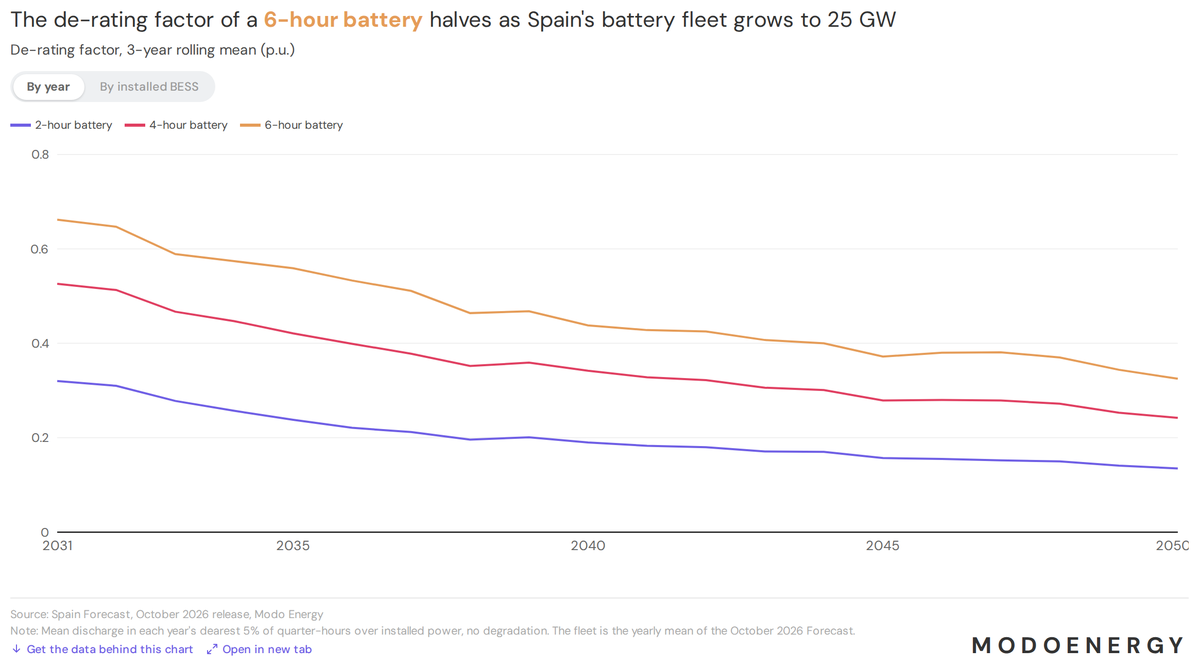
Spain: as the battery fleet grows from 9.2 GW in 2031 to 24.6 GW by 2050, each battery contributes less firm capacity at system stress. De-rating for a 2-hour battery falls from 0.32 to 0.14. The more batteries discharge, the longer the stress periods they leave behind.
#EnergyTwitter at its best — sharing free, rapid analysis of complex high-stakes regulatory dockets as an entire industry is on a 20-30 day shot clock to respond!
Once a renewables developer reaches scale, bringing everything in-house can look like the obvious next step.
Mehmet Energin, Chief Commercial Officer at OX2, sees the risk: vertical integration can be a very expensive way of delivering worse results than a specialist partner would.
OX2 keeps mission-critical capabilities in-house and partners where the market offers strong alternatives, including optimisation. That works as long as incentives are aligned: if the asset performs, the partner is rewarded too. If the market shifts and incentives drift apart, the decision changes.
Full episode of Transmission below.
#BESS #Renewables #EnergyStorage #EnergyTrading
ISONE queue: 7 battery projects (6 in MA) hold executed interconnection agreements, expected online by 2029, adding 1.65 GW power capacity - 79% of ISONE's 2.1 GW 2027-2029 buildout. Boston alone: 1,262 MW. No duration/energy capacity figures disclosed in the queue data.
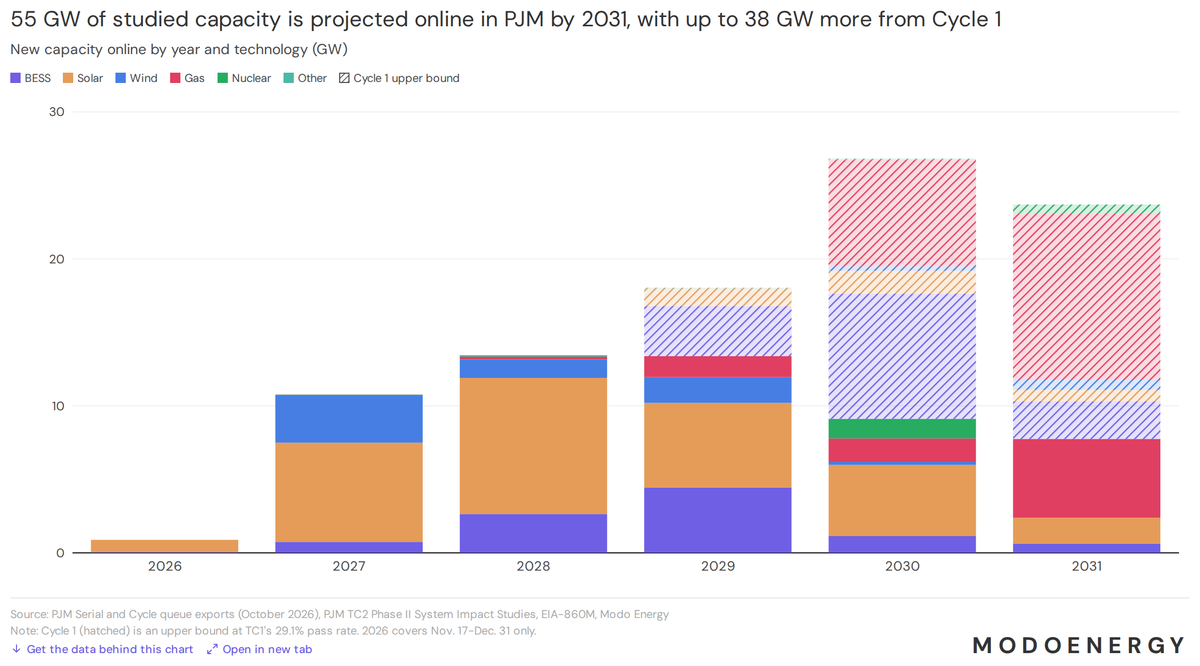
PJM: 55.3 GW projected online by 2031 from transition cycles, two-thirds already with signed interconnection agreements. BESS makes up 9.6 GW of power capacity (duration/GWh not disclosed in queue data). Cycle 1 could add up to 14.5 GW more, an upper bound set by TC1's pass rate.