A Visual Guide to CI/CD
𝗖𝗼𝗻𝘁𝗶𝗻𝘂𝗼𝘂𝘀 𝗜𝗻𝘁𝗲𝗴𝗿𝗮𝘁𝗶𝗼𝗻 (𝗖𝗜) is a foundational practice in DevOps where developers frequently merge code changes into the main branch, often multiple times a day. This process is complemented by automated testing to ensure new changes integrate seamlessly with existing code. The primary goal of CI is to find and address bugs quicker, improve software quality, and reduce the time required to validate and release updates
𝗖𝗼𝗻𝘁𝗶𝗻𝘂𝗼𝘂𝘀 𝗗𝗲𝗽𝗹𝗼𝘆𝗺𝗲𝗻𝘁 (𝗖𝗗) automates deploying code changes to a production without human intervention. It ensures every change passing all automated tests gets deployed. It accelerates customer feedback by releasing updates more frequently. CD also reduces pressure on developers by eliminating manual release processes.
Some companies rely on 𝗖𝗼𝗻𝘁𝗶𝗻𝘂𝗼𝘂𝘀 𝗗𝗲𝗹𝗶𝘃𝗲𝗿𝘆 instead. Continuous Delivery extends CI by automatically preparing code changes for release to production. However, unlike Continuous Deployment, it requires manual approval prior to production deployment. This practice ensures that all changes are automatically built, tested, and ready for release. It allows teams to deploy new changes anytime at the push of a button.
–
Subscribe to our weekly newsletter to get a Free System Design PDF (158 pages): https://t.co/kNfv0DVDdf
📗I created a GitHub repository to help you learn System Design and Software architecture
It gives you:
- system design problems
- tutorials
- system design resources
Feel free to add and contribute, this is just start, let's make it best
repo - https://t.co/40koHrJwUw
The Kubernetes Intro You Deserve!
✅ What is Kubernetes?
It’s a piece of software that lets you orchestrate multiple containers.
How does it appear for the developers?
[1] The developer creates manifest files for their apps and submits them to Kubernetes
[2] Kubernetes checks those files and deploys the necessary apps to a cluster of nodes
[3] Kubernetes manages the complete life cycle of these apps based on the manifest file
✅ Kubernetes Architecture
Kubernetes is deployed as a cluster with two main parts:
- Master Node
- Worker Nodes
👉 The Master Node hosts the Control Plane. Think of it as the manager in an organization.
It consists of several important parts:
[1] The Kube-apiserver acts as an entry point to the cluster
[2] A scheduler that assigns pods to worker nodes
[3] Controller manager for tracking the nodes and handling failures
[4] etcd for storing the cluster’s configuration
👉 There are multiple worker nodes controlled by the master node. Think of them as employees.
A worker node consists of:
[1] A container runtime such as Docker
[2] Kubelet for talking to the API server and managing containers.
[3] kube-proxy for communication between pods and outside the network
✅ Top Kubernetes Resources
You can create many resources using Kubernetes.
However, these 4 are probably the most used.
- Pod
- Service
- Deployment
- Volume
👉 Pods are the smallest atomic unit you can create in Kubernetes.
Kubernetes groups multiple containers into a single unit known as Pod.
Containers host your applications and a Pod provides a single execution environment to these containers.
👉 Kubernetes Service provides a uniform interface for various pods to talk to each other internally.
They also help load balance requests between multiple pods running the same app.
👉 Deployment is a high-level resource used for deploying applications declaratively.
Think of the deployment as a template for multiple pods.
Depending on the configuration, the Deployment ensures that the desired number of pods is always running.
👉 Kubernetes Volumes are a component of a pod.
They are a form of storage and are used when you want the application to persist some data across container restarts.
⏰ So - have you used Kubernetes in your project?
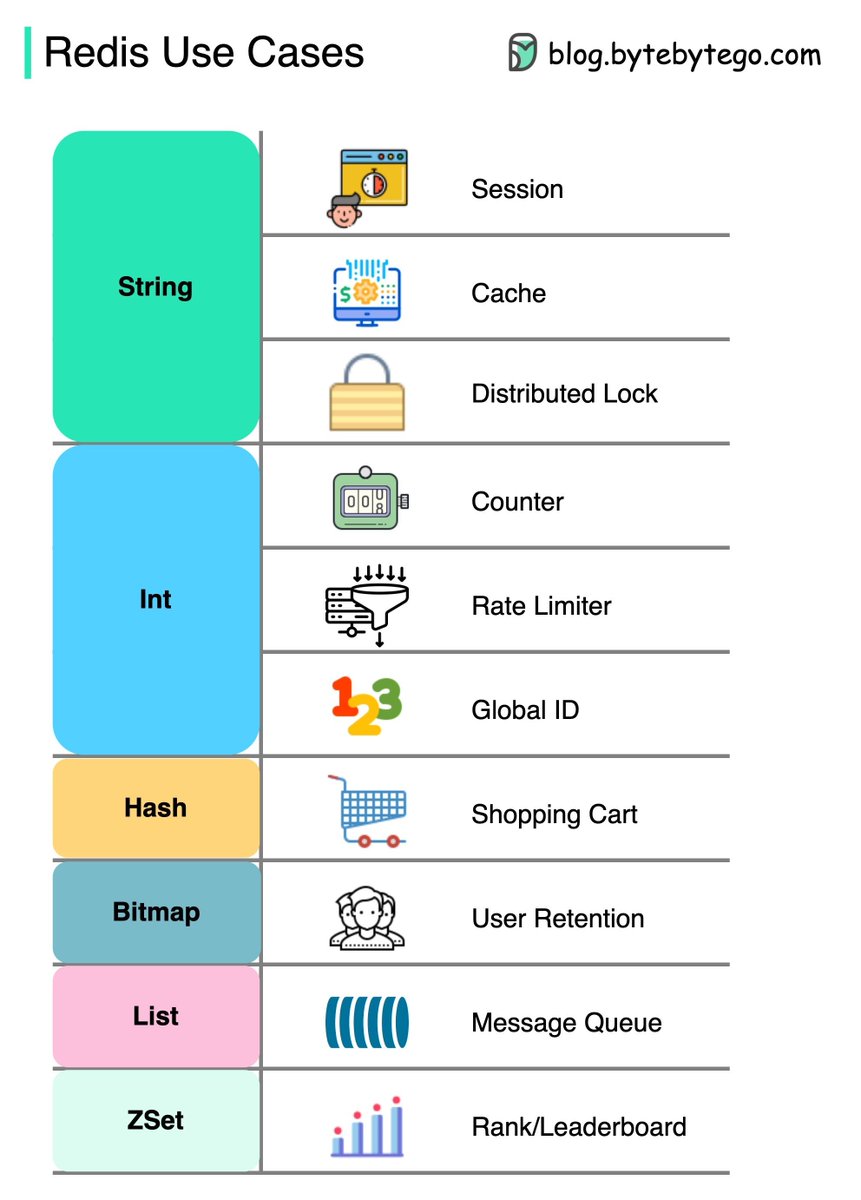
Top Redis Use Cases
I've used Redis in production for almost a decade. It's reliable and easy to use (if used correctly). Here are my top 5 use cases where it shines:
1. Caching
The most common use case is to utilize Redis for caching. This helps protect the database layer from overloading. Redis offers fast lookup for cached data and can help improve application performance.
2. Session Store
We use Redis to share user session data among stateless servers. Redis provides a centralized place to store session data and makes it easy to scale out servers.
3. Distributed lock
We use Redis distributed locks to grant mutually exclusive access to shared resources. This prevents race conditions in distributed systems. Redis locks are easy to implement and automatically expire.
4. Counter and Rate Limiter
We use Redis to track like counts, view counts etc on social media apps. Redis counters provide atomic increments/decrements. We also use Redis to enforce rate limits on our API endpoints. This helps prevent abuse.
5. Leaderboard
Sorted sets make it easy to implement gaming leaderboards in Redis. We can add, update, or remove users from the leaderboard and query ranges efficiently.
There are many other features in Redis. What are some other real-world use cases where you've used Redis successfully?
–
Subscribe to our weekly newsletter to get a Free System Design PDF (158 pages): https://t.co/kNfv0DVDdf
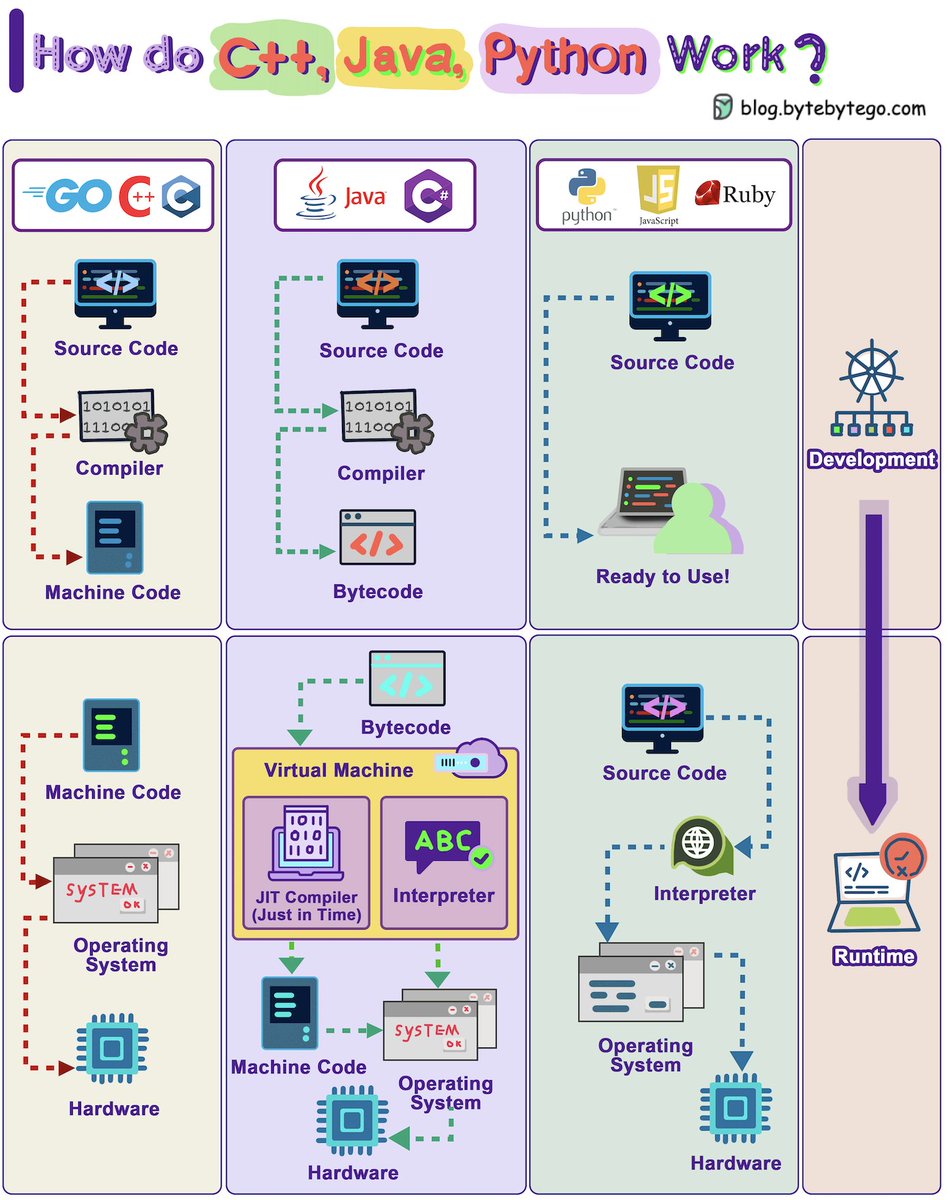
How C++, Java, and Python Work Under the Hood?
Compiled languages like C++ and Go transform source code into machine code using a compiler before execution. The compiled machine code can then be directly executed by the CPU.
Java first compiles source code into bytecode, which is platform-independent and executed by the Java Virtual Machine (JVM). The JVM can further boost performance using Just-In-Time (JIT) compilation to convert bytecode to machine code at runtime.
Interpreted languages like Javascript and Ruby don't undergo compilation. Instead, their code is processed line-by-line by an interpreter during execution. However, modern JavaScript engines like V8 also utilize JIT compilation for enhanced performance.
Python is a mix of both worlds. It first compiles source code into platform-independent bytecode, which is then executed line-by-line by the platform-dependent interpreter. In addition, implementations like PyPy use JIT compilation for a speed boost.
Generally, compiled languages can offer speed advantages, but the line between compiled and interpreted languages is increasingly blurred thanks to modern optimization techniques.
–
Subscribe to our weekly newsletter to get a Free System Design PDF (158 pages): https://t.co/kNfv0DVDdf
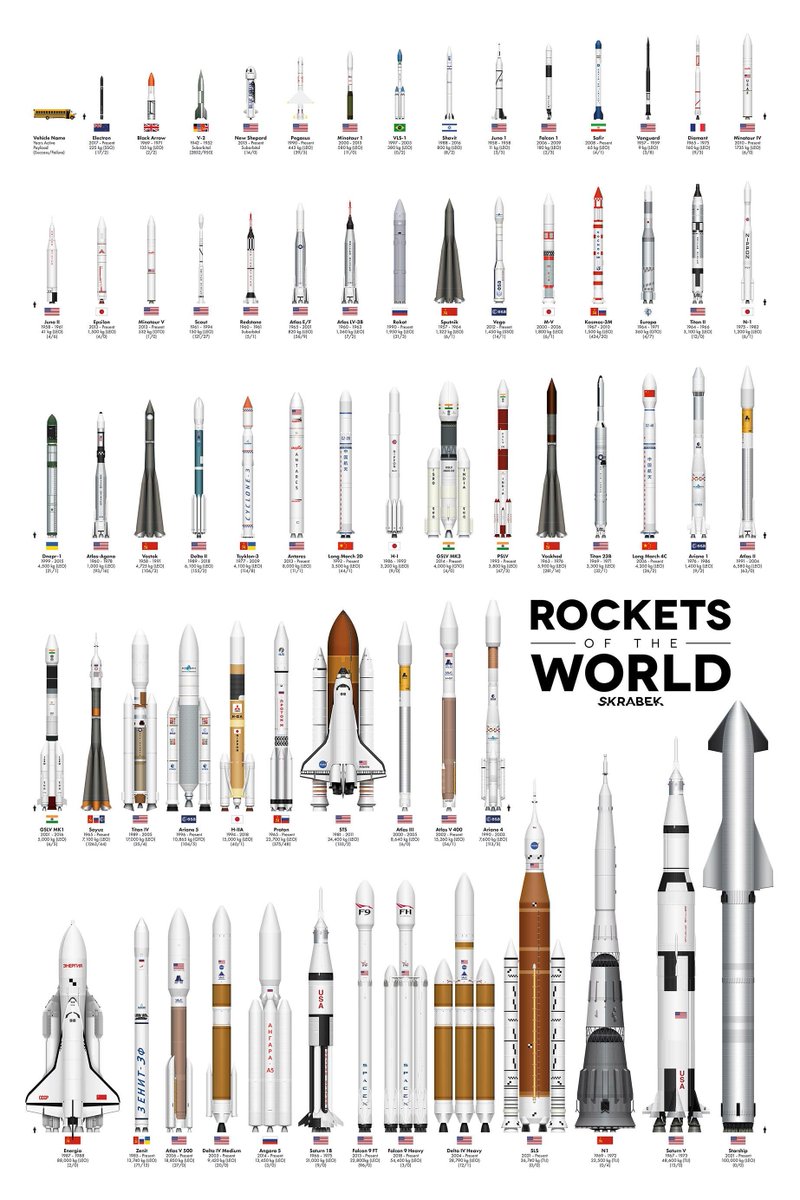
A single SpaceX's Starship is designed to do in a day what all rockets on Earth currently do in a year. Not many fully understand the insane capability of Starship 🤯 @elonmusk
Announcing a lightweight version of VS @Code in the browser!
🗂 Local file viewing & editing
💻Code client-side HTML, JavaScript, & CSS
🐞Debug
🔋use lower powered machines like Chromebooks & iPads
☁️ Work with GitHub
🦚Enjoy Peacock v3.10+
https://t.co/Tgwfxwznix
👩🚀 Introducing 𝗪𝗠𝗥:
The tiny all-in-one development tool for modern web apps.
Everything you need to build a fast Preact site, from dev to prod.
🦄 TSX, HMR, CSS Modules, etc
🦦 use npm modules without installing
📦 one 2mb file, no dependencies
→ https://t.co/B9738JEgsY








![ProgressiveCod2's tweet photo. The Kubernetes Intro You Deserve!
✅ What is Kubernetes?
It’s a piece of software that lets you orchestrate multiple containers.
How does it appear for the developers?
[1] The developer creates manifest files for their apps and submits them to Kubernetes
[2] Kubernetes checks those files and deploys the necessary apps to a cluster of nodes
[3] Kubernetes manages the complete life cycle of these apps based on the manifest file
✅ Kubernetes Architecture
Kubernetes is deployed as a cluster with two main parts:
- Master Node
- Worker Nodes
👉 The Master Node hosts the Control Plane. Think of it as the manager in an organization.
It consists of several important parts:
[1] The Kube-apiserver acts as an entry point to the cluster
[2] A scheduler that assigns pods to worker nodes
[3] Controller manager for tracking the nodes and handling failures
[4] etcd for storing the cluster’s configuration
👉 There are multiple worker nodes controlled by the master node. Think of them as employees.
A worker node consists of:
[1] A container runtime such as Docker
[2] Kubelet for talking to the API server and managing containers.
[3] kube-proxy for communication between pods and outside the network
✅ Top Kubernetes Resources
You can create many resources using Kubernetes.
However, these 4 are probably the most used.
- Pod
- Service
- Deployment
- Volume
👉 Pods are the smallest atomic unit you can create in Kubernetes.
Kubernetes groups multiple containers into a single unit known as Pod.
Containers host your applications and a Pod provides a single execution environment to these containers.
👉 Kubernetes Service provides a uniform interface for various pods to talk to each other internally.
They also help load balance requests between multiple pods running the same app.
👉 Deployment is a high-level resource used for deploying applications declaratively.
Think of the deployment as a template for multiple pods.
Depending on the configuration, the Deployment ensures that the desired number of pods is always running.
👉 Kubernetes Volumes are a component of a pod.
They are a form of storage and are used when you want the application to persist some data across container restarts.
⏰ So - have you used Kubernetes in your project?](https://pbs.twimg.com/media/GP2japFWwAAidUM.jpg)