So pleased to announce that Sharon Hammes-Schiffer has received a 2027 Irving Langmuir Award in Chemical Physics from the American Physical Society!
See our announcement here: https://t.co/9dY5fDmmqk
Congratulations, Sharon!
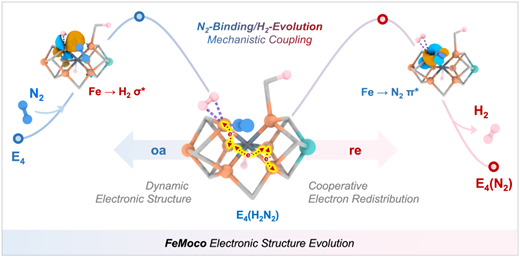
How do multiple Fe centers in Nitrogenase’s FeMoco dynamically couple to activate N₂? Our study on FeMoco’s electronic structure evolution is now published in @InorgChem! Grateful to @ANRFIndia for funding and @iit__mandi for all the support.
https://t.co/piHuqbYciV
Some papers are particularly special, and this is one of them! Excited to share our latest work on nitrogenase, exploring how nature has intricately designed its active site. Congratulations to Serena and mine PhD student, Guru, and the entire team!
https://t.co/ANxzCLQdT6
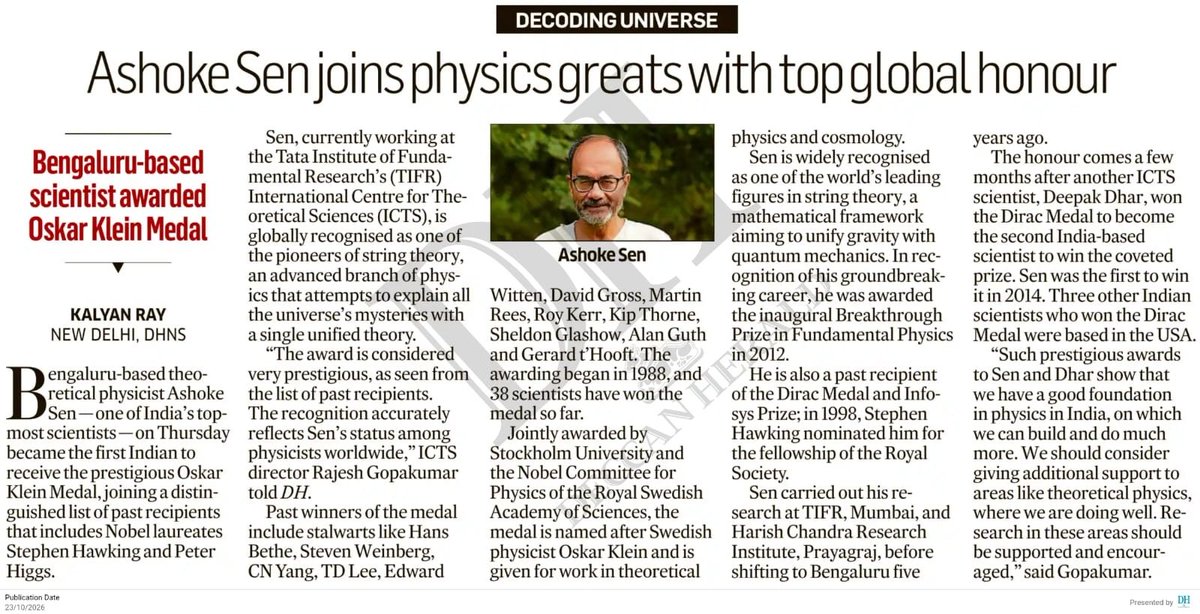
In a historic milestone for Indian science, renowned theoretical physicist Professor Ashoke Sen has just been awarded the 2026 Oskar Klein Medal, becoming the first Indian physicist to receive this prestigious honor. Celebrated internationally for his foundational contributions to string theory. Professor Sen delivered the memorial lecture titled "Gravity from strings and strings from gravity" at Stockholm University.
Those of you who don't know, the Oskar Klein Medal is one of theoretical physics' most prestigious honors, awarded annually in Stockholm to celebrate groundbreaking ideas about how our universe works. Instituted in 1988, it is conferred jointly by Stockholm University and the Nobel Committee of the Royal Swedish Academy of Sciences. The award invites leading thinkers from around the globe to deliver the Oskar Klein Memorial Lecture, recognizing monumental leaps in fields like quantum mechanics, cosmology, and string theory.
The medal is named after Oskar Klein, an influential Swedish theoretical physicist who helped shape early quantum mechanics and modern field theory. Working closely with titans like Niels Bohr, Klein is best remembered for Kaluza–Klein theory, where he proposed the daring idea that extra dimensions of spacetime might exist curled up into microscopic, invisible loops. He also helped formulate the Klein–Gordon equation for relativistic particles and the Klein–Nishina formula for photon scattering, cementing his legacy as a true pioneer of 20th-century physics.
Over the decades, the medal has gone to some of the greatest minds in science, many of whom are also Nobel laureates. Iconic recipients include Chen-Ning Yang, Steven Weinberg, and Hans Bethe in its earliest years, followed by visionary cosmologist Alan Guth and leading theorists like Edward Witten, Gerard 't Hooft, and Peter Higgs. More recently, luminaries such as gravitational physicist Kip Thorne, black hole theorist Roy Kerr, and cosmologist Renata Kallosh have joined this distinguished roster, keeping Klein’s imaginative scientific spirit alive.
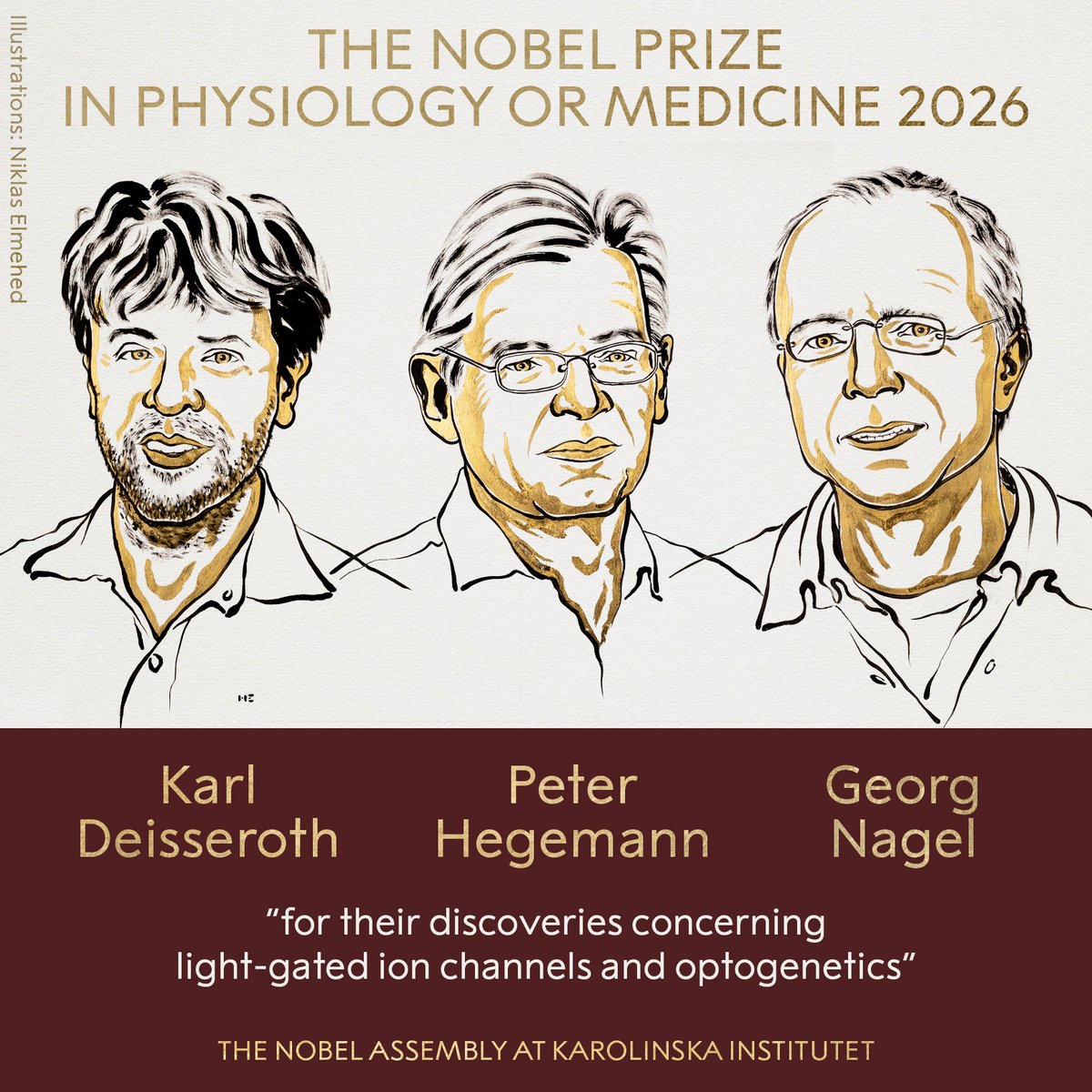
BREAKING NEWS
The 2026 #NobelPrize in Physiology or Medicine has been awarded to Karl Deisseroth, Peter Hegemann and Georg Nagel “for their discoveries concerning light-gated ion channels and optogenetics.”
Some bacteria that are harmful to humans escape elimination by antibiotics because they carry resistance genes. However, antibiotic-susceptible bacterial populations often harbor rare persister cells that survive antibiotic exposure without being resistant. Antibiotic persistence favors recurrent infections and resistance emergence and is a public health threat.
Persister cells are thought to be metabolically dormant. Decreased activity of antibiotic targets would enable them to remain alive when antibiotics are present and to regrow after antibiotic removal.
In a new Science study, researchers report that Escherichia coli persister cells do not simply enter a dormant state upon antibiotic treatment. Instead, genetically identical cells diverge into two physiological states.
Some cells produce membrane vesicles that are loaded with specific proteins, which are taken up by other cells to enhance survival. Therefore, vesicle donors and recipients actively cooperate to benefit the entire bacterial population.
Learn more in a new #SciencePerspective: https://t.co/be5JNwqHJa
Scientists have created one of the most detailed 3D reconstructions of a human cell (eukaryotic cell) ever produced.
This groundbreaking model, often termed a "Cellular Landscape Cross-Section Through a Eukaryotic Cell," combines data from X-ray tomography, nuclear magnetic resonance (NMR), and cryo-electron microscopy to map molecular structures in extreme detail.
We live in a golden age of biology. So why are people still dying from disease?
Because discovery and development move slower than they should.
Today, we’re partnering with Incyte to change that.
Kosmos is now the first agent that can compress months of drug development into weeks, from the earliest stages of scientific discovery through to FDA approval. @Incyte will be the first company to deploy it across their pipeline.
Work that used to take a team of scientists months now happens in weeks.
Patients can't wait, and neither can we.