📢: For 6-8yo kids to *organically* fall in love with Star Wars, it needs to look NEW
A 2027 rerelease needs a CGI/AI pass to look shot on today’s budgets (camera motion, sets, lighting, etc)
The visual bar for kid-cinema has never been higher:
OT's story = 🎉
50yo visuals = 🚫
The original cut of ‘Star Wars’ screened for the first time in decades yesterday
Kathleen Kennedy attended so fans wouldn’t think it was an ‘illegal screening’
A roadmap for learning robotics! 🔥
📌 If you’re self-learning robotics, this is genuinely one of the better repos to save for later!
This GitHub repo is basically a curated learning map for anyone trying to get into robotics without drowning in random bookmarks.
SOOOOO many free courses on almost every topic related to robotics, 5k ⭐️ on GitHub says it all...
If I had had this list during my studies, my career might have turned out differently.
But I didn't, so I the only thing I can do is to recommend it and give it to you now...
It’s a structured collection of links to:
→ robotics courses (online + university)
→ ROS / embedded / hardware basics
→ math & algorithms that actually matter for robots
A clean, opinionated list that helps you go from “where do I start?” question as I had after graduating :D
And it’s open-source, so you can contribute resources too.
🔗 Try it out here: https://t.co/qUME6mJCzZ
Do you have an awesome resource to learn AV and robotics? Share it with me, and I'm happy to put it on the spotlight.
~~
♻️ Join the weekly robotics newsletter, and never miss any news → https://t.co/GoA3ZuwoPB
@AlexFinn@steipete I'm holding out hope John Ternus is taking the 'Product Guy' approach by preserving RAM supply for an M5 Ultra refresh of the Studio line.
C'mon, 768GB+ RAM model!
Russell Crowe on Gladiator 2:
‘They failed, and they failed because they didn’t understand what made the first film so successful: it had a moral core. Here’s the thing, most people want that. On the surface, they might go for entertainment, but if they’re going to love something and keep it with them forever, like that movie? …The love for that thing is because of its moral core. All guys want to be that man who can stay that strong, and all women want a man who can love them in that way.’
a practical guide to get started in robotics:
don’t start with humanoids.
start with control over motion.
• build a small wheeled bot → motors, drivers, batteries
• add sensors → encoders, IMU, ultrasonic, camera
• learn control → PID before fancy AI
• simulate → Gazebo, MuJoCo, PyBullet, ROS 2
• make it autonomous → perception → planning → control
your first goal is not intelligence.
your first goal is reliable motion.
make a machine move, sense, correct, and repeat.
that is where robotics starts.
A dev got so frustrated watching his AI agent write 500 lines for a 5-line problem that he built a fix.
He called it Ponytail. Named after the guy every team has - long ponytail, oval glasses, been there longer than the version control. You show him fifty lines; he looks at them, says nothing, and replaces them with one.
Now your agent does the same. Before writing anything, it looks for a reason not to.
80-94% less code. 47-77% cheaper. 3-6x faster.
The best code is the code you never wrote.
GitHub Repo: https://t.co/WnFp9YNY53
Tim Dillon had a brutally funny take on Gen Z’s approach to work.
He says a lot of them have figured out the whole system feels like a scam, so they’re treating it like one. Fake mental health days, quiet quitting, weaponizing HR language, doing the bare minimum while demanding maximum accommodation.
And Tim’s reaction? “I’m for it.” They’re just using the playbook society handed them.
This is what happens when trust in institutions and old-school work ethic collapses. People stop playing the game seriously and start playing the system instead.
Do you think Gen Z is smart for gaming a broken system, or is this approach ultimately making things worse?
Elon Musk explains his 5-step algorithm for solving any problem:
"The most common mistake of smart engineers is to optimize a thing that should not exist."
"I have this very basic first principles algorithm that I run as a mantra."
Elon breaks it down:
Step 1: Question the requirements.
"Make the requirements less dumb. The requirements are always dumb to some degree, no matter how smart the person who gave you those requirements. You have to start there, because otherwise you could get the perfect answer to the wrong question."
Step 2: Try to delete it.
"Try to delete the part or the process step entirely. If you're not forced to put back at least 10% of what you delete, you're not deleting enough. Most people feel like they've succeeded if they haven't been forced to put things back in. But actually they haven't, they've been overly conservative and left things in that shouldn't be there."
Step 3: Optimize or simplify.
"The most common mistake of smart engineers is to optimize a thing that should not exist. So you don't optimize until after you've tried to delete."
Step 4: Speed it up.
"Any given thing can be done faster than you think. But you shouldn't speed things up until you've tried to delete it and optimize it otherwise, you're speeding up something that shouldn't exist."
Step 5: Automate.
"And then the fifth thing is to automate it."
Elon explains why the order matters:
"I've gone backwards so many times where I've automated something, sped it up, simplified it, and then deleted it. I got tired of doing that. So that's why I have this mantra."
There is a certain type of person everywhere now, especially online.
He consumes endless information every day: philosophy, psychology, productivity, spirituality, neuroscience, business, self-improvement, history.
He knows a little about everything and deeply experiences almost nothing.
His entire identity becomes built around understanding instead of living.
He watches videos about confidence instead of speaking confidently. Reads about discipline instead of becoming disciplined. Studies relationships instead of learning how to love. Consumes motivational content instead of taking action.
He feels intelligent because he is constantly mentally stimulated. But stimulation is not transformation.
Most of the time, knowledge becomes emotional protection. Reality is unpredictable. Reality humiliates. Reality exposes weakness. Books and ideas do not.
Inside information, he can continue imagining himself as intelligent, deep, insightful, different from ordinary people. So he remains trapped in preparation.
He constantly feels as if he is "becoming" someone, while his real life remains strangely untouched. He develops sophisticated language for problems he never confronts directly. He can explain human behavior beautifully while being unable to handle ordinary discomfort, rejection, uncertainty, loneliness, or risk.
He slowly turns life into observation instead of participation.
The internet rewards this personality heavily. He receives validation for sounding aware rather than becoming capable.
Eventually, he begins confusing self-analysis with growth and information with wisdom.
But beneath the intelligence usually exists the same thing: fear. Fear of failure. Fear of embarrassment. Fear of reality answering back.
Because action destroys fantasy. The moment he truly acts, he can no longer hide inside potential.
Fred Rogers met with a child psychologist every week for 22 years to build his show. She shaped everything: every script, prop, and song. The whole point was to give a child's nervous system time to slow down. In 1984, a single regulatory decision ended all of it.
The psychologist was Dr. Margaret McFarland, who co-founded the Arsenal Family and Children's Center alongside Benjamin Spock and Erik Erikson. She and Rogers understood that the prefrontal cortex in children, the part of the brain that controls impulse, emotion, and attention, takes decades to fully develop. At the start of every episode, Rogers tied his sneakers and changed his sweater while children settled in. Those pauses were intentional, designed to help a child's nervous system shift into a calmer, more focused state.
What ended it had nothing to do with child development science. In 1984, Reagan's FCC chairman Mark Fowler abolished the advertising limits that had protected children's programming from commercial pressure. Toy companies moved within months. Between 1984 and 1985, cartoons tied to toy lines increased by 300%, from a handful of shows to more than 40 animated series. In almost every case, the toy was designed first. The cartoon was built to sell it.
Researchers later put numbers to what parents were already noticing. A 2011 study in Pediatrics from the University of Virginia tested 60 four-year-olds across three groups: one watching SpongeBob, which cuts scene every 11 seconds; one watching a slow PBS show, which cuts scene every 34 seconds; and one drawing. Nine minutes later, all three took tests on attention, impulse control, short-term memory, and problem-solving. The SpongeBob group scored significantly worse across every measure.
In the 1970s, children began watching television around age 4. Research from pediatrician Dimitri Christakis found that by 2009, the average age of first screen exposure had dropped to 4 months, as the content got faster and the audience got younger. Researchers separately found that each additional hour of daily screen time at ages 1 or 3 raised the risk of attention problems at age 7 by 9%.
French President Macron:
France is the only country in Europe to have an LLM model capable of competing with the great Americans and the great Chinese with Mistral AI.
AI doomers are in shambles over this one
this robot drives through California strawberry fields at night and does the job pesticides used to do, with NO chemicals at all
it shines UV light on the plants, which fries the mites, mold, and mildew that normally get sprayed with pesticide.
then a vacuum on the back sucks the remaining bugs right off the leaves
that's it, just light and suction, no poison, running while everyone sleeps
so you get healthier food, no chemicals soaking into what you eat, and no human stuck spraying poison by hand all day
there's genuinely nothing to hate here. so if you still find a way to, that's a you problem
this is the entire optimistic case for AI
better quality of life, healthier food, people freed from brutal work that wrecks their bodies
now run the same play across every domain
> robots inspecting bridges so nobody has to dangle off one
> AI reading every scan so cancer gets caught 3 years early
> machines taking the dangerous, poisonous, back-breaking jobs
another W for the AI optimists
So you wanna get started in robotics?
stop treating it like one field.
robotics is the collision of hard things.
• mechanics → the body
• electronics → the nerves
• control theory → the reflexes
• software → the brain
• sensors → the perception layer
start with one small robot.
make it move.
make it sense.
make it correct itself.
then you’ll understand the truth:
robotics is not AI with wheels.
it is physics, math, code, hardware, and failure stacked together.
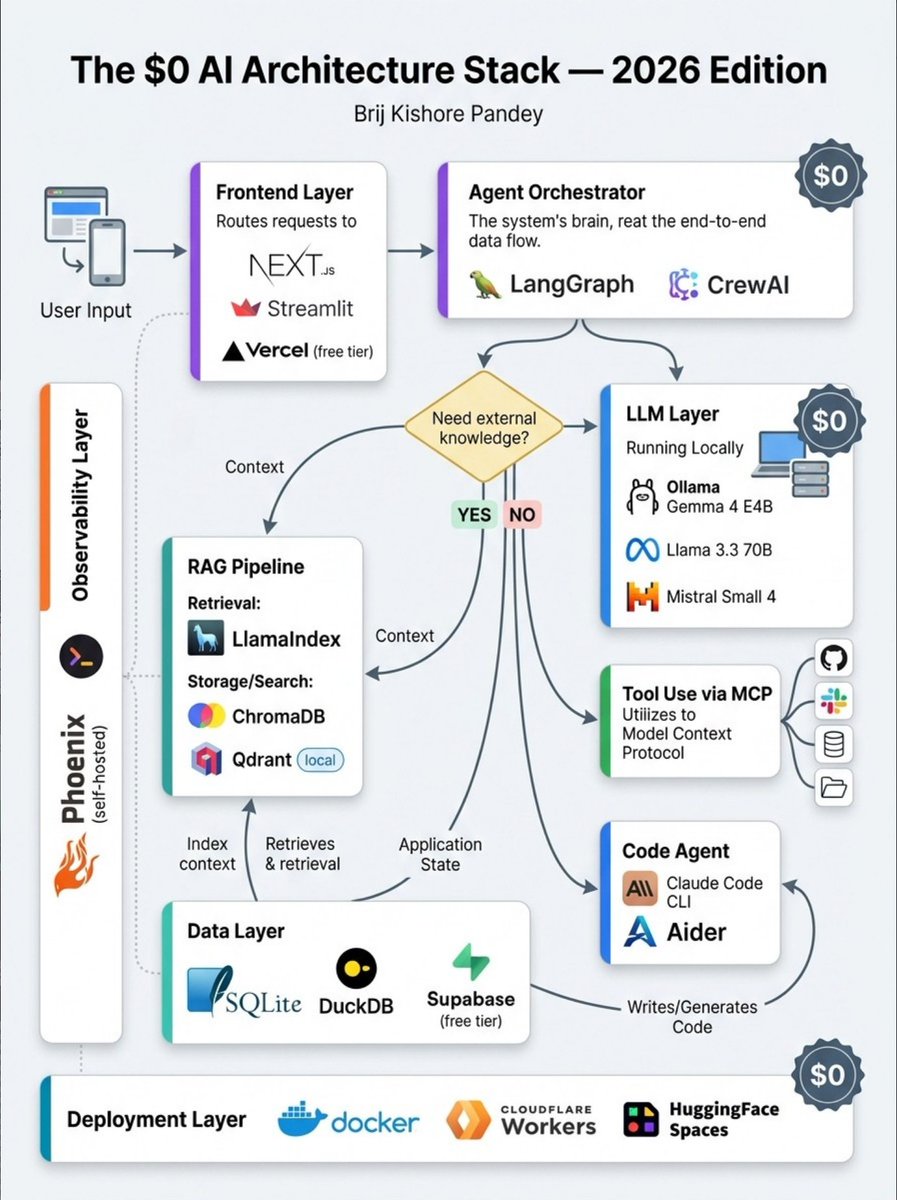
You don't need to spend a single dollar to build a production AI system in 2026.
Here's the full stack:
→ LLM: Ollama + Gemma 4 / Llama 3.3 / Mistral Small 4 (local, free)
→ Orchestration: LangGraph / CrewAI (open source)
→ RAG: LlamaIndex + ChromaDB / Qdrant (local)
→ Tool Layer: MCP — the open protocol connecting agents to everything
→ Code Agent: Claude Code CLI / Aider
→ Frontend: Next.js + Vercel free tier / Streamlit
→ Data: SQLite / DuckDB / Supabase free tier
→ Observability: Langfuse / Phoenix (self-hosted)
→ Deploy: Docker / Cloudflare Workers / HuggingFace Spaces
Total cost → $0.
The tools are free.
The architecture knowledge is what's valuable.
Save this for your next build 🔖
Credit: codewithbrij
#AIArchitecture #AgenticAI #LLM #Ollama #Gemma4 #LangGraph
SHIPPED. Mistral Vibe is now the AI agent for long-horizon productivity and coding, and the home for Work mode, Code mode, the CLI, and a brand new VS Code extension. Let's go... 🧵
Another win for open-source robotics! 🔥
@huggingface just released a fully open-source humanoid robot, and you can build one for $2,500.
I'm a huge advocate of open-source in robotics space.
Why? Robotics is too hard to solve alone. So lowering the entry point is crucial. Also, ROS proved open ecosystems create lasting industry standards.
So let's have a look at the new member of humanoids family!
@LeRobotHF Humanoid is a 3D-printed, bipedal humanoid platform designed for real robot learning experiments.
It's a complete and, buildable robot
Anddddd yes, it's a full stack release:
→ Hardware files, bill of materials and full assembly documentation
→ Simulation assets and training environments
→ Runtime tools for calibration and real-world control
→ Sim-to-real identification pipeline
When a part breaks, reprint it. When a design choice doesn't work, modify it and test again.
The whole point is fast iteration on real hardware, not treating the robot as a fixed artefact.
The timing is not a coincidence. As foundation models for robotics mature, the field desperately needs open physical platforms to train, validate and deploy them on.
@ClementDelangue LET'S GO!!!
Build it here: https://t.co/kHDe2cvjPx
~~
♻️ Join the weekly robotics newsletter, and never miss any news → https://t.co/GoA3ZuwWF9
$800 ONCE INSTEAD OF $340 A MONTH. THIS 19 YEAR OLD KOREAN BUILT HIS OWN AI LAB UNDER HIS DESK
he was paying $340 a month on api calls running agents for his side projects. one weekend with a screwdriver and that bill went to zero forever
two GPUs running qwen3 with a 100k context window as his daily driver. agents loop 400 times without a single rate limit because there's no rate limit to hit
his openai subscription was $340 a month. his new monthly cost is the electricity bill which sits at $18
over a year that's $3,864 saved. the entire setup paid for itself in 90 days
his data never leaves the room. no api keys to rotate, no usage dashboards to watch, no quotas to negotiate, just a machine that does what he tells it
while everyone else is still copy-pasting their api key into config files he's running models that don't even exist on the openai catalog
bookmark this and read the article below - it's worth it
THIS GUY SPENT $55 ON A MINI COMPUTER + CLAUDE AND SHIPPED A $740/MO MICRO-SAAS
Tiny box, Claude Code, Stripe, Supabase and one boring idea: track competitor prices for small stores while owners sleep.
No startup team. No investor deck. Just one manual task people already hated doing in spreadsheets every week.
He wired the product, payments and reports in one weekend. Now the setup handles the boring work while everyone else is still “testing AI prompts”.
Most people use AI like a toy. He used it like a factory.
- j'utilise Claude tous les jours
- je me crois assez bon là-dedans
- je regarde deux ingénieurs Anthropic pendant 2 HEURES
- l'ingénieur de Claude explique les Skills from scratch
- les 5 premières minutes
- attends. Les Skills c'est juste des dossiers ?
- des dossiers qui retiennent ton workflow ?
- ton domaine ? ton expertise ?
- pause. retour arrière. je regarde a nouveau
- je pense à chaque prompt que j'ai réécrit de zéro
- chaque contexte que j'ai expliqué 100 fois
- chaque session qui a tout oublié
- ça n'aurait pas dû se passer comme ça
- 16 minutes. tout change
- skill issue détecté