KRG PM Masrour Barzani said today that the allocation of 50,000 barrels per day for local consumption had been "imposed" on the KRG by the previous Iraqi cabinet, and that the region's share should instead be 126,000 barrels per day.
The KDP bloc in the Iraqi parliament has separately called on Baghdad to raise the KRG allocation to 140,000 barrels per day. KRG spokesperson Peshawa Hawrami has implied a higher figure still, saying that 90,000 barrels per day would cover only half of the region's needs, which puts total demand at roughly 180,000.
These claims sit awkwardly against the KRG's own position in negotiations with Baghdad only a year ago. The KRG acting natural resources minister was then, in June 2025, demanding 65,000 barrels per day, while joint federal-KRG audit bodies assessed local consumption at 46,000. The final agreement settled on 50,000, with Baghdad able to supply refined products equivalent to a further 15,000 if required.
The KRG, in other words, cannot produce a consistent figure for what the region actually needs. Its stated requirement has risen within a year from 65,000 barrels per day to competing claims of 126,000, 140,000 and, by implication, 180,000.
Either the authorities do not know what the region consumes, or officials are generating figures to fit whichever argument they are making at the time.
The petrol crisis in the Kurdistan Region meanwhile continues, despite the KRG being forced to revise its price caps. Improved-grade petrol, or muḥassan, has risen from 1,000 to 1,300 dinars per litre, and super from 1,200 to 1,500. The official price of unsubsidised regular petrol is, for now, meant to hold at 850.
The revision has done little to change conditions at the pump. Most stations remain closed, report no stock, or refuse to sell at prices they say would leave them trading at a loss. What fuel does reach drivers is increasingly informal, with a limited kerbside trade selling at more than 3,000 dinars per litre, roughly double the new ceiling for super. The shortage has brought movement across Erbil and Duhok close to a standstill.
Iraq has some of the world’s largest oil reserves but the money it earns doesn’t fully flow through Baghdad. Instead, a system set up after the US invasion in 2003 still gives Washington lasting leverage over Iraq's oil revenues.
Al Jazeera’s Osama bin Javaid explains.
I wonder what logical contortions are needed by Israelis to explain how they can boast the ruthlessness of Genghis Khan while simultaneously claiming the status of victim.
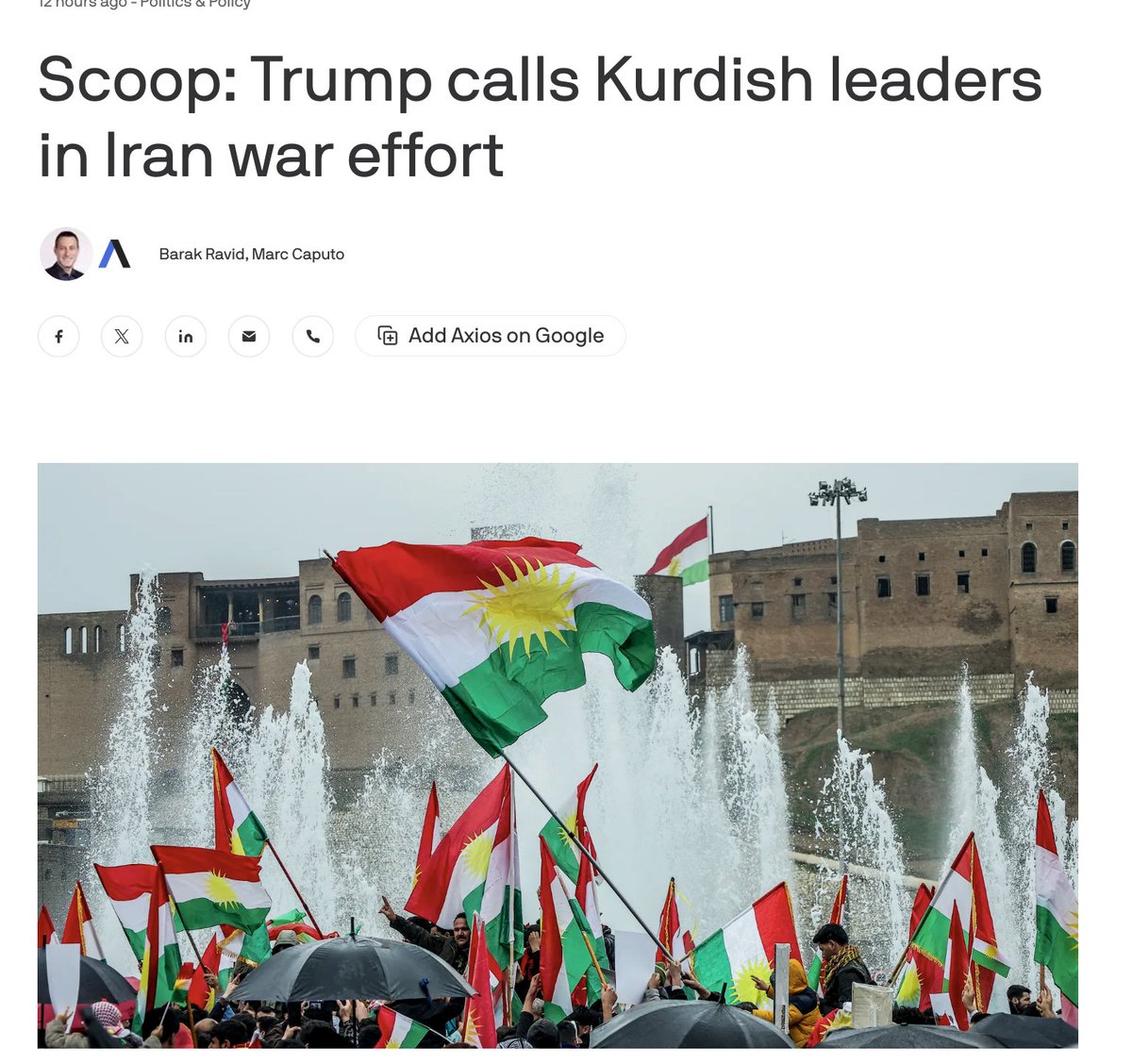
On the news of Trump speaking with Masoud Barzani and Bafel Talabani, the real question is why it was leaked?
First, this is highly irresponsible. It puts the Kurdistan Region in immense danger and, in effect, legitimises Iranian attacks by handing Tehran a ready-made justification. It is also highly unlikely to be an innocent scoop, especially given how media works during wartime, not least with Axios, which has strong ties to intelligence and policy circles.
So why leak it?
The most likely explanation is that this is part of a pressure campaign. Either they are trying to shape behaviour, or the private track is not moving in the way they want, meaning Barzani and Talabani may not want to be part of it, so they are escalating into public signaling. That can be a way to force Kurdish leaders to clarify their position or to narrow their room to quietly say no. It is coercive because it raises the political cost of hesitation.
This leak reads less like the behaviour of a protective ally and more like that of a power treating the Kurdistan file as a tool. If the real objective were to help Kurds operationally, they would do the opposite. They would keep contacts quiet, preserve deniability, reduce exposure, and avoid giving Iran an easy public narrative. You do not publicise a sensitive Kurdish angle in the middle of a war unless your priority is something other than protecting the Kurds who would bear the consequences.
This leak does four harmful things at once:
1. It gives Iran a clearer justification to escalate against Iraqi Kurdistan and against Iranian Kurdish groups.
2. It strengthens the broader regional narrative that this war is about fragmentation and partition, which increases backlash.
3. It creates more political enemies for the Kurdistan Region by making it look like a forward operating space for outside powers.
4. And it makes it harder, not easier, for Iranian Kurdish actors to do anything, because Tehran can now move faster to monitor, disrupt, infiltrate, or strike.
Let me repeat. If you must keep murdering more and more people in order to survive, & use a (temporary) superpower to prop up fragile regimes around you for the illusion of peace, you are, simply, not sustainable.
There are 37 abandoned Crusader fortresses in the Levant.
The “rules-based order” boils down to this: The states of the imperial core can use unlimited violence to secure access to the lands, resources and labour of the global South, including gross violations of international law, and with total impunity. But any use of violence in resistance by the people of the South, even if minimal, and even if it is within the bounds of international law, can legitimately be punished with apocalyptic devastation.
The Federal Supreme Court has removed all 11 minority seats from the Kurdistan Parliament. That's a very significant move that went beyond what was expected. For a background on why these seats were controversial, check out my piece for @KurdishCenterGR.
https://t.co/FmJFOzcg1a