Yesterday, we 3x’d limits on Antigravity and are seeing you build so much more. One thing we heard was people are worried about hitting their weekly limits after a couple work sessions. To give you more runway, we’re 3x’ing the weekly Gemini quotas AGAIN on all paid plans.
We’ve also gone ahead and reset Gemini quotas on all paid plans. Don’t stop building!
Google just revealed Omni, personalized cross-device intelligence, and Spark agents at I/O 2025.
I sat down with CEO Sundar Pichai to figure out what comes next:
1:46 Omni: "Nano Banana for video"
4:59 The future of YouTube
7:04 Advice for AI skeptics
9:33 Why your mom should switch to Gemini
11:13 Google's vision for personalized intelligence
13:02 What AI looks like in 3 years
16:08 What tasks AI agents won't replace
17:58 Sundar's advice for an 18-year-old
19:33 Would Sundar still go to college today?
Gemini Omni doesn't just build scenes that look real, it reasons about what should happen next. It combines an intuitive understanding of physics with Gemini's knowledge of history, science, and cultural context.
Rolling out today starting with video outputs to Google AI Plus, Pro and Ultra subscribers globally through the @Geminiapp + Google Flow, and @YouTube Shorts this week.
1/ Today at #GoogleIO, we’re releasing Gemini 3.5, our latest family of models combining frontier intelligence with action.
We’re starting by releasing 3.5 Flash, which is built to help you execute complex, long-horizon agentic workflows.
Gemini 3.5 Flash is our strongest model for coding and agent https://t.co/m62cBJhIjJ outscores 3.1 Pro on agentic and coding benchmarks like Terminal-Bench and MCP Atlas, while running 4x faster than other frontier models.
Used in Google Antigravity, 3.5 Flash is even further optimized to be up to 12x faster. It’s a powerful engine to deploy sub-agents that collaborate, run high-frequency iterative loops, and solve real-world problems at scale.
Some highlights we’re excited about 🔽
This report does a pretty good job highlighting the differential impact AI will have across different economies. "While industrialized nations worry about AI systems" ..., "the low and middle income countries face a shortage of such highly skilled workers"
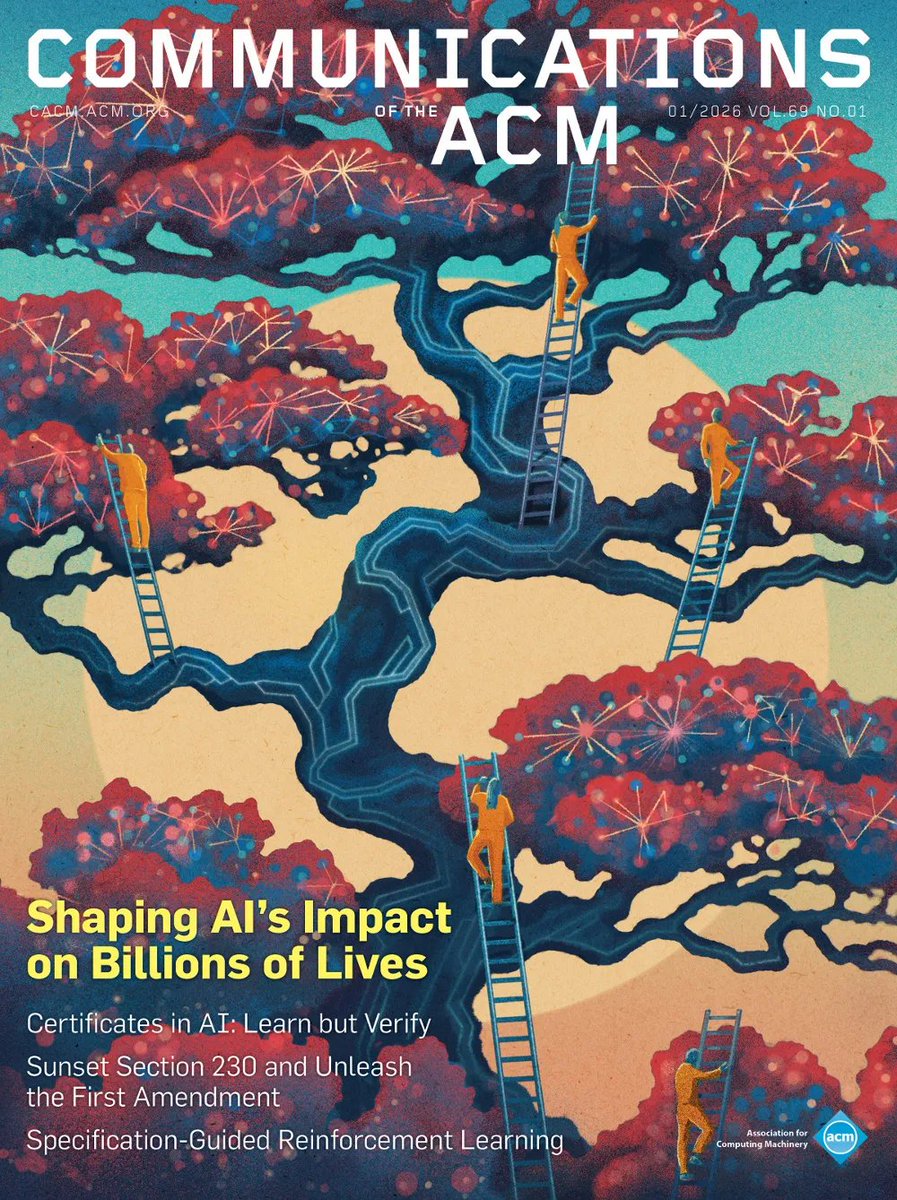
In 2024, I was delighted to be a co-author on an Arxiv paper on"Shaping AI's Impact on Billions of Lives", covering areas we thought AI would have significant impact on the world. We cover AI's potential impact on employment, education, healthcare, (mis)information, media, national security, and science, and propose 18 potential moonshot research directions in these areas to maximize positive impact and minimize downsides. A shortened version appears as the cover article in this month's Communications of the ACM (CACM).
CACM version: https://t.co/996f1lfA9r (~12 pages + video discussion with David Patterson)
Arxiv: https://t.co/sBRkdIGo2x (expanded 30 page version)
You can find these and more at: https://t.co/pwDUiMRJZ5
It was a delight to work on this with awesome co-authors! Authors: Mariano-Florentino Cuéllar, myself (@JeffDean), @FinaleDoshi, John Hennessy, @andykonwinski, @sanmikoyejo, @tamati_biskit, @2plus2make5, and David Patterson.
(PDF link of CACM version is a bit hard to find. It's at https://t.co/hC5sri3Enq)
Kelp forests — luxuriant coastal ecosystems that are home to a wide variety of marine biodiversity — are being wiped out from Tasmania to California, replaced by sea urchin barrens that are nearly devoid of life.
https://t.co/L8NwCgqKlR
"It is inhumane to deport and dislocate young people who have only known the United States as their only home. They represent the best of our future."
https://t.co/TrAEfqhlTX
Water is life. We cannot take it for granted. Failing infrastructure, oil pipelines, and polluters that dump toxic chemicals threaten our rivers, lakes, aquifers, and oceans. This precious resource must be protected.