95% of people live and die without knowing their purpose on earth.
Are you among the 5%?
Do you know why you’re here?
Start today, discover your purpose and never die until you fulfill it.
Your purpose got a leash on you
#Knowyourpurpose
@Yar33ma_Cisse Duk maganan nan a kan auren da Maqiri ke so ya halatta ne. Na tabbata idan na ce Allah yasa ayi irin auren da yayar ka ko kanwar ka ko yar ka baza kace ameen ba. Iya larabci ba shine sanin addini ba. Wani bayahuden ma ya fishi iyawa.
He Betrayed Gani Fawehinmi, He Betrayed Abubakar Rimi, He Betrayed The Struggle For Democracy. Who is El-Rufai @elrufai ?
By Omotayo Kehinde
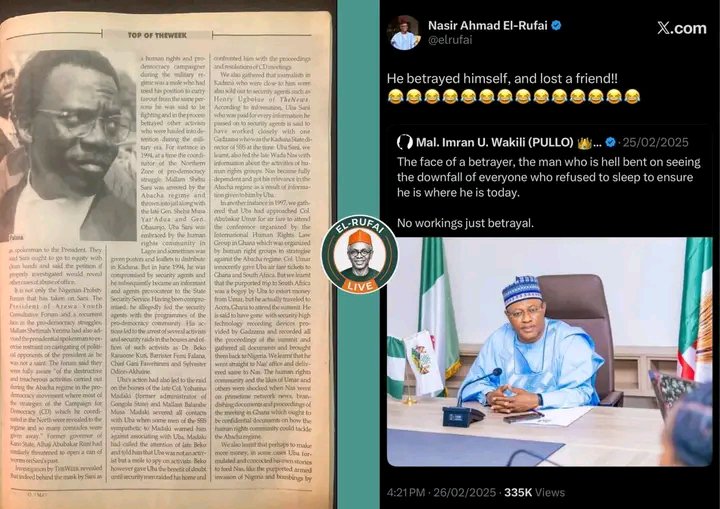
Reading this 2007 The Week article feels like reading today’s news. Uba Sani has always been Uba Sani.
The current political drama in Kaduna between Governor Uba Sani @ubasanius and his predecessor Nasir El-Rufai has drawn national attention. To those who have followed Sani’s past, the “betrayal” narrative is unsurprising. What El-Rufai’s supporters call treachery from a once-trusted protégé is simply a pattern documented nearly two decades ago.
In 2007, *THEWEEK* magazine published a damning investigation that stripped away Sani’s image as a human rights and pro-democracy activist. It alleged he was compromised by security agents in June 1994 and became an informant and agent provocateur for the State Security Service under the Abacha regime. He reportedly fed them the programmes of the pro-democracy community, leading to the arrest of activists and raids on the homes and offices of figures including Dr. Beko Ransome-Kuti, Barrister Femi Falana, Chief Gani Fawehinmi, Sylvester Odion-Akhaire, the late Col. Yohanna Madaki, and Mallam Balarabe Musa.
Madaki severed contact with Sani after warnings from sympathetic SSS officers and told Beko that Sani was “not an activist but a mole.” Beko gave him the benefit of the doubt until security men raided his home and confronted him with the exact proceedings of Campaign for Democracy meetings—proof of the leaks. Journalists close to Sani in Kaduna were also sold out. He was paid for the information he passed and worked closely with Gadzama, then Kaduna State SSS director. He also allegedly fed the late Wada Nas with information that boosted Nas’s relevance in the Abacha government.
The most striking claim: in 1997 Sani approached Col. Abubakar Umar for airfare to a human-rights conference in Ghana organised against the Abacha regime. Umar provided tickets. Sani allegedly used the trip to record the entire proceedings with devices supplied by the SSS, gathered the documents, and delivered them to Nas’s office. Nas later brandished the confidential materials on national television. In some cases Sani reportedly invented stories, including claims of armed invasion and bombings.
This is the same man who today wraps himself in the language of democracy, inclusion and good governance while launching a probe into El-Rufai’s tenure that alleges mismanagement of about ₦423 billion and has sent the former governor to anti-graft agencies.
El-Rufai has publicly called Sani a betrayer: “He was my boy, my mentee.” He has said he has not spoken to Sani once since leaving office. When a social-media user labelled Sani “the face of a betrayer,” El-Rufai replied with a laughing emoji and the words, “He betrayed himself and lost a friend.”
Warnings existed long ago. The Nigerian Probity Forum challenged Sani. Arewa Youth Consultative Forum president Mallam Shetimah Yerima reminded people of his alleged role in revealing Campaign for Democracy strategies and handing over comrades during the Abacha years. Former Kano governor Abubakar Rimi also threatened to expose his past.
Sani’s alleged betrayal of genuine pro-democracy fighters Gani Fawehinmi (whom he now claims as a mentor), Femi Falana, Beko Ransome-Kuti and others makes his treatment of El-Rufai predictable rather than shocking. The 2007 investigation stands as a warning that was ignored by those who preferred to see a reformed activist instead of a man practised in self-preservation through betrayal.
El-Rufai appears to have learnt the lesson only after the fact. Sani’s actions against his former mentor are not a new chapter; they are the latest verse of a song that began in the Abacha years.
I've interviewed presidents, governors, generals, activists and politicians. But sometimes it's the interviews with the families left carrying the emotional burden that stay with you.
A few days ago, I interviewed the lawyer Asiya El-Rufai, wife of former Kaduna state governor, Nasir El-Rufai. She spoke with the precision of a legal expert and the pain of a spouse.
She didn't ask me to defend her husband. She didn't ask Nigerians to take sides. She spoke instead - quietly but powerfully - about constitutional rights, due process, access to lawyers and doctors, and the emotional toll prolonged detention takes on a family.
It reminded me that behind every politically charged courtroom battle is a human story.
Whatever anyone thinks of Nasir El-Rufai politically, one truth remains: the rule of law only has meaning when it protects people whose politics we may disagree with. That is why due process is not a favour. It is the foundation of democracy.
Power is temporary. The legal precedents we tolerate today may become the standards - and the nightmare - we all live under tomorrow.
@kabirusaje@Blark_Roze@Abu_Jawaadd I don’t pray for you to experience this, but i’m certain if it were you, the 1999 constitution will be no where to be found.
@Muhammad_kvbir@Abu_Jawaadd As far as them no go kill am, in a case like this i support the beating 100%. Bro na Nigeria we dey, you fit carry am go station with all the evidence you think you have, the case go turn against you.