The right hemisphere is NOT an appendix. Large strokes-low NIHSS but w cognitive deficits/neglect
When you see someone with a large right hemispheric stroke & low NIHSS, remember that for the same DWI volume, NIHSS is less in right vs. left sided strokes https://t.co/b0Z3O7Nced
How often does recanalization occur after cervical artery dissection? What predicts recanalization? Is no recanalization associated with stroke risk? Check out our paper led by @MicheleRomoli from 🛑CAD
#stroke#meded#neurology@GreenJournal https://t.co/4qoEdX9R67
Tune in to this AHA podcast on secondary stroke prevention discussing stroke subtyping systems and secondary prevention strategies. @AHAScience@StrokeAHA_ASA@eva_mistry#stroke#meded
https://t.co/cAaby62Q20
https://t.co/Tv3xYXC7dv
A terrific paper in @JAHA_AHA using real data to subtype AIS using ISPS25. There are real world gaps in our approach to AIS. A good reason for not finding a potential mechanism is simply not looking enough. @GhilSchwarz#stroke
https://t.co/MUcHGiaJNq
https://t.co/Tv3xYXBznX
#FlashbackFriday!
💊Early DOAC initiation is safe and non-inferior to delayed treatment regardless of infarct volume
❌⏱️No evidence that anticoagulation initiation should be delayed beyond 4 days on the basis of infarct size
Read here!👇
https://t.co/3P82y5VF72 @UCLStrokeRes
#MondayTip
🧠AF-related ischemic stroke 🫀
#CATALYST pooled 4 RCTs and supports early DOAC initiation (≤4 days) in selected patients, reducing recurrent events without more symptomatic ICH.
👉 Use imaging + bleeding risk, not a rigid calendar
https://t.co/rOBvR578JB
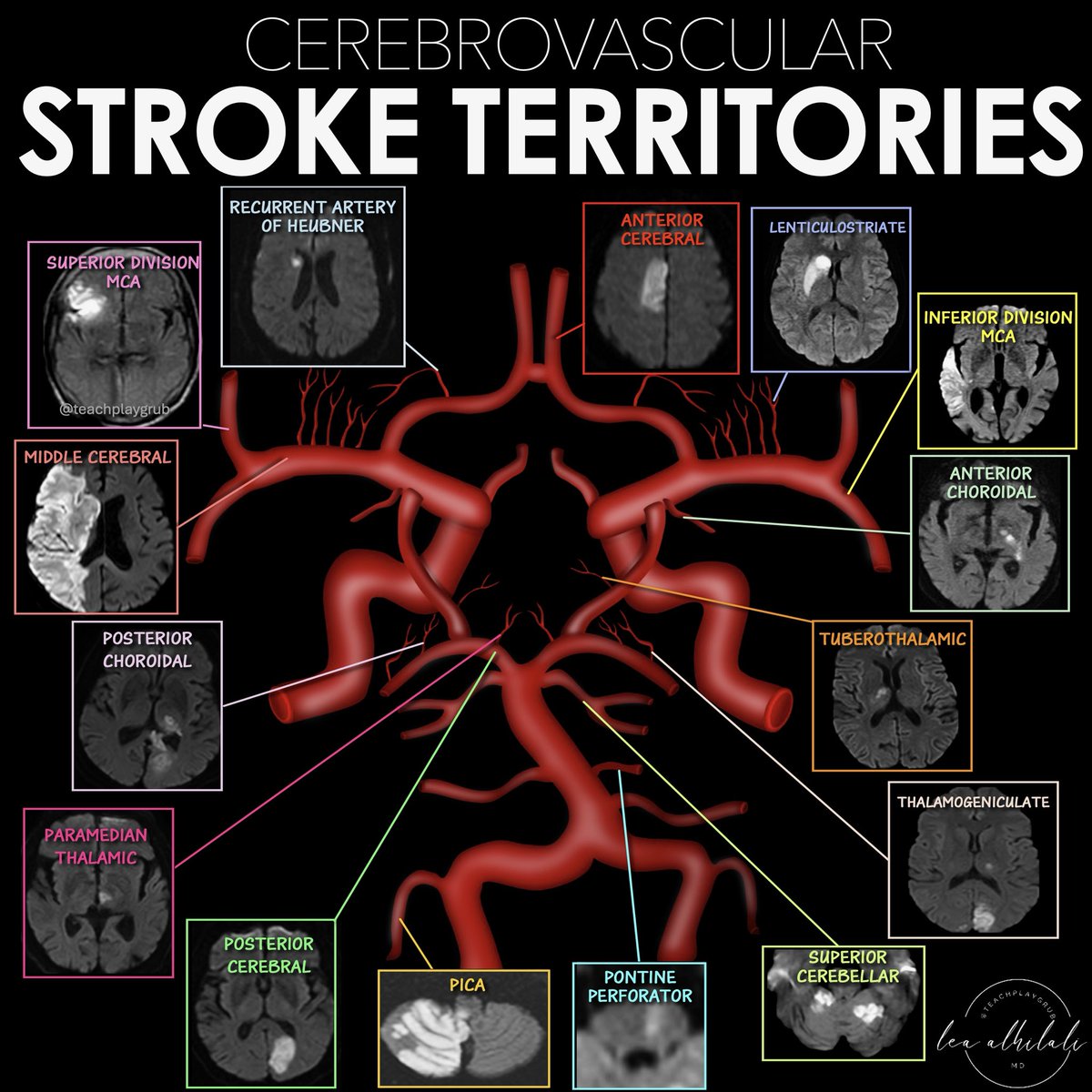
Anyone can see the bright spot of diffusion imaging!
What sets you apart is your ability to tell them where it is—what vascular territory
Here are the vascular territories you need to know:
* Posterior Inferior Cerebellar Artery (PICA)
Soft under surface of the cerebellum
* Superior Cerebellar Artery (SCA)
The SCA territory is the top of the cerebellum (SCA is the SCAlp of the cerebellum)
* Basilar perforators
Make a line in the pons like a penetrating injury. So perforator infarcts look like perforating injuries
* Anterior Choroidal artery
This supplies the posterior limb of the internal capsule & corticospinal tract. Remember COR-roidal is COR-ticospinal
* Lenticulostriate arteries
Infarct territory looks like a tadpole
* Heubner's artery: infarct is the caudate head.
Remember "who called" which sounds like "heu caud" so heubner takes out the caudate
* Anterior cerebral artery (ACA)
Medial, anterior surface of the cerebral hemispheres
* Middle cerebral artery (MCA)
Lateral surface of the cerebral hemispheres
* Posterior cerebral artery (PCA)
Medial, posterior surface of the cerebral hemispheres
Hopefully now when it comes to the vascular territories, you will always be right when it's bright!!
ENRICH-AF trial just presented at ESC: In patients with AF and prior ICH, edoxaban did not reduce the risk of stroke or systemic embolism but increased the risk of major bleeding. The benefit in ischemic stroke reduction was outweighed by ICH risk. https://t.co/RVIC1vCr1k
Time to go with the flow!
Do you know the anatomy of internal carotid artery (ICA)?
Do you just say “carotid siphon” & hope no one asks for more detail?
Do you even know what "carotid siphon" means??
Here’s how to remember the ICA segments so they just flow off your tongue:
C1 = Cervical
Number 1 looks like a long straight neck. So C1 travels straight in the neck
C2 = Petrous
Number 2 makes a curve like a swan’s neck, the same way the petrous ICA curves as it enters the skullbasee
C3 = Lacerum
Number 3 looks like the zig zag of a ragged cut or laceration, so 3 is a laceration = lacerum
C4 = Cavernous
ICA takes a turn here, called the genu, which means knee. This is bc it bends like a knee
Number 4 looks like a calf with a big gastrocnemius along the back so C4 is at the knee or genu
C5 = Clinoid
Clinoid comes from the same root as recline
What do you do when you reCLINE? You take a break or take 5
Take 5 and reCLINE!
C6 = Ophthalmic
Round whole in the number 6 looks like an eye, so 6 = ophthalmic
C7 = Communicating
Number 7 looks an open beak or pac man mouth talking = communicating, so 7 = communicating
So now you can be precise in your localization and siphon away the term “carotid siphon”!!
A patient with atrial fibrillation is taking apixaban regularly.
No missed doses.
Correct dose.
Yet he develops an ischemic stroke.
Our first reaction is often:
The DOAC has failed.
Not so fast.
The first question is NOT
Which anticoagulant should I switch to?
The first question is
Why did the stroke happen despite anticoagulation?
That single change in thinking can completely change management.
I now use a simple bedside approach.
DOAC BREAKTHROUGH STROKE CHECKLIST
1️⃣ Was the patient really taking the DOAC?
• Missed doses
• Stopped before a procedure
• Couldn't obtain the medicine
2️⃣ Was the dose actually correct?
Many elderly patients receive reduced-dose DOACs without fulfilling guideline criteria.
Underdosing can become undertreatment.
3️⃣ Any hidden drug interaction?
Think especially of enzyme-inducing antiseizure drugs.
Carbamazepine.
Phenytoin.
Phenobarbital.
Primidone.
These can significantly reduce DOAC levels.
4️⃣ Any absorption problem?
One practical pearl many people miss:
Rivaroxaban 15 mg and 20 mg should be taken with food.
Also ask about bariatric surgery or inflammatory bowel disease.
5️⃣ Was AF really the cause?
Not every stroke in an AF patient comes from AF.
Always look for:
• Carotid stenosis
• Intracranial atherosclerosis
• Carotid web
• Dissection
• Small vessel disease
6️⃣ Is there another prothrombotic state?
Think of:
• Occult malignancy
• Antiphospholipid syndrome
• Left atrial appendage thrombus
Only after excluding all of these should we call it a true breakthrough stroke.
The biggest practical message from the 2026 BMJ review?
There is no good evidence that routinely switching from one DOAC to another reduces recurrent stroke.
There is also no evidence to routinely add aspirin, but there is clear evidence that it increases bleeding risk.
The answer is usually not a new drug.
The answer is finding the missed mechanism.
In stroke medicine, changing the prescription is easy.
Finding the real reason the patient stroked is what changes outcomes.
#NeuroX #MedX #Anticoagulation #AF
Reference
Lun R, et al.
Investigation and management of breakthrough ischemic stroke in anticoagulated patients with atrial fibrillation.
BMJ. 2026;394:e084905.
Not every patient with decreased LOC has a metabolic or toxic cause.
Brainstem stroke should remain on the differential but it's one of the easiest strokes to miss, especially when the non-contrast CT head is unrevealing.
The neuro exam often points you in the right direction.
Case vignette 👇 from The Code Stroke Handbook.
#stroke #MedEd #neurology