Turki, Why not leave behind a legacy like your forefather did?
Why not leave behind righteous deeds that will continue to benefit you even after you enter your grave, just as your forefather did?
Why not use the influence Allah has blessed you with to promote goodness, as your forefather sought to do?
And if you are already doing so, then I pray Allah increases you in that. Just be mindful that some of the things you promote may not bring benefit in the Hereafter, and that they do not diminish the good you have accomplished.
Muhammad ibn Abd al-Wahhab played a significant role in shaping your nation and the legacy associated with your family name. You have been given a platform and influence that few people possess—use it for what will remain with you when this world comes to an end.
As the Prophet ﷺ said:
“Whoever introduces a good practice in Islam will have its reward and the reward of those who act upon it after him, without that diminishing their rewards in the slightest. And whoever introduces a bad practice in Islam will bear its burden and the burden of those who act upon it after him, without that diminishing their burdens in the slightest.”
May Allah guide you, heal you, bless you with sincerity, and grant you a beautiful ending. @Turki_alalshikh
The lecture with @AbuHakeemBilal will begin at 8PM insha’Allaah.
The lecture Will be live streamed on Mixlr and TikTok for those unable to attend.
TikTok: @DusDawah
Mixlr: https://t.co/e0Yb7n4zwn
Eternal Delight
Allāh's Messenger (ﷺ) stated,
"When the people of Paradise enter it, a caller will announce:
"Indeed, you are promised now to live forever & never die, to be healthy & never be sick, to be youthful & never age,& to be happy & never be sad."
[Muslim no.2837]
The Servant’s Journey to Allah!
July 3-5 insha Allah
Al-‘Allamah Sh Ibn ‘Uthaymin said:
“If you seek a deeper understanding of the implications and realities of Allah’s Names and Attributes then study and review Madarij al-Salikin.
It truly remarkable and astonishing.”
Time is the only currency you spend without ever knowing how much remains.
Life does not pause or wait for anyone. With every passing moment, we move closer to the end of our journey. Youth fades, beauty changes, and wealth comes and goes.
When we leave this world, our possessions stay behind. What continues to benefit us are three things: ongoing charity, beneficial knowledge, and the sincere supplication of a righteous child.
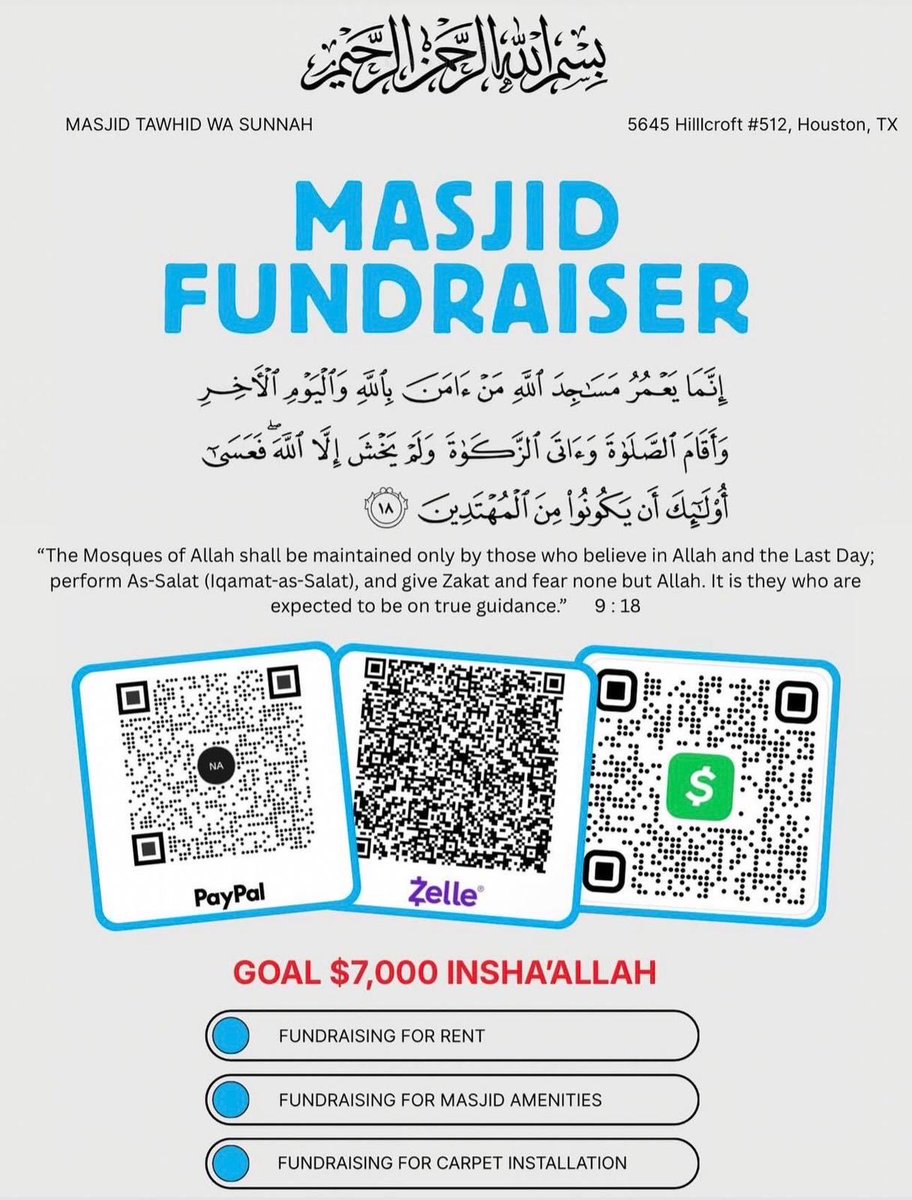
Help the brothers at Masjid Tawheed (Houston)
🚨 $3,600 needed for NEW CARPET installation 🚨
Don’t miss this opportunity for reward.
May Allah bless you all.
At a time when the Muslims were united upon one creed and one methodology, there were no sects and no competing “forms” of Islam. The Muslims simply called themselves Muslims, as Allah had named them.
Then deviations began to appear. The Khawarij emerged, followed by the Qadariyyah and other deviant groups. These titles were used by the Sahabah to distinguish such groups from the Muslims who remained upon the truth.
Later came the Rafidah, the Murji’ah, and many others. These names were given by the Sahabah and their students to identify and clarify these deviations.
As time passed, the Ummah spread across lands and more sects emerged. Meanwhile, the number of Sahabah and their students steadily decreased until those adhering to the original understanding became one group among many. The Prophet ﷺ foretold this when he said:
“My Ummah will split into seventy-three sects. All of them will be in the Fire except one.”
Those who remained firmly attached to the way of the Prophet ﷺ, his Companions, and their students became known by names such as Ahl al-Sunnah, Ahl al-Hadith, and Athari. These names were not adopted out of partisanship, but to distinguish the people of Sunnah from the people of innovation.
This is the principle Shaykh al-Islam Ibn Taymiyyah articulated:
“There is no fault upon one who openly professes the doctrine of the Salaf and ascribes himself to it; rather, it is obligatory by consensus to accept this from him, for the doctrine of the Salaf can only be truth.” (Majmu‘ al-Fatawa, 4/149)
When Ibn Taymiyyah himself was examined by the scholars of Damascus regarding his creed, Ibn ‘Abd al-Hadi records:
“Agreement then settled upon the conclusion that this was a sound Salafi creed.” (al-‘Uqud al-Durriyyah, p. 212)
Likewise, twenty years ago, you would hardly find anyone calling themselves Salafi except the students and followers of Shaykh Ibn Baz, al-Albani, Muqbil, and Ibn ‘Uthaymin.
At that time, many people of bid‘ah objected to the term, saying, “Allah called us Muslims.” Yet they had no issue using labels such as Khariji, Rafidi, Murji’, or Sufi. The reality is that names become necessary when deviations arise and distinctions must be made.
Today, however, all kinds of people claim Salafiyyah. But the issue was never merely about a name. The purpose was always to distinguish oneself from the people of innovation and to identify with the methodology of the Salaf.
A Salafi is one who follows the Qur’an and Sunnah according to the understanding of the first three virtuous generations: the Sahabah, the Tabi‘un, and the Tabi‘ al-Tabi‘in.
Al-Dhahabi used the term in exactly this sense. About Ibn al-Salah he wrote:
“Salafi in his general orientation, sound in creed.” (Siyar, 23/142)
About al-Daraqutni:
“Rather, he was Salafi.” (Siyar, 16/457)
And regarding the qualities of a scholar of hadith:
“…pure, modest, and Salafi.” (Siyar, 13/380)
In every instance, the term is a description of a person’s creed and methodology, not merely a claim.
The way to determine whether someone is truly upon Salafiyyah is not by the label they adopt, but by comparing their beliefs and methodology to the books and statements of the Salaf. Whoever agrees with them is upon their way., and whoever opposes them has departed from their path to the extent of that opposition.
In India, many of these people became known as Ahl al-Hadith. Elsewhere they were called Athari. Al-Dhahabi described Ibn Hubayrah as:
“Salafi and Athari in creed.” (Siyar, 20/317)
The names differed according to time and place, but the methodology remained one.
As the well-known saying goes:
“Between us and you are the books of the Salaf.”
The criterion is not personalities, slogans, organisations, or mere claims. Rather, it is adherence to the understanding and methodology of the Salaf, preserved in their books, narrations, and teachings.
🌟 Daar Us Sunnah Kids Summer Camp 2026 🌟
A fun and beneficial summer programme combining Islamic learning, sports, fitness, character development, and teamwork.
📍 Daar Us Sunnah, 3 Warple Way, London W3 0RX
📅 Dates: TBC
🕙 Monday - Thursday | 10:00am–3:00pm
💷 From £25 per day
👨👩👧👦 Sibling discounts available
📲 For details and registration, WhatsApp:
+44 7535 545816
Build your Iman. Grow strong. Succeed. 💪📖⚽
Contact - +44 7535 545816
COMING SOON - insha Allah!
One of the most beneficial works ever written on the journey to Allah.
The complete three-volume abridgement of Madarij al-Salikin by Imam Ibn al-Qayyim.
The Servant’s Journey!
How many of us attend funerals without knowing the du'ā of the funeral prayer, despite the fact that the deceased are in greatest need of that du'ā? And what is even more saddening is that it could be the funeral of our loved ones and we haven't learnt the du'ā. And how many of us know the du'ā, yet fail to reflect upon its deep and beautiful meanings?
The purpose of attending a funeral is not to show one's face, rather, it is to benefit the deceased through sincere supplication, to take lessons from the reality of death, and to attain the tremendous reward associated with praying the funeral prayer and attending the burial.
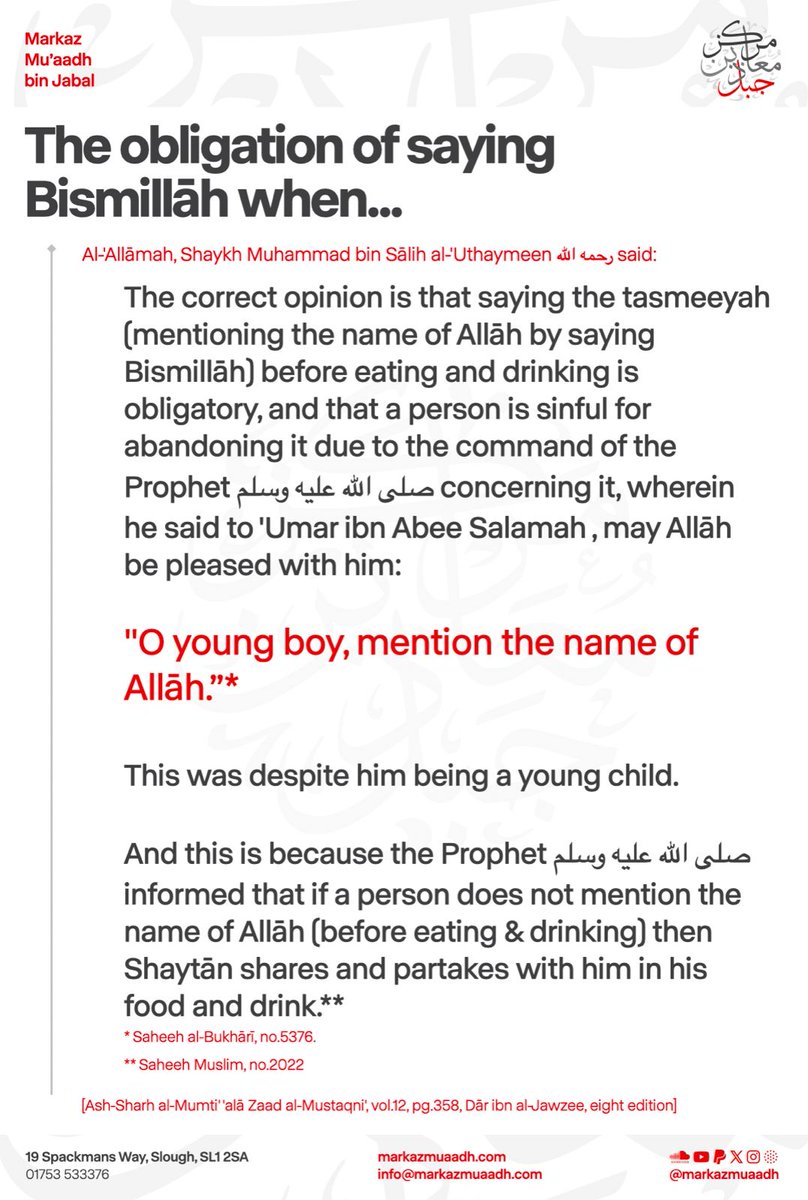
A statement so simple, yet one that carries tremendous benefits in bringing about abundant good and blessings, while warding off evil and harm. It is a statement many of us learned in our early years, and alhamdulillāh it remains upon our tongues till this day. So nurture your children and your families upon this tremendous statement, teaching them when to say it, its importance, encouraging them with love and mercy, and leading by example:









![MarkazMuaadh's tweet photo. Eternal Delight
Allāh's Messenger (ﷺ) stated,
"When the people of Paradise enter it, a caller will announce:
"Indeed, you are promised now to live forever & never die, to be healthy & never be sick, to be youthful & never age,& to be happy & never be sad."
[Muslim no.2837] https://t.co/Cn55xrmRfE](https://pbs.twimg.com/media/EZv6zEJXgAEp_Lx.jpg)