Some Muslims beg Allaah for guidance ( اهدنا الصراط المستقيم ) & then when Allaah responds & provides seminars & lessons, they don't attend!
A poet said:
❝Beware of your enemy once, but beware of your friend a thousand times. Perhaps a friend might flip, so he will know how to harm you more.❞
Shaykh Sālih al-Fawzān was asked:
Q: May Allāh reward you, what is the statement regarding one who says: a specific individual is not declared a kāfir until the conditions are fulfilled and the impediments are removed?
Take your time to study:
1. Usul-Thalathah
2. Al-Qawāid al-Arba'
3. Nawāqid al-Islam
4. Usul as-Sittah
5. Kitāb at-Tawhīd
6. Usul as-Sunnah
5. Al-aqeedah al-Wāstiyyah
6. Kashfus-Shubuhāt
And More...
Imam Ahmad رحمه الله said:
"I would like to live in Makkah's mountain valleys so that I can be unknown. I have been tested with popularity. Morning and evening I hope to die."
[Siyar A'laam Al-Nubalaa' 11/216]
Ibn al-Qayyim:
• What corruption is greater than a heart stripped of love, fear, hope, and trust in Allah?
• Stripped of turning to Him, finding peace in His remembrance, and joy in turning to Him?
• Is such a heart but one deeply ruined, while its bearer does not realize?
Al-Hasan al-Basri (may Allah have mercy on him) said:
The corruption of hearts comes from six things:
-They sin while assuming they can always repent later.
-They acquire knowledge but do not live by it.
-And when they act, their actions lack sincerity.
-They enjoy Allah’s provisions but fail to show gratitude.
-They are unhappy with what Allah has allotted for them.
-They bury their loved ones yet take no lesson from death.
Struggling to connect with the Quran?
Here’s some advice from Ibn al-Qayyim:
When the Qur’an is recited to you, imagine that you are hearing it from Allah, speaking directly to you.
In that moment, the meanings, subtleties, and marvels of His words will gather upon your heart
Al-Rabīʿ b. Sulaymān relates that al-Shāfiʿī said:
“When I entered Baghdād, I stayed with Bishr al-Marīsī (who was a Muʿtazilī). He gave me a room in his house. His mother asked me, ‘Why have you come to him?’
I replied, ‘To learn knowledge from him’
She said, ‘He is a heretic’”
The Blessing of Eyesight
The love for reading is an abyss that every learner enjoys falling into. As years pass, the excitement in stumbling upon beneficial knowledge increases, while the vision in our eyes decreases.
This reminds me of the couplets of Ibn al-ʿAṭṭār al-Dunaysirī al-Shāfiʿī (d. 794), an 8th century Muslim scholar from Egypt who lost much of his vision to old age, but his love for reading did not diminish.
Undeterred by this, he would use pieces of glass to continue reading in his old age. Ibn Ḥajar (d. 852) mentions that he expressed what he went through in poetry:
After youth came my grey hair, and my back was curved after being straight—
It were sufficient if I had sight as sharp as iron, but my eyes are of glass now.
Among other things, there’s definitely one thing for which we should all be very thankful to God: our eyesight.
Abdul Malik al-Qasim mentions in his book Nikkah As-Sālihāt:
Imam Ahmad ibn Hanbal رحمه الله chose a woman named Awra' to marry over her sister, despite her sister being more beautiful. He had asked about the intelligence of the two sisters, and it was said that Awra' was the
Advice for Those Learning Arabic
Language skills come in four types:
1. Listening (Receptive)
2. Speaking (Productive)
3. Reading (Receptive)
4. Writing (Productive)
After teaching Arabic for nearly two years, I’ve noticed that students often struggle most in one particular area: speaking.
Why?
Because most learning environments naturally cover the other three skills.
In class, you listen to your teacher.
You read the Qur’an and Arabic books.
You write assignments
But speaking requires active effort. It’s uncomfortable, it takes courage, and it doesn’t happen automatically in most learning settings, if not all.
Yet, here’s the truth: improving your speaking actually strengthens your other skills too. When you speak, you practice listening, take note of new vocabulary, and reinforce what you’ve read.
If you neglect it, however, the weakness shows quickly.
From my experience, there are two keys that I honestly believe if you came with, you could start benefitting from the scholars directly in a very short period of time:
1. Consistently building vocabulary – even 5–10 new words daily adds up.
2. Frequent conversations in Arabic, if you don't have anyone to speak to, think in arabic!
Barakallahu feekum.
ʾImām al-Daʿwah al-Shaykh Muḥammad bin ʿAbdil-Wahhāb al-Tamīmī (رحمه الله) said:
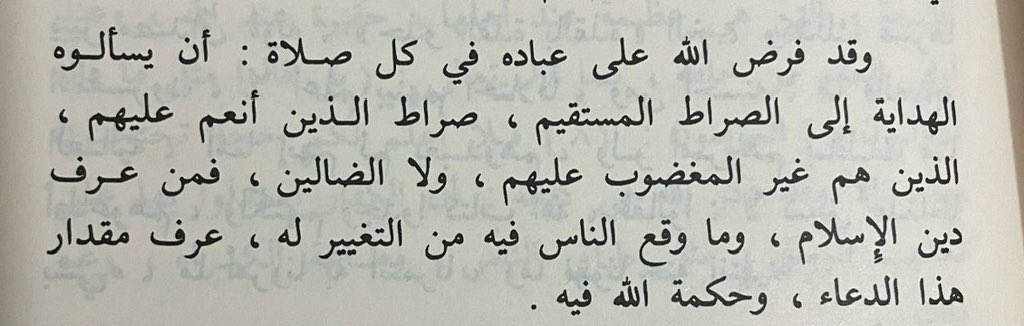
“And Allāh (عزّ وجل) has made it obligatory upon His servants in every prayer that they ask Him for guidance to the Straight Path – the path of those upon whom He has bestowed His favor…
(1/2)
The Prophet ﷺ once held onto the branch of a tree and started to shake it until the leaves fell off. He then said:
“Indeed the Muslim servant observes a prayer seeking the Face of Allah by it, so his sins begin to fall off him like the leaves of this tree.”
[Ahmad, #21556]
Abdullah ibn Umar (رضی اللہ عنہ) said
“Do not revoke the Companions of Muhammad (صَلَّی اللہُ علیہ وسلم) for verily the eminence of one of them of an hour is better than the worship of one of you for forty years”