@Arron_Honniball's thoughtful review of my book 'Sustainable Fisheries Management and International Law: Marine Fisheries in Bangladesh and the Bay of Bengal' has recently been published in the Asian Journal of International Law. Enjoy!
https://t.co/Ib86MPMgXo
🌊 𝑷𝒂𝒔𝒔𝒊𝒐𝒏𝒂𝒕𝒆 𝒂𝒃𝒐𝒖𝒕 𝒕𝒉𝒆 𝒐𝒄𝒆𝒂𝒏?
Are you a student eager to promote ocean governance and the law of the sea on your campus? If yes, apply to become a BCOLP Campus Ambassador for 2025 and join a global network of future ocean leaders.
🌊 𝐂𝐚𝐥𝐥𝐢𝐧𝐠 𝐚𝐥𝐥 𝐨𝐜𝐞𝐚𝐧-𝐦𝐢𝐧𝐝𝐞𝐝 𝐬𝐭𝐮𝐝𝐞𝐧𝐭𝐬!
Are you a student passionate about ocean governance and the law of the sea? Join the BCOLP Campus Ambassador Program 2025.
📅 Apply by 30 April 2025, 11:55 PM (Bangladesh Time)
📄 https://t.co/khTBE88dKC
𝐂𝐚𝐥𝐥 𝐟𝐨𝐫 𝐁𝐥𝐨𝐠 𝐒𝐮𝐛𝐦𝐢𝐬𝐬𝐢𝐨𝐧𝐬: 𝐁𝐂𝐎𝐋𝐏 𝐁𝐥𝐨𝐠 𝟐𝟎𝟐𝟓
@bcolp2022 invites submissions for its blog. The best blog post submitted during 2025 will be awarded 𝐁𝐂𝐎𝐋𝐏 𝐄𝐬𝐬𝐚𝐲 𝐨𝐟 𝐭𝐡𝐞 𝐘𝐞𝐚𝐫 𝐏𝐫𝐢𝐳𝐞. The winner will be announced in January 2026.
🌟 Congratulations to @QFoysal 🌟 We are thrilled to announce that @QFoysal, deputy director at @bcolp2022, has secured the Best Speaker position at the prestigious Yeosu Academy of the Law of the Sea Alumni Programme 2024.
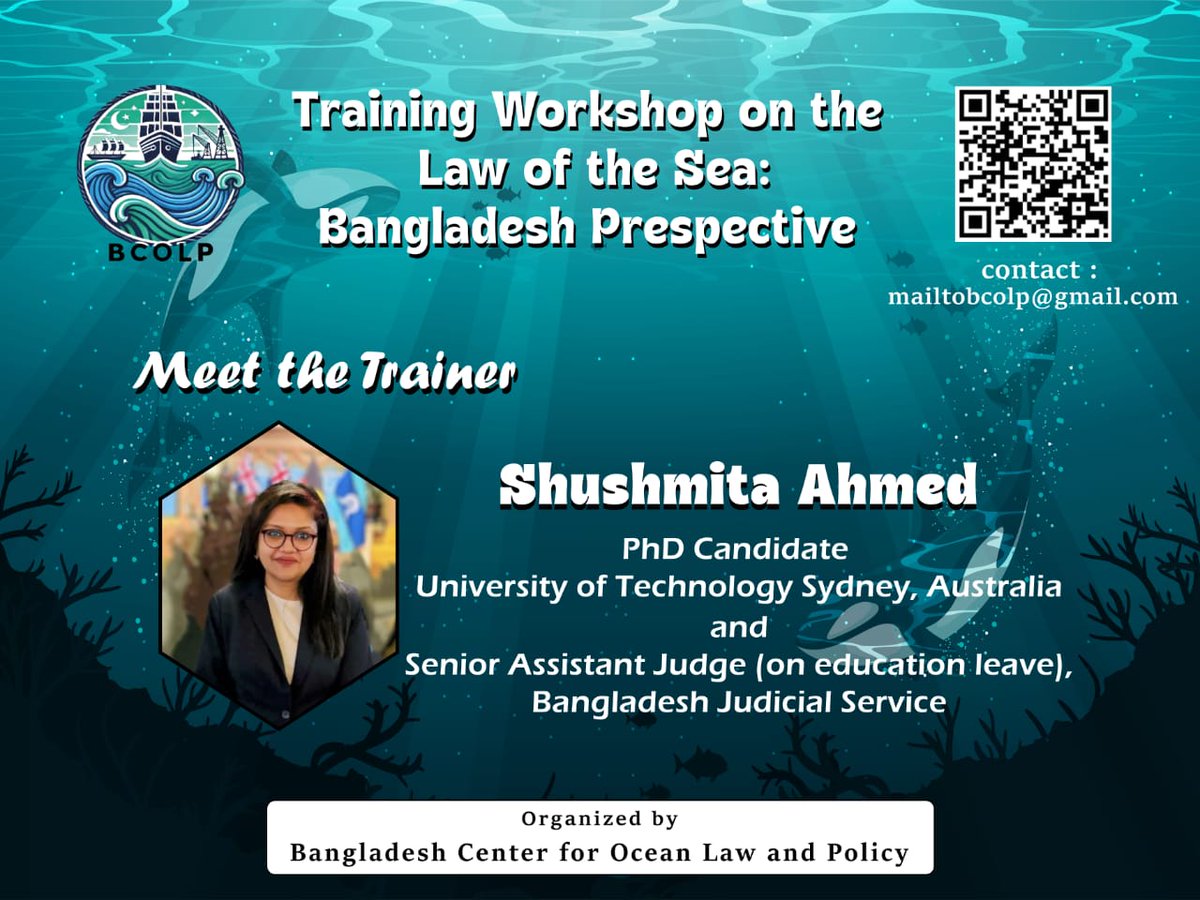
Meet Ms Shushmita Ahmed, a PhD Candidate at the University of Technology Sydney, Australia, researching deep seabed mining from Third World perspectives. She holds a Master of Environmental Law from the University of Melbourne, Australia.
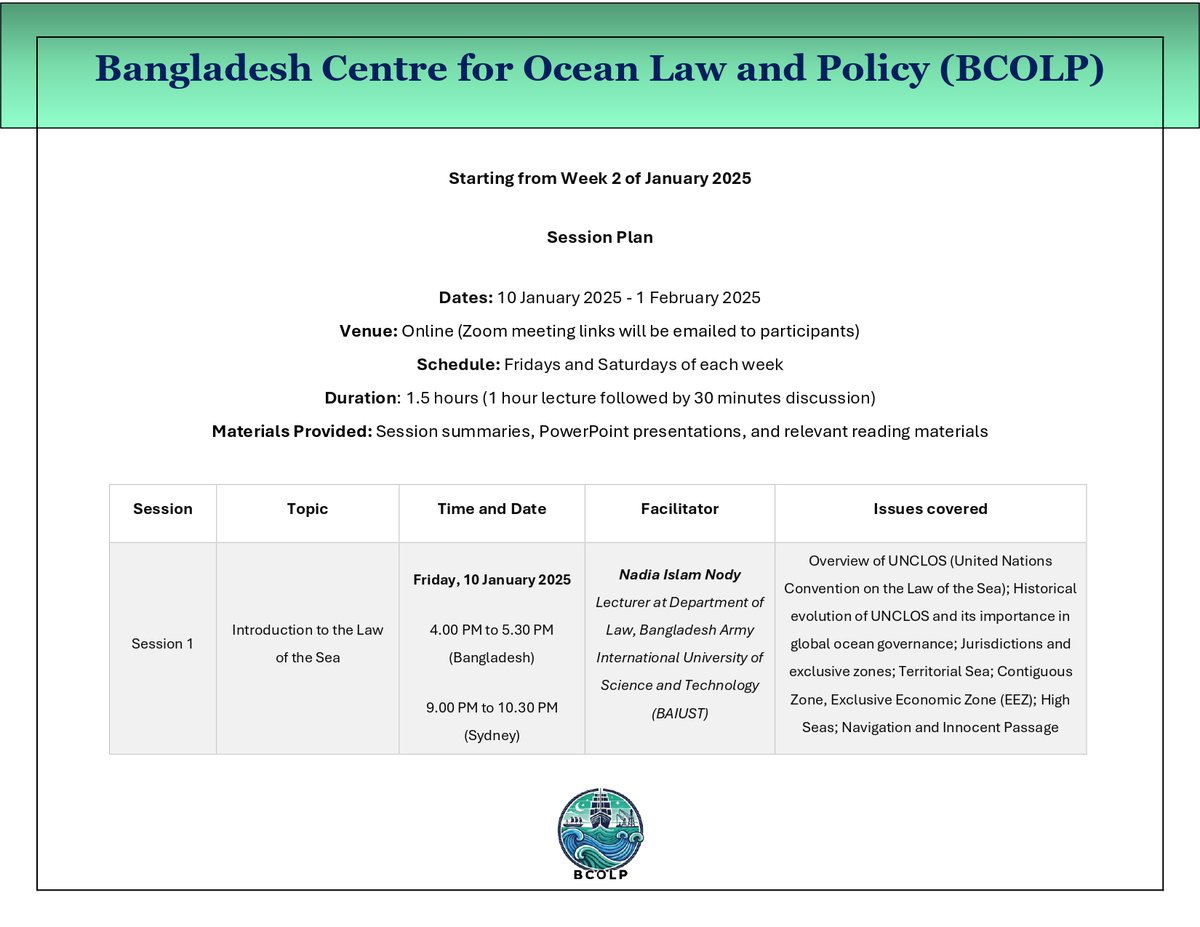
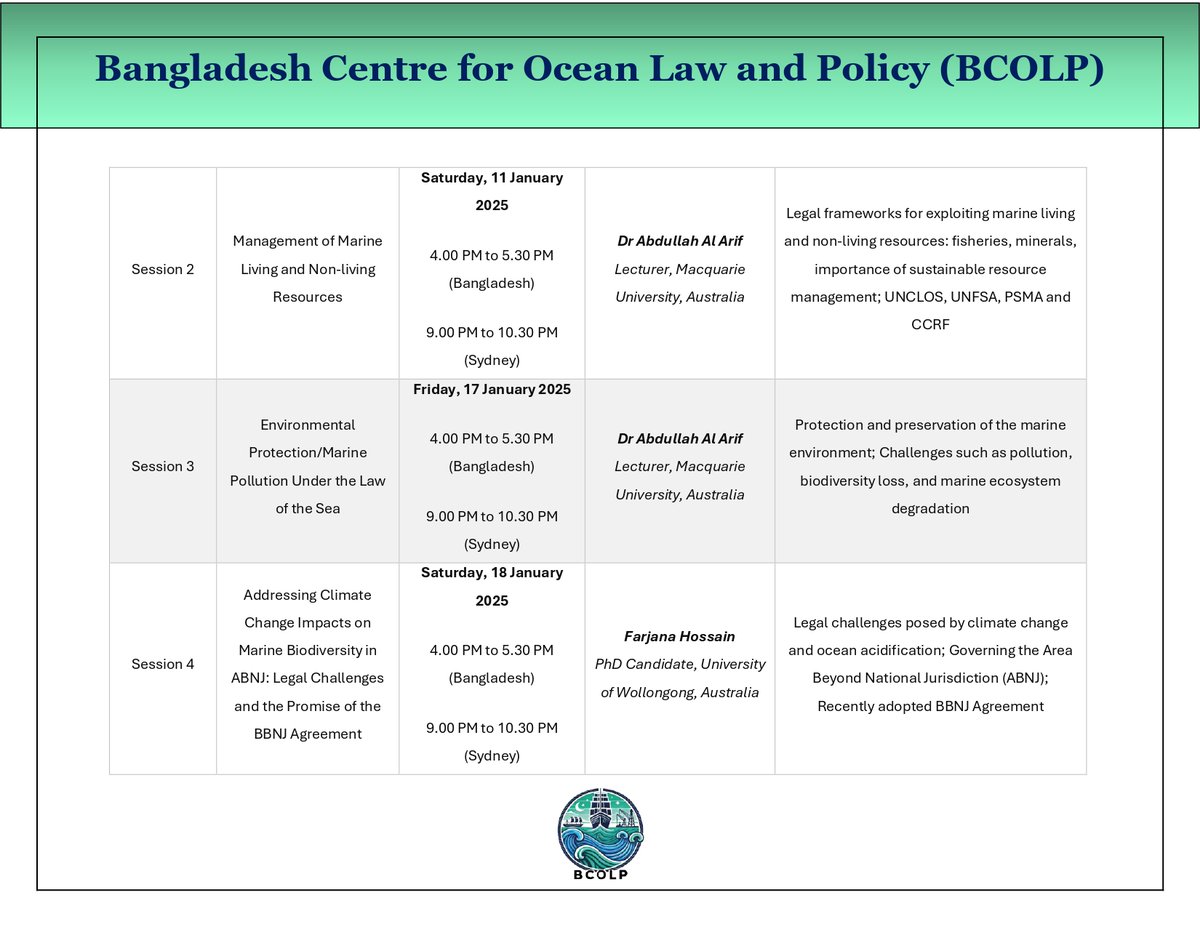
Here is the Program Outline for BCOLP’s Law of the Sea Training Workshop! This month-long program is designed to provide participants with a comprehensive understanding of ocean governance, with a special focus on Bangladesh’s maritime issues.
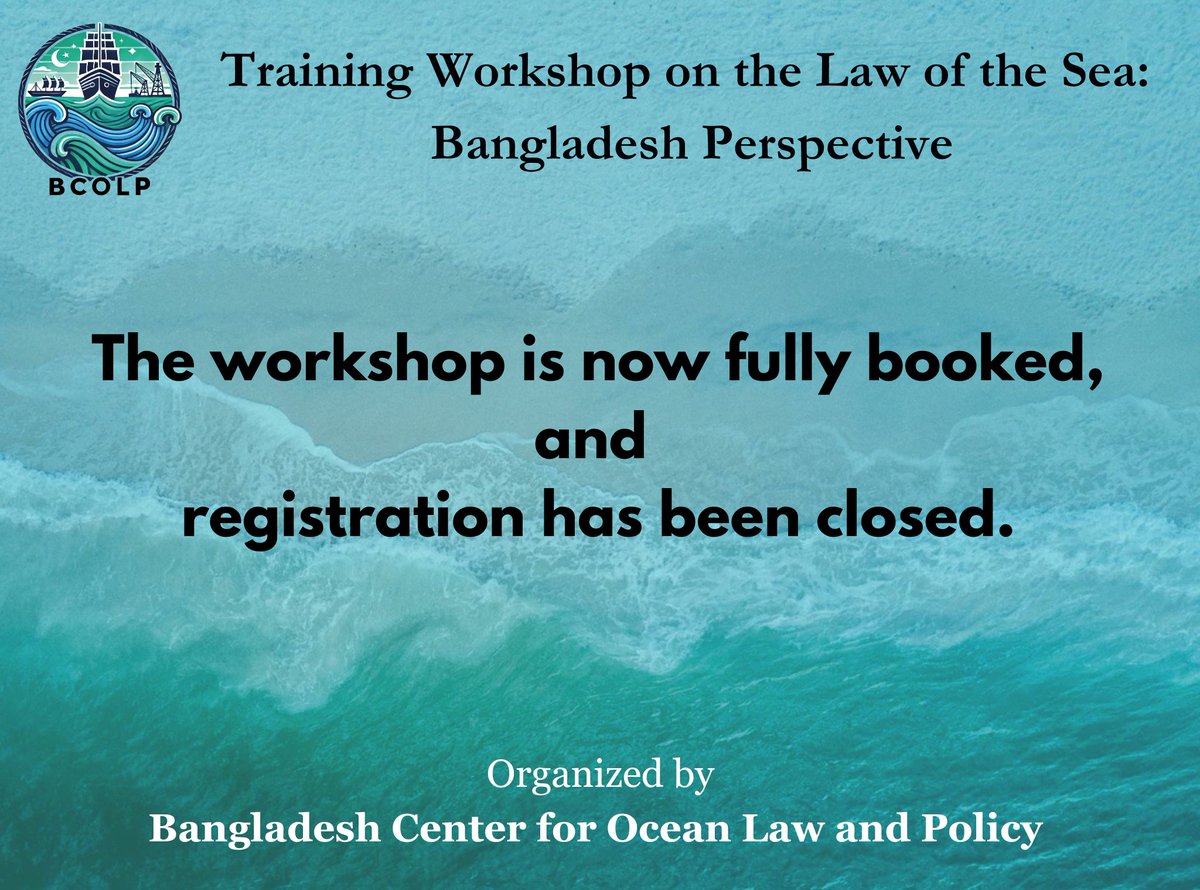
𝐉𝐨𝐢𝐧 𝐭𝐡𝐞 𝐌𝐨𝐧𝐭𝐡-𝐋𝐨𝐧𝐠 𝐓𝐫𝐚𝐢𝐧𝐢𝐧𝐠 𝐖𝐨𝐫𝐤𝐬𝐡𝐨𝐩 𝐨𝐧 𝐭𝐡𝐞 𝐋𝐚𝐰 𝐨𝐟 𝐭𝐡𝐞 𝐒𝐞𝐚: 𝐁𝐚𝐧𝐠𝐥𝐚𝐝𝐞𝐬𝐡 𝐏𝐞𝐫𝐬𝐩𝐞𝐜𝐭𝐢𝐯𝐞
We are excited to announce a month-long training workshop on the Law of the Sea, focusing on Bangladesh's perspective.
🌊We are thrilled to announce the launch of the BCOLP's website! 🌐 Visit us at https://t.co/qNAgXhufFh for the latest updates, research, and resources on ocean governance, maritime security, and sustainable management of marine resources in the Bay of Bengal and beyond.🌎
The author argues that Bangladesh could strengthen its legal framework to combat marine pollution by drawing inspiration from global models like Taiwan's mandatory waste segregation and the EU's recycling directives.
https://t.co/j3clFCckVh
This piece by Shah Maruf Uddin Ahmad delves into Bangladesh’s journey towards sustainable ocean governance, highlighting the challenges and opportunities of deep seabed mining within the blue economy framework.
https://t.co/zLyHDjQELM
🌊 BCOLP Webinar Announcement 🌊
We are excited to invite you to our upcoming webinar titled "বাংলাদেশের সমুদ্র ব্যাবস্থাপনার জন্য আইনি সংস্কারের রূপরেখা" (Outline of Legal Reforms for Ocean Governance in Bangladesh) on Saturday, November 9, at 10 AM Bangladesh Time.
🌊 Join the movement to protect our oceans with BCOLP! 🌍 Become a member today and connect with passionate individuals working towards sustainable ocean governance and marine protection. Together, we can make a lasting impact! #BCOLP
https://t.co/OyoVWuIR9C
BANGLADESH 🇧🇩 : The Government must immediately overturn the curfew with a ‘shoot on sight’ order that grants excessive powers to the security forces.
The curfew must be urgently lifted, and all the people detained or arrested solely for exercising their right to protest peacefully should be immediately and unconditionally released.
The authorities are obligated under international law to always exercise restraint and use no more force than is strictly necessary, proportionate and lawful in response to any escalation they may face. #SaveBangaldeshiStudents #ProtectTheProtest
"The Bay of Bengal faces challenges that require innovative solutions, and while modern technologies provide tools for monitoring and adapting, effective ocean governance remains essential."
https://t.co/sboo9TtMCR
Reported Starvation in Gaza
What message is it that the Israeli Government does not hear?
"Starvation of civilians as a method of combat is prohibited." (Art. 14 Additional Protocol II to the Four Geneva Conventions, 1977)
"Starvation of civilians as a method of warfare is prohibited" (Art. 54(1) Additional Protocol I to the Four Geneva Conventions, 1977)
"The use of starvation of the civilian population as a method of warfare is prohibited" (Rule 53 of the ICRC's Customary International Humanitarian Law Collection)
Perhaps, one day its members will hear:
"For the purpose of this Statute "war crimes" means: ...
Intentionally using starvation of civilians as a method of warfare, by depriving them of objects indispensable to their survival, including wilfully impeding relief suplies as provided for under the Geneva Conventions" (Article 8(2)(b)(xxv) Rome Statute of the International Criminal Court)
War crimes consisting in the use of prohibited methods of warfare
"Whoever in connection with an international armed conflict or with an armed conflict not of an international character ... uses starvation of civilians as a method of warfare by depriving them of objects indispensable to their survival or impedes relief supplies in contravention of international humanitarian law ... shall be punished with imprisonment for not less than three years" (German Code of Crimes against International Law, Section 11(1)(5), providing for universal jurisdiction)