One thing I’ve learned as an engineer is that building alone isn’t enough.
I used to dive straight into systems, wiring tools like HubSpot and Salesforce, writing automation, fixing data flows.
But I rarely stopped to talk to the people living those processes every day.
Lately I’ve shifted my focus.
I’m spending more time having real conversations with marketers, sales teams, and operators to see how things actually work on the ground.
Every chat reveals something that no dashboard or API ever could.
My new rule: talk to people first, build second.
5 DMs a day. One real talk at a time.
Outreach is part of engineering.
#RevOps #HubSpot #Salesforce #AutoParts #LearningInPublic
I’ve been studying how AutoParts sellers actually sell online, and it’s wild how many layers sit between a click and a sale
1. Marketers run Google or Amazon ads to bring buyers in.
2. Buyers click… but most don’t know which part fits their car.
3. Fitment data, catalog info, inventory. All live in different systems.
It made me realize:
AutoParts Ecommerce isn’t just about traffic or ads,
it’s about how truth moves from marketing => product => inventory.
Still trying to figure out how demand-gen teams and sales actually connect all of this.
If anyone working in AutoParts Ecom or RevOps is open to chat, I’d love to learn.
#Ecommerce #AutoParts #RevOps #HubSpot #ERP #LearningInPublic
One concept I’ve been thinking about lately is “Stock Illusion” in the auto-parts quoting process.
It’s when the system shows a part as available, but in reality, it’s already reserved, damaged, or simply not there.
The quote gets approved based on that illusion, and everything downstream (fulfillment, invoicing, trust) starts to fall apart.
It’s a fascinating RevOps problem: the data says “yes,” but the warehouse says “no.”
For those working in distribution or ERP operations,
how do you keep stock truth consistent across your systems and the physical floor?
#AutoParts #Aftermarket #RevOps #B2B #ERP #Quoting #HubSpot
I’ve been learning how the quoting process works inside auto-parts and aftermarket businesses.
I’m curious, how do sales teams usually build a quote when a customer asks for a part?
Do they start from TecDoc or another catalog?
Do they check ERP stock and price first?
Is the quote made inside the ERP, a CRM, or just Excel / WhatsApp?
Trying to understand the real flow, from request => part identification => stock check => price => quote => follow-up.
If you work in parts sales or distribution, I’d love to hear what your day-to-day quoting workflow looks like.
#AutoParts #Aftermarket #B2B #RevOps #Quoting #HubSpot
I’ve been studying how quoting actually works in the auto-parts business.
One thing I’m trying to understand better, what happens at the very first step, when a workshop requests a part.
Often the message sounds like: “Need front brake pads for a 2017 Hilux.”
No VIN, no part code.
Then the sales rep has to jump between TecDoc, Partslink24, or internal Excel catalogs to find the right fit.
This early stage feels like where many quoting challenges begin.
If you’ve worked in the aftermarket or parts distribution side, how do you handle this kind of request ambiguity?
Any best practices or tools that help?
#AutoParts #Aftermarket #RevOps #B2B #Quoting #HubSpot
I’ve been breaking down the micro processes that drive the auto parts business, starting with the one that sets everything in motion: Quoting.
It looks simple: a customer asks for a part => sales sends a quote => order confirmed.
But under the surface, this single step touches catalog accuracy, ERP stock data, supplier pricing, and even credit limits.
For anyone working in auto parts or aftermarket distribution, what are the biggest pain points you face in the quoting stage?
(Stock accuracy? VIN matching? Price updates? Credit approvals?)
Would love to learn from people in the trenches.
#AutoParts #Aftermarket #RevOps #B2B #Manufacturing #HubSpot
I’ve been learning how data actually flows inside automotive spare parts businesses.
Most people assume it’s simple, but in reality it passes through layers of tools and file formats before it reaches the customer.
1. Catalog (TecDoc, PartsLink24, proprietary)
2. Master Data (Excel sheets, sometimes APIs)
3. ERP (Odoo, SAP, Dynamics)
4. CRM (HubSpot, Zoho)
By the time a quote is sent, the truth about stock, price, or fitment can already be outdated.
How do companies in this space keep their catalog data accurate across all these systems?
#RevOps #HubSpot #ERP #Spareparts #TecDoc #PartsLink24
The biggest problem I keep noticing in ERP-driven industries isn’t bad data, it’s delayed truth.
In manufacturing, logistics, or construction…
1. Sales marks a deal as “won.”
2. Production hasn’t confirmed capacity.
3. Finance hasn’t even issued the invoice.
By the time everyone sees the same reality, it’s already outdated.
We talk a lot about “CRM <=> ERP integration,”
but what these companies really need is truth integration.
one shared version of what’s real, happening now.
For those working in ERP-based environments,
how does “truth lag” show up day-to-day in your org?
#RevOps #Manufacturing #ERP #B2B #HubSpot
@getnachonacho That makes total sense, I keep hearing Excel come up again and again.
Do you think the main reason it sticks around is flexibility, or just that ERP/CRM systems don’t match the real process on the ground?
The sales <=> production handoff seems like a universal pain point.
Most of what we see online about HubSpot, Salesforce, and marketing automation comes from high-velocity industries. SaaS, eCommerce, agencies.
But I’ve been wondering
How do slower-cycle, complex industries like manufacturing, construction, logistics, and healthcare actually run their revenue operations?
What tools and systems do they rely on day to day?
Where do things break. Quoting, follow-ups, handoffs between sales and production?
If you’ve worked in one of these spaces, I’d love to hear what the real challenges look like on the ground.
#HubSpot #RevOps #B2B #Manufacturing #MarTech
I’ve been studying how revenue actually flows inside manufacturing companies.
One friction that keeps showing up: the Lead => Quote handoff.
A deal gets created in the CRM… then someone manually re-enters it in the ERP to generate a quote or job order.
That’s hours of duplicate work, and plenty of room for errors.
Curious for anyone in manufacturing or RevOps
– How do you handle the CRM → ERP quote process today?
– Is it automated or still manual?
– What breaks most often?
#RevOps #Manufacturing #HubSpot #ERP #B2B
I’ve been trying to understand what RevOps actually looks like in manufacturing.
Most content online talks about RevOps in SaaS. high-velocity funnels, fast CRMs, short sales cycles.
But manufacturing feels different:
Demand => Sales => Production => Finance => Customer Success.
How do these teams stay aligned when revenue depends on physical output, long projects, and slow feedback loops?
If you’ve worked in manufacturing, I’d love to learn
1. Where do handoffs usually break?
2. How do you keep sales, ops, and finance looking at the same truth?
#RevOps #Manufacturing #B2B #Operations #HubSpot
I’ve been knee-deep in the HubSpot ecosystem lately, testing integrations with Google Ads, Meta Ads, and LinkedIn Ads (plus some finance + support tools).
One pattern: every connector solves 80% of the job, but leaves painful gaps.
If you could snap your fingers and get a small MVP to fix one HubSpot integration pain you’ve had, what would it be?
Polling vs Webhooks in HubSpot What’s the Real Difference
As marketers and RevOps teams working with HubSpot, we often rely on constant data syncing to keep systems aligned. But there’s another option: webhooks, a way to receive updates automatically, in real-time.
Depending on your use case, you might choose one or the other. Here’s a simple breakdown of the two:
🔹 Polling
- Your app keeps asking HubSpot:
“Anything new? Anything new? Anything new?”
- Works without needing setup
- Can be heavy, delayed, or redundant
🔹Webhooks
- HubSpot taps your shoulder and says:
“Hey, something changed — here’s the update!”
- Real-time and efficient
- Requires setup, handling auth + events
Both have pros and cons. The best option depends on your context, your systems, and your timing needs.
@TheJonMartin That’s a rough way to find out. I think this is where integrators need to go beyond just the engineering side. Reading the docs carefully and understanding the business-level limits (monthly quotas, billing tiers) is just as important as handling the technical rate limits
This hits hard. I’ve seen the same thing when syncing Google Ads into HubSpot.
On the surface: traffic flat.
Inside HubSpot: form fills drop, lifecycle progression slows.
That’s where UTMs + gclid capture become critical, you actually see which “same traffic” is no longer converting.
Quality > volume, every time.
@blvckledge Super helpful. Curious, has anyone here used HubSpot to capture UTMs + gclid for BFCM campaigns? Would love to hear if attribution lined up well for you.
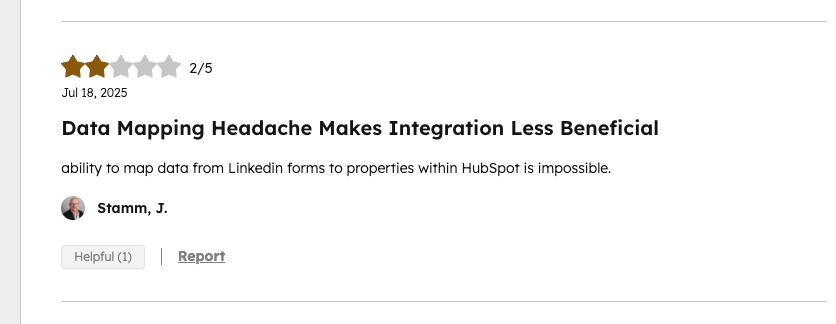
I’ve been reviewing the LinkedIn Ads connector on the HubSpot marketplace, and came across this feedback:
“Ability to map data from LinkedIn forms to properties within HubSpot is impossible.”
It looks like the main pain point is around data mapping, getting LinkedIn lead form fields to sync cleanly into HubSpot contact properties.
Curious if anyone here has found workarounds for this? Or is this still a blocker in your setup?
https://t.co/iP9AB9KmA4
#HubSpot #RevOps #LinkedInAds