Software Engineer becoming an entrepreneur
📚 Books are cool
💥 Building Perceptr in public
📈 Took two companies from zero to Series A (Engineering Side)
I just got my first customer!
But with a twist...
Week 9 update:
So let me explain
A design partner is not yet a paying customer.
They work with you before you have a finished product.
They help shape what you build.
In exchange, they get early access and a real voice in the process.
That is the deal I am getting now.
Many don't recommend design partners at all
And here is why (the risk):
Work too closely with a small group,
and you start solving their specific problems,
not the market's.
You drift.
You become a software house,
not a product company.
I know that.
I am doing it anyway.
Because this space requires a deep understanding.
Compliance. Regulatory frameworks. ISO. PCI. Local regulators.
Each framework is 300 to 400 pages.
I am studying 4 of them right now.
On outreach, I got 30 discovery calls in 2 weeks
The trick? (my secret sauce hehe)
At the end of every discovery call, I ask:
"Do you think there's someone else I can speak with?"
You'd be surprised by the result.
Now the uncomfortable part.
The deeper I go, the more this market looks relationship-driven.
Maybe consulting-heavy.
Not pure software.
That is a hard thing to sit with.
But I keep coming back to something from YC - the idea of AI-native services.
Services that were not economically possible before AI existed.
Not software pretending to be a service.
Not a consultant pretending to be a product.
A third thing.
Companies have broken into this space before.
And developing markets may behave differently from developed ones.
There might be a path here that does not look like what I expected.
Still figuring it out.
15-hour days.
Trying to impress these design partners and see where it leads.
Have you navigated a market that felt more relationship-driven than product-ready? What did you do with that signal?
♻️ If you know a founder grinding through early customer discovery, share this with them.
➕ Follow @abesolyman for more.
Bending Spoons just acquired Airtable for $1.285 billion.
A company that raised $1.4 billion from VCs.
Once valued at $11.7 billion.
This is a masterclass in how a valuation trap works.
And how one founder found the exit anyway.
The real culprit was not the market.
It was the math from 2021.
Raising at $11.7 billion meant Airtable needed
$1.5 billion in annual recurring revenue
just to justify an IPO...
By June 2026, they had $480 million.
Growing at 20 percent year over year.
Solid execution. Wrong price tag.
Then the market shifted.
In 2021, investors were paying high prices for software companies.
That era ended.
Company valuations crashed across the board.
Airtable's revenue was solid.
But it could never justify an $11.7 billion price tag anymore.
That is a prison sentence, not a valuation.
However,
Bending Spoons decided to buy the product.
Why?
They bought
↳500,000 customers
↳$480 million in recurring revenue.
↳80% of the Fortune 500
↳Distribution.
Now look at who won and who lost.
Airtable had $965 million in cash when the deal closed.
So the real payout was $2.25 billion, not $1.285 billion.
Late-stage investors get their money back first.
That is the deal they signed...
Their big returns are gone.
Early investors walk away healthy.
The founders split around $144 million.
About $40 to $50 million each.
Not the $11.7 billion story they once imagined.
But not nothing either.
And then there is Howie Liu.
The SEC filings reveal what most people missed.
Liu quietly spun out Hyperagent as its own company. Hyperagent Inc.
Bending Spoons gets the database, the customers, the revenue.
Liu gets a clean slate.
A fresh startup.
A new company already running.
That is not luck.
That is a founder thinking three moves ahead.
4 lessons every technical founder should take from this deal:
1/ Your valuation is not a trophy. It is a constraint.
↳ Every dollar you raise at a high price narrows your future options.
↳ The higher the valuation, the fewer exits are available to you.
↳ A $500 million exit is life-changing. At an $11.7 billion valuation, it is a failure.
2/ Build distribution like it is the product.
↳ The acquirer did not buy Airtable's code.
↳ They bought 500,000 customers.
↳ Customer relationships are worth more than your code.
3/ Design your next move while running this one.
↳ Liu did not figure out Hyperagent after the deal.
↳ It was carved out before the deal closed.
↳ Always be building the door before you need to use it.
4/ Raise what the business needs. Not what VCs will give you.
↳ More money at a higher price feels like validation.
↳ It is actually a ceiling.
↳ Take what you need to hit the next milestone. Nothing more.
The founders who understand this build differently.
They raise what they need.
They protect their distribution.
And they always leave themselves a door.
Howie Liu is already walking through his.
♻️ Repost this if you know a founder who needs to hear this!
➕ Follow Abdelrahman Soliman for more on building as a technical founder.
The market I am entering is broken, crowded, and extremely hard.
That is exactly why I chose it.
This week was dense. In a good way.
I started with a framework I am calling "diverge then converge." I do not understand this market yet. So before I narrow down, I needed to go wide. Talk to everyone. Get a full picture of the ecosystem before committing to anything.
So that is what I did.
15+ discovery calls this week. Auditors, regulators, FinTechs, people inside banks. One question driving all of them: where is the real pain, and is it worth building around?
→ Egypt is far behind on compliance. Not a little. A lot.
→ Enterprises mostly do not care enough to change
→ FinTechs are a different story. They are regulated, they feel the pressure, and some of them genuinely want to make compliance less painful
→ There is willingness in certain corners to fix this. That is the signal I needed.
The market already has serious players. ServiceNow. Archer. Vanta. Drata. Deep pockets, long track records, products that have been around for years.
My question is not "can I beat them." My question is: why have Egyptian companies not adopted these tools already? Is it price? Is the product not solving the problem at the right depth? Is it something else entirely?
I do not know yet. That is still the diverge phase.
But one rule I am holding onto: always assume you are competing against an extremely intelligent, well-funded competitor. Features alone will not win. Not in the AI era. The answer is depth, not breadth.
Now I need to converge. One target. One real problem. One MVP.
The discovery calls are starting to show me where that might be. I have not committed yet. But the direction is getting clearer.
This space is heavy. Compliance, legal frameworks, regulatory papers, cybersecurity - all tangled together. I am downloading materials this week to study deeply. You cannot build for a market you do not speak.
Next step is straightforward: build the MVP fast. Go back to the same people I spoke with this week. Show them something real. Then decide if this is a go or a no-go.
And I am actively looking for a co-founder. This space probably needs one.
If you have done customer discovery in a regulated market - what actually surprised you?
♻️ Repost this if you are building in a space that scares you.
➕ Follow @abesolyman for more on building in public as a technical founder.
Tools like Vanta exist. They automate compliance well. SOC2, ISO27001, all of it.
They just do not solve what is actually breaking Egyptian fintechs.
This is week 9, and I have done 6-7 discovery calls now. And a pattern is starting to emerge.
In most markets, compliance is a CTO problem. Maybe a security team problem. It lives somewhere in the background. In Egypt's fintech space, it is a survival problem. Founders are not asking "how do we scale?" They are asking "how do we get licensed before we run out of runway?"
The CBE or FRA licensing process is a different beast entirely. Shifting requirements. Months of waiting. No clear timeline. And nothing in the existing compliance tech stack was built for it.
That is the gap I keep seeing.
But I have two questions I cannot answer yet.
The first: is the pain recurring, or is it a one-time thing? If it disappears after licensing, that is a consulting business. Not a SaaS. And I am not building consulting.
The second: is the market big enough? Are Fintechs willing to pay? What about banks? Maybe expansion into insurance, healthtech, or other African and MENA markets could change the math. But I do not know that yet.
All I know is that compliance is becoming an important theme in the era of AI.
So for the next one to two months, I am going to keep talking to people. Pre-licensed fintechs. Post-licensed fintechs. Both are living completely different realities.
I made the mistake once of building before I understood the problem. I spent months engineering Perceptr before I knew if anyone actually needed it. I am not doing that again.
No code. Just calls.
If you have been through CBE licensing, or you are in the middle of it right now, I would like to hear from you.
#fintech #Egypt
@romaindewolff I kept working on my idea for two years and zero revenue, I thought I would have quit by now, but looking back I learned alot through this journey.
Especially that I am an introvert, but now I speak and reachout to customers
Founders find a market and immediately start building.
That is exactly why they fail.
Week 8: I found the market. Now I am doing everything I can to not build it yet.
Last week I posted about compliance. Founders, lawyers, fintech people all showed up in the comments. The excitement was real.
Then I sat down and actually mapped the space.
Insurance compliance. Financial compliance. Healthcare compliance. AML. SOC2. ISO27001. Auditing. Transaction monitoring. User monitoring. Legalization frameworks.
That is not a market. That is a continent.
And staying broad kills you.
Every book says it. Every founder who survived says it. You have to start somewhere specific or you start nowhere at all.
Compliance is still the right direction though.
My assumption is: It is a painkiller. Not a vitamin.
My last startup, Perceptr, was a vitamin. Nice to have. Nobody was going to die without it. That is why it did not work.
Compliance is different. You comply or you get fined. You comply or regulators shut you down. The pain is not abstract. It is existential for the companies living it.
That is the right type of problem to build on.
But I am not building yet.
Because before I write a single line of code, I need answers to these:
↳ Who is suffering the most right now?
↳ Do they have budget to actually pay for a solution?
↳ Have they already tried to solve it? Built internal tools that failed?
↳ How much would they pay to make this pain go away?
↳ Is the market big enough to grow into something real?
↳ Is there a repeatable formula? Or does every company have different regulations, turning this into a software house? That is a disaster.
The only way to answer these is to talk to people.
Discovery calls. Real conversations with people in insurance, fintech, healthcare. Maybe someone on the regulator side.
Someone asked me this week if I was going to bring in a compliance expert or co-founder.
My honest take: you can learn almost anything in two weeks if you are focused enough. A consultant who does not care about the business is worse than no expert at all.
I am very open to a Co-founder. In fact, this will be my next move if I prove the market
The next two weeks are about understanding, not building.
If I find the right niche, and the answers hold up, then we build.
Not before.
If you have ever had to niche down from something that felt huge, how did you pick where to start?
And if you work in compliance, fintech, or healthcare, I want to hear from you. Drop it below.
♻️ Repost this for the founder in your network who needs to hear it
➕ Follow @abesolyman for more
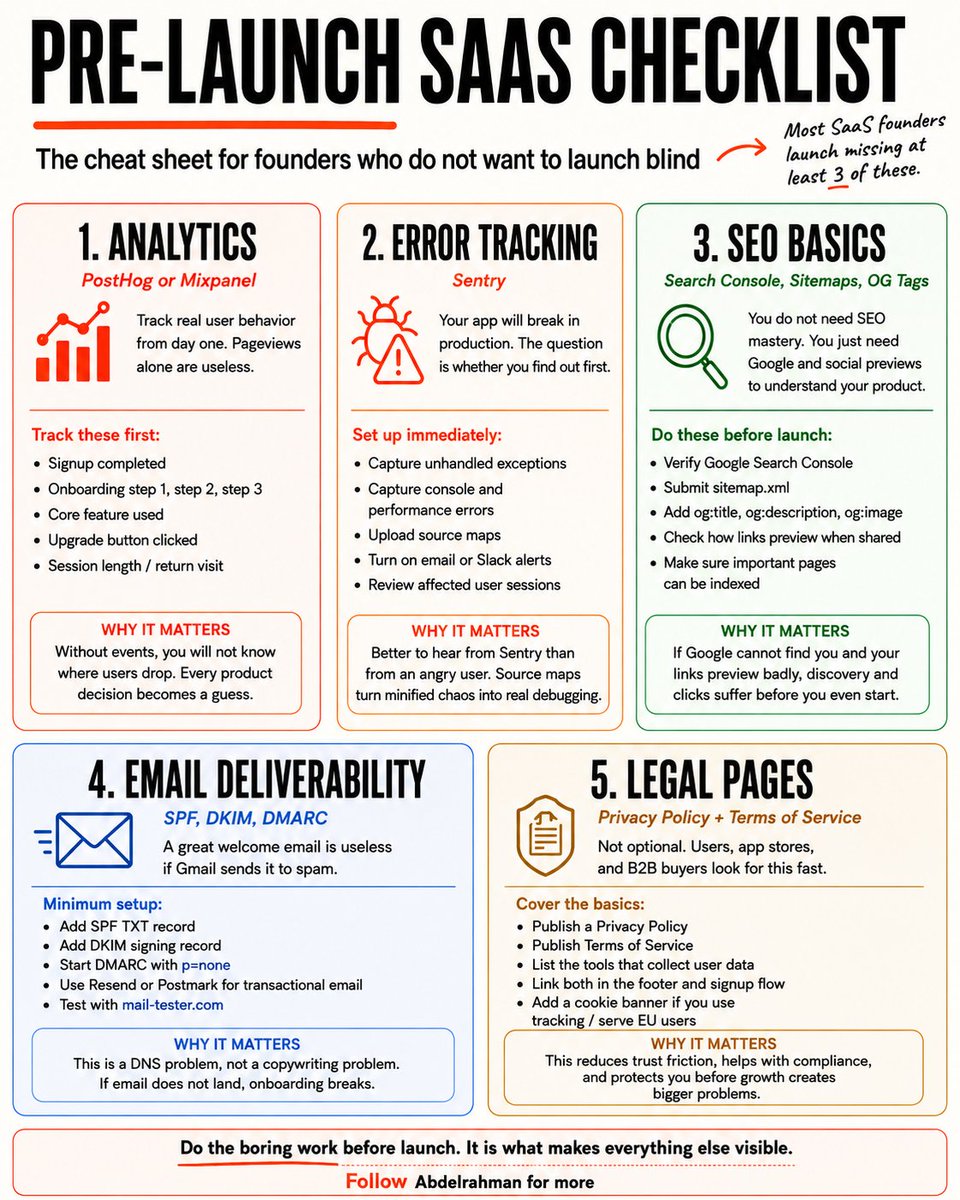
Most SaaS founders launch missing at least 3 of these.
Then spend months guessing why no one converts.
Here is the pre-launch checklist I wish I had:
━━━━━━━━━━
📊 1. Analytics (PostHog or Mixpanel)
Most founders track pageviews and stop there.
You need to know if users reach step 2 of onboarding, or if they sign up, hit a blank screen, and never come back.
Events need tracking:
↳ Signup completed
↳ Onboarding steps 1, 2, etc.
↳ Core feature clicked
↳ Upgrade button clicked
↳ Session length
Without this, every product decision is a guess.
━━━━━━━━━━
🚨 2. Error Tracking (Sentry)
Your app will break in production. The question is whether you find out from Sentry or from an angry user tweeting at you.
Sentry captures every exception with a full stack trace —> exact file, line, and user session.
Setup: npm install @sentry/node (or @sentry/react), then Sentry.init() with your DSN.
↳ Upload source maps so traces point to real code, not minified garbage
↳ Set up Slack or email alerts for the moment something breaks
━━━━━━━━━━
🔍 3. SEO Basics (GSC, Sitemaps, OG Tags)
You do not need to be an SEO expert. You just need Google to know your product exists.
Google Search Console
↳ Verify ownership via DNS TXT record or HTML meta tag
↳ Submit your sitemap so Google indexes your pages
Sitemaps
↳ On Next.js, use next-sitemap —> one config file, auto-generated on build
↳ You can use this free tool: https://t.co/hk2xSYcM5Z
OG Tags
↳ Add og:title, og:description, og:image to every page's head tag
↳ Without og:image, your link preview is a blank box. Nobody clicks a blank box.
Use https://t.co/MZR89aIUI5 to check your tags before going live.
━━━━━━━━━━
📬 4. Email Deliverability (SPF, DKIM, DMARC)
You spent a week writing your welcome email. Gmail sent it to spam.
This is a DNS problem, not a writing problem.
SPF
↳ A DNS TXT record authorizing which servers can send on your behalf
DKIM
↳ A cryptographic signature on every email — your ESP (Resend, Postmark, SendGrid) gives you the CNAME to paste into DNS
DMARC
↳ Tells providers what to do when SPF or DKIM fails
↳ Start with p=none, move to p=quarantine once clean
Run your domain through https://t.co/BjzP5FkWxd before your first send.
━━━━━━━━━━
⚖️ 5. Legal Pages (Privacy Policy + Terms of Service)
Required by GDPR, CCPA, and the Apple App Store. B2B buyers check before signing up. Skip this and it will catch up with you.
Privacy Policy
↳ What data you collect, how it is stored, who you share it with
↳ List every third-party tool (PostHog, Sentry, etc.)
Terms of Service
↳ Limits your liability and sets rules for acceptable use
↳ Gives you ground to terminate abusive accounts
Use Termly or Iubenda to generate free drafts. Link both in your footer.
━━━━━━━━━━
This is a one-time setup. I learned these lessons the hard way...
Which one of these are you missing right now?
♻️ Repost if you find this useful.
➕ Follow Abdelrahman Soliman for more.
@GoldilocksOrbit Yes exactly, one thing I learned, build it and they wont come. You have to handpick your first customers by yourself, no running away from this
Week 7. I think I found a market I am interested in.
Not building a startup yet, but time for exploration.
First off, let me answer a question: Why leave Perceptr after 2 years of hard work?
There is a framework early-stage investors use: vitamins vs painkillers. Vitamins are nice to have. Painkillers solve something that actively hurts. The best startups are painkillers.
What that framework quietly leaves out: vitamins can build great companies. But only if you already have distribution, an audience, or a track record that makes people trust you before you have proven anything. As a first-time founder with no prior exits and a limited network, I was not that person. I was asking people to take a vitamin from someone they had no reason to trust yet.
So I killed it. Thanks to Mohammed Sherif for handing me the ammo haha.
This week I attended two events inside the Egyptian startup ecosystem. I was listening for pain.
What I heard surprised me: agriculture is Egypt's biggest industry. And over 50% of the harvest is wasted. Not because of poor farming. Because of broken logistics and broken economics. This year, strawberry farmers let their harvest rot in the fields. Literally. It was cheaper to leave the strawberries on the ground than to pay to transport them to stores.
That is not a vitamin. That is a bleeding wound.
But I am putting it on hold...
Because:
↳ I do not speak the language of that industry.
↳ I do not know the customer.
↳ I have no network inside Egyptian agriculture.
Jumping into a painful problem I do not understand would just be a different kind of mistake.
So I kept talking to anyone I could speak with.
What kept surfacing: compliance.
I know how that sounds. Broad. Dry. Unglamorous. But the reason it caught my attention is that the pain is not regional. It is everywhere. Fintech companies drowning in transaction monitoring. Healthtech startups navigating licensing. SaaS companies filling the same security questionnaires on loop. Founders watching months disappear into central bank paperwork before they can touch a single customer.
And there is already proof this can scale. Vanta turned compliance automation into a billion-dollar business by solving SOC2 and HIPAA. The problem is not unique to Egypt or MENA. That matters to me.
I made one rule for myself: I will not write a single line of code until I can answer three questions.
What is the actual painful problem? Not the category. The specific, recurring, costly moment.
What does the right solution look like? Not what I want to build. What the customer actually needs.
Will someone pay for it? Not "would you use this." Will you sign something.
Right now I am setting up discovery calls with people in my network across fintech and legal and regulatory. I want to understand where compliance hurts most before I decide which niche to go deep on. Early-stage fintechs trying to get licensed? Healthtech navigating data regulations? Something I have not thought of yet?
I do not know. And I am sitting with that.
If those calls produce letters of intent, I build. If they do not, I keep asking better questions or find a new problem.
Week 7. Still no product. Still no revenue. But I am closer to a real problem than I have ever been.
If you work in fintech, legal, or compliance anywhere in the world - what is the task that makes you want to throw your laptop out the window?
@foliofed Definitely, read mom test and it changed my life. Another question like
Would you pay x for this? Is just useless.
What tools do you use to fix this problem? Really why didnt you try to fix
Would save you years of building