BREAKING: Israeli settlers attacked the Christian village of Taybeh in the West Bank, attacking homes, storming private properties, and vandalizing them.
In this video, one of the settlers is seen emptying a water tank onto the ground.
https://t.co/QiOAbofNdn
He died looking like a homeless man. Passersby walked past him for hours before anyone helped. He was the most celebrated architect in Catalonia, and he had spent his final years living in the construction site of a church that would take 144 years to complete.
Antoni Gaudí took over the Sagrada Família in 1883, when it was barely a crypt and some foundations. No government funding. No guaranteed timeline. It ran entirely on donations from ordinary Catalans, collected coin by coin.
For 43 years, he worked on nothing else. After losing those closest to him, he stepped back from the world. The architect who wore tailored suits and attended political rallies gave up meat, gave up socializing, and moved into a workshop inside the construction site. He slept there and ate almost nothing. He walked to evening prayer every day.
His design approach was unlike anything before him. He hung chains from a board, photographed the natural curve upside-down, and built his arches in that exact shape. A hanging chain naturally makes the strongest arch shape possible, sending weight straight down with no side supports needed. He studied bat wings, sea shells, and bones. There are no straight lines in the Sagrada Família. Every column and arch doubles as decoration.
By 1926, after 43 years of work, less than a quarter of the building was finished. He had 17 more towers to build. “My client is not in a hurry,” he said.
On June 7, 1926, at 6:05 in the evening, a tram hit him while he walked to confession. He was 73, wearing threadbare clothes, carrying no identification. He fell in the street, and no one stopped. Passersby assumed he was a vagrant. A nearby doctor eventually found him and had him taken to Hospital de la Santa Creu, Barcelona’s paupers’ hospital. His friends found him the next morning and tried to move him to a private room. He refused. He died there three days later.
Ten years after his death, anarchists burned his workshop during the Spanish Civil War. His plans, models, and calculations were destroyed. Architects spent decades rebuilding them from photographs and fragments.
Ground broke in 1882. On February 20, 2026, the central tower of the Sagrada Família reached its full height of 172.5 meters, making it the tallest church in the world, exactly 100 years after his death. Interior work and the Glory Facade are still ongoing. Final completion is expected in the 2030s. The Eiffel Tower took 2 years. The Empire State Building took 14 months.
He is buried in the crypt of the Sagrada Família.
I just play it on repeat since yesterday:
"Hello Pope Leo XIV, I'm Renzo, I'm six years old.
I'd like to ask you a few questions."
Renzo, a little a boy from the poor neighborhood of Barcelona, stole the show yesterday at St. Augustine's parish, a place where Pope Leo admitted he "feels at home."
Renzo in the sweetest way ever asked those questions to the pope:
Do you like soccer?
When you were little, did you want to be Pope?
Why are my mom and dad worried?
Why does my dad have so many jobs?
Why do bad things happen to some people and not to others? Whose fault is it?
Why are there so many people living on the streets? Does no one see them? Does no one help them?
How can we help if the world is so big?
Does God want there to be poor and rich?
Why are there so many lonely grandparents, if they are so important?
And one last question ... Must we always forgive?
What pope Leo answered the boy was really moving.
"Regarding whether I like football, I confess that I play tennis and I enjoy it very much, but I also appreciate football; in fact, during my years as bishop in Peru, I liked to follow how some local teams were doing; and now, as Pope, I have also received football clubs and sports groups," the pope said, adding that "sport is important because it helps us grow up healthy in body and mind."
He said that as World Cup unfolds, "many will be watching the matches. Football reminds us of something we must not forget: life is not a race to show off alone, but a path we learn to travel together."
"Whoever doesn't know how to pass the ball, even if they have talent, hasn't yet understood the game. And whoever doesn't know how to live with others and for others hasn't yet understood life."
Answering whether he wanted to be Pope when he was little, the pope said: "Well, Renzo, I don't think so. I don't think I ever thought about it."
"But I can tell you something: from a young age, I felt the desire to dedicate my life to God. I didn't yet know exactly how or where the Lord would lead me. Over time, I discovered that Jesus was calling me to follow him as a priest, and that this path led through the Order of Saint Augustine."
"But this isn't just true for me," he said. "Every child is a dream of God. You are too. God desires the happiness of all and wants us, from childhood and throughout our lives, to have a heart like that of children (cf. Mt 18:3): capable of trusting, full of kindness; he wants us to be his friends and not turn away from him. Therefore, more important than asking oneself whether one will be a priest, doctor, teacher, parent, or anything else, is asking oneself whether one wants to be a friend of Jesus. Because friendship with Jesus gives us joy, sets us free, and helps us to see, step by step, the vocation and the path that God has planned for each of us."
Answering the point on injustices in the world, Pope Leo told the boy that "through the life of Jesus Christ, God shows us that, although there is suffering, he never abandons any of his children, because he has prepared for us an eternal joy where there will be no more sadness or pain. Let us have confidence, Jesus is with us, he helps us and accompanies us, and gives us strength to go through the difficult moments we may encounter in life."
Stressing that grandparents play a crucial role in families, the pope said: "Let us not allow loneliness and abandonment to become normalized in the lives of older adults. That is a very sad thing. Let's have our hearts open to all of them."
On forgiveness, he told Renzo and those gathered: "It does not mean forgetting by force, as if nothing had happened. Forgiveness means not letting hatred become the master of our hearts ... our willingness to forgive is a condition for the forgiveness we receive from God."
Video: Vatican Media
"Here so many wounded lives arrive, stripped of almost everything, but never of their dignity."
"Here the Gospel pulls us out of our comfortable position as spectators and places before us a brother or a sister who has arrived."
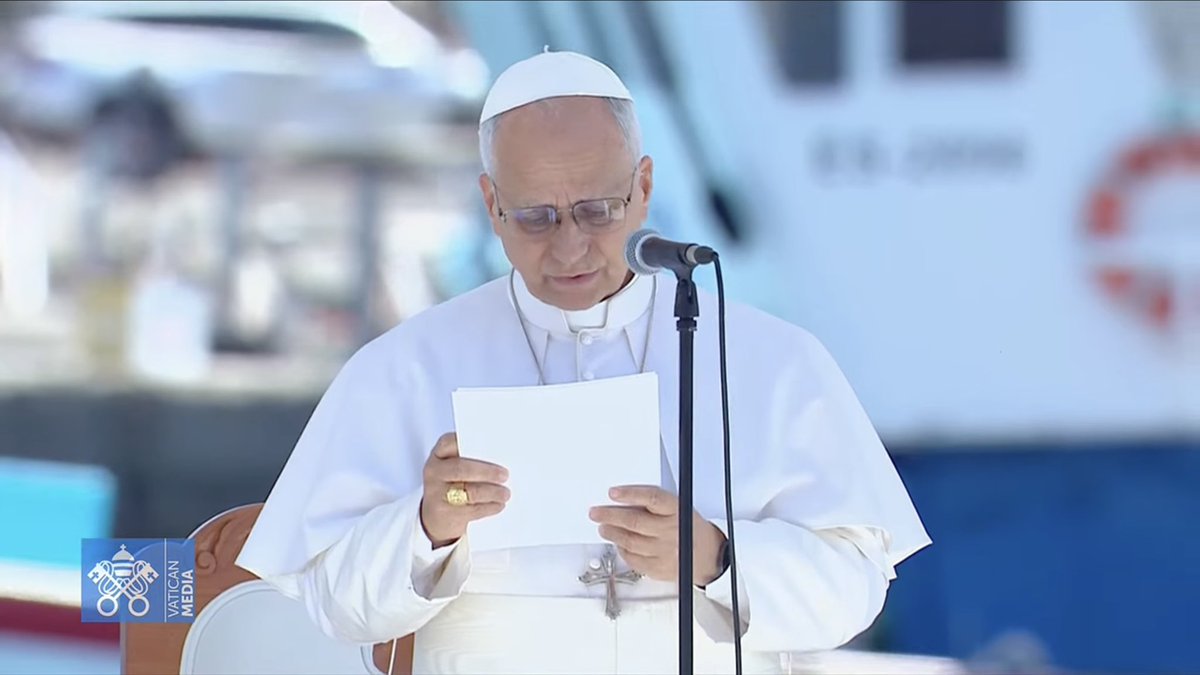
Pope Leo XIV speaking at a Port in the Canaries where migrants from Africa arrive by boat: “While there is a right to seek refugee when life is threatened, there is also the right not to have to migrate, the right to remain in ones own home without hunger, war, persecution, violence, the land becoming uninhabitable, corruption stealing the bread from the poor, or weapons destroying the future of children.”
NEW: Pope Leo met with migrants & migrant charities in Gran Canaria today
Snippet below & analysis soon on @PelicanBriefHQ:
“Dear migrants, before saying anything else to you, I want to bow before your dignity. You are not just numbers or files. You are people who have left behind families and homes. You have dreams that no one has the right to despise.
However, I also want to tell you that your lives must be protected. Do not surrender your lives to those who trade with them. Do not believe those who promise easy paradises in exchange for your body, your money, your silence or your freedom. Those false promises are “siren songs”; they are industries of death.
This tragedy must serve as an appeal to the conscience of the nations of origin of the migrants, which must establish conditions for peace, justice and development.
It is also an appeal to the conscience of the transit nations, which are called to protect the vulnerable and not leave them in the hands of criminal networks.
It is likewise an appeal to the conscience of Europe, which cannot claim to uphold human dignity while growing accustomed to the Mediterranean and the Atlantic becoming unmarked graves, as well as that of the international community, which is called to effective and persevering cooperation.
The Church, too, must allow herself to be challenged. Welcoming migrants cannot be a secondary matter that is left to a few volunteers. We kneel before the altar to adore Christ present in the Eucharist, from whom we receive the strength and the motivation to live charity; for this reason, we cannot then “pass by” the small boats and rafts, for all service and every commitment spring from prayer and lead back to it”
"I had to chose: Die trying, or stay and have nothing."
One of the most powerful testimonies Pope Leo XIV is hearing in Gran Canaria is one he cannot hear directly from the woman who lived it.
For security reasons, a volunteer is reading the testimony of Blessing, a Nigerian woman who survived human trafficking and sexual exploitation.
"I did not leave my country because I wanted to. I left because there was no other way out."
Blessing describes growing up in poverty, leaving Nigeria at 22 and making the painful decision to leave behind her two daughters in hopes of giving them a better future.
"The mafia took me to a place where they performed a ritual on me. They told me I owed a debt of €25,000 that I would have to repay when I arrived in Europe. That is how my captivity began."
She spent months waiting to leave, often without enough food, before attempting the Atlantic crossing.
"When the time came to cross the sea, I saw how the people who left before us that same day drowned."
"I had to choose: live suffering or cross and take the risk. Die trying, or stay and have nothing."
She survived the crossing, but the suffering continued.
"During the journey I became pregnant by a man from the mafia. When I arrived in Spain, they took my baby away from me to force me into prostitution."
Her son was 11 months old when police dismantled the network holding her captive and she was finally reunited with him.
"With the help of the Church, through social workers, my life has begun to change. Little by little."
"There are days when hope becomes very small. But I have learned to believe in myself again."
Today, although Blessing cannot be present, her voice is reaching Pope Leo — and through him, the world.
To victims of trafficking Pope Leo XIV said:
"If others have put a price on your body, know that God has never ceased to recognize your inestimable worth."
"The Church wants to tell you today that you are a daughter and a sister; you are a blessing."
The World Cup begins tomorrow, and many will watch the matches. Soccer reminds us of something we must not forget: life is not a race to show off on our own, but a path we learn to walk together. Anyone who does not know how to pass the ball, even if they have talent, has not yet understood the game. Anyone who does not know how to live with and for others has not yet understood life. #ApostolicJourney
The Sagrada Família in Barcelona has 18 towers. Twelve represent the Apostles, four symbolize the Evangelists, one is dedicated to the Virgin Mary, and the tallest central tower represents Jesus Christ.
This was very good from Leo:
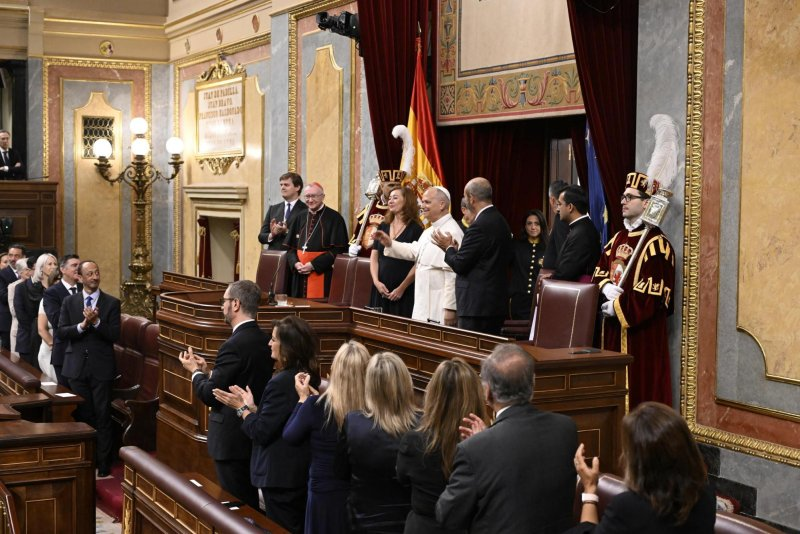
“If life ceases to be recognized as a fundamental value, what future can our societies have? Can a community that casts into the shadows the unborn child, the elderly, the sick, those who suffer in silence, or those who depend entirely on the care of others be called fully just? The defense of human life is neither a partisan issue nor a confessional interest: it is a goal of civilization. Every human life must be recognized and safeguarded from conception to its natural end, in every circumstance of its existence. When this certainty is obscured, the most vulnerable are the first victims, and the law loses its deepest meaning: to serve and protect every person. For this reason, the moral greatness of a nation is manifested, above all, in its capacity to accompany, protect and love those lives that are most fragile.” - Pope Leo XIV, Address to the Spanish Parliament, 8 June 2026. Full address:
https://t.co/suW544vuQv
"My client is not in a hurry."
One hundred years ago today, on June 10, 1926, Antoni Gaudí died in Barcelona, three days after being struck by a tram on his way to confession. Because of his simple clothes and unkempt appearance, many mistook him for a beggar and delayed helping him. By the time he was identified, it was too late.
A century later, the man known as "God's architect" is being remembered not only for his genius, but for the faith that inspired it.
Today, Pope Leo XIV will visit the Basilica of the Sagrada Família to bless the newly completed Tower of Jesus Christ, the final and tallest of Gaudí's planned towers. Rising 172.5 meters (566 feet), it makes the Sagrada Família the tallest church in the world.
Gaudí devoted the last years of his life almost entirely to the Sagrada Família, convinced that he was not building a monument to himself but offering a work of praise to God. He famously accepted that he would never see it completed, saying, "My client is not in a hurry."
One hundred years after his death, the basilica remains a testament to a faith capable of imagining eternity—and to a man whose greatest masterpiece was never really about architecture at all.
@Mmathiass17 Unge jenter kommer til helsesøster og spør om det er normalt med kvelning første gang man har sex med noen. Og Høyres Oslo-ordfører heier fram sadisme nettopp av denne typen. I bunad.
🇫🇮🇻🇦A primeira escola católica da Finlândia será aberta em agosto de 2026. A instituição seguirá o currículo nacional finlandês, mas incluirá formação moral e cultural com identidade católica.
A iniciativa acontece num momento de crescimento da população católica no país, que é majoritariamente luterano e ortodoxo.
Not a single dry eye in Barcelona's Olympic Stadium, where Pope Leo is leading a prayer vigil and responding to questions from young people.
A young woman asked Pope Leo XIV how she could forgive her father after he tried to kill her mother, and where God was when she suffered as a child.
“So many crime reports, even today,
reflect a toxic climate in family relationships marked by abuse and oppression and, in particular, by
violence against women, which unfortunately often leads to femicide. We are all called to address
this dramatic reality, both personally and as a society, because we are responsible for confronting it
in all its dimensions. We cannot attribute to God what has been entrusted to our responsibility; we
cannot imagine that God, from on high, will automatically respond to our needs or miraculously
prevent evil from happening.”
On forgiveness, Pope Leo offered hope:
“We must learn to view forgiveness — that powerful remedy for evil that heals our inner wounds — as part of a process and a journey.”
“This is a long journey and a process that requires great patience.”
Three cheers for Pope Leo's comments regarding the Christian foundations of Europe and the defense of the unborn. Echoing the sentiments of Pope Benedict XVI, Leo reminded his audience that the essential structures of European society and Europe's commitment to human rights are unthinkable apart from Christianity. And speaking before a hard-left Spanish Parliament, the Pope presented an admirably consistent ethic of life, defending migrants, to be sure, but also insisting that no society which "casts into the shadows" the unborn can be called truly just. With bracing clarity, he insisted, "Every human life must be recognized and safeguarded from conception to its natural end, in every circumstance of its existence." And he concluded that "the moral greatness of a nation" is manifested in this principle. That he has been received so warmly in Spain I take to be an encouraging sign that the people of that country, especially the youth, have finally had it with a soul-flattening secularist ideology.