@elonmusk , don’t just bring Starlink to India—let India own a piece of it! 🇮🇳
George Fernandes challenged MNCs to share ownership with Indian shareholders. You could take that idea further by voluntarily listing Starlink India on NSE/BSE.
Build in India. Invest in India. 🇮🇳
Dear Prime Minister Ambani,
Please accept my humble apologies for not realizing that you are the real boss of India.
Naturally, you would prefer to maintain your monopolistic exploitation of the great people of India, but would you nonetheless consider allowing Starlink to compete?
There are many areas of India, as there are in all countries, with no Internet access, which denies children the opportunity for education and for small businesses the opportunity to sell their goods to a global market. Starlink would change their lives for the better.
Thank you 🙏
@AlexDemolitor@PeterBerezinBCA The divergence between a rising 30Y yield and falling XLI/XLV is a warning that the rise in long-term yields may not be entirely growth-driven.
So for economic growth, the signal is Cautiously bearish / warning signal.
@awealthofcs If government spending alone drove stock returns, China should have crushed it.
The bigger issue is per-share earnings growth.
MSCI found China's deteriorating per-share profitability was a key reason for weak long-term earnings growth, with US EPS growth significantly stronger
@babyfolio@Isabel55326641 Build a system/ process, which tells you what to buy, when to buy, how much to buy, when to exit- backtest it and follow the system, don't be random guessing
@glocalinvestor The chart is real, but misleading.
It shows OpenRouter usage, not the global AI market. Chinese models gained share there due to strong price/performance—not because US leaders were displaced.
Context matters.
@asianinvestors Even if hyperscaler spending moderates, sovereign AI demand could keep HBM and memory supply tight far longer than traditional memory-cycle models suggest.
@asianinvestors The analysis assumes hyperscaler AI CapEx is the entire demand story. It ignores Sovereign AI. Nations are increasingly treating AI infrastructure like power grids, telecom, and defense—strategic assets, not ROI projects.
5/ GPUs will likely remain the most valuable component of the AI stack.
But the next AI infrastructure cycle may create a second wave of winners in CPUs, memory, networking, and data-center hardware.
The first AI wave rewarded compute.
The second may reward orchestration.
1/ The market may be about to discover that AI was never just a GPU story.
Bernstein just raised its server CPU TAM forecast to $223B by 2030 (vs ~$37B today).
Reason?
AI is evolving from chatbots to autonomous agents—and agents need far more CPUs than most investors realize.
4/ The key investment debate:
Is AI primarily a compute problem or a workflow problem?
If enterprises deploy millions of AI agents, orchestration may become as important as inference.
The market is still valuing AI as a GPU story.
Bernstein is valuing AI as a systems story.
$MRVL specializes in high-speed data infra, providing essential ASICs, electro-optics, and networking silicon for data centers
Catalyst 1: Inflection from "General Compute" to "Custom AI Silicon" dominance
Catalyst 2: Optical Connectivity Bottleneck in Scale-Out AI Fabrics
$AMPX
Develops ultra-high energy density lithium-ion batteries using silicon anode technology (400–500 Wh/kg vs ~250–300 for standard Li-ion), targeting aviation, drones, and defense
Catalyst: High-volume manufacturing ramp, Energy density advantage enables new categories
$VIAV is mispriced as a telecom cyclical, but is actually leveraged to AI optical infrastructure + high-margin test monopolies. The rerating hinges on order inflection visibility
Catalyst: 1.6T optical + AI network validation cycle drives step-function deman
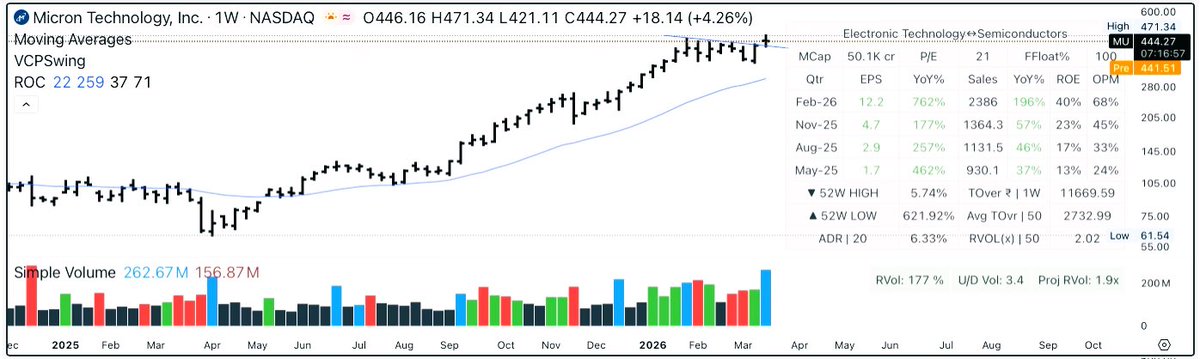
Market still anchors $MU to historical memory cyclicality (low multiple), while reality is shifting to contracted, supply-constrained, high-margin AI infrastructure. If sustained, this drives both EPS explosion + multiple expansion → 2–3x potential