India's Biggest Economic Challenge Is not Inflation, Oil, or War - It is an Unskilled Population Addicted to Distraction.
Every time oil prices rise, economists panic. Every time a war breaks out in the Middle East or Europe, television studios declare that India's economy is under threat. And yes, both matter. But neither represents India's greatest economic challenge. The real crisis is unfolding much closer to home.
It is a generation that spends more time consuming content than creating value. A workforce that debates geopolitics without mastering spreadsheets, artificial intelligence, coding, welding, precision manufacturing, sales, finance, communication, or even basic problem-solving. An economy where attention has become the most wasted national resource.
India is one of the youngest countries in the world. That should have been our greatest competitive advantage. Instead, we risk turning our demographic dividend into a demographic liability.
The Age of Endless Consumption
Never before has information been so accessible. Yet never before have so many people spent so much time learning so little. Hours disappear into political debates, celebrity gossip, cricket controversies, influencer reels, conspiracy theories, and outrage cycles that have absolutely no impact on an individual's earning potential. Ask someone how many hours they spent on social media last week. Then ask them how many hours they invested in acquiring a new professional skill. For many, the answer is uncomfortable. We have become experts at commenting on the economy while contributing very little to it.
Degrees Are Not Skills
India has no shortage of graduates. It has a shortage of employable graduates. Companies repeatedly report the same problem: vacancies exist, but suitable candidates are difficult to find. Not because people lack certificates. Because many lack practical skills. The world is rewarding competence, not credentials.
- Can you solve problems?
= Can you communicate effectively?
- Can you sell?
= Can you lead a team?
- Can you analyze data?
- Can you use AI to improve productivity instead of merely asking it amusing questions?
- Can you create something that another person is willing to pay for?
Those are the questions that determine economic success. Not the number of degrees hanging on a wall.
Attention Is the New Currency
The biggest theft today is not of money. It is of attention. Every notification fragments concentration. Every endless scroll delays mastery. Every hour spent consuming outrage is an hour not spent building expertise.
Modern economies reward deep work, specialized knowledge, creativity, and disciplined execution. Algorithms reward emotional reactions. Unfortunately, millions choose the algorithm.
The Coming Divide
Artificial intelligence is not replacing everyone. It is replacing people who refuse to learn. The future will belong to workers who continuously upgrade themselves. Those who combine human judgment with technological tools will become dramatically more productive. Those who stop learning will find themselves competing for fewer opportunities at lower wages. The divide will not be between rich and poor. It will increasingly be between skilled and unskilled.
National Growth Begins With Individual Discipline
Governments can build highways. Businesses can build factories. Universities can build campuses. But none of them can force an individual to develop skills. Economic transformation begins with personal responsibility. Spend one less hour arguing online. Spend one more hour learning. Read instead of scrolling. Build instead of complaining. Acquire one valuable skill every year. Become indispensable.
If millions of Indians made that simple choice, the country's economic trajectory would change more profoundly than any fiscal stimulus, any election promise, or any temporary fall in oil prices.
Wars will end. Oil prices will rise and fall. Markets will recover. But a nation that neglects skill development while surrendering its attention to endless distraction will struggle long after those headlines have disappeared.
The strongest economy is not built by the loudest voices. It is built by the most capable people.
#JaiHind
Today’s decision from a U.S. District Judge to vacate the policy implementing the Presidential Proclamation mandating a $100,000 fee for H-1B visa applicants—a 5,000% increase in some cases—came at a critical time for Alaska’s schools that are in the midst of hiring before next fall. Many school districts in rural and remote parts of the state rely on the H-1B visa program to bring quality teachers to their communities. In Alaska, this isn’t a partisan issue: the state legislature unanimously passed a resolution last month urging the federal government to waive the fee for educators.
Last year, I introduced legislation to create an educator exemption, and I’ve been talking to Secretary Mullin about an administrative waiver from the fee to help bring teachers here. Today’s news is welcome relief for Alaska’s schools, but I will continue working to eliminate this fee permanently so that Alaska’s students are receiving the best education possible, regardless of the outcome of future legal challenges.
https://t.co/SyEJoeqvtJ
Underrated life advice: Make yourself easy to root for. Be kind. Be reliable. Celebrate other people’s wins. Work hard without complaining. Carry good energy into rooms. You'll be shocked by how many doors open for you by making life better for others.
This is an email I sent earlier today to all employees at Coinbase:
Team,
Today I’ve made the difficult decision to reduce the size of Coinbase by ~14%. I want to walk you through why we're doing this now, what it means for those affected, and how this positions us for the future.
Why now
Two forces are converging at the same time. We need to be front footed to respond to both.
First, the market. Coinbase is well-capitalized, has diversified revenue streams, and is well-positioned to weather any storm. Crypto is also on the verge of the next wave of adoption, with stablecoins, prediction markets, tokenization, and more taking off. However, our business is still volatile from quarter to quarter. While we've managed through that cyclicality many times before and come out stronger on the other side, we’re currently in a down market and need to adjust our cost structure now so that we emerge from this period leaner, faster, and more efficient for our next phase of growth.
Second, AI is changing how we work. Over the past year, I’ve watched engineers use AI to ship in days what used to take a team weeks. Non-technical teams are now shipping production code and many of our workflows are being automated. The pace of what's possible with a small, focused team has changed dramatically, and it's accelerating every day.
All of this has led us to an inflection point, not just for Coinbase, but for every company. The biggest risk now is not taking action. We are adjusting early and deliberately to rebuild Coinbase to be lean, fast, and AI-native. We need to return to the speed and focus of our startup founding, with AI at our core.
What this means
To get there, we are not just reducing headcount and cutting costs, we’re fundamentally changing how we operate: rebuilding Coinbase as an intelligence, with humans around the edge aligning it. What does this mean in practice?
- Fewer layers, faster decisions: We are flattening our org structure to 5 layers max below CEO/COO. Layers slow things down and create coordination tax. The future is small, high context teams that can move quickly. Leaders will own much more, with as many as 15+ direct reports. Fewer layers also means a leaner cost structure that is built to perform through all market cycles.
- No pure managers: Every leader at Coinbase must also be a strong and active individual contributor. Managers should be like player-coaches, getting their hands dirty alongside their teams.
- AI-native pods: We’ll be concentrating around AI-native talent who can manage fleets of agents to drive outsized impact. We’ll also be experimenting with reduced pod sizes, including “one person teams” with engineers, designers, and product managers all in one role.
In short: AI is bringing a profound shift in how companies operate, and we’re reshaping Coinbase to lead in this new era. This is a new way of working, and we need to leverage AI across every facet of our jobs.
To those who are affected
I know there are real people behind these decisions — talented colleagues who have poured themselves into this company and our mission. To those of you who will be leaving: thank you. You’ve helped build Coinbase into what it is today, and I am sincerely grateful for everything you've done.
All impacted team members will receive an email to their personal account in the next hour with more information, and an invitation to meet with an HRBP and a senior leader in your organization. Coinbase system access has been removed today. I know this feels sudden and harsh, but it is the only responsible choice given our duty to protect customer information.
To those affected, we will be providing a comprehensive package to support you through this transition. US employees will receive a minimum of 16 weeks base pay (plus 2 weeks per year worked), their next equity vest, and 6 months of COBRA. Employees on a work visa will get extra transition support. Those outside of the US will receive similar support, based on local factors and subject to any consultation requirements.
Coinbase prides itself on talent density. Our employees are among the most talented people in the world, and I have no doubt that your skills and experience will be highly sought after as you pursue your next chapters.
How we move forward
To the team that is staying, I know this is a difficult day. We’re saying goodbye to colleagues and friends you've been in the trenches with. But here’s what I want you to know as we move forward together:
Over the past 13 years, we have weathered four crypto winters, gone public, and built the most trusted platform in our industry. We’ve made it this far by making hard decisions and by always staying focused on our mission. This time will be no different – nothing has changed about the long term outlook of our company or industry. And most importantly, our mission has never been more important for the world. Increasing economic freedom requires a new financial system, and we’re building it.
The Coinbase that emerges from this will be more capable than ever to achieve our mission.
Brian
Major cheat code for life: Stop dragging yesterday into today. The argument. The mistake. The missed chance. It’s already gone. Stop reliving it. Learn fast. Forgive yourself faster. Move forward. Life happens in the direction you face.
Tim Cook will deservedly get a great deal of credit for helping Apple scale into one of the most powerful economic machines in the world.
But I think an equally important part of his legacy is cultural. His job was not only to grow Apple after Steve Jobs. It was to preserve as much of Apple’s core identity, values, and operating culture as possible while leading it through a vastly different era.
That may ultimately be the harder achievement, and perhaps his most important one.
Major cheat code for life: Learn to delay your reaction. Anger, fear, and impulse will try to make you move fast. There's power in pausing. In the pause, you see clearly, you respond wisely, and you avoid decisions you’ll regret. Slow down to speed up.
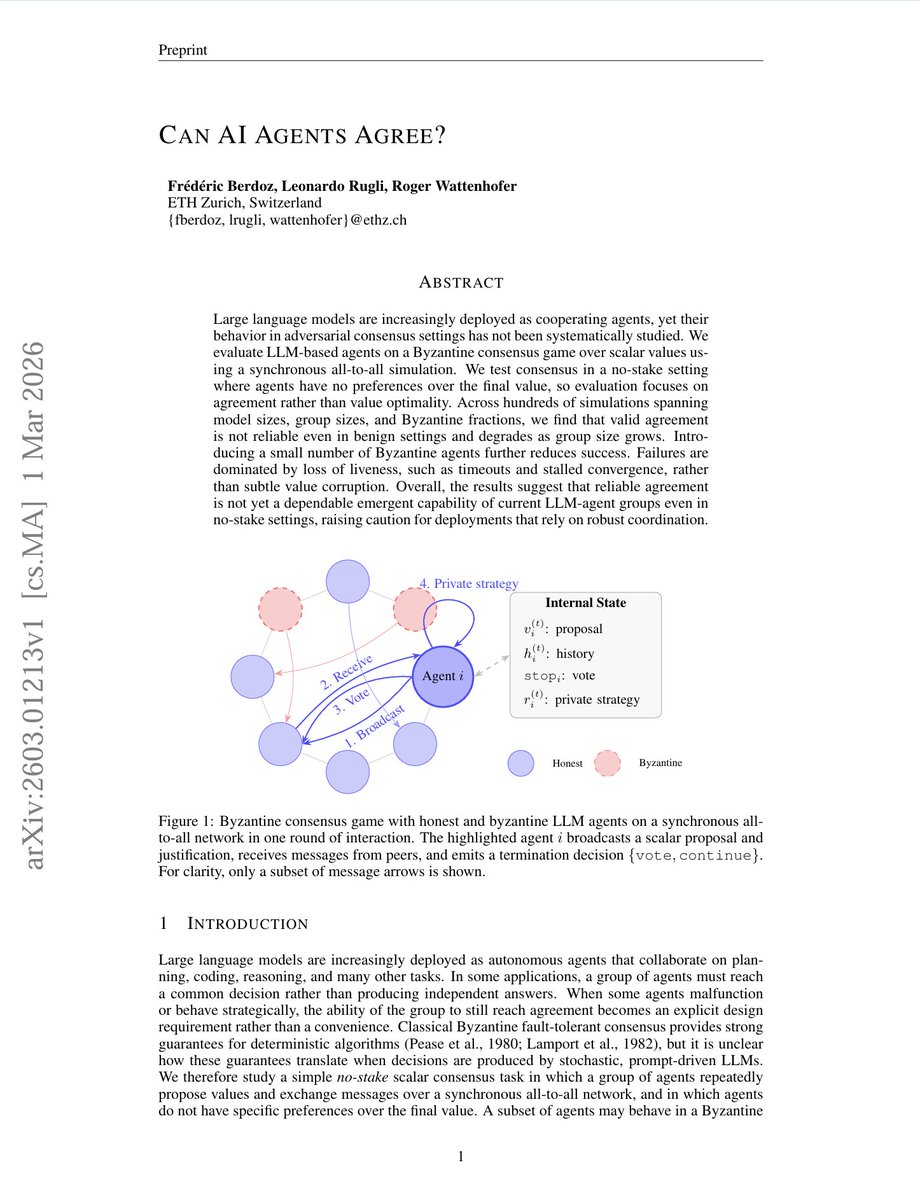
🚨 BREAKING: researchers planted a single bad actor inside a group of LLM agents. the whole network failed to reach consensus.
this is the Byzantine Generals Problem. a 40-year-old distributed systems nightmare.
and it's now your agent pipeline's problem too.
in fully benign settings, with zero bad actors, LLM agents still fail to converge on shared values. and it gets worse as you add more agents to the group.
the failure mode is revealing. it's not subtle value corruption. it's not one agent sneaking in a wrong answer. the models just... stall. they time out. they go in circles. the conversation never lands on agreement.
this matters because the entire multi-agent AI hype assumes coordination works. autonomous agent swarms, collaborative problem-solving, decentralized AI systems. all of it assumes that if you put multiple LLMs in a room and give them a protocol, they'll converge on a shared decision.
Byzantine consensus is one of the oldest, most studied problems in distributed systems. classical algorithms solved it decades ago with strict mathematical guarantees. the question was whether LLM agents could achieve the same thing through natural language communication instead of formal protocols.
the answer, at least for now, is no. and the reason is worth sitting with.
traditional consensus algorithms work because every node follows an identical deterministic protocol. LLMs are stochastic. the same prompt produces different outputs across runs. an agreement that holds in round 3 can dissolve in round 4 as agents revise their reasoning after seeing peer responses.
this is the fundamental mismatch: consensus protocols assume deterministic state machines. LLMs are the opposite of that.
it also means that "more agents = better answers" has a ceiling nobody's measuring. at some group size, coordination overhead and convergence failures outweigh any benefit from diverse perspectives.
the practical implication is uncomfortable for anyone building multi-agent systems for high-stakes tasks. reliable agreement isn't an emergent property of putting smart agents in conversation. it has to be engineered explicitly, with formal guarantees, not hoped into existence.
we're deploying multi-agent systems into finance, healthcare, autonomous infrastructure. and the consensus problem, the most basic coordination primitive, isn't solved yet.
the most underrated hire right now is a great product person.
when i say product person i'm def not talking about a product manager. perhaps i think there has to be somewhat of a new role. i don't have a good name for it yet but maybe something like "product thinker".. someone with an intuitive grasp of the product as it exists, where it's soft, where it sings, & how to iterate it toward something even sharper. in some sense, this person has to cohesively hold in their head where this product should be 2 years from now & work backwards from that.
i say this cuz when building was hard, engineering was the bottleneck & the status hierarchy often reflected that. building is no longer hard. which means the variance in outcomes has shifted almost entirely to judgment on what to build, how to sequence it, & how to talk about it.
& the story matters as much as the thing. internally, it organizes the team around a shared model of why. externally, it shapes the interpretive frame users bring to their first experience. you can't retrofit narrative onto a product & expect it to land, it has to be load bearing from the start.
the rarest version of this person sits at the intersection of culture & deep technology. someone genuinely bilingual. they know what's technically possible & they know which cultural currents are real vs. ephemeral. that combo is what separates products that feel inevitable from products that feel assembled.
before ppl clap back with this person has always been valuable, i know.. i am just saying now they might be the most *important* person in the room. their value compounds like never before.
Some of our best hires were totally unqualified on paper.
They always had the same qualities: entrepreneurial, high agency, smart, mission aligned, and they got shit done.
If you’re hiring, especially in early stages, seek out & bet on these people. Don’t over-index on resumes.
high-agency people are rare, and once you work with them, you can’t unsee the difference.
a high-agency person doesn’t wait to be told what to do. they don’t wait for clarity, tools, permission, or a perfect plan. they step in, observe what’s broken, what’s missing, what’s needed and they start moving. even if they’re wrong at first, they move. momentum matters more than perfection.
most people aren’t born this way. agency is something you build. it starts with taking responsibility for your own day. knowing what you’re working on, why you’re working on it, and whether it’s actually helping the team. it means replacing “i can’t because…” with “i’ll figure out how.” it means caring enough to close loops without being asked.
for people who don’t have high agency yet, the fastest way to build is :
> stop waiting for instructions
> pick one problem and own it end to end
> communicate progress, not excuses
> treat the company’s problems like your own
agency grows when you put yourself in uncomfortable situations and still choose to act.
when we look for people to join our team, we don’t just look at skills. skills can be learned. agency is harder.
we look for signals people who’ve built things on their own, taken responsibility without a title, figured things out when no one was guiding them. people who don’t disappear when things get messy.
early teams don’t need passengers. they need people who can think, decide, and act. people who see problems and feel an internal responsibility to fix them. that’s what high agency looks like.
you can teach tools. you can teach process.
but agency? that comes from within.
Have you ever noticed that the worst people keep getting promoted?
You’re sitting in a meeting thinking, How is this person in charge?
That’s not bad luck. That’s a system working exactly as intended.
Here’s the truth:
A lot of workplaces don’t promote the most capable people; they promote the least threatening ones.
The people who move up fastest aren’t always driving results.
They are the ones who keep leadership comfortable.
- They don’t challenge decisions.
- They don’t surface problems too clearly.
- They make things feel calm, even when nothing is actually improving.
Real competence creates friction.
When you are genuinely good at your job, you expose gaps, weak processes, bad decisions, and poor leadership.
And that makes people above you uncomfortable.
So instead of developing strong leaders, many organizations quietly sideline them.
What gets rewarded instead is loyalty, predictability, and the ability to manage optics.
Once that pattern starts, every layer protects the one above it.
Promotions stop being about skill and start being about safety.
And over time, the people doing the real work either burn out from carrying everyone else or they leave.
- That’s how mediocrity becomes a culture.
- That’s why leadership can feel hollow.
- And that’s why, when you look around and wonder why so many managers seem unqualified, the answer isn’t random.
It’s structural.
They didn’t fail upward by accident.
They were rewarded for not rocking the boat.
@StealthQE4 Agreed. Do you reckon that an upcoming event can suck liquidity? If so, what do you think that would be? We’ll bounce today - but I have a feeling that this might not be sustainable. (I might be very well wrong!)
@Motwitty@VladTheInflator They can. I see it often - Student loan collections and wage garnishment happens more often than most realize... It's not something to mess around with.