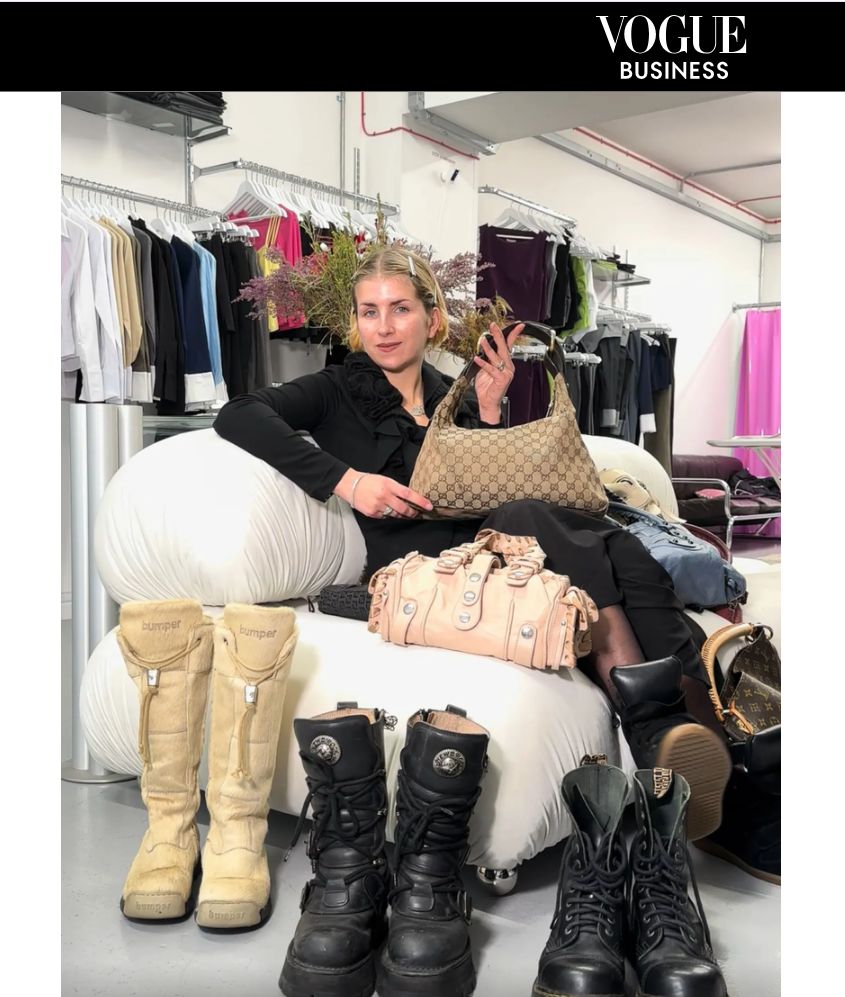
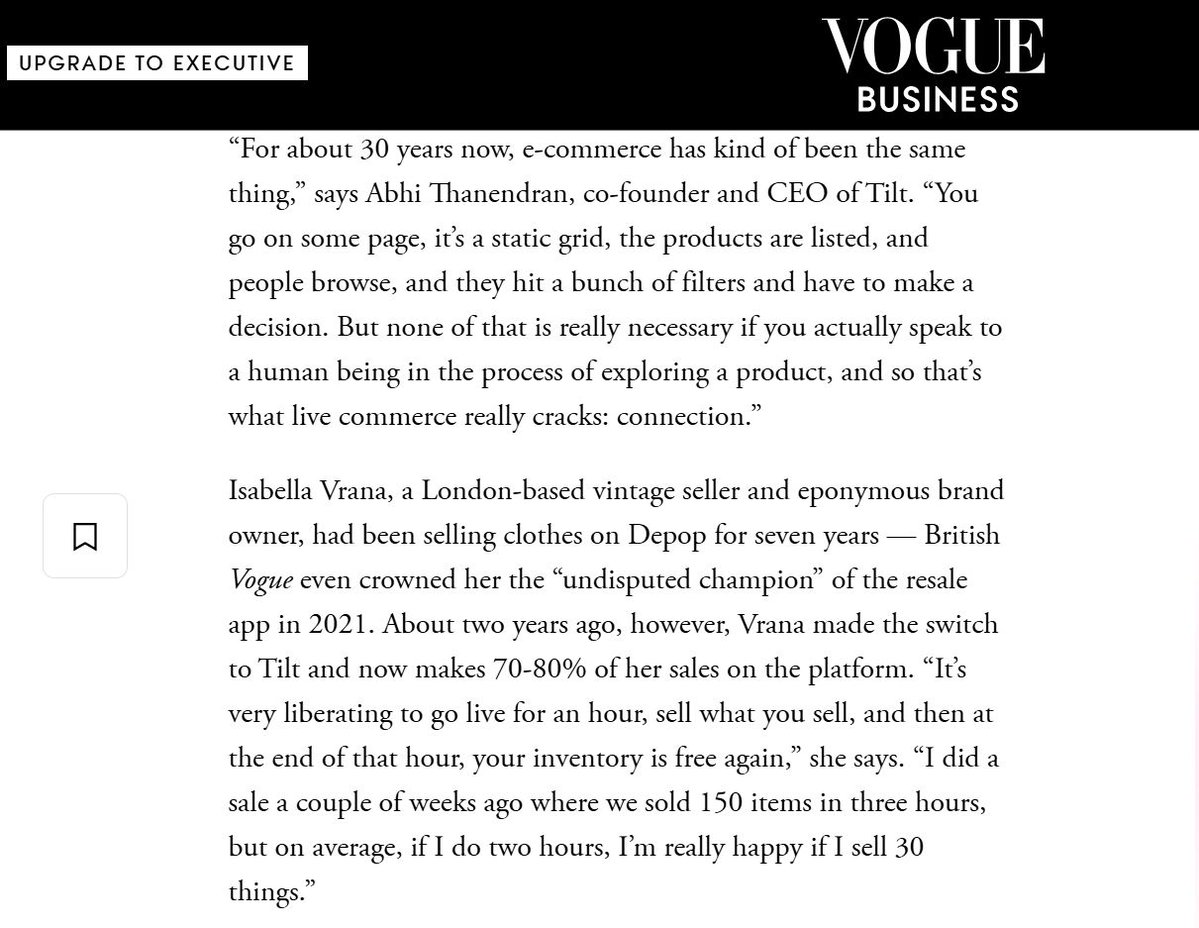
7 years on depop, now building her business on @trytilt.
Isabella Vrana, formerly British Vogue's "undisputed champion" of resale, in @voguebusiness on switching to live, alongside CEO @abhinavan_ on why the format works.
25k sellers and 70% week-on-week buyer return. consumer is back
1/8 Today we're announcing $26M to make commerce alive again.
30 years of e-commerce prioritized speed and efficiency over human interaction.
Tilt solves all three: sellers go live, AI does the heavy lifting, and every transaction starts with a conversation🧵
Consumer is the most underpriced category in venture right now.
The companies people actually use for hours a day are still consumer. The biggest outcomes of the last 20 years were consumer and yet most rooms I'm in are funding the opposite.
Europe is one of the best places in the world to build one. #BuiltInEurope
@Balderton - https://t.co/pn1nfLgSIu
Couldn’t agree more. Consumer captures the soul of society and the few that make it redefine everyday life.
Consumer founders are dreamers. In our heads, we already live in the future.
But too much VC money now goes to grifters building generic AI SaaS instead of founders trying to drag the future into existence. Just feels like venture’s lost the plot.
For a minute, forget that venture capital exists.
Forget Benchmark, Sequoia, and Y Combinator. Forget Kalanick, Faulkner and Chesky. Gone. No legacy.
You're trying to assemble a private market product that appeals to large institutional LP allocators, built on the promise of technology companies.
Their preferences are:
1) Strong interim performance, so they can hit internal benchmarks, get bonus compensation and advance their career.
2) Protection against the visible impact of systemic drawdowns, protecting relative performance metrics even in a market correction.
3) Bragging rights, from involvement in strong brands with large media platforms and passthrough exposure to lots of hot logos.
4) A high level of service, with a fully staffed IR team to handle everything and organise spectacular AGMs with all kinds of perks.
Essentially, you need to offer a scalable basket of assets that will reliably rise in value, attached to a marketing machine, with a valuation policy that aligns your marks with other managers in your network.
The ideal asset for this strategy is the most obvious; the 25 year old Stanford graduate who did 2 years on Meta's product team and is now launching some B2B AI widget — and they've just gone viral with their launch video.
The cost of capital for a founder that ticks so many boxes is rock bottom; coordination frictions at a minimum. They're likely to keep raising larger rounds and generating markups on sheer momentum, regardless of any idiosyncratic quality.
It's also such an easy profile to identify that you can employ an army of associates and scouts to track them down, assuming they don't respond directly to your heavily advertised "call for startups".
Essentially, what you have created is a synthetic "venture" asset, built on the elasticity of software companies, that prints growth metrics for allocators.
It can scale as much as required, absorbing as much capital as may be shoveled into it, growing at a rate correlated with how close to the consensus you are.
Of course, all of these things are correlated with worse ultimate cash returns, as they reflect attributes that are predictive of worse returns in a market with zero alpha. Surprisingly, that's ok. It's not the point.
All you have to do is push exits out to 12+ years, giving you space to raise 3-4 subsequent funds and your allocator friends time to move on to a better role.
Along the way you'll be able to extract just enough liquidity to keep things moving. Secondaries in a hot company, a continuation fund or intra-portfolio acquisition, and the occasional opportunistic exit to talk about on podcasts.
You wont be breaking DPI records or driving much real technological progress, but the fee income will be lovely and your allocator friends will be totally satisfied with the product you have created.