I didn’t expect my 1:1 with @JeffDean to change how I thought about a PhD.
At the time, I already had two first-author papers at top AI conferences with 3 years of undergrad left.
So I was seriously considering a PhD.
I asked Jeff whether he thought having a long pedigree was necessary to build an AI startup.
His answer was more nuanced than I expected:
> You don’t need a PhD to get experience solving hard problems. Practical, hands-on experience can teach you that too.
> A PhD teaches you how to dive into a new area, figure out what the important problems are, understand what’s already been done, and connect ideas. Those are useful skills for almost any technical career.
> But that’s different from building a company. You need to find something that’s important, matters to people, and is commercially valuable. Academic training isn’t necessarily designed to teach you that.
If I did want a PhD, he recommended doing it early.
Once you’re established in a career and earning a good salary, going back becomes much harder.
Does that advice still apply in 2026?
If you’re interested in the full 1:1 and my own insights, I’ll be sharing that in a thread soon.
Steve has single handedly convinced the entire twitter to buy an esp32 device.
Heres me building a simple note taking device that saves everything on my notion.
A new era of personal devices is coming up.
A 900-line React component walks into a talk...
Kaleb Garner shares a five-step playbook for turning messy components into modular, testable code.
Watch the talk: https://t.co/EtQepwF3rR
Introducing Mintlify Index: the first publisher-direct search layer for technical knowledge, built on Mintlify’s ecosystem of more than 200,000 orgs.
In our benchmark against Context7, agents using Mintlify Index finished tasks at twice the speed, and with 9% higher factual accuracy.
Today, we're opening up the Index MCP server for everyone to try, fully for free:
Don’t know where to start with Local AI?
Read my Local LLMs From Zero to Hero series
It covers:
- Hardware
- Software
- Models Mechanics
- Everything else necessary
Needs no prior experience
Easy to understand for any background
Local / Opensource AI FTW
Releasing BTL-4 35B and Macaw 2.7B a frontier agentic reasoning model and an on-device Mac agent. Both open weights, both available now.
• 73.5% BFCL v4 (AST) — +4.3 over the base model, paired: identical harness, identical decoding, only the weights differ, all 1240 cases
• 78.4% SWE-bench Verified
• 66.1% LiveCodeBench v6 — 99.1% easy · 86.7% medium, full 442-problem window
• 262K native context, and it uses it: raising the output budget 16K → 32K moved LiveCodeBench +5.2 points on its own. Long problems need room to finish.
Macaw 2.7B — the assistant your Mac should have shipped with. 97 verified macOS tools, chained from one sentence.
• 1.5 GB on disk, ~2 GB running, ~2s per request on a base M2 • Reads your screen and your documents — no vision model(uses esp as vision), no cloud • 100% local. No account, no telemetry, no server to send anything to
Open weights, deploy anywhere:🤗 https://t.co/DZY9RVHL4E 🤗 https://t.co/Gr7rrmnoTd 💻 https://t.co/grXlnOVnny 🔗 https://t.co/2N8oeWAMDf
vLLM and MLX supported day one.
Cloudflare built a browser that runs INSIDE a Cloudflare Worker 🤯
Cloudflare Agents Week day 4 is here, and it's a banger:
🪁 Kitesurf: agent-first browser running on Workers
🕸️ WebMCP: Give any website an MCP interface
⚒️ The next generation of MCP is here
🔍 AI Search improvements + pricing announced
🤖 AI Readiness in the Dash & AEO diagnosis
🌎 Building an open Agentic Internet
🪁 Kitesurf: agent-first browser running on Workers 🪁
There are projects that come up from time to time that are uniquely Cloudflare, and Kitesurf is one of them. Workers are an insanely powerful primitive, and there is very little they can't do these days.
Kitesurf is a browser built for the agentic web. Chromium-backed browsers are large, and use a lot of memory. There simply isn't enough memory for every agent in the world to have a browser. That's where Kitesurf comes in, a lightweight alternative to Chromium-based browsers.
It uses WebAssembly, Dynamic Workers, Durable Objects and more to make this happen. And yes, it can run Doom.
Best of all, it's available in open beta to try today for free, via Browser Rendering's CDP endpoint and Quick Actions.
If you want to see it in action, there's a public playground too, linked below, as well as the full blog post - which is packed with interesting technical details!
🕸️ WebMCP: Give any website an MCP interface 🕸️
WebMCP is a new browser standard that lets any website expose itself via MCP. Rather than an agent having to click around the website, it can interact with it using MCP instead.
You could implement this yourself, but why would you, when Cloudflare can enable it on your site with one toggle?
You can enable this in the dashboard today under Agent Readiness > Labs. There's currently two groups of featuers you can enable, called packs, to help agents browser your website.
⚒️ The next generation of MCP is here ⚒️
The Model Context Protocol (MCP) has evolved over time, and the latest iteration makes it simpler than ever. How? By making it so that an MCP server can be stateless. That removes the burden of sticky sessions and other complexities from running an MCP server.
With the rapid movement of the AI landscape, it's important for companies to move in the direction the puck is going. Once again, Cloudflare is ready to receive the puck, as stateless MCP servers have been possible on Cloudflare for some time.
That means, from day one of the specification being announced, it has been supported on Cloudflare when using the official MCP SDKs.
There's a bunch of other changes as part of this spec, including:
- Elicitation no longer needs an open stream
- Mcp-Method and Mcp-Name in HTTP headers, to avoid parsing request bodies for features such as rate limiting
- MCP now prefers pre-registered clients when the server and client already have a relationship, then Client ID Metadata Documents (CIMD) for dynamic registrations, with Dynamic Client Registration (DCR) as a fallback
And much more. This is a good one to read yourself, as there's a lot of technical depth to the article!
🔍 AI Search Improvements 🔍
AI Search is Cloudflare's offering to solve the problem of how you give your AI agent access to specific knowledge to improve its work. In simple terms, it makes the RAG aspect of your AI agents effortless.
AI Search already lets you ingest data into an R2 bucket, scrape your own website, along with an array of options at search time.
AI search can now:
- You no longer need a sitemap to ingest your website's data, Cloudflare will discover the pages automatically
- Get a single public endpoint for searching across a namespace (both /search and /mcp).
- Add a custom domain to your public AI search namespaces
- Add semantic search to your sites built on EmDash (Cloudflare's WordPress successor) with AI Search plugin
AI Search always identifies itself when crawling websites, and respects bot protections that website owners put in place.
Pricing is also being announced today, as AI Search has been in beta since its release. As always, there's a generous free plan too, with full details in the blog post.
🤖 AI Readiness in the Dash & AEO diagnosis Share of Voice
Getting your website ready for the agentic era is no small feat. There's a ton of protocols, and a bunch of considerations around how to make your website accessible to AI agents.
In April, Cloudflare launched a tool to check your website's readiness for AI agents. That tool is now available in the dashboard for all your websites hosted on Cloudflare.
Alongside the check, the tool provides actionable insights on how to improve your website's agent readiness.
Now, if you thought getting your website ready for agents was some dark art, then AEO takes that to another level.
AEO is the practise of getting your website content surfaced in public LLMs such as ChatGPT and Gemini.
Working out if your website is AEO optimised is incredibly hard. That's why Cloudflare is launching a new tool today that allows you to get insights into how your website performs on the AEO front, with insights such as:
- Citation Rate
- Prominence
- Mention Rate
- Share of Voice
Putting your website behind Cloudflare has always been a no-brainer, but it's rapidly becoming a deal breaker with the new tools available to websites hosted on Cloudflare, such as the new AEO tool.
🌎 Building an open Agentic Internet 🌎
AI agents are a new kind of web user, they are already overtaking humans in terms of request volume.
Every request has a paying human behind it, so if you treat agents the same way you do web scrapers, you're potentially blocking paying customers.
That's why Cloudflare is working hard to set the standards to make the web ready for the agentic era. These are based on open standards such as x402, MCP, Web Bot Auth and PACT.
There's four pillars that Cloudflare believes paves the way for an Agentic web:
- Readable, so agents can read content cheaply via Markdown (and Kitesurf, a lightweight agent-first browser!)
- Discoverable, meaning agents can find things through AI Search, and sites measure their agent visibility with AEO
- Callable, with sites exposing actions directly to agents via WebMCP and Code Mode
- Payable, with agents paying per use with Wallets and x402. Monetization Gateway lets sites charge agents in a few clicks, replacing broken ad models of what came before.
Ultimately, Cloudflare's mission is to help build a better Internet. Today, it is reaffirming that aim in the era of the agentic web, with the aim to enable AI agents and website owners to thrive on the agentic internet.
If you made it this far, thank you for reading - it was a pretty chonky one today, and there's one more day of announcements tomorrow! What did you think of today's announcements?
Centuries before modern observatories, Indian astronomers used systematic observation, mathematics, and precise calculations to understand the cosmos. Their discoveries shaped one of the world's oldest scientific traditions and continue to inspire astronomy today.
Acharya Āryabhaṭa (476–550 CE) is regarded as the Father of Indian Astronomy. In his seminal work Aryabhatiya, he explained Earth's rotation, accurately estimated the length of the solar year, and developed advanced methods for calculating planetary positions.
Acharya Varāhamihira refined astronomical observations, documented planetary movements, and expanded the understanding of eclipses through works such as the Pañca-Siddhāntikā.
Acharya Bhāskara II advanced mathematical astronomy with innovative methods for predicting planetary motion and celestial phenomena through his masterpiece Siddhānta Śiromaṇi.
Their remarkable contributions demonstrate that ancient India combined observation, mathematics, and logic to build a rich scientific legacy one that continues to influence astronomy and mathematics across the world.
✨ Discover more about India's timeless knowledge traditions with BharatiyaGPT.
#IndianAstronomy #Aryabhata #Aryabhatiya #Varahamihira #BhaskaraII #IndianKnowledgeSystems #AncientScience #ScientificHeritage #BharatiyaGPT #Astronomy #IndicKnowledge
Hello @AshutoshRanka@abhijeet_dipke@SauravDassss. Please tell us who these people are:
• Ajay Agarwal
• Rishi Makhija
• Divjot Singh
• Siddharth Chowdhary
Waiting for your answer.
Yesterday “everyone is sick - we can’t go to Jharkhand”
Today “let’s party with a carton of Amrut at 5500 ₹ per bottle”
Again I request @JPNadda ji to make these miraculous cures available to the general public
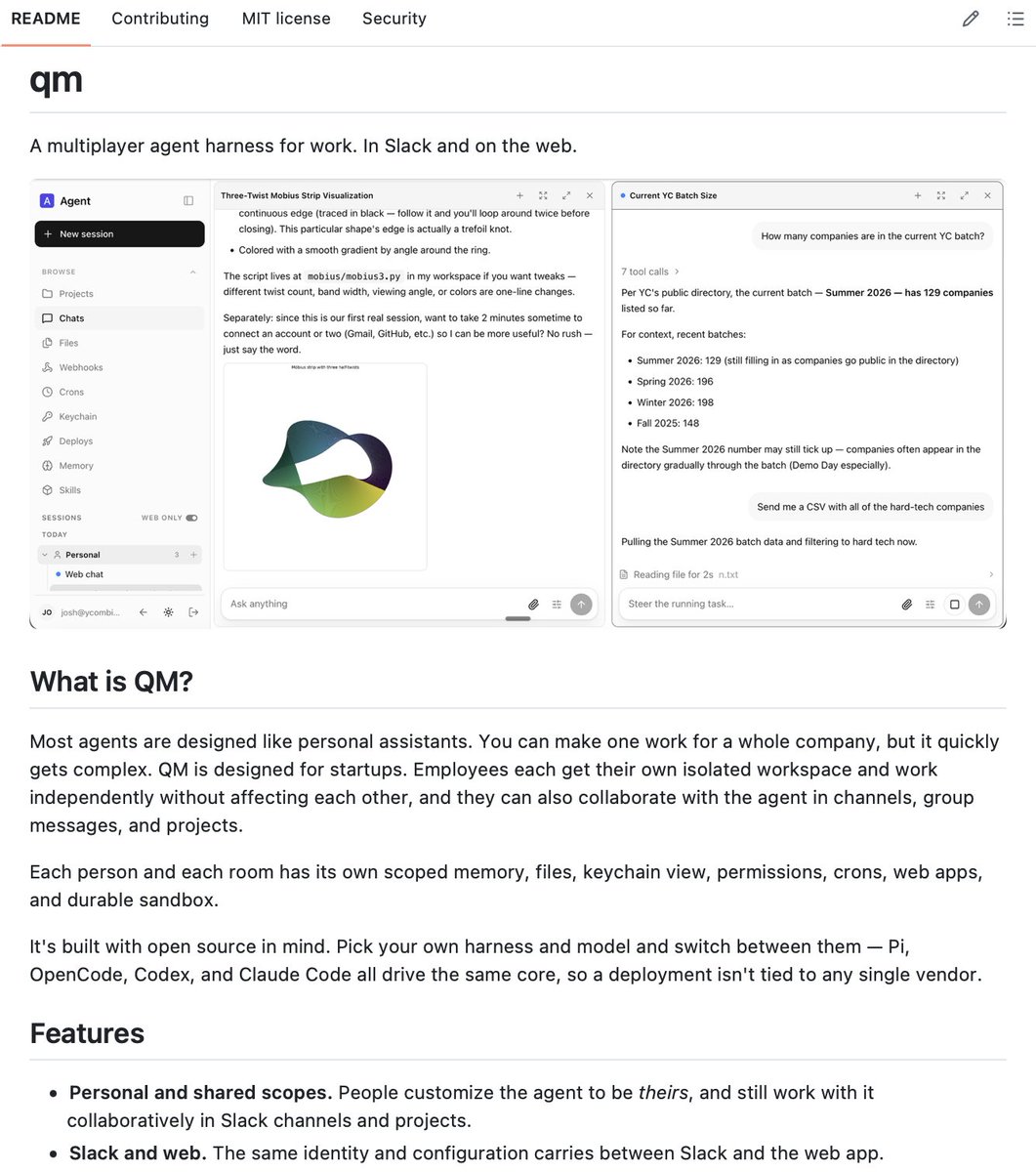
YC just open sourced their multi-agent harness!
QM is the multiplayer agent harness Y Combinator built and has been running internally across accounting, legal, events, and engineering. They used QM to build QM itself.
The starting point was a fleet of 50+ Hermes agents - one personal assistant per employee. Managing that many separate agents became complex. QM came from asking a different question: instead of one agent per person, what if a company had one harness that worked for everyone?
Most agents are designed like personal assistants. QM is designed for teams. Each employee gets their own isolated workspace with scoped memory, files, permissions, crons, and a durable sandbox. Those workspaces also connect in shared Slack channels and projects where people and the agent work together.
The same identity and configuration carries between Slack and the web app. Admin controls which harnesses and models are available org-wide. Pi, OpenCode, Codex, and Claude Code all drive the same core, so a deployment isn't tied to any single vendor.
Background work runs while nobody's watching. Crons and webhooks trigger tasks across the org. Skills are scope-owned and shareable by grant, with admin-gated promotion to the whole organization.
YC is direct about where it stands: it's an experiment, it's early, and it has bugs.
Key capabilities:
• Multiplayer: personal workspaces + shared Slack channels and projects
• Works natively in Slack and on the web
• Vendor agnostic: Pi, OpenCode, Codex, Claude Code all supported
• Per-scope memory, files, keychain, permissions, crons, and durable sandbox
• Background crons and webhook triggers
• Shareable skills with admin-gated org promotion
• Three security postures: Strict, Auto, Dangerous
100% open source.
The multiplayer harness problem is real and QM is a solid approach to it. The other harness problem most teams haven't named yet is context quality - what actually flows into the harness from your organization's systems determines everything that follows.
Wrote a detailed breakdown on exactly that.
I've also shared the link to QM in the replies!
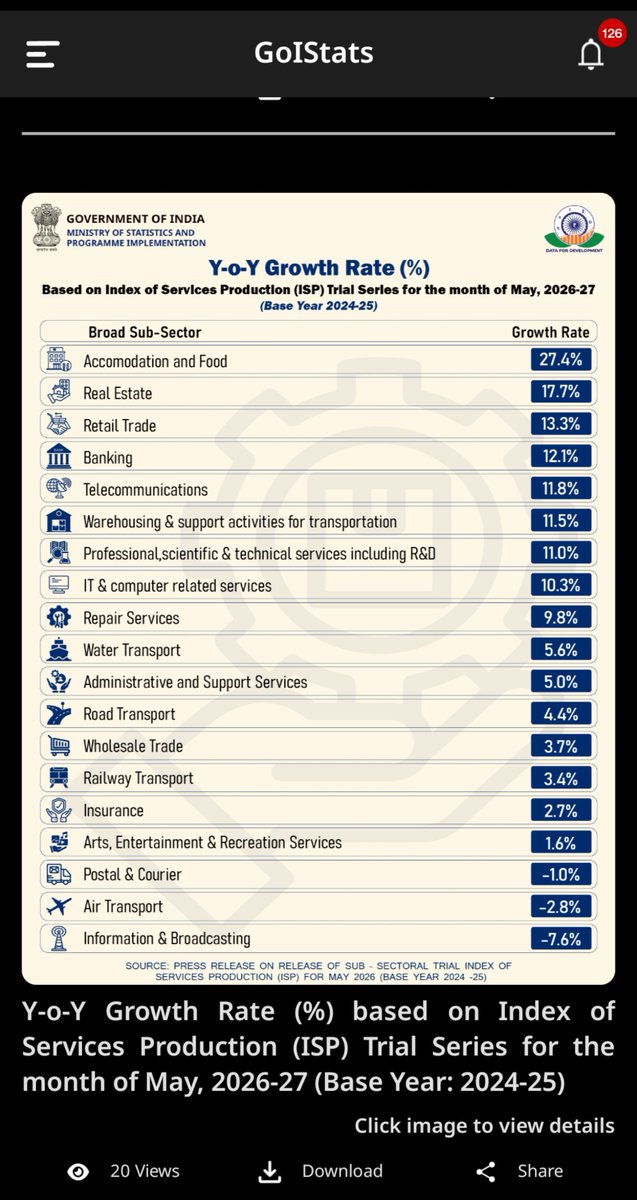
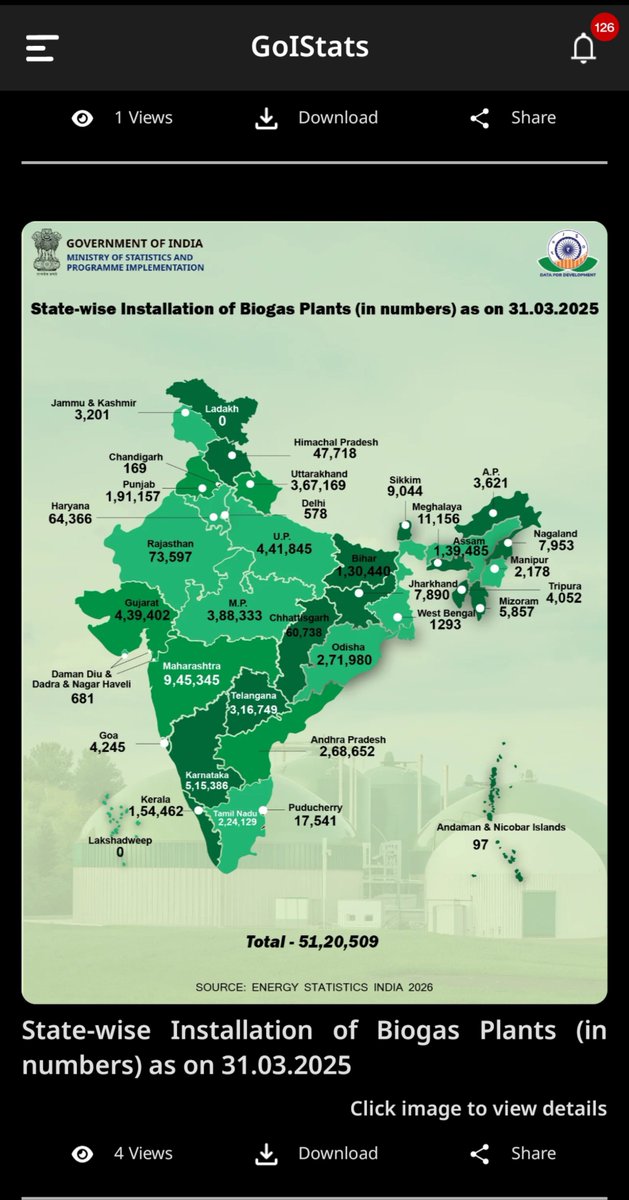
There is an official app GoIStats which brings together official data, reports, releases, infographics, and visualizations from across GoI ministries and departments all in one actively updated app.
Yet, almost no one knows it exists. See the Views.
🤷🏻♂️
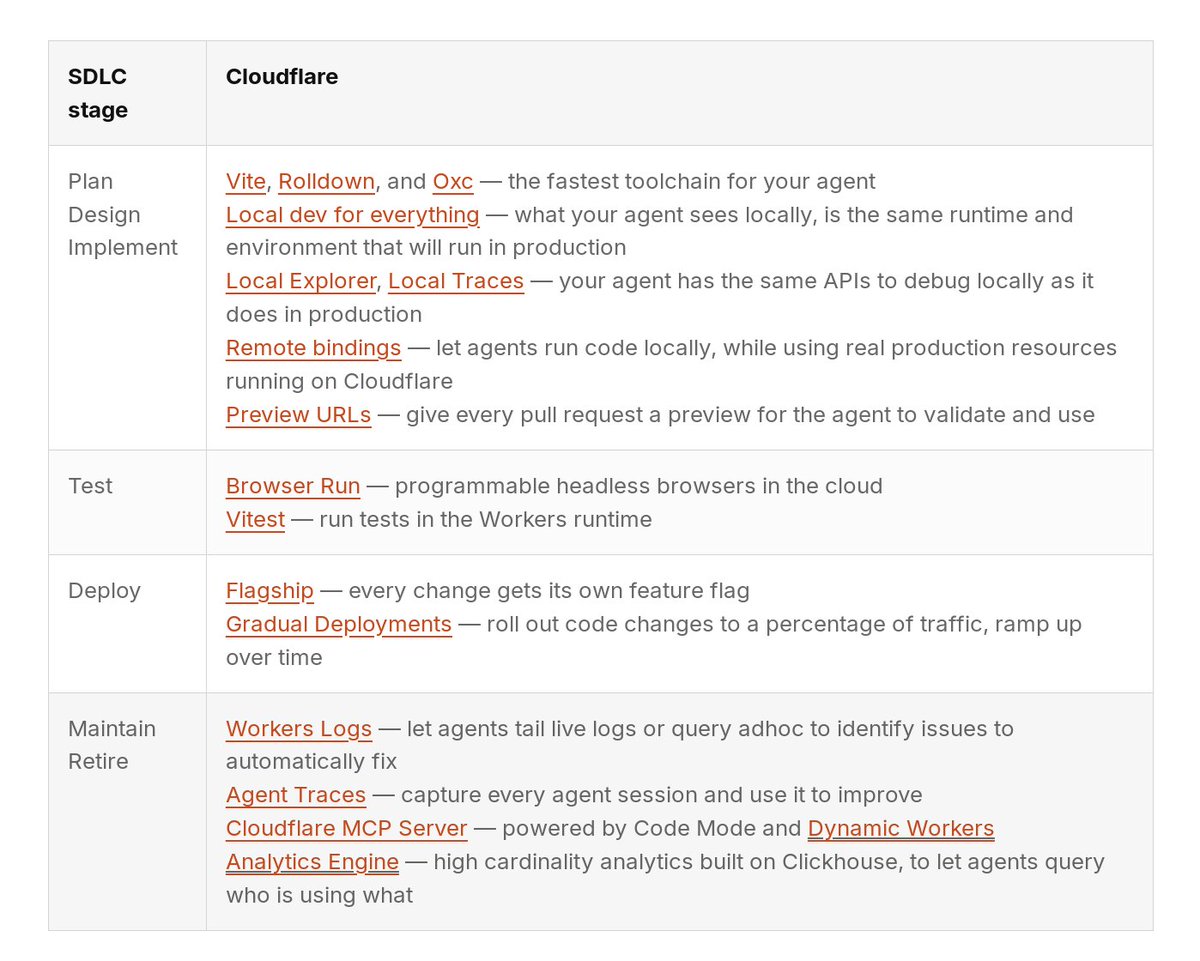
the software development lifecycle (SDLC) is transforming into ADLC (agent development lifecycle)
@cloudflare is providing the full lifecycle of tools, built for agents, with opportunities for humans to plug into the loop where needed
agents are so good at things humans are bad at! they're way more efficient at writing code, and can identify far more bugs and edge cases reviewing it (they don't just do a once over and comment "sgtm")
this begs the question: how do you build the right factory floor for agents, instead of forcing them into human-designed factories?
that's the question we're answering today @cloudflare
we started with artifacts — source control built for agents. but that's just the beginning. you also need CI/CD, workflows, testing, deployment tools
everything your agents need in one place.
https://t.co/Nee4R08QOQ
Today we're launching anydoc, our new Rust-based doc parsing engine 🔥
sub ~5ms markdown parsing for PDFs, Word docs, slide decks, and 10 other formats with best in class quality.
100% open source and powering our /parse endpoint!
introducing anydoc
now your agents get 100x faster local parsing for pdf, docx, pptx & 10 more formats
- sub-5ms md conversion
- 500 docx files in 1.7s
- top quality across all 13 formats
- rust-based
- open source
already powering @firecrawl /parse
https://t.co/fVsRsYFNyC