Hope you all had a good day ...
Please take 3.26 mins to watch this
Meet Venkat Ramana a man whose body may be confined to a bed, but whose determination knows no limits. 💯
Despite having no mobility in his hands and legs, he completed his education, built a successful career, and today leads a team of 8 people.
Venkat's journey is a powerful reminder that hard work, resilience, and perseverance can overcome even the toughest challenges.
Instead of making excuses, let his story inspire you to chase your dreams and never give up. ✨
summary from @kirat_tw's latest video:
2-3 years ago, an engineer could spend weeks shipping one feature
today, an agent can probably one-shot the same thing in a few hours
you're no longer hired just to write code
you're hired to 'get shit done'
give one engineer a problem, they gather context, run multiple agents, review the output and ship
basically,
high-level languages abstracted assembly
now AI is abstracting high-level languages
which also means high agency + domain knowledge are becoming way more valuable than just knowing syntax
the scary part for juniors is figuring out the balance
depend completely on AI → your fundamentals suffer
ignore AI → you move 10x slower
coding isn't dying
the abstraction layer is just moving up
engineers who understand that early will probably have a massive advantage
The average person does not try to solve their problems or struggles. They get stuck in a routine and live the same day over and over. It does not cross their minds to snap out of it, engage in strategic thinking, and change direction so they can eventually reach a more advantageous position in life.
If you want to get ahead of 90% of people, all you have to do is pause, think, and actually attempt to overcome the struggle you're faced with.
Personal Finance Checklist ✅
Term Insurance ✅
Family Health Insurance✅
6-12 Month Emergency Fund✅
₹10K+ Monthly SIP✅
Debt Free✅
Credit Card Bill Paid in Full✅
Portfolio Above ₹10L✅
Slowly ticking the boxes that truly matters📈
People post their success.
Never their journey.
Before you make assumptions about how "easy" or "lucky" someone has it, remember this: you don't see the silent, soul-crushing grind. You don't see what it takes to show up and sit in the chair when you absolutely do not feel like it.
Avoiding the actual work and feeding on daily drama is easy.
Putting your head down and executing isn't.
Stop judging the outcome if you aren't willing to endure the process.
Stop consuming other people's lives. They are not better than you. They are simply living their own. You live yours. Do things that you find exciting. Follow your interests. Write a book. Start a business. Teach something that feels like play to you. Start a Vlog on the thing you've been obsessed about since you were seven. Don't become a spectator in your own life. You are the main character. You are the hero of your story. Not them, You. Remember that.
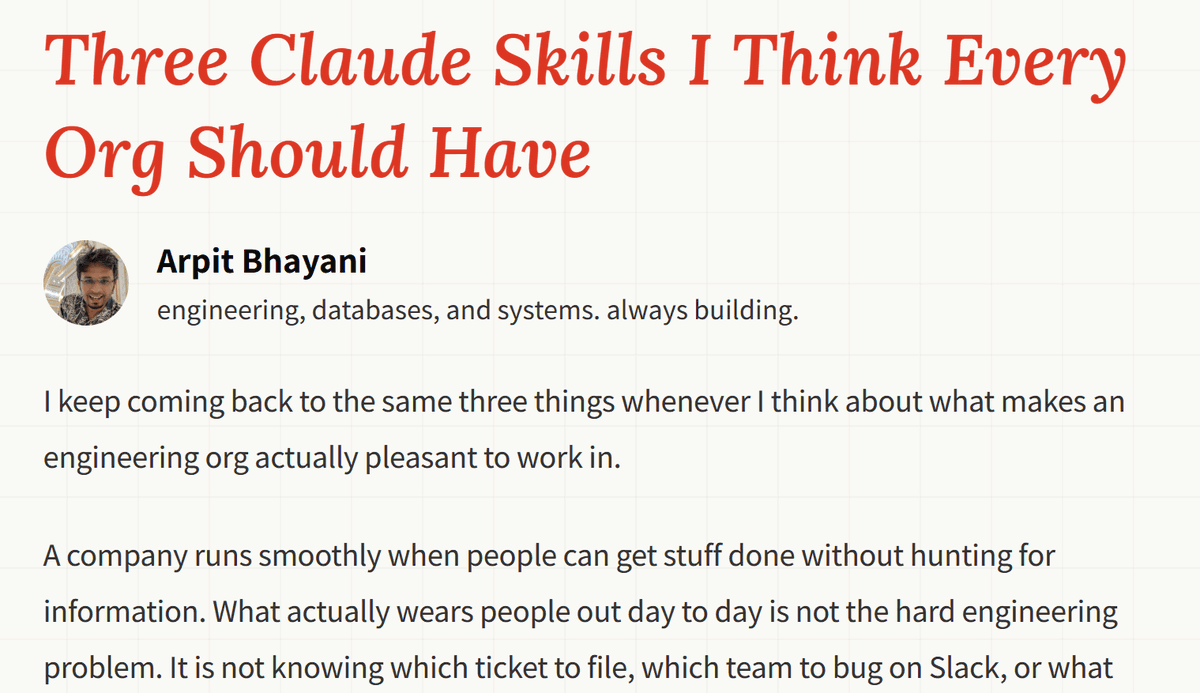
New write-up - I have always believed that the biggest bottlenecks (or points of frustration) inside engineering organizations are not technical.
More often than not, they are operational. Engineers do not lose time because the engineering problems are hard. They lose time because of information discovery and bureaucracy. So, I wrote an essay about the three Claude skills that I think every company should have.
In this article, I break down why these three Claude skills have massive leverage, what each one should know, and why they become even more important as software development becomes increasingly agentic.
If you are building developer platforms, internal tooling, or thinking about how engineering organizations will evolve in the age of AI agents, I think you will find this useful. Give it a read.
00:05
Salary day today !
Savings
Debts
Broadband bill
Maid payment
Apartment maintenance
Petrol full tank
Milk monthly bill
Monthly Groceries
Electricity bill
Monthly medicines
#PersonalFinance
Oh okay ... here we go again ... aren't you guys (usa) bored of freaking out people like why the hell you have universities? Just for studies (pay u fun money from bank loans) and then do farming (which many are exploring that's another conversation) in India? Why don't you guys just stop allowing people from foreign and make your people study big & then show off & make your america great again.
OAuth 2.0 is a framework that gives apps limited access to your data without sharing credentials.
But the flow can be confusing at first.
Here, @ashutoshkrris covers OAuth 2.0 from the ground up, including, clients, tokens, grant types, and secure auth flows.
https://t.co/JOIKMspl2o
You’re going to f*cking die so there’s no point being afraid.
Stop waiting for the right time. Stop thinking about the downside. Get your sh*t together. Live all out because 99% of what you do will be remembered by no one. To do anything less than try to be incredible is a waste of a life and an embarrassment to your bloodline.
The best engineers I know have become slower
That sounds backwards.
But hear me out.
When they receive a new requirement, they don't immediately start coding.
They ask questions.
They challenge assumptions.
They think through edge cases.
They understand the business problem before discussing the technical solution.
It looks slower.
Until you compare it with rushing into implementation, rewriting half the feature, and fixing bugs for the next two weeks.
Experience doesn't always make you faster.
Sometimes it makes you pause long enough to avoid going in the wrong direction.
Slow thinking often leads to fast delivery.
Kicking off a new series: Daily Software Engineering Concepts.
(Every day, one engineering concept, explained from first principles)
Day 1: Cron Jobs🕐
Let's go deep.
1. What is cron, really?
You can think of a cron job as an alarm clock for your computer, except instead of waking you up, it wakes up a script or command and runs it automatically.
The core idea:
You tell the system: "Run this task at this time, every time", and then you forget about it. No need to manually trigger it ever again.
For example:
You set a recurring reminder: "Take out the trash every Monday at 8 AM."
You don't run downstairs every Monday to check the calendar and decide. It just happens, automatically, forever, until you cancel it.
A cron job works exactly like that, but for your server or computer:
"Back up the database every night at 2 AM."
"Send a report email every Monday morning."
"Delete temp files every hour."
Cron is a time-based job scheduler built into Unix-like operating systems. It runs in the background as a daemon (crond), constantly checking a table of scheduled tasks called the crontab, and executing commands when their scheduled time matches the current system time.
You can think of it as a persistent background process that wakes up every minute, checks "does anything need to run right now?", and if yes, forks a new process to run it.
2. The crontab syntax
Each line in a crontab follows this structure:
* * * * * command-to-run
│ │ │ │ │
│ │ │ │ └── day of week (0-6, Sunday = 0)
│ │ │ └──── month (1-12)
│ │ └────── day of month (1-31)
│ └──────── hour (0-23)
└────────── minute (0-59)
Five fields, each representing a unit of time. An asterisk means "match every value" for that field. You can also use:
Ranges: 1-5 (Monday to Friday)
Lists: 1,15,30 (specific values)
Steps: */15 (every 15 units)
Combinations: 1-5,10-15
3. How the daemon actually works internally
Cron doesn't "sleep" and wake up exactly on schedule using timers per job. Instead, the daemon wakes up once every minute, reads the current time, and scans all registered crontabs (system wide and per user) to check whether any entry's schedule matches that timestamp.
If it matches, cron forks a child process, sets up the environment (often minimal, which is a classic gotcha), and executes the command via /bin/sh by default.
This is important: cron jobs run in a very stripped down shell environment. No PATH from your interactive shell, no aliases, sometimes not even the environment variables you expect. This is the number one reason cron jobs work when tested manually but silently fail when scheduled.
4. Where crontabs live
User crontabs: edited via "crontab -e", stored per user, typically in /var/spool/cron/crontabs/
System crontab: /etc/crontab, includes an extra field for which user to run the command as
Drop-in directories: /etc/cron.d/, /etc/cron.daily/, /etc/cron.hourly/ for system level scheduled tasks, often used by package managers and system services
5. Common real world use cases
Database backups during low traffic windows
Log rotation and cleanup
Sending scheduled reports or digest emails
Refreshing caches or materialized views
Health checks and monitoring pings
Certificate renewal checks (like Let's Encrypt's certbot)
Triggering ETL pipelines
6. When cron isn't enough
Cron is great for simple, time based, single machine scheduling. But it starts to break down when you need:
Distributed scheduling across multiple machines
Retry logic and failure handling
Dependency chains between jobs
Observability and alerting out of the box
That's when tools like Airflow, Temporal, or Kubernetes CronJobs come in, essentially cron's more powerful, distributed, fault tolerant cousins (sort of).