At 3:38 PM on April 25, India demanded more power than it ever had in history. The grid handled 256 GW in a single instant. We had enough power to meet all that demand, about a fifth of which came from solar plants. The system had worked. 🧵👇
China now publishes more research papers in high quality journals than the US or EU. China's rise over the past 2 decades has been astounding.
It is important to realise that China's rise in R&D happened along with her rise in induatrial prowess. These two cannot be decoupled.
India has a lot of work to do here. I would suggest a "National Technology Mission" to specifically identify the broad spectrum of fields where we have to catch up industrially and encourage public-private as well as academia-industry collaboration. We should also establish national awards for the high ranked teams in each sub field.
Finally people who are pessimistic because "corruption" or "politics" or "reservation" etc such pessimism was also common in China. China didn't end pervasive corruption or become a democracy before she rose as a technological power.
India can rise too and we don't need everything to be perfect. We need optimism and the can do spirit.
https://t.co/PQ2Rxa6Xze
It's only been 2 hours since Open AI launched GPT-4o, and people are going crazy over it.
Here are 10 wild examples you don't want to miss:
1. Math Problems with GPT-4o
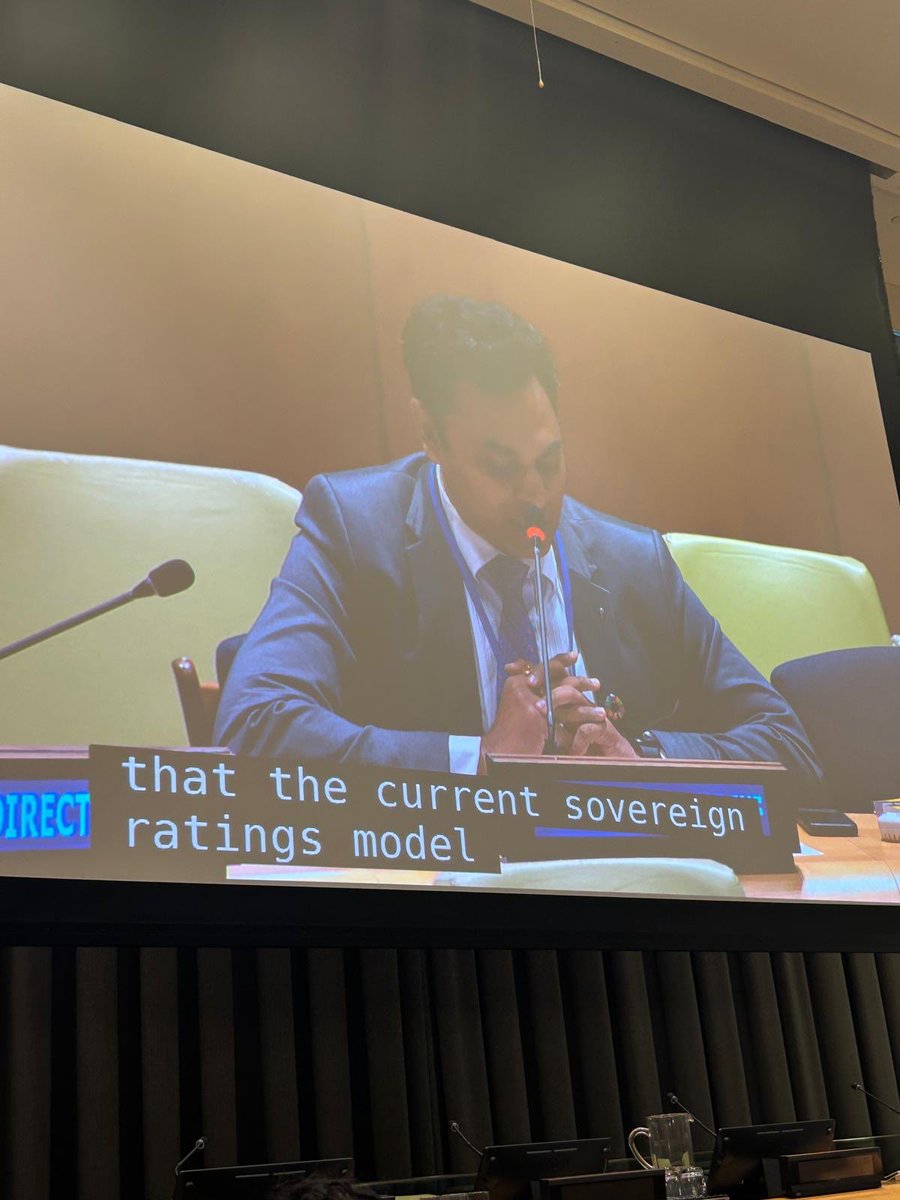
Had the opportunity to raise the problem of sovereign credit ratings in the @UN this week. Highlighted that:
1. Never in the history of ratings has the 5th largest economy - India - been rated BBB.
2. Rating is purely a mapping onto the probability of default, which depends in turn on (a) ability to repay & (b) willingness to repay.
3. On both counts, India should be at least AA!
4. On ability to repay, our forex debt is minimal even accounting for private borrowing.
5. And our willingness to repay is gold standard… even when India faced its worst BoP crisis, we shipped gold to Bank of England and Bank of Japan to get forex.
6. @UN, @IMFNews and @WorldBank must work together to ensure that Sovereign Rating Agencies rectify fundamental problems in their model. This is necessary so that the optimal financing for climate change comes into Emerging and Less Developed economies.
PFRDA has enabled mix-and-match in NPS. You can select a pension fund manager (PFM) for each asset class (equity, bonds etc). Earlier you had to choose a single PFM for all. The extra return is modest historically, but can compound over the long term. Infographic by @sashindnj.
For anyone here who hasn’t worked in corporate strategy at a Fortune 500 company and wants to understand how utterly bone-headed decisions—such as changing your customers’ cell-phone plans unless they proactively call to opt out—get made, here’s a quick explainer 👇
This chain of events typically starts during a quarterly board of directors meeting, during which an independent director (generally a current or retired CEO of a company in a different, non-competing industry) says that the company isn’t making enough money and that it’s the fault of the CEO, who is a supremely unqualified buffoon.
(Tangent: Every board director has his own pet favorite metric, be it growth (e.g., year-over-year sales), profitability (e.g., EBITDA margin), investor returns (e.g., change in share price if public, return on invested capital if private), or some byzantine metric that he used to love when he was the division president of a Ma Bell carve-out back in the 1980s (e.g., change in same-store gross profit divided by number of people on the sales team, raised to the power of pi and divided by 1998, which represents the year his current girlfriend was born). The exact metric doesn’t matter; what matters is that, by the standards thereof, the CEO sucks.)
The independent director will then pull open the calculator app on his iPhone 7, punch some numbers in, and say something to the effect of, “If we can increase revenue per customer by just $5, our market cap will increase by billions. Get your strategy team to figure it out.”
From here, the CEO and the CFO will then set up a meeting with the SVP of corporate strategy for 7:15 AM the next morning, to be held in the locker room of the country-club whose $20k annual membership dues the company’s shareholders generously cover. Sitting in the sauna, buck naked save for bleached white towels barely sufficient for the mission to which they’ve been called, the executives will decide that the most prudent course of action is to call McKinsey and pay them approximately $2.5M to figure this out for them. (Note: The CFO will get a quote from his buddy at Deloitte or KPMG, just to be able to tell the board that they solicited competing bids, but everyone knows that the work is just going to end up with McKinsey. Or Bain.)
McKinsey will rapidly set up office in a large conference room on-site, as if it’s the makeshift command-and-control center of an air base in Kuwait on the eve of Operation Iraqi Freedom, and they’ll deploy a dozen MBAs with a weighted average age of 26.5 years across the company’s headquarters. The consultants will meticulously evaluate all levers for revenue growth, including M&A, organic growth from new customers, and organic growth from existing customers (either by reducing churn or just finding ways to get more money out of each one). M&A will quickly get crossed off the list, since McKinsey doesn’t want Goldman coming in and taking over, and new-customer growth is always just painful, so, by process of elimination, they’ll decide on getting more money from existing customers.
After performing an analysis called a customer segmentation, McKinsey will realize that the company has already squeezed every last dollar possible out of the company’s highest-paying customers, whose loyalty is already pushed to the limit. They will therefore instead try to figure out how to get more money from lower-paying customers.
Associate 1: How do we get more money from our cheapest customers?
Associate 2: Can we go back to selling ring tones, like we did in 1998?
Associate 1: I did a case study on that at HBS! Ten minutes go by. Anyway, that’s why it won’t work. What if we just… raised prices?
Associate 2: These customers are highly price-sensitive. We can’t do that unless the customers think they’re getting additional value.
[CONTINUED IN NEXT TWEET]
A thread on Aerial shots of Old Mumbai.
An aerial view of South Bombay during late 1930s. Brabourne Stadium, Eros cinema, Churchgate, Art Deco buildings coming up , Flora Fountain, Rajabai tower, University, High Court…
#AerialShotsofOldMumbai
Need O +ve blood in Max Mohali. Patient Name Mahesh Swami, department - Ctvs Icu , attendant phone number 8199001268. Please retweet this post, your one rt can deliver this message to donors.🙏
THREAD 🧵1. India is launching a controversial new carbon market. To trade in greenhouse gases. Why should citizens care about some companies making legit (or illegitimate) money from selling tonnes of a gas in a market?
I and my @reporters_co colleague @nit_set explain 👇🏿
Dark side of loyalty: How companies exploit their most dedicated workers | Researchers found that managers tend to eye their most loyal workers over less committed ones when it comes to handing down unpaid or additional assignments.
https://t.co/ygOrxUrzoC
BOOM!
GPT4All native app now here. No more terminal!
Mac: https://t.co/ZU8V4HwWQh
Windows: https://t.co/OU5kNpYAcJ
Linux: https://t.co/iJ0H7owHtU
Extraction takes up to 20 minutes. Mac will report a notice that the app is not trusted, if so inclined, go to System Settings-Privacy & Security look for “Security” and approve the installation.
After downloading the installer for your platform, run the installer and pay close attention to the installation location, as you will need to navigate to that folder after the installation is complete. Once the installation is finished, locate the 'bin' subdirectory within the installation folder. To launch the GPT4All Chat application, execute the 'chat' file in the 'bin' folder. The file will be named 'chat' on Linux, 'chat.exe' on Windows, and 'https://t.co/1hAe1gbmXn' on macOS.
The old terminal way will still work.
By 2025 Autonomous AI Agents will be in every aspect of life.
They've been out for a week - and already the possibilities are mind-blowing.
But what are they? How did we just figure them out and whats next for us?
I'll try my best to explain. Buckle up, its gonna be a douzey




![RobertMSterling's tweet photo. For anyone here who hasn’t worked in corporate strategy at a Fortune 500 company and wants to understand how utterly bone-headed decisions—such as changing your customers’ cell-phone plans unless they proactively call to opt out—get made, here’s a quick explainer 👇
This chain of events typically starts during a quarterly board of directors meeting, during which an independent director (generally a current or retired CEO of a company in a different, non-competing industry) says that the company isn’t making enough money and that it’s the fault of the CEO, who is a supremely unqualified buffoon.
(Tangent: Every board director has his own pet favorite metric, be it growth (e.g., year-over-year sales), profitability (e.g., EBITDA margin), investor returns (e.g., change in share price if public, return on invested capital if private), or some byzantine metric that he used to love when he was the division president of a Ma Bell carve-out back in the 1980s (e.g., change in same-store gross profit divided by number of people on the sales team, raised to the power of pi and divided by 1998, which represents the year his current girlfriend was born). The exact metric doesn’t matter; what matters is that, by the standards thereof, the CEO sucks.)
The independent director will then pull open the calculator app on his iPhone 7, punch some numbers in, and say something to the effect of, “If we can increase revenue per customer by just $5, our market cap will increase by billions. Get your strategy team to figure it out.”
From here, the CEO and the CFO will then set up a meeting with the SVP of corporate strategy for 7:15 AM the next morning, to be held in the locker room of the country-club whose $20k annual membership dues the company’s shareholders generously cover. Sitting in the sauna, buck naked save for bleached white towels barely sufficient for the mission to which they’ve been called, the executives will decide that the most prudent course of action is to call McKinsey and pay them approximately $2.5M to figure this out for them. (Note: The CFO will get a quote from his buddy at Deloitte or KPMG, just to be able to tell the board that they solicited competing bids, but everyone knows that the work is just going to end up with McKinsey. Or Bain.)
McKinsey will rapidly set up office in a large conference room on-site, as if it’s the makeshift command-and-control center of an air base in Kuwait on the eve of Operation Iraqi Freedom, and they’ll deploy a dozen MBAs with a weighted average age of 26.5 years across the company’s headquarters. The consultants will meticulously evaluate all levers for revenue growth, including M&A, organic growth from new customers, and organic growth from existing customers (either by reducing churn or just finding ways to get more money out of each one). M&A will quickly get crossed off the list, since McKinsey doesn’t want Goldman coming in and taking over, and new-customer growth is always just painful, so, by process of elimination, they’ll decide on getting more money from existing customers.
After performing an analysis called a customer segmentation, McKinsey will realize that the company has already squeezed every last dollar possible out of the company’s highest-paying customers, whose loyalty is already pushed to the limit. They will therefore instead try to figure out how to get more money from lower-paying customers.
Associate 1: How do we get more money from our cheapest customers?
Associate 2: Can we go back to selling ring tones, like we did in 1998?
Associate 1: I did a case study on that at HBS! Ten minutes go by. Anyway, that’s why it won’t work. What if we just… raised prices?
Associate 2: These customers are highly price-sensitive. We can’t do that unless the customers think they’re getting additional value.
[CONTINUED IN NEXT TWEET]](https://pbs.twimg.com/media/F8rsqAEX0AAzc_A.jpg)






![RobertMSterling's tweet photo. For anyone here who hasn’t worked in corporate strategy at a Fortune 500 company and wants to understand how utterly bone-headed decisions—such as changing your customers’ cell-phone plans unless they proactively call to opt out—get made, here’s a quick explainer 👇
This chain of events typically starts during a quarterly board of directors meeting, during which an independent director (generally a current or retired CEO of a company in a different, non-competing industry) says that the company isn’t making enough money and that it’s the fault of the CEO, who is a supremely unqualified buffoon.
(Tangent: Every board director has his own pet favorite metric, be it growth (e.g., year-over-year sales), profitability (e.g., EBITDA margin), investor returns (e.g., change in share price if public, return on invested capital if private), or some byzantine metric that he used to love when he was the division president of a Ma Bell carve-out back in the 1980s (e.g., change in same-store gross profit divided by number of people on the sales team, raised to the power of pi and divided by 1998, which represents the year his current girlfriend was born). The exact metric doesn’t matter; what matters is that, by the standards thereof, the CEO sucks.)
The independent director will then pull open the calculator app on his iPhone 7, punch some numbers in, and say something to the effect of, “If we can increase revenue per customer by just $5, our market cap will increase by billions. Get your strategy team to figure it out.”
From here, the CEO and the CFO will then set up a meeting with the SVP of corporate strategy for 7:15 AM the next morning, to be held in the locker room of the country-club whose $20k annual membership dues the company’s shareholders generously cover. Sitting in the sauna, buck naked save for bleached white towels barely sufficient for the mission to which they’ve been called, the executives will decide that the most prudent course of action is to call McKinsey and pay them approximately $2.5M to figure this out for them. (Note: The CFO will get a quote from his buddy at Deloitte or KPMG, just to be able to tell the board that they solicited competing bids, but everyone knows that the work is just going to end up with McKinsey. Or Bain.)
McKinsey will rapidly set up office in a large conference room on-site, as if it’s the makeshift command-and-control center of an air base in Kuwait on the eve of Operation Iraqi Freedom, and they’ll deploy a dozen MBAs with a weighted average age of 26.5 years across the company’s headquarters. The consultants will meticulously evaluate all levers for revenue growth, including M&A, organic growth from new customers, and organic growth from existing customers (either by reducing churn or just finding ways to get more money out of each one). M&A will quickly get crossed off the list, since McKinsey doesn’t want Goldman coming in and taking over, and new-customer growth is always just painful, so, by process of elimination, they’ll decide on getting more money from existing customers.
After performing an analysis called a customer segmentation, McKinsey will realize that the company has already squeezed every last dollar possible out of the company’s highest-paying customers, whose loyalty is already pushed to the limit. They will therefore instead try to figure out how to get more money from lower-paying customers.
Associate 1: How do we get more money from our cheapest customers?
Associate 2: Can we go back to selling ring tones, like we did in 1998?
Associate 1: I did a case study on that at HBS! Ten minutes go by. Anyway, that’s why it won’t work. What if we just… raised prices?
Associate 2: These customers are highly price-sensitive. We can’t do that unless the customers think they’re getting additional value.
[CONTINUED IN NEXT TWEET]](https://pbs.twimg.com/media/F8rsqAGW0AARJ6f.jpg)


