Every Number Has a Story. Every Story Deserves to Be Heard.
Have you ever watched a woman express an opinion online and noticed how quickly the conversation shifts from what she said to who she is?
Her appearance becomes the subject. Her personal life is dragged into the discussion. Insults replace arguments. Sometimes, the comments escalate into threats.
Now imagine experiencing this repeatedly, simply because you chose to speak.
The internet did not invent misogyny. It gave it new tools.
Digital platforms can make harassment easier to distribute, allow harmful content to reach larger audiences, and enable attacks to continue long after the original incident.
For women who are journalists, activists, politicians or public advocates, the consequences can be particularly troubling.
The same visibility that allows their work to reach people can also expose them to targeted abuse.
And when women anticipate harassment before speaking, the harm extends beyond the individual. Their voices may be missing from conversations that affect us all.
The question is not just whether women can access the internet.
It is whether they can participate freely without being punished for their visibility.
Read the Technology-Facilitated Violence Against Women: Africa Digital Harm Report https://t.co/qzEDTV4KIV and explore what the experiences of women in Nigeria and Kenya reveal about the future of digital safety, inclusion and participation.
For today's reading: Context and Structural and Power Dynamics Shaping TFVAWG, p. 15.
@BigBadReni@faree_for_real@SavvyRinu
“There is no greater force for change, peace, justice, and inclusive growth than empowered women.” Phumzile Mlambo-Ngcuka
You were a teacher, a mentor, a legend, and an extraordinary woman whose character, integrity and commitment to humanity continue to inspire.
Your Excellency Phumzile Mlambo-Ngcuka, your legacy is a gift to generations of women and the movement for equality.
With love, respect and deep admiration, I celebrate you.
Good night, Comrade. ❤️✊🏾
#SheroesRising #WomenEmpowerment #PeaceAndJustice #InclusiveGrowth #WomenLead
@faree_for_real@SavvyRinu@BigBadReni
Dr Phumzile Mlambo-Ngcuka was South Africa's first female Deputy President and former head of UN Women.
She spent her life breaking barriers so women could lead as equals in government, business, and every other field.
She showed that when we empower women to lead, we lift entire nations and build a fairer world for the future.
"Now is the time for a woman to lead."
For 30 years, the UN Trust Fund has played a vital role in supporting the movements, organizations, and activists working to end violence against women and girls.
I am honored to be among the 30 voices celebrating this journey. But our work is far from over. We must continue to invest in feminist movements, strengthen solidarity, and ensure that every woman and girl can live free from violence.
The movement must continue.
https://t.co/7CNwMsbctg
@BigBadReni@SavvyRinu@faree_for_real
#30YearsOfImpact #EndVAWG
Meet the keynote speakers leading the conversations at #AIMCA2026!
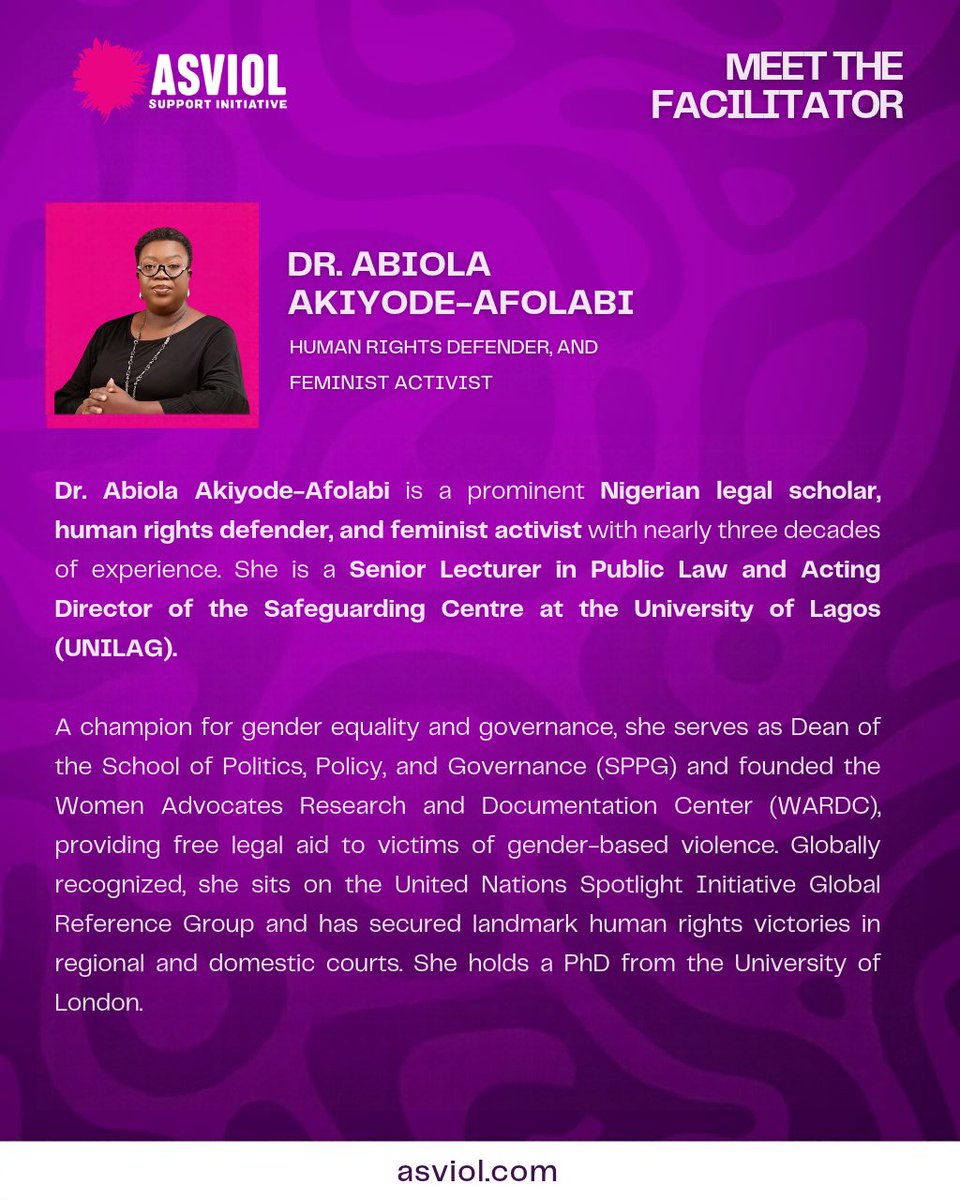
Kadaria Ahmed, Chief Executive Officer, @RadioNow953FM and Daria Media Limited; Frank Aigbogun, Publisher and Editor-in-Chief, @BusinessDayNg; and Abiola Akiyode-Afolabi, Executive Chairperson, Women Advocates Research and Documentation Centre (@womenadvocate) and Acting Director, Safeguarding Centre, University of Lagos, will deliver the keynote addresses at this year's Amplify In-depth Media Conference & Award (AIMCA), themed Truth. Power. Rights. Journalism at the Heart of Democracy.
From Tuesday, 8 to Thursday, 10 December 2026, join us at NECA House, Alausa, Ikeja, Lagos, with sessions beginning at 9 a.m. daily, for critical conversations on truth, accountability, democracy and the future of journalism.
Three days of thought-provoking conversations, masterclasses, networking and the celebration of outstanding investigative journalism at the 21st Wole Soyinka Award for Investigative Reporting.
Be part of the conversation shaping the future of journalism and democracy.
Register now at https://t.co/kGsngdVaUl.
#AIMCA2026 #TruthPowerRights #WSAIR2026 #WSCIJ
As Nigeria prepares for 2027, we must address the growing threat of AI generated sexual deepfakes used to intimidate and silence women in politics.
We need stronger safeguards and enforcement to protect women’s dignity, safety and participation in our democracy.
Read more: https://t.co/3HgJlY4UUZ
@SavvyRinu@faree_for_real@BigBadReni
The 220-hour @GWR Guinness World Record attempt by #OlubunmiUluba officially began today! Supported by @unwomenNG @unfpang @ncwd_abuja the reading marathon will spotlight #GBV laws & frameworks across 15 African countries to raise awareness of #SGBV & protection for women & girls
Who is responsible for ending digital violence?
We cannot fight this alone.
When women experience online abuse, platforms must respond, governments must provide protection, and civil society must support survivors and demand accountability.
As the Africa Digital Harm Report highlights, ending technology-facilitated violence against women and girls requires shared responsibility, stronger laws, safer platforms and meaningful collaboration.
No single institution can do it alone. But everyone has a role to play.
The question is: If everyone is responsible, who takes the first step?
Read the Technology-Facilitated Violence Against Women: Africa Digital Harm Report and explore what the experiences of women in Nigeria and Kenya reveal about the future of digital safety, inclusion and participation. https://t.co/qzEDTV4KIV…
Report reference: Gaps in Laws and Policies, p. 41, and Recommendations, p. 50.
@ChiomaChuka@obyezeks@NatashaAkpoti@BigBadReni@UNTrustFundEVAW@UN_Women@SavvyRinu@faree_for_real
“The report serves as both evidence and manifesto. Technology is not neutral—it is built in manners that reflect offline inequalities online. Unless women’s safety is placed at the center of digital governance, the promise of technology as a tool for liberation will remain out of reach, an open door leading not to empowerment but to yet another arena of violence” — no truer words.
quite an enlightening read. well done, doctor!
i read the part where you highlighted that: “courts are ill-equipped to handle cases of technology-facilitated harm” i don’t quite understand the statement, do you mean judicial tools or necessary tools to root tech-based crimes?
Imagine a woman reporting online abuse, knowing that laws exist to protect her, yet still struggling to find meaningful support or justice.
It reminds us of an important distinction: having laws is not the same as ensuring that women are protected.
The Digital Harm Effect report examines gaps in laws and policies addressing technology-facilitated violence against women and girls in Nigeria and Kenya. It highlights the need to move beyond legal provisions towards effective implementation, accessible justice and accountability.
Laws are important, but their impact depends on whether institutions understand them, whether survivors can access protection and whether perpetrators are held accountable.
What good are stronger laws if the women they are meant to protect cannot feel their impact?
Addressing digital violence requires more than legislation. It demands consistent enforcement, institutional commitment, survivor-centred responses and collaboration between governments, technology companies and civil society.
The goal should not simply be to have laws against digital violence. It should be to make those laws work for the women and girls who need them.
Read the Technology-Facilitated Violence Against Women: Africa Digital Harm Report and explore what the experiences of women in Nigeria and Kenya reveal about the future of digital safety, inclusion and participation. https://t.co/qzEDTV4KIV
Report reference: Gaps in Laws and Policies, p. 41, and Recommendations, p. 50.
@ChiomaChuka@obyezeks@NatashaAkpoti@BigBadReni@UNTrustFundEVAW@UN_Women@SavvyRinu@faree_for_real
Imagine reporting abusive content on a social media platform, hoping it will be taken down, only to find that it remains online or the response offers little reassurance.
For women experiencing technology-facilitated violence, digital platforms are not just where abuse happens. Their policies, reporting tools and responses can influence whether survivors feel protected or abandoned.
The Digital Harm Effect report examines accountability among technology companies and the role platforms must play in addressing technology-facilitated violence against women and girls.
Platforms provide spaces for women to connect, learn, advocate and participate in public life. They must also take responsibility for addressing the abuse that occurs within those spaces.
What does digital safety mean if the platforms women rely on fail to respond effectively when abuse occurs?
Responsibility cannot rest on survivors alone. Technology companies must strengthen reporting mechanisms, respond appropriately to abuse and make their safety policies meaningful in practice. Governments and civil society also have roles in demanding transparency and accountability.
Women deserve digital spaces where their participation is protected, their reports are taken seriously and their safety is not treated as an afterthought.
Read the Technology-Facilitated Violence Against Women: Africa Digital Harm Report and explore what the experiences of women in Nigeria and Kenya reveal about the future of digital safety, inclusion and participation.https://t.co/IxqfU3KghW reference: Accountability with Tech Companies, p. 46.
@ChiomaChuka@obyezeks@NatashaAkpoti@BigBadReni@UNTrustFundEVAW@UN_Women@SavvyRinu@faree_for_real
Imagine reporting online abuse, explaining what happened and sharing your experience with the hope of getting help. But after taking that difficult step, you are still left wondering whether anything will change.
For survivors of technology-facilitated violence, reporting is only one part of the journey. What follows matters just as much: whether the complaint is taken seriously, whether support is provided and whether there is meaningful accountability.
The Digital Harm Effect report examines survivors’ satisfaction with the support they received. In Nigeria, 41.4% of respondents reported being satisfied with the support received.
This finding invites us to look beyond whether reporting channels exist. We must also ask whether the response survivors receive meets their needs and helps them feel supported.
If a woman reports abuse but is left without meaningful support, can we say justice has been served?
A survivor-centred response must go beyond receiving complaints. It should provide clear guidance, respectful treatment, appropriate support and meaningful steps towards accountability.
Reporting should be the beginning of a response, not the end of the conversation.
Read the Technology-Facilitated Violence Against Women: Africa Digital Harm Report and explore what the experiences of women in Nigeria and Kenya reveal about the future of digital safety, inclusion and participation.https://t.co/nQtVrD2tFG
Report reference: Satisfaction with Support Received, p. 38.
@ChiomaChuka@obyezeks@NatashaAkpoti@BigBadReni@UNTrustFundEVAW@UN_Women@SavvyRinu@faree_for_real
When Help Is Hard to Find
Dear All,
Imagine experiencing online abuse and finally deciding to seek help. You want someone to listen, guide you and help you understand your options. But you are unsure which organisation to contact or whether support will be available when you need it.
For survivors of technology-facilitated violence, knowing where to turn can make a difference. Without clear information about available services, women may struggle to find the support they need.
The Digital Harm Effect report examines awareness of support services and the role organisations can play in responding to technology-facilitated violence. In Nigeria,
57.4% of respondents were aware of NGOs and feminist organisations as sources of support.
This awareness is important, but it also raises a question: how do we ensure that every woman who needs help knows where to find it?
Support should not depend on knowing the right person or stumbling upon the right organisation.
Civil society organisations, feminist movements and other support providers must continue making their services visible, accessible and responsive to survivors’ needs. Women deserve to know that help exists and how to reach it.
Read here, the Technology-Facilitated Violence Against Women: Africa Digital Harm Report and explore what the experiences of women in Nigeria and Kenya reveal about the future of digital safety, inclusion and participation.
Today's reading:
Report reference: Awareness of Support Services, p. 45.
https://t.co/qzEDTV4KIV
@ChiomaChuka@obyezeks@NatashaAkpoti@BigBadReni@UNTrustFundEVAW@UN_Women@SavvyRinu@faree_for_real
Day 15: When the System Itself Becomes a Barrier
Imagine finding the courage to report online abuse, only to encounter a system that is difficult to navigate, offers little guidance or leaves you uncertain about what happens next.
For a survivor, seeking help should be a step towards safety and justice. But when reporting processes are unclear, support is difficult to access or responses fall short, the system itself can become another obstacle.
The Digital Harm Effect report examines the barriers women face when seeking help for technology-facilitated violence. These challenges remind us that encouraging survivors to report abuse is not enough. The systems receiving those reports must also be accessible, responsive and trustworthy.
What does it mean to encourage women to speak up if the systems meant to support them are difficult to navigate?
Survivors deserve clear information, respectful treatment and meaningful support. Reporting should not become another burden placed on the person who has already experienced harm.
Building safer digital spaces also means building systems that listen, respond and hold perpetrators accountable.
Read here, the Technology-Facilitated Violence Against Women: Africa Digital Harm Report and explore what the experiences of women in Nigeria and Kenya reveal about the future of digital safety, inclusion and participation.
https://t.co/qzEDTV5iyt
Today's reading: Report reference: Barriers to Reporting, p. 37.
@ChiomaChuka@obyezeks@NatashaAkpoti@BigBadReni@UNTrustFundEVAW@UN_Women@SavvyRinu@faree_for_real
DAY 14: What If She Doesn't Know Where to Go?
Imagine experiencing online abuse and deciding you want help, only to realise you do not know who to contact, where to report it or what support is available.
For many women, the challenge is not simply finding the courage to speak up. It is knowing where to turn and whether anyone will take their experience seriously.
The Digital Harm Effect report found that 39.3% of respondents in Nigeria were unsure where to report technology-facilitated violence.
This points to a critical gap. Support systems cannot protect survivors if women do not know they exist or how to access them.
Awareness matters. Clear reporting pathways, accessible information and trusted support services can help women take the next step without feeling abandoned to navigate the process alone.
How can survivors seek justice when they don't know where to turn?
Ending technology-facilitated violence means making support visible, accessible and responsive. Every woman deserves to know that help exists and that she does not have to face abuse alone.
Read the Technology-Facilitated Violence Against Women: Africa Digital Harm Report and explore what the experiences of women in Nigeria and Kenya reveal about the future of digital safety, inclusion and participation.
Report reference: Reasons for Not Reporting, p. 35, and Barriers to Reporting, p. 37.
https://t.co/qzEDTV4KIV
@ChiomaChuka@obyezeks@NatashaAkpoti@BigBadReni@UNTrustFundEVAW@UN_Women@SavvyRinu@faree_for_real
Every Number Has a Story. Every Story Deserves to Be Heard.
Have you ever watched a woman express an opinion online and noticed how quickly the conversation shifts from what she said to who she is?
Her appearance becomes the subject. Her personal life is dragged into the discussion. Insults replace arguments. Sometimes, the comments escalate into threats.
Now imagine experiencing this repeatedly, simply because you chose to speak.
The internet did not invent misogyny. It gave it new tools.
Digital platforms can make harassment easier to distribute, allow harmful content to reach larger audiences, and enable attacks to continue long after the original incident.
For women who are journalists, activists, politicians or public advocates, the consequences can be particularly troubling.
The same visibility that allows their work to reach people can also expose them to targeted abuse.
And when women anticipate harassment before speaking, the harm extends beyond the individual. Their voices may be missing from conversations that affect us all.
The question is not just whether women can access the internet.
It is whether they can participate freely without being punished for their visibility.
Read the Technology-Facilitated Violence Against Women: Africa Digital Harm Report https://t.co/qzEDTV4KIV and explore what the experiences of women in Nigeria and Kenya reveal about the future of digital safety, inclusion and participation.
For today's reading: Context and Structural and Power Dynamics Shaping TFVAWG, p. 15.
@BigBadReni@faree_for_real@SavvyRinu
DAY 13: Why Didn’t She Report online abuse?
When a woman experiences online abuse, reporting it may seem like the obvious next step. But what if she fears being blamed, judged, ignored or exposed to even more harm?
For many survivors, speaking up is not that simple. Fear, stigma and uncertainty about what will happen next can make reporting feel like another risk to take.
The Digital Harm Effect report found that 80.8% of surveyed survivors in Kenya did not report the abuse they experienced.
That figure raises an important question: how many women suffer in silence because the available reporting systems do not feel safe, accessible or trustworthy?
When survivors stay silent, it should not automatically be interpreted as a lack of courage or a sign that the abuse was insignificant. We must also examine the barriers that make seeking help difficult.
Instead of asking why she didn’t report it, shouldn’t we ask what made reporting feel impossible?
Survivors deserve safe reporting channels, respectful responses and support that protects their dignity. Reporting should be a pathway to help, not another source of fear.
Read here, the Technology-Facilitated Violence Against Women: Africa Digital Harm Report and explore what the experiences of women in Nigeria and Kenya reveal about the future of digital safety, inclusion and participation.
Today's reading:
Report reference: Reporting Patterns, page 34, and Reasons for Not Reporting, page 35.
https://t.co/qzEDTV4KIV
@ChiomaChuka@obyezeks@NatashaAkpoti@BigBadReni@UNTrustFundEVAW@UN_Women
The internet did not invent misogyny. It gave it new tools.
Online harassment, threats, impersonation, doxxing and the non-consensual sharing of intimate images are ways technology can be used to silence, intimidate and control women and girls.
While digital spaces offer opportunities for learning, connection, advocacy and participation, they can also reproduce the inequalities and power imbalances women face offline.
Women should not have to choose between using their digital voice and protecting their safety.
The question is not whether women belong online. It is how we make digital spaces safe for them?
Read The Digital Harm Effect: Confronting Technology-Facilitated Violence Against Women and Girls in Africa: A Case Study of Nigeria and Kenya.
Reference - Context: Structural and Power Dynamics Shaping TFVAWG, page 15
🔗 https://t.co/qzEDTV4KIV
@BigBadReni@faree_for_real@SavvyRinu
Throwback to the moment the whole hall sang. 🎷
Last Saturday, after the keynotes, saxophonist Temilayo Abodunrin, who has been playing since she was 12, took the stage with Dr Obiageli "Oby" Ezekwesili’s (@obyezeks) favourite song.
Within moments the room was singing. The graduates left their seats, came to the front, sang along, took photos, and many of us found ourselves in tears of joy.
After ten months of late nights and hard assignments, this was the Class of 2026 celebrating together.
The future is here.
#ThrowbackThursday #SPPG #SPPGClassOf2026 #Graduation #FixPolitics #Nigeria