Starlink V3 satellites have >10X bandwidth of V2 and there’ll be >10X launched, which means >100X more bandwidth.
Also, altitude will be 350km vs 550km, so min latency can be cut in half.
Light travels 300km/ms in space, so physics round trip min latency drops to <5ms.
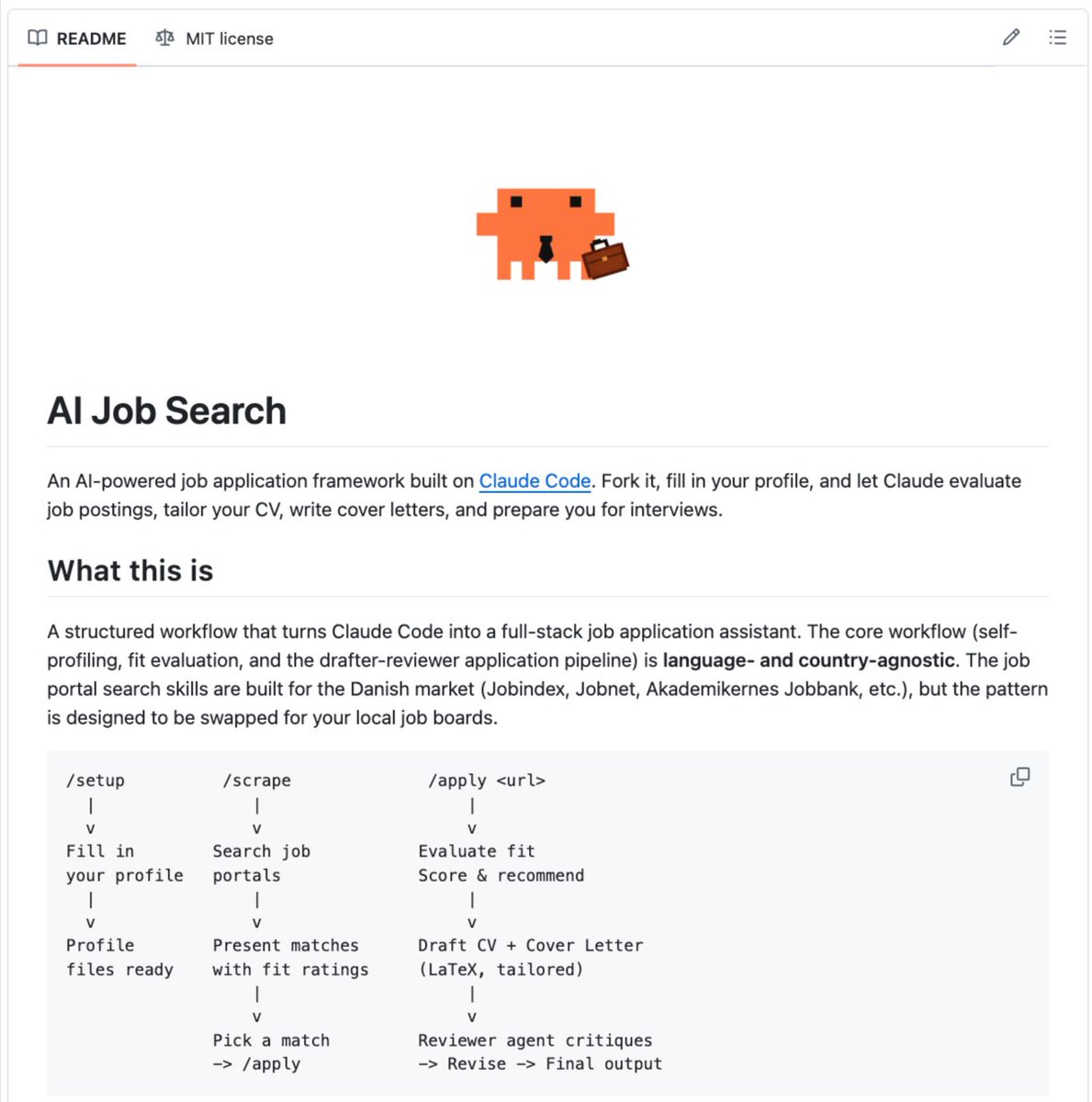
A scientist in Denmark figured out how to make Claude prepare his job applications. He open-sourced the whole thing.
His name is Mads Lorentzen. He is a PhD geophysicist. He built it on top of Claude Code and released it under MIT license.
Here is what it does. You fork the repo, fill in your background once, and it runs a five-step pipeline for every job you want to apply to.
Step 1. It reads the job posting and scores how well you fit.
Step 2. It drafts a tailored CV in LaTeX, picking only the experience that matches.
Step 3. It writes a cover letter framed around what you would bring to the role.
Step 4. A second AI agent reviews the first agent's work, points out weaknesses, and the first agent revises.
Step 5. It compiles both into clean PDFs you can send.
The whole thing is a folder of markdown files. The candidate profile, the writing style rules, the CV templates, the interview prep notes. Every step is plain text you can read and change.
The job portal search is built for Danish boards. The application workflow itself works for any country.
489 stars. 270 forks. A fork-to-star ratio that high means people are using it, not only bookmarking.
Mads is not a startup founder. He built this because he needed it for himself, then shared it.
This is the future of job hunting. Not a service you pay for. A workflow you own.
(Link in the comments)
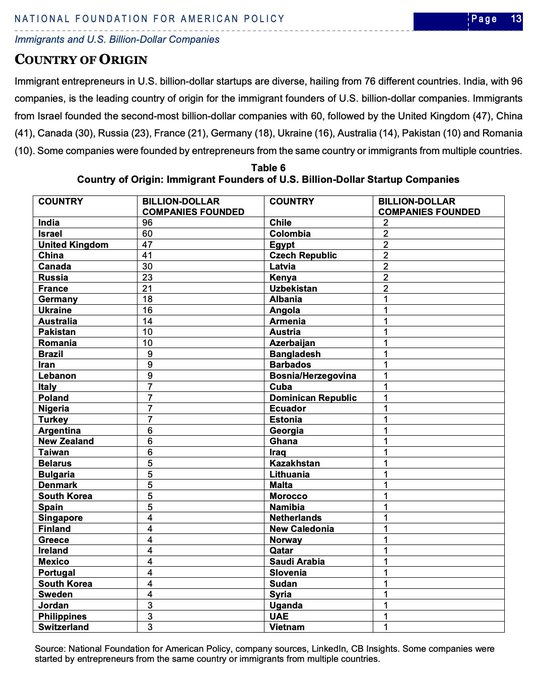
India has sent 96 people to America who started billion dollar companies. No one else is even close.
There's only about 5 million Indians in America. Almost one in 50,000 of them is a unicorn founder!
What a holy, special, beautiful people.
I will always fight for them.
a citadel quant told me something that broke my entire trading framework
"we don't predict markets. we model the state machine"
he explained markov chains in 90 seconds
the market is never random - it always exists in one of three states
trending up, trending down, ranging - each has a fixed probability of shifting to another
build the transition matrix from real price data:
> trending up -> 68% stays trending, 21% flips to range, 11% reverses
> ranging -> 54% stays range, 28% breaks up, 18% breaks down
> trending down -> 61% stays falling, 24% flips to range, 15% reverses
now you're not guessing, you're playing probability
identify current state, enter with the 68% edge, size with kelly criterion based on that probability
the formula is public - markov published it in 1906
hedge funds use it, the math costs nothing
what costs you is asking the wrong question
"where is price going?" is random
"what state am I in right now?" has an answer
transition matrix built from 10 years of data is your edge
Bookmark it
not a signal, not an indicator - just conditional probability that compounds every single trade
Jane Street, Goldman Sachs, JP Morgan, BlackRock, Hudson River Trading, Two Sigma, D.E. Shaw.
The most expensive engineering teams in the world released their financial tools on GitHub. Here are 7 repos, one from each.
1. Jane Street, janestreet/magic-trace
https://t.co/a2G20vnewK
5.3k stars. Process tracer powered by Intel PT. When your profiler is blind, magic-trace sees every CPU instruction.
2. Goldman Sachs, goldmansachs/gs-quant
https://t.co/SMYFwP3TWD
Derivative pricing the GS traders use at their desks. MIT licensed.
3. JP Morgan, finos/perspective
https://t.co/9rgy6FxYt4
What JPM traders use to watch markets in real time. A $24k/year terminal, for free.
4. BlackRock, blackrock/lcso
https://t.co/iHwsxZDZD9
Rust optimizer for portfolio problems. Where scipy gives up, this works.
5. Hudson River Trading, hudson-trading/corral
https://t.co/YhmrQFmYaZ
Structured concurrency for C++20. The foundation of HFT infrastructure at one of the largest U.S. trading firms.
6. Two Sigma, twosigma/flint https://t.co/ebEFqcDxJ6
Time-series joins on Apache Spark with temporal tolerance. Built for billions of ticks.
7. D.E. Shaw, deshaw/pyflyby https://t.co/uYDQKtnDVd
Auto-import for IPython and Jupyter. D.E. Shaw also funded the development of IPython itself.
Bookmarked it
Google published an entire library of highly sophisticated, end-to-end agent examples.
100% open-source.
• Complete documentation
• Source code
• Ability to one-click deploy
In the video, I break down one of the coolest examples in this collection.
Norway and the UK drilled the same North Sea.
🇳🇴Norway got $2 trillion.
🇬🇧The UK got tax cuts.
Same basin,Same era.... Completely different outcomes.
Norway captured $30 per barrel in government revenue. The UK captured $11.
That gap, compounded over 50 years of production, is the entire difference.
Norway's model was simple: tax heavily (78% marginal rate), take direct equity stakes in fields via the SDFI, own part of Equinor, and put everything surplus into a fund invested abroad.
The Government Pension Fund Global now holds over $2 trillion in assets.
That's $390,000 per Norwegian citizen about 1.5% of all listed equities on earth.
The fiscal rule: only spend the 3% annual real return. Never touch the principal.
The UK started producing earlier, at lower prices, with a lower tax rate (40%) and no saving mechanism.
North Sea revenues flowed straight into the general budget.
Economists estimate the UK missed out on roughly £400 billion compared to a Norwegian style regime.
The windfall largely financed tax cuts in the 1980s rather than a fund.
Where things stand in 2026?
Norway's petroleum sector will generate $63 bn in net cash flow this year alone feeding a fund already large enough to cover 10-15% of the national budget from returns alone.
The UK is a net energy importer.
Since 2021 it has paid countries like Norway more than £100 billion for gas.
One country treated oil as a finite resource to convert into permanent financial wealth.
The other treated it as income.
image source:eia
Peter Lynch said: "There is 100% correlation between a company's earnings and what happens to the stock.”
If stock price follows EPS, here are 6 stocks that look like opportunity.
1. $MSFT - Microsoft